Wesley Early, Alaska's Energy Desk - Kotzebue
Study connects physical decline of Alaska seals to warming Arctic

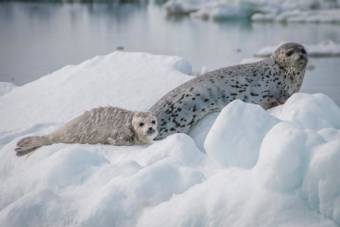
Spotted seal mother and pup in the Bering Sea. (NOAA Fisheries photo)

As global temperatures rise and warm the coldest parts of the world, scientists are watching for changes to species that live there. A new study has found evidence connecting the rapid warming of the region with a physical decline in three species of Alaska seals.

For 12 years, researcher Peter Boveng with the National Oceanic and Atmospheric Administration led a team that monitored ribbon and spotted seals in the Bering Sea. They were specifically monitoring body condition, or how fat the seals were. Boveng says what they found was the youngest seals were getting smaller.

“The fatness of the pups, the young of the year, declined on average over that time period,” Boveng said.

Boveng says this is one of the first major studies that shows evidence of a noticeable change in the seals’ body condition related to global warming.

“There hadn’t been, up until now, really much of any documentation of impacts that we think are climate related,” Boveng said.

Both of these species of seal tend to gather on the edge of the sea ice to hunt for food and raise their young. However, sea ice extent has drastically diminished over the past decade, with an average loss of just over 18,000 square miles a year. Boveng says that could impact how much seal mothers are able to forage.

“The mothers, maybe, were not finding as much food in the period prior to the birth of their pups, when they were pregnant,” Boveng said. “And also maybe not having as much fat or finding as much food during the nursing period.”

NOAA Fisheries scientists approach a ribbon seal. (NOAA Fisheries photo)

Between 2007 and 2018, the time period of the study, Boveng says that the two species of seals experienced two unusual mortality events, or an unexpected rapid decline in population. During the first event, the seals acted more lazy, with many showing sores on their bodies and loss of hair. Boveng says there was no evidence linking those things to a loss of food or a warming climate. He says the second however, saw more evidence that the decline was food-related.

“So this second UME which occurred right in the years of record low ice extent in the Bering Sea, really seemed to line up with the things we were seeing,” Boveng said.

A related study of harbor seals in the Aleutians found a similar decline over a three-year period, with an average decrease of 13 pounds per year — that’s about 10% of their weight. Boveng says that decrease is tied to a heat wave in Southwest Alaska between 2014 and 2016. He says it’s clear the dramatic decline in weight hadn’t been going on for long.

“The decline in harbor seal body condition over that period was pretty rapid,” Boveng said. “Something like that wouldn’t be something that had been going on for a long time, because they would’ve just wasted away.”

Looking to the future, Boveng says that scientists forecast warmer Arctic conditions will become more normal, and he anticipates that changes to seal bodies will be much clearer as time goes on.

US and Russia update plan to address marine pollution in Bering, Chukchi seas

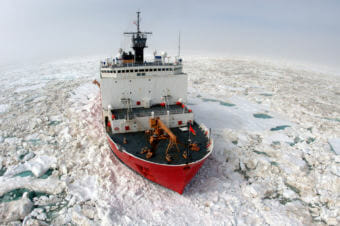
The U.S. Coast Guard Cutter Healy, a 420 ft. icebreaker homeported in Seattle, Wash., breaks ice in support of scientific research in the Arctic Ocean.
The U.S. Coast Guard Cutter Healy, a 420-foot icebreaker homeported in Seattle, Washington, breaks ice in support of scientific research in the Arctic Ocean. (Public domain photo by Petty Officer Prentice Danner/U.S. Coast Guard)

The United States and Russia have updated their plan for addressing pollutants across national boundaries in the Bering and Chukchi seas.

The agreement between the United States and Russia, known as the Joint Contingency Plan, has been in effect since 1989. The U.S. Coast Guard is the federal agency that does most of this work, working with counterparts at Russia’s Marine Rescue Service.

Coast Guard incident management official Mark Everett said the plan lays out protocols for pollution that spreads from one nation’s waters to the other’s.

“This agreement says, essentially, we will agree to notify you. We will agree to request assistance in the response if needed,” Everett said.

Everett said to date, there have been no joint responses to pollution like oil or marine debris along that boundary with Russia. However, he said the two entities regularly conduct exercises and share information on pollution within their boundaries.

“There was one recently in Kamchatka, on the Russian side, that the Russian Federation government shared information with the United States,” Everett said. “We offered assistance. They didn’t accept the offer of assistance, but that is part of the bilateral agreement — to share information about other incidents, even though they may not affect the other party.”

Everett said one of the major new features of the latest Joint Contingency Plan is the addition of what’s called an international coordination officer.
“Someone potentially from the U.S. Coast Guard, in the event of a joint response, could go over to the Russian side,” Everett said. “A Russian representative could come over to the U.S. side, and then we have embedded liaison officers.”

Everett said he’s hopeful that having the new positions will make it easier and more efficient for either nation to share information. He said U.S. and Russia officials plan to meet in the fall to discuss their next exercises related to marine pollution response across national boundaries.

Researchers ask for more Indigenous input in national Arctic science initiative

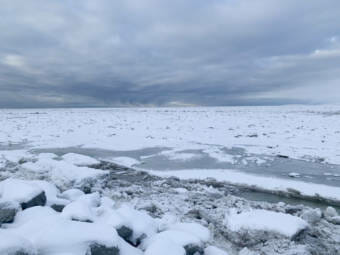
Snow piles on sea ice in the Kotzebue Sound. (Wesley Early/KOTZ)

One of the National Science Foundation’s flagship initiatives for the past few years is called Navigating the New Arctic. It looks at the effects of a warming climate on Arctic communities. However, some in the field believe NSF isn’t doing enough to involve Indigenous people who live there.
More than 200 researchers from around the country signed an open letter to the foundation last month, requesting more Indigenous input within the initiative.

Margaret Anamaq Rudolf is a doctoral candidate at the University of Alaska Fairbanks. An Inupiaq woman originally from Fairbanks, her area of study is cross-cultural science education — which she says involves trying to answer the question, “How do we improve working relationships between researchers and Indigenous communities?”

Rudolf is one of the people who authored the letter to the National Science Foundation. While she welcomes the foundation’s initiative, she says it falls short of its potential to include the people who live in the Arctic.

“NSF is still centering researchers in Navigating the New Arctic, instead of centering Indigenous people in what they want and they need,” Rudolf said.

The letter from researchers was formed in solidarity with another letter sent last year from four Native organizations — Kawerak Inc., the Association of Village Council Presidents, the Bering Sea Elders Group and the Aleut Community of St. Paul Island.

The letter from Native groups outlines several issues that would have been studied more comprehensively if traditional knowledge was included from the start. Those include food security and community infrastructure. The letter also highlighted problems with requests for proposals.

Henry Huntington is an Eagle River-based independent researcher who’s worked with the initiative. He’s also one of the main authors of the open letter. He says that requests for research proposals from the National Science Foundation are geared to traditional academic knowledge.

“The forms that you fill out work pretty well if you have a bunch of university degrees and you have some scientific publications and all the standard things that you’d expect of someone with academic training,” Huntington said.

Comparatively, Huntington says it’s harder to list the traditional knowledge of Alaska Natives, who often are much more informed about their communities and will contribute as much if not more to the research.

“They confirm what we already know, instead of investigating what we want to know,” said Cana Uluak Itchuaqiyaq, one of the more than 200 scientists who signed the letter.

Itchuaqiyaq is a PhD candidate in technical communication and rhetoric at the University of Utah. An Inupiaq woman from Kotzebue and Noorvik, she says growing up, researchers coming into her community often would form questions that Alaska Native people already knew the answers to.

“And so, it’s taken tons of time for academia and the sciences to catch up to us,” Itchuaqiyaq said. “They’re just catching up.”

Kawerak social science program director Dr. Julie Raymond-Yakoubian helped write last year’s letter. She says oftentimes when Arctic researchers are making research proposals, one of their last steps is to ask for collaboration with tribal organizations, instead of including them from the start.

“When tribes and tribal organizations and Alaska Native organizations are brought into the process so late in the game, there’s really no way to effectively collaborate on a truly equitable level,” Raymond-Yakoubian said.

NSF Arctic sciences program director Colleen Strawhacker says a major initial issue with Navigating the New Arctic was that many researchers were eager to compete for grants and proposals, making tribal outreach a lower priority.

“Given the feedback from communities, that’s clearly … quite frankly a disrespectful approach to including Indigenous communities in NNA-type science,” Strawhacker said.

While NSF officials are still working on a formal response to the letter from the Arctic researchers, Strawhacker says she values the feedback. She says building and strengthening tribal relationships is key moving forward with Navigating the New Arctic.

“I think it’s critical if we want to fund the best science in the Arctic, we need those perspectives,” Strawhacker said. “We need perspectives from multiple scientific disciplines, but we need perspectives from Indigenous elders and the knowledge that they’ve acquired. I think if we don’t do that, we are doing a disservice to the science and understanding the changes in the Arctic.”

At the beginning of February, NSF announced that the Navigating the New Arctic community offices would be hosted at three universities, including the University of Alaska Fairbanks and Alaska Pacific University, a tribal college in Anchorage.

APU president Valerie Nurr’araaluk Davidson, a Yu’pik woman, described the office as a “hub for Indigenous engagement.”

Raymond-Yakoubian from Kawerak says she’s hopeful that outreach like this, the solidarity between Native groups and researchers shown by both letters, and a push for more Indigenous researchers will produce better outcomes in Arctic research.

‘It brings back memories’: Northwest Alaska health provider cleared to make seal oil and serve it to elders

A jar of seal oil processed at the Siglauq building in Kotzebue. (Photo by Wesley Early, KOTZ – Kotzebue)

In Inupiaq communities, more than any other food, seal oil is a fixture.

“I had it for lunch today,” said Cyrus Harris. “I’ll have it for supper tomorrow.”

Like many Inupiaq people in the Northwest Arctic, Harris grew up eating traditional foods like seal oil, caribou and musk ox. When his relatives moved into Maniilaq’s Utuqqanaat Inaat long term care, he found they weren’t able to eat the same food they’d lived off for years.

“They didn’t choose to be living off the Western diet that they were being served every day,” Harris said. “So I found out I could cook a meal at home and take it to my ahna and taata over at the long term care, and serve it in that manner. But where does that leave the other 18 elders there?”

Seal oil has been a diet staple for Alaska’s Inupiat people for centuries. However, because of federal and state health regulations, you can’t buy it in stores and it can’t be served in restaurants.
Cyrus Harris is in charge of Maniilaq’s hunter support program. (Photo by Wesley Early, KOTZ – Kotzebue)

In 2015, Congress passed the federal farm bill which allowed people to donate wild game that they’ve hunted to certified non-profits, like hospitals or food banks. Since then, Harris has been in charge of Maniilaq’s hunter support program, which prepares traditional foods for elders at long term care.

The food is processed at the Siglauq, a state-certified meat processing building. The name comes from the Inupiaq word for the underground ice cellars used to store meat.

“Back in the day, everybody had their own Siglauq,” Harris said. “They had their own underground cold storage.”

Cyrus Harris shows frozen musk ox meat to be served to elders at Maniilaq’s Utuqqanaat Inaat long term care. (Photo by Wesley Early, KOTZ – Kotzebue)

Walking in the Siglauq freezer, Harris described some of the donations.

“These are some products that we will most likely use for our certain potlucks,” Harris said. “This is sheefish filet. We do have moose burger. We do have some musk ox burger.”

While getting wild meat on the menu for elders has gone smoothly for about five years, Harris says seal oil remained prohibited. The only time it could be served was at a potluck, and it had to be brought in from home. It couldn’t be made and served by Maniilaq – until now.

Just before the freezer in the Siglauq is the main processing room. And sitting on a table are three large drums with blubber floating in vats of seal oil. Harris describes the process for rendering the seal oil, which starts with separating the skin and blubber from the carcass.

“Then flesh the blubber from the skin,” Harris said. “And cut into maybe one inch by three inch pieces and set into containers like this.”

Three containers of seal oil being rendered by Cyrus Harris. (Photo by Wesley Early, KOTZ – Kotzebue)

Granted, Harris says most seal oil is made out in the field, and not under the strict lab requirements of the Siglauq.

“The best seal oil I ever had was stored in seal pokes,” Harris said. “Seal pokes have a long story behind it. It’s seal hides made into a container.”

While seal oil is generally ingested without incident, a major reason it was restricted was due to its connection to a foodborne illness called botulism, which can cause nausea, blurry vision, muscle fatigue, and in some cases, death. Since the 1950s, the Maniilaq service area has seen more than 15 outbreaks of the illness tied to eating traditional Native foods.

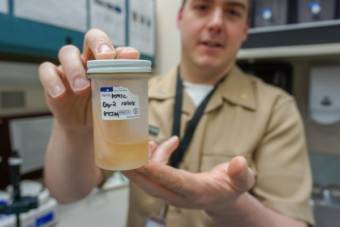
Chris Dankmeyer is environmental health manager for Maniilaq. For the past few years, he, Harris and others have been collaborating to develop a way to safely render seal oil. Those include food safety scientists at the Kodiak Seafood and Marine Science Center as well as microbiologists at the University of Wisconsin. After several years of running lab tests, they found that heating the seal oil to 176 degrees for 10 continuous minutes made seal oil safe.

“That completely destroys the toxin that may or may not be in the oil,” Dankmeyer said.

Dankmeyer stated that this heat treatment has only proven to make pure seal oil safe and not seal oil that contains other traditional additives.

“We’re not keeping blubber in there,” Dankmeyer said. “We’re not throwing in pieces of dry meat. And that’s a traditional thing.”

Chris Dankmeyer displays a sample of seal oil in 2018, when researchers were developing a method to heat treat the oil (Photo by Anne Hillman/Alaska Public Media)

Once the seal oil is heat treated, it’s rapidly cooled to prevent the toxin from reforming, and placed in the freezer where all the other traditional foods are.

“And we keep it frozen until it’s time to serve,” Dankmeyer said. “Basically, over there at the hospital, they’re going to dip it out frozen into a serving dish. It’s going to come up to room temp and be eaten.”

Dankmeyer says the last step is to make sure that Maniilaq’s kitchen staff are prepped on how to safely handle and serve the seal oil. For example, it can’t be left out for more than four hours, or it runs the risk of creating more toxin.

In the next few weeks elders can look forward to seeing plates filled with the traditional foods they’ve eaten their whole life.

One person excited to see the reactions from elders is Marcella Wilson, who heads Maniilaq’s long-term care facility. She says elders have been able to have seal oil during the occasional potluck, and she always sees an immediate reaction.

“It brings back memories,” Wilson explained. “Memories of when they were children and how they had the seal oil and traditional foods growing up. And that brings about storytelling. And then the storytelling starts bringing about laughter.”

Wilson says that she’s learned a lot about the Inupiaq culture from the elders, and she expects them to feel more lively as their traditional foods become more available.

“I’m not saying there’s magic in it, because there’s not,” Wilson said. “But there is such a nutritional value to it and such a cultural value to it, that the two together are just immeasurable.”

Dankmeyer says Maniilaq is the first organization in the nation approved to make and serve seal oil, and he’s excited to share their process with other organizations in the future.

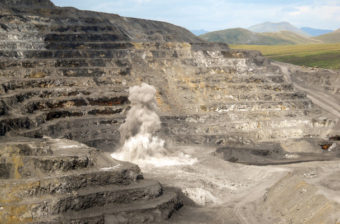
Red Dog Mine employee dies in production drill incident, mine operators say

The Red Dog Mine in 2010. (Photo by Alaska Public Media)

An employee at the Red Dog Mine died during an incident at a production drill, mine operators say.

In a release Sunday, officials with Teck Alaska, the operators of the mine, say a 47-year-old employee died on Saturday. Teck says no other employees or contractors were injured and “there is no ongoing safety or environmental risk.”

A spokesman for Teck said the federal Mining Safety and Health Administration is investigating the incident, and the only information they could provide was that the employee was male.
A major employer in the Northwest Arctic Borough, Red Dog Mine is the largest zinc mine in the world, located about 90 miles north of Kotzebue.

There is an update to this story here.

Arctic seals were listed as threatened in 2012. Now their sea ice habitat will be protected, too.

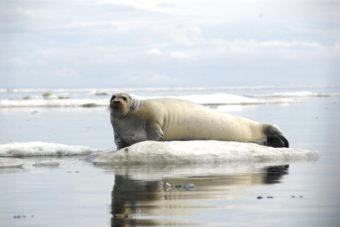
A bearded seal rests on ice in 2011 off the coast of Alaska. (Photo by John Jansen/NOAA’s Alaska Fisheries Science Center)

After being delayed for almost a decade, the federal government is moving forward with the process for designating critical habitat for two species of seal listed as threatened. What was supposed to be accomplished during the Obama administration has been dragged out by legal challenges.

The Bering, Chukchi and Beaufort seas are home to a variety of marine mammals, including bearded seals and ringed seals. Though both species are in relative abundance, long-term projections forecast a threat to the once abundant sea ice that the seals live on. As a result, the species were listed as threatened in 2012 under the Endangered Species Act.

But because their numbers aren’t low yet, and the threat comes from the loss of their habitat, Jon Kurland with the National Oceanic and Atmospheric Administration says the seals should have also gotten what’s called critical habitat designation.

“Critical habitat is areas within the geographical area occupied by a species that have physical or biological features essential to the conservation of that species, and may need special management over time,” Kurland said.

For ringed seals and bearded seals specifically, those areas need to have enough sea ice for the mammals to breed and nurse their pups, as well as provide enough food for the seals. As a result, Kurland says the proposed critical habitat area comprises a huge chunk of Arctic waters.

“It’s necessarily large because both of these species have really broad geographic distributions and they range widely,” Kurland said. “It’s the seasonality of that ice coverage that largely influences their habitat use.”

Ringed seal in Kotzebue Sound, Alaska
Ringed seal in Kotzebue Sound, Alaska. (Photo courtesy of NOAA)

By law, critical habitat is supposed to be designated as soon as a species is listed as threatened, or within a year if the habitat can’t be determined at the time. Emily Jeffers is an attorney for the Center for Biological Diversity, a prominent conservationist nonprofit. She says for the bearded and arctic ringed seals, it should have happened back in 2012.

“And here, the government had been dragging its heels, so we filed a lawsuit to hurry up the process,” Jeffers said.

That lawsuit happened in 2019. Jeffers says she believes the main holdup has been a lack of focus from the Trump administration on conservation.

“I think the short answer in terms of why it’s taken so long is that the Trump administration has been more interested in selling off the Arctic to the oil industry than they were with protecting ice seals and our climate,” Jeffers said.

Kurland with NOAA thinks that assertion isn’t totally fair. First of all, the two species were listed under the Obama administration, four years before he left office. During that time, the State of Alaska, the oil industry and others filed lawsuits challenging the listing, claiming it was premature due to the current abundance of the two species.

“Both of the listings were vacated by the U.S. District Court,” Kurland said. “In other words, they were put on hold, basically. They were not in effect for a period of time while the litigation went on.”

Eventually, a circuit court upheld the listings for the bearded seal and the arctic ringed seal in 2016 and 2018 respectively. After that, NOAA jump-started the process during the Trump administration. Kurland admits it hadn’t been done as promptly as it should’ve been.

“We didn’t get any kind of policy direction that we should stand down and not designate critical habitat,” Kurland said. “But obviously we didn’t do it as quickly as is envisioned, and that prompted the litigation that got us to where we are today.”

As part of the settlement with the Center for Biological Diversity, NOAA has until March to finalize their proposal for the critical habitat. Last week, they opened their proposed habitat to public comment for 60 days. Once that is finalized, Kurland says the critical habitat will be in place, though that doesn’t mean it’s totally off-limits to human activity. For instance, Alaska Native subsistence hunters are exempt from the Endangered Species Act.

“There tends to be this perception that once it’s designated as critical habitat that means, ‘Hands off, we can’t go there. We can’t do any development or can’t touch those areas,” Kurland said. “That’s actually not the case.”

Jeffers with the Center for Biological Diversity says the group supports the area that was proposed as critical habitat. While it isn’t as strong as federally protecting the land as a national preserve or refuge, she says when the government makes decisions about the area, they will have to take the two species into account.

“The main impact that you see from critical habitat designations is making sure that when the government is permitting something, giving someone a license to do something, it makes sure they talk to the biologists so that the species isn’t impacted,” Jeffers said.

Even though the biologists that would review those impacts are part of the federal entity that put off the designation for years, Jeffers says she still has faith in the science side of NOAA despite the bureaucratic issues.

Site notifications
Update notification options
Subscribe to notifications