Wesley Early, Alaska's Energy Desk - Kotzebue
Without ice, killer whales are preying on bowheads in Alaska’s northern seas

The population of endangered southern resident killer whales has dwindled to 76 individuals. (Holly Fearnbach/NOAA)

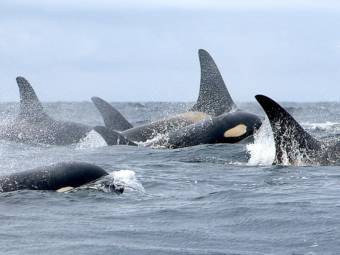
For subsistence hunters in the northern parts of Alaska, the bowhead whale has been a part of their diet for generations. However, scientists have found that as sea ice has dwindled in Arctic waters, a new predator has moved in to feed on the marine mammals: killer whales.

It’s not unheard of for killer whales to feed on bowhead whales in subarctic waters. Amy Willoughby is a researcher with the University of Washington specializing in aerial surveys of Arctic marine mammals.

“Killer whale predation on western Arctic bowhead whales has been documented in the shores of Russia and the Bering Sea,” Willoughby said. “For example, the St. Lawrence Island.”

However, in the colder waters north of Alaska, like the Eastern Chukchi and Western Beaufort Seas, sea ice becomes more plentiful, and it was thought that bowhead whales were better protected from predators.

But Willoughby says that sea ice has gotten thinner as Arctic temperatures have risen in recent decades.

Bowhead whales (Photo courtesy of NOAA Fisheries)

“Bowhead whales are thought to have an avoidance strategy to predation by evading predation and hiding out in thicker sea ice,” Willoughby said. “And without that sea ice there, bowhead whales don’t have anywhere to retreat to.”

Willoughby says scientists documented the first direct evidence of killer whale predation in those traditionally sea-ice-rich waters in 2015.

“The mouth was missing. The tongue was missing. The jaw was broken. And it also had healed rake marks on its flipper,” Willoughby said. “And that was kind of the ‘Aha!’ moment where we realized that killer whales might be predating on bowhead whales.”

Researchers began examining bowhead whale carcasses found from 2009 to 2018. Of the 33 whales observed by scientists, 18 of them had evidence of killer whale predation.

(A) The 2015 bowhead calf carcass that provided the first evidence of killer whale predation on a bowhead whale in the U.S. Pacific Arctic. Note rake marks on the calf’s flipper, mouth and jaw. (B and C) Carcasses of young bowhead whales with lethal injuries to the mouth and jaw from killer whale attacks. (Photo courtesy of NOAA Fisheries)

“We can’t technically say that there’s been an increase because there can be a lapse in data and information from years prior,” Willoughby said. “But when we look at the years from 2009 to 2018, killer whales are the primary cause of death.”

Willoughby says scientists don’t know for sure what the long-term effects of killer whale predation on bowhead whales could be, but she speculates bowhead whales may change their migration patterns in response to predation. Additionally, their feeding opportunities could change as a result of killer whales moving in. That could have repercussions on the 11 Inupiat whaling communities that subsist on bowhead whales.

“The Indigenous people that hunt these whales for subsistence have hundreds of years of traditional ecological knowledge to base their efforts off of,” Willoughby said. “And killer whale presence might negate that knowledge that they hold.”

At the very least, she says it’s now more important than ever for scientists to continue to keep an eye on killer whales as they expand their hunting grounds into the coldest parts of the world.

Northwest Arctic leaders urge Ambler Metals to focus on local hire for future mining

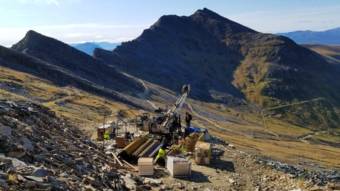
Drilling at the Trilogy Metals Inc. copper-rich Arctic polymetallic deposit in Alaska’s Ambler Mining District. (Photo courtesy of Trilogy Metals Inc.)

Ambler Metals is a company dedicated to the development of the copper-rich Ambler Mining District in Northwest Alaska. But it can’t move forward without the blessing of NANA Regional Native Corporation and permits from local governments.

Ambler Metals is a joint effort formed by two multinational corporations: Trilogy Metals and South32. President and CEO Ramzi Fawaz started at the beginning of September, relocating to Anchorage from Colorado. During a Northwest Arctic Borough Assembly meeting, Fawaz highlighted his hopes for the Northwest Arctic region.

“A lot of opportunities for us to work together and to invest in the region in Alaska and make something wonderful and profitable and sustainable for the long duration,” Fawaz said.

The company’s plans for resource development in the region are still several years away. Most of the work right now is in preliminary surveys and drilling. Trilogy CEO Tony Giardini says getting approval from the Alaska Industrial Development and Export Authority on the controversial Ambler Road project is the first major step in the region.

“We’re working with them right now to sign a memorandum of understanding to effectively start the finely detailed engineering of the road,” Giardini said.

Environmentalists have criticized the 211-mile private road, which would cut through Gates of the Arctic National Park and Preserve. Subsistence hunting advocates are also concerned with potential effects to caribou migration in the region.

However, regional leaders are also concerned over another topic — jobs.

For these multinational companies to come in and extract resources from their lands, local officials want to ensure that their communities — which are overwhelmingly made up of Inupiaq people — have employment options.

“You’re going into the region to the land where people own,” said assembly member Walter Sampson. “And we expect companies to make sure that they take their word to make sure that regional employees are the number one in this region to be hired.”
Sampson says that is a similar model to how Teck, the operators of the Red Dog Mine, said that they would hire employees for their mine. The mine is the largest producer of zinc in the world.

“Red Dog said 100% 30 years ago,” Sampson said. “They’re still at 55-60% today.”

Fawaz with Ambler Metals says the company has worked with local hires for the preliminary work, and he hopes to increase that amount as the project gets rolling.

“I would love that,” Fawaz said. “And we will try our utmost in allowing opportunities in the region to apply for the jobs once we start creating them.”

Hannah Paniyavluk Loon echoed Sampson’s sentiments. She expressed concern that Ambler Metals only has offices in Anchorage and Fairbanks, and pushed for a more local presence to keep with regional and cultural ties.

“I believe that in doing so, you may need to have an office up in the Kobuk region or in Kotzebue where you could train and recruit local hire,” Loon said.

Loon and other assembly members say doing work in advance could help guide the region’s youngest to careers in the mining district.

Fawaz agreed with the need for community engagement, though he didn’t make any promises about a permanent presence in Kotzebue or any other local community.

As walruses haul out near Point Lay, locals ask visitors to leave them alone

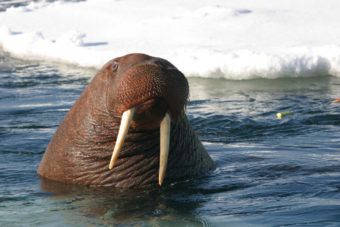
A young Pacific Walrus bull in coastal Alaska waters. (Photo by Joel Garlich-Miller/USFWS)

Point Lay and the nearby beaches of Cape Lisburne might seem like popular spots for walruses, but the haulouts there are a recent phenomenon.

“We had a few times that they gathered,” Point Lay resident Allen Upicksoun told U.S. Fish and Wildlife workers in 2018. “They’d say, ‘lots of walrus up north.’ But there were 10 to 12, not 40,000.”

Since 2007, walruses have been hauling out on land between their hunts. Before then, they’d populate sea ice patches throughout the Arctic. Fish and Wildlife spokeswoman Andrea Medeiros says that sea ice hasn’t been as reliable in recent years.

“As the ice has retreated further north in the summer times, the walruses have been hauling out on land in larger numbers and for longer periods of time,” Medeiros said.

And Upicksoun of Point Lay wasn’t exaggerating about the numbers. Medeiros says that upwards of 50,000 walruses have been hauling out on Arctic shores since the decline in sea ice.

And that’s led to myriad new issues, especially due to the walruses’ temperaments. Medeiros says in the past, the ice allowed for safe respite for the marine mammals.

“They can just, if something disturbs them, drop off into the water,” Medeiros said. “So when they’re on land, they tend to be skittish.”

If 10 or 12 walruses were hauling out on shores, being skittish wouldn’t be that big of a deal. But the average pacific walrus weighs more than a ton, and when 50,000 of those heavy animals panic in a tight space, Medeiros says there’s a high risk for mortality among the smaller ones.

“They’ll stampede into the water, and in that process, any weak animals — any animals that are young and small — can get trampled and severely injured and sometimes are killed,” Medeiros said.

For Point Lay locals like Julie Itta, this is a risk to those who rely on the walrus as part of their subsistence diet. She told Fish and Wildlife interviewers in 2018 that the people of Point Lay have a traditional connection with the animals that spans generations.

“That’s something that this village has always been strong in, is that spirituality we have with our animals. Because they provide for us,” Itta said. “So if you’re not taking care and respecting them in the way that you’re supposed to, they won’t give themselves to you.”

Point Lay residents sometimes are able to harvest the animals that are trampled due to stampedes, but only if they’re able to get to them in time. For them, a better solution is to prevent disturbances in the first place. That means constantly monitoring the walruses to make sure they’re alright and penalizing those who get too close.

Last year, two pilots were fined $3,000 for disrupting a haul out in 2017. It was deemed a violation of the Marine Mammal Protection Act.

Upicksoun says it’s all a way to make sure that the life cycle for both the residents in the village and their marine mammal neighbors can remain fruitful.

“Walrus are important because of the animal chain,” Upicksoun said. “They go down and harvest small animals, and the small animals depend on them. We depend on them. It’s all part of the animal chain.”

Fish and Wildlife officials expect the walruses to haul out on the shores near Point Lay through October.

Western Alaska just had it’s toastiest May on record

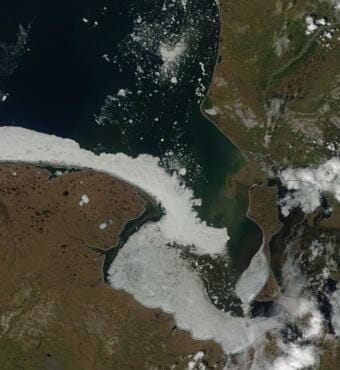
Moderate Resolution Imaging Spectroradiometer (MODIS) image of Kotzebue Sound on June 7, 2020. (Image courtesy of Alaska Arctic Observatory and Knowledge Hub)

This year, Western Alaska had its warmest May on record. It was the fourth warmest May for the state as a whole. Certain conditions aren’t as blistering as last year, but maintain the recent trend of a warming Arctic.

Climatologist Rick Thoman with the International Arctic Research Center in Fairbanks says last month was in the top ten warmest Mays for most regions in the state. An exception was the North Slope region which saw a high pressure system of cool air.

“That kept the easterly winds going quite smartly across the North Slope,” Thoman said. “And with more normal ice conditions this year than in the past few years, that cooling breeze off the ice pack kept temperatures down a bit.”

However, from Point Hope down to the Bethel area, this May was toastier than ever. Thoman says sea ice in the Bering Sea has mostly melted. Sea ice in the Chukchi Sea is taking longer to melt than last year, which saw the earliest sea ice melt on record, but Thoman says it’s still much earlier than normal.

“Not that early and less open water at this point than we had last year, but compared to the longer term normal, this ice loss is well ahead of schedule,” Thoman said.

Thoman says that temperatures have been considerably warmer on average since about 2012. In years past, Thoman says sea ice break-up normally occurred in mid to late June.
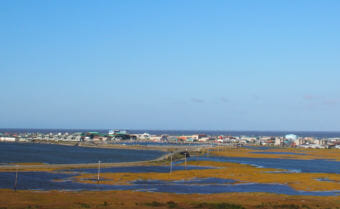
“Some years back in the 80s it actually was in the first days of July,” Thoman said. “Nowadays, typically we’re seeing the ice melt get underway in earnest starting in late May. This year a little bit later than that, but again part of that long term trend.”

Thoman says that current climate predictions for June show an increased chance of warmer than normal temperatures across Western and Northwestern Alaska, with the Southwest Bering Sea due for a drastically warmer month.

“Their ocean temperatures are way above normal and that puts another thumb on the scale for Northwest Alaska,” Thoman said.

While most areas of the state saw an increase in overall temperature during May, it was more drastic in Western Alaska, where some regions were as high as 10.5 degrees warmer than average.

Kotzebue’s sole positive COVID-19 case volunteered to be tested. Can the community expect that kind of compliance from everyone?

Kotzebue City Hall (Photo courtesy of City of Kotzebue)

On Tuesday, May 19, Kotzebue saw its first positive case of COVID-19.

Local health officials were pleased that the infected individual had volunteered to be tested, which ultimately led to finding the case. However, some city officials have expressed concerns over how effective voluntary testing will be moving forward, and how much authority the city has to mandate testing.

Officials from Maniilaq Association, the regional health care provider, initially gave few details about Kotzebue’s first COVID-19 case. They said the infected person had arrived in Kotzebue by plane and had voluntarily submitted to a screening at the airport. After they tested positive, they self-quarantined.

During a more detailed presentation to the Kotzebue City Council, Tim Gilbert, president and CEO of Maniilaq, said the circumstances surrounding Kotzebue’s first case were not surprising.

“As we discussed many times before, we felt like if the COVID-19 was going to come to our region, it was going to walk off the plane from somebody from the outside,” Gilbert said.

Like all passengers on flights incoming to Kotzebue, the man who tested positive was asked to fill out a declaration form, which asks where someone has traveled from and whether they have any underlying medical symptoms.

Gilbert says that every passenger on the flight into Kotzebue that day took a voluntary rapid COVID-19 test, which was conducted at the FBX Aviation Services building right next to the Ralph Wien Airport.

“While they’re waiting for the results of that test, they’re asked to remain in the area and not wander off and go to AC [Alaska Commercial Company store] or do whatever,” Gilbert said. “For this particular gentleman, he stayed in the area, didn’t go into town, didn’t interact.”

When the test came back positive, Gilbert says a Maniilaq employee drove the infected individual to the Maniilaq Health Center’s respiratory clinic. After a health screening, the passenger was then transported to the Nullagvik Hotel.

“They have set up a couple floors as COVID rooms, and that’s where he started his quarantine on Tuesday, and that’s where he remains with strict instructions to not leave the room,” Gilbert said.

Sharon Kurz, Maniilaq Vice President of Health Services, also presented with Gilbert and described the precautions Maniilaq staff took while interacting with the patient.

“Only individuals who were appropriately gowned in PPE (personal protective equipment) in our own vehicles that were thoroughly cleaned after to make sure there could be no contamination of other individuals,” Kurz said.

Kurz says the 19 passengers on the flight have been quarantining at the hotel since arriving in Kotzebue.

“Unfortunately for the unhappy travelers, it’s still somewhere between three and 14 days before we’ll know whether any of those exposures resulted in somebody else contracting the COVID-19,” Kurz said. “But it’s better to be safe than sorry.”

Kurz says there are two types of COVID-19 tests that Maniilaq can offer. One test is conducted with a swab that is sent to the Alaska Native Medical Center in Anchorage. She says those results come back in about 48 hours. Maniilaq has access to 5,000 – 10,000 of those tests.

The other test is the rapid test performed at the airports.

“We can probably only do about 100 of those and then we’ll run out,” Kurz said. “And that’s why we would want to use those on the people who have to move that day from an Alaska Airlines flight to go to a village.”

Both Kurz and Gilbert highlighted that the patient’s willingness to volunteer for the test is ultimately what allowed for them to detect it. However, Kurz says that despite efforts from Maniilaq to test every individual who comes in for a medical procedure, a concerning number of Kotzebue residents are refusing to test for COVID-19.

“We’re still having trouble getting Kotzebue individuals to get tested when they come back from Anchorage or other traveling events,” Kurz said.

Several city council members, including Eugene Smith, expressed gratitude to Maniilaq for testing the individual, as well as the individual himself for volunteering himself. However, Smith remains worried for all passengers arriving.

“That was a big concern of mine, even in the last meeting, was why are we not mandatory testing everybody that gets off that plane,” Smith said. “According to our clerk, Dillingham is doing that, and is there a way to figure that it’s not a volunteer process.”

Gilbert says that there are varying rules and jurisdictions in communities that allow certain communities more weight in enforcing testing. He says tribes have stronger enforcement policies, pointing to Buckland as an example.

“They meet people at the airport,” Gilbert said. “They contact Bering Air to say ‘how many of our tribal members are scheduled to fly in today?’ So we’re working closely with tribes to see if they will put some teeth in their proclamations so that we can use that and show it to passengers who are village-bound.”

Councilman Matt Tekker proposed an incentive policy to increase testing in Kotzebue.

“My question was why couldn’t we give an incentive saying if you don’t take the test, you have to quarantine for 14 days, but if you take the test and it shows negative, you still have to quarantine for like two days,” Tekker said. “That way it gives people that two days where they can generally feel their symptoms change at that time.”

Kurz with Maniilaq says that plan could be complicated as sometimes someone could test negative, but then develop symptoms later and test positive. She says a good way to make sure people are getting tested would be for employers to individually incentivize their employees to take the test. She also says that Nome has posted a police officer at the airport to encourage testing, and she believes that has resulted in more tests in that area.

For now, the number of positive COVID-19 cases is still just the one, and he remains in quarantine.

Beaver numbers have exploded in Northwest Alaska with some striking effects on the environment

A beaver dam in Juneau’s Mendenhall Valley. Taken May 26, 2019 (Photo by David Purdy/KTOO)

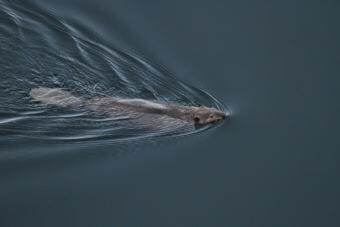
The Baldwin Peninsula near Kotzebue has seen a massive increase in beavers over the last two decades, according to new research from the University of Alaska Fairbanks.

With more beavers come more dams, which impacts everything from fish populations to permafrost. Scientists and locals are still trying to figure out what caused the dam influx, and how to slow some of its more serious effects.

Henry Horner is the president of the Tribal Council for the village of Kobuk. He’s lived in the village since the 1950s, and says that he remembers beavers popping up in the region periodically, but there are considerably more now. And they can be a nuisance.

“Where we subsist for fish and stuff like that, they’ll be blocking the creeks,” Horner said.

A new paper from the University of Alaska Fairbanks shows a massive increase in beaver activity in the region. In 2002, there were two beaver dams near Kotzebue. Now there are 98. And when beavers dam, UAF researcher Ken Tape says you can see it from space.

“What we’re seeing in the satellite imagery is that beavers have been building these new ponds and moving into these treeline [areas] and eventually into these tundra areas,” Tape said. “And that’s pretty exciting and a little bit scary as well.”

He says he’s not surprised the beavers like the area. It’s got water, food and willow trees for them to form dams. While scientists don’t yet know what caused the migration, Tape says that there’s speculation that the beavers could be migrating in response to heavy trapping during the 19th Century. Additionally, he says climate change may be a factor.

“We know that their habitat has improved in the tundra, more shrubby vegetation, more unfrozen water in winter,” he said. “So beavers are probably exploiting those things, the improved habitat, and moving into these tundra areas.”

When beavers build their dams, they are slowing down streams and flooding the surrounding land. That introduces a new source of heat to the area, adding to the gradual decline of permafrost. Additionally, when you create a pond where there was none before, it creates thermokarsts.

“You thaw permafrost and you create these pits in the landscape where that permafrost was thawed,” Tape said. “The ground subsides, and it can turn into kind of a mess.”

Tape says beavers tend to flock to these thermokarsts, compounding the impact they were already making on the landscape.

“What we see is that beavers seem to be accelerating the effects of climate change when they make these ponds,” Tape said. “And if it were just a few dozen ponds, it wouldn’t be a big deal. But what we’re actually seeing is thousands of new ponds over the recent decades.”

Back in Kobuk, tribal president Horner says in addition to increasing the rate of permafrost melt, the beavers are also affecting salmon spawning.

“Farther up [the Kobuk] river, I see where they’ve built dams, and the salmon have to start spawning elsewhere,” Horner said.

Horner says some locals think that eliminating the beavers is a viable solution to their concerns, though he doesn’t see it as very practical.

“Some of our elders would say, ‘kill the beaver,’ and they might get the beaver,” Horner said. “But while they think they’ve got it, another one arrives.”

Tape, with UAF, says that he doesn’t see the beavers as a pest, but there are local and global implications to having thousands of new lakes in the area. He says that researchers are hoping to meet with a group of locals to discuss the future of beavers in the Northwest Arctic.

“We’re going to need local perspectives if we want to implement any management. Or maybe the management is hands-off, and let’s see what happens. I think that depends a lot on what people decide in these various communities.”

For now, Horner in Kobuk says they’re going to continue keeping a watchful eye on their new neighbors.

Site notifications
Update notification options
Subscribe to notifications