National News

What to make of the new COVID variants, FLiRT

Dr. Ashish Jha says the U.S. is seeing typically two COVID waves a year. (Justin Sullivan/Getty Images)

As much as we would all love to ignore COVID, a new set of variants that scientists call “FLiRT” is here to remind us that the virus is still with us.

The good news: as of last Friday, the CDC says that the amount of respiratory illness in the U.S. is low.

The not-so-great news: the U.S. has often flirted with summer COVID waves because of travel and air-conditioned gatherings.

Dr. Ashish Jha, the dean of the Brown University School of Public Health and former White House COVID-19 response coordinator, returned to All Things Considered to speak with host Ailsa Chang about what the new variants could bring.

Interview highlights

Ailsa Chang: So how concerned would you say scientists are about whether these FLiRT variants come with increased transmissibility or increased disease severity, compared to previous variants?

Ashish Jha: We’re seeing exactly what we have expected: The virus continues to evolve to try to escape the wall of immunity we have built up through vaccines and infections. Is this more transmissible? It is. That’s why it has become more dominant. But the really important question is, is it going to get people to become more sick than previous versions? And all the evidence right now we have is no. If you have been vaccinated, or you had previous infections – or you’re one of the majority of Americans who have had both – you are likely to have a mild infection and not get particularly sick. Obviously, we have to continue monitoring every new variant, but this is pretty expected.

Former President Trump is found guilty in historic New York criminal case

Former President Donald Trump sits in a courtroom at Manhattan Criminal Court on May 21 for his trial for allegedly covering up hush money payments. (Justin Lane/Pool/Getty Images)

NEW YORK — Former President Donald Trump has been found guilty of 34 counts of falsifying business records to influence the outcome of the 2016 election, a historic verdict as Trump, the presumptive Republican presidential nominee, campaigns again for the White House.

This is the first time a former or sitting U.S. president has been convicted of criminal charges.

On Thursday, 12 New York jurors said they unanimously agreed that Trump falsified business records to conceal a $130,000 hush money payment to adult film star Stormy Daniels to influence the 2016 election.

The decision came after about a day and a half of deliberations.

Trump spoke to reporters outside the courtroom, calling it a “rigged, disgraceful trial,” and said the “real verdict” will be Election Day.

The jury heard from 22 witnesses during just over four weeks of testimony in Manhattan’s criminal court. Jurors also weighed other evidence – mostly documents like phone records, invoices and checks to Michael Cohen, Trump’s once loyal “fixer,” who paid Daniels to keep her story of an alleged affair with the former president quiet.

The facts of the payments and invoices labeled as legal services were not in dispute. What prosecutors needed to prove was that Trump falsified the records in order to further another crime – in this case violating the New York election law that makes it a crime for “any two or more persons who conspire to promote or prevent the election of any person to a public office by unlawful means.” The jurors were able to choose whether those unlawful means were violating the Federal Elections Campaign Act, falsifying tax returns, or falsifying other business records.

Trump’s defense focused intently on the credibility of Cohen, and argued that influencing an election is not illegal.

The verdict came more than a year after a grand jury indicted Trump, on March 30, 2023, marking the first time a former or sitting president faced criminal charges.

Republicans quickly dismissed the indictment as an overreach of power by Democratic District Attorney Alvin Bragg, who had brought the charges. Trump has continually blasted the case as “election interference” affecting his 2024 campaign.

What the jury heard

In August 2015, two months after Trump announced his 2016 presidential bid, David Pecker, then the publisher of the National Enquirer tabloid, met with Trump and Cohen at Trump Tower, according to testimony from Pecker and Cohen.

At that meeting, Pecker testified, it was agreed that he would be the “eyes and ears” of the Trump campaign. His job was to look out for negative stories from women he could “take off the marketplace,” by buying up the rights but never publishing them.

The plan, as Pecker outlined it, was that he would suppress these stories, and at the same time publish negative stories about Trump’s opponents. Some of these stories, Pecker said, were sent to Trump and Cohen for approval prior to publication.

Over the next year, Pecker said he carried out this role. His testimony was corroborated by Keith Davidson, an attorney who represented both Daniels and former Playboy model Karen McDougal. In about June 2016, McDougal considered going public with her story of a year-long affair with Trump. But Pecker bought the rights to that story, with the expectation that he would be reimbursed by Trump. That never happened.

In early October 2016, according to the testimony of former Trump communications aide Hope Hicks, the campaign was rocked by the release of the Access Hollywood tape, where Trump could be heard boasting “When you’re a star they let you do it. You can do anything. Grab ’em by the p****.”

The next day, according to Pecker, Cohen and Davidson, Daniels threatened to go public with accusations she’d had a sexual encounter withTrump in 2006 in a Lake Tahoe hotel suite during a celebrity golf tournament.

In her testimony, Daniels said there was a “power imbalance” when, after leaving the suite’s restroom, she found Trump on the hotel bed in his underwear. That’s when, Daniels said, they had sex.

She testified that Trump had dangled a possible role on his TV show Celebrity Apprentice. This detail — that the sex wasn’t entirely wanted — caused the defense to request a mistrial, which was denied. It also provided a motive for Trump to suppress the story. Prosecutors said, “Trump knew what happened in that hotel room” and didn’t want it to come out. The adult film actor’s testimony also included intimate details of her alleged sexual encounter, some of which Judge Merchan agreed with the defense were not necessary.

As October drew to a close, Cohen testified, he frantically opened bank accounts and tried to come up with a way to pay the $130,000 to keep Daniels quiet. But Trump, Cohen said, wanted to delay the payment until after the election, with the idea that after that it wouldn’t matter if Daniels was paid.

This point, that Trump was making the payment to influence the election by keeping women voters on board, was corroborated by a number of other witnesses. Hicks testified Trump, by then in the White House, told her that it was better the story came out in 2018, rather than 2016.

Cohen ultimately wired the money himself to Daniels, with the understanding, he said, that he would be repaid by Trump. Cohen testified to a number of conversations with Trump, backed up by phone records, including on the day he wired the payments. But the defense rattled Cohen on cross-examination when it presented evidence that one of the calls which Cohen had said was made through Trump’s bodyguard, Keith Schiller, was instead with Schiller about threats from a 14-year-old prankster.

Still, the heart of the case rested on the testimony of what happened after the election, when the records were falsified, in particular the handwritten notes and documents from the Trump Organization’s former comptroller, Jeff McConney.

McConney authenticated a key record: the bank statement showing Cohen’s wire transfer. That record included handwritten notes from Cohen and Trump’s former chief financial officer, Allen Weisselberg, describing the $130,000 payment that would be “grossed up” to cover Cohen’s taxes. That sum, combined with another reimbursement and a bonus, for a total of $420,000, was paid out over 12 months at a rate of $35,000 per month.

The payments would be described as pursuant to a “legal retainer.” (Weisselberg, who is serving jail time for perjury in Trump’s civil fraud trial, did not testify.)

On the stand, Cohen described a repayment scheme that formed the basis of the 34 counts of falsified business records: 11 falsified invoices, 12 falsified ledger entries and 11 checks falsely recording the repayment as legal “retainers.” Nine of the checks were signed by Trump, himself.

Cohen said he and Weisselberg met and discussed the agreement with Trump shortly before he left for Washington, on or about Jan. 17, 2020. Cohen said Trump approved the deal, saying at the end of the meeting that “it was going to be one heck of a ride” in Washington. Cohen said he and Trump discussed the arrangement again, in early February, in the Oval Office. Photos and White House records corroborated that the two met in the Oval Office at the time.

The defense presented just two witnesses, including Robert Costello, an attorney who wanted to represent Cohen after Cohen’s home and office were searched by the FBI in 2018. Costello had been put on the stand to refute Cohen’s claim that Costello was pressuring Cohen to stay on Trump’s “team.” But Costello’s emails showed that Trump was deciding which of Cohen’s lawyers he wanted to pay, and that Costello was concerned about not giving “the appearance that we are following instructions from [Rudy] Giuliani or the president,” referring to the former New York City mayor who was Trump’s lawyer at the time.

How this conviction could affect the 2024 election

This likely is the only one of Trump’s four ongoing criminal cases that will be heard ahead of the 2024 election in November, since federal trials in Washington, D.C., and Florida, and a state case in Georgia are in various stages of delays.

This decision in New York is likely to have rippling effects as Trump campaigns as the presumptive Republican presidential nominee. For now, the other 54 criminal charges he faces have not turned off potential voters and, among some Republicans, the cases have bolstered support for him. However, a conviction may not play well with independent and swing voters.

The latest NPR/PBS NewsHour/Marist poll, from May, showed that 17% of voters said they would be less likely to vote for Trump if he is convicted, while 15% said they would be more likely to vote for him. And 67% of registered voters nationally say it makes no difference to their vote if Trump is found guilty in his hush money trial.

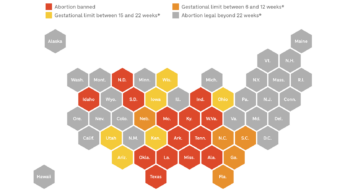
6 key facts about abortion laws and the 2024 election

*Weeks since Day 1 of last menstrual period (Source: KFF analysis as of May 2, 2024/Credit: Hilary Fung/NPR)

In the nearly two years since the Supreme Court overturned Roe v. Wade, abortion access has been in an almost constant state of flux.

State laws keep changing – with new bans taking effect in some places while new protections are enacted in others. And there have been a slew of lawsuits and ballot measures that may motivate voters come November.

Here are 6 facts about where things currently are with abortion and the election.

1. About half of states restrict abortion.

In 14 states, there are total bans on abortion, with very limited exceptions in cases such as rape or to save the life or health of the mother. A few more states – including Florida – have six-week bans, and often that’s so early in a pregnancy most people don’t yet know they’re pregnant. Another half dozen states have restrictions that limit abortion after 12, 15, 18 or 22 weeks of pregnancy.

In the states that ban or severely restrict abortion access, the number of abortions has dropped drastically.

But legal challenges and ballot initiatives mean the map could keep shifting. So far, voters will be weighing in on the right to an abortion in four states: Colorado, Florida, Maryland and South Dakota. Six more states are in the process of getting it on the ballot, including Missouri, Nebraska, Nevada, Arizona, Arkansas and Montana.

2. Bans are affecting where doctors work.

Idaho illustrates how abortion bans can affect a state’s broader health care system. Doctors are leaving the state, and three maternity wards have closed since the abortion ban took effect there.

“We lost 58 obstetricians either to moving out of state or retiring, and in that same time period, only two OB-GYNs moved into Idaho,” says Dr. Sara Thomson, an OB-GYN in Boise. “That is not really a sustainable loss-to-gain ratio.”

It’s not just Idaho – a lot of hospital systems in states with abortion bans are having recruiting problems. The Association of American Medical Colleges earlier this month reported a decrease in medical students applying to residencies in states that limit abortion access. Essentially, these early career doctors are saying they don’t want to practice medicine with the threat of fines, jail time, and the loss of their medical license.

3. Abortions are actually increasing nationally.

Since the Supreme Court overturned Roe v. Wade, the number of abortions in the U.S. has continued to grow.

“We are seeing a slow and small, steady increase in the number of abortions per month and this was completely surprising to us,” says Ushma Upadhyay, who co-leads the Society of Family Planning’s WeCount project. According to their recent report, in 2023 there were, on average, 86,000 abortions per month compared to 2022, when there were about 82,000 abortions per month. “Not huge,” says Upadhyay, “but we were expecting a decline.”

A major factor in the uptick in abortions nationwide is the rise of telehealth, made possible in part by regulations first loosened during the coronavirus pandemic. Telehealth abortions now make up nearly 1 in 5 of all abortions in the U.S. Patients don’t need to take off work and go to a clinic, they can connect with providers over text messages, phone calls or video, no matter where they live. Abortion medication is then mailed to them at home.

John Seago, president of Texas Right To Life, is concerned with the rise of abortions and increased access through telehealth.

“I’m afraid that we are going to wake up in 20 years and just kind of realize that we won in Dobbs, and then we’ve been losing ever since,” Seago says. He told NPR his group is currently working on how to bring criminal and civil challenges to tamp down on the number of abortions.

4. Some states have moved to make abortion access easier.

Abortion was heavily regulated even while Roe v. Wade was the law of the land, and states like Michigan, Colorado, California, Minnesota and others have made moves to undo some of those regulations.

They are passing laws to get rid of waiting periods and gestational limits, and they are allowing more types of providers like nurse practitioners, for instance, to perform abortions. Some states have stockpiled mifepristone, one of the medicines that can be used for abortion, in case access is curtailed federally in the future.

New York City made an abortion hub as part of its health department, including a hotline and chat for people to find out where to get an abortion and how to get funding to cover the costs.

5. “Shield laws” create new access in untested legal terrain.

Another way some states have expanded abortion access is by passing “shield laws.” These are laws that say doctors and nurses in states where abortion is legal can’t be prosecuted by another state if they provide abortion across state lines. They apply if a woman travels to another state for an abortion or if the abortion provider mails pills to someone in a state with restrictions.

Lauren, who is 33 and lives in Utah, got a telehealth abortion from a provider in a state with shield laws. Lauren got pregnant on birth control and decided quickly that she couldn’t afford another child. (NPR is not using her last name because she’s worried about professional repercussions.)

Abortion is technically legal in Utah until 18 weeks, but access is severely restricted. It can only be performed in hospitals, for instance. So Lauren chose an online company called Aid Access, that provides telehealth abortion for people in all 50 states.

“In my situation, I felt more at ease than I would in a physician’s office and more comfortable, to be honest,” she explains. “Especially with a provider within the state of Utah – I feel like there’s always a judgmental indication or undertone.”

She filled out a form online with questions about how far along she was and her medical history, connected with a doctor via email and text messages, and received abortion medication in the mail. She had her abortion at home.

Some anti-abortion rights groups are hoping to test the legality of shield laws by bringing charges against a doctor, but that hasn’t happened yet.

6. The Supreme Court could shake things up again.

There are two major decisions on abortion pending right now before the Supreme Court.

One is about the abortion pill mifepristone. The Court could restrict this drug for the whole country and totally change access to medication abortion through telemedicine. Court watchers think it won’t go that way, but no one knows for sure.

The other case is about abortion in emergency situations and it centers on Idaho’s medical exception. It’s a fight over whether federal or state law should have priority. The oral arguments left legal analysts unsure about which way the Court was leaning.

Both of these decisions are expected in late June or early July, just a few months before the election. Regardless of what the justices decide, it’s going to catapult abortion back into the headlines a few months before the election.

Copyright 2024 NPR

A big survey asked Americans about their finances. Here are some trouble spots

Rising prices remain a top concern for Americans, according to a new survey by the Federal Reserve. But 72% of adults say they’re living comfortably financially or at least doing OK. (Frederic J. Brown/AFP via Getty Images)

Americans overwhelmingly say they’re “doing at least OK financially,” but most remain worried about rising prices, and 1 in 6 says they have bills they can’t pay, according to a report released Tuesday by the Federal Reserve.

Each year the Fed surveys thousands of people about their household finances, including income, savings and expenses. This year’s snapshot shows family budgets generally held steady over the last year, but they’re not as solid as they were two years ago, when pandemic relief payments helped pad people’s bank accounts and inflation was just beginning to take hold.

The survey, conducted last fall, found that 72% of adults are living comfortably financially or at least doing OK. That’s down from 73% in 2022 and 78% in 2021.

Child care is a significant expense

One group that saw a bigger drop in well-being was parents. Just 64% of those with children under 18 said they were doing at least OK — down from 75% in 2021. Child care is a significant expense for many families, often costing at least half as much as their housing. The median monthly cost for child care was $800, or $1,100 for those using more than 20 hours a week.

About a third of those surveyed said their monthly income had increased during the year, while a slightly higher percentage — 38% — said their monthly expenses had grown.

2 in 3 Americans say inflation has made their finances worse

Although inflation is lower now than it was a year ago and less than half what it was in 2022, two-thirds of Americans say rising prices have made their financial situation worse, including 19% who say they’re much worse off. About 1 in 3 people said inflation had little effect on their family finances.

1 in 3 Americans couldn’t cover a $400 surprise expense

Unsurprisingly, lower-income households reported more financial hardships, such as an inability to pay their bills every month or skipping meals or medical care. Overall, 48% of those polled said they had money left over after paying expenses, while 17% said they had unpaid bills in the previous month.

Faced with an unexpected $400 expense, 63% of survey respondents said they could cover it with savings. That’s unchanged from 2022 but down slightly from 2021. About 1 in 8 people said they would be unable to handle such an expense by any means.

Double-digit price increases in home insurance

This year’s report included a new question about home insurance, which has seen double-digit price increases in the last year. While the vast majority of homeowners have insurance, some of the most vulnerable people do not, including more than 20% of low-income families in the South.

“This perspective continues to help the Federal Reserve better understand how families are coping with the ongoing economic challenges they face,” Federal Reserve Board Gov. Michelle Bowman said in a statement.

Copyright 2024 NPR

He fell ill on a cruise. Before he boarded the rescue boat, they handed him the bill

On the last full day of a Bahamas excursion, Vincent Wasney had three epileptic seizures. While being evacuated, he received a bill for expenses incurred during the cruise. (Kristen Norman for KFF Health News)

Vincent Wasney and his fiancée, Sarah Eberlein, had never visited the ocean. They’d never even been on a plane. But when they bought their first home in Saginaw, Michigan, in 2018, their real estate agent gifted them tickets for a Royal Caribbean cruise.

After two years of delays due to the coronavirus pandemic, they set sail in December 2022.

The couple chose a cruise destined for the Bahamas in part because it included a trip to CocoCay, a private island accessible to Royal Caribbean passengers that featured a water park, balloon rides, and an excursion swimming with pigs.

It was on that day on CocoCay when Wasney, 31, started feeling off, he said.

The next morning, as the couple made plans in their cabin for the last full day of the trip, Wasney made a pained noise. Eberlein saw him having a seizure in bed, with blood coming out of his mouth from biting his tongue. She opened their door to find help and happened upon another guest, who roused his wife, an emergency room physician.

Wasney was able to climb into a wheelchair brought by the ship’s medical crew to take him down to the medical facility, where he was given anticonvulsants and fluids and monitored before being released.

Vincent had had seizures in the past, starting about ten years ago, but it had been a while since his last one. Imaging back then showed no tumors, and doctors concluded he was likely epileptic, he said. He took medicine initially, but after two years without another seizure, he said his doctors took him off the medicine to avoid liver damage.

Wasney had a second seizure on the ship a few hours later, back in his cabin. This time he stopped breathing, and Eberlein remembered his lips being so purple, they almost looked black. Again, she ran to find help but, in her haste, locked herself out. By the time the ship’s medical team got into the cabin, Wasney was breathing again but had broken blood vessels along his chest and neck that he later said resembled tiger stripes.

Wasney was in the ship’s medical center when he had a third seizure — a grand mal, which typically causes a loss of consciousness and violent muscle contractions. By then, the ship was close enough to port that Wasney could be evacuated by rescue boat. He was put on a stretcher to be lowered by ropes off the side of the ship, with Eberlein climbing down a rope ladder to join him.

But before they disembarked, the bill came.

The patient: Vincent Wasney, 31, who was uninsured at the time.

Medical services: General and enhanced observation, a blood test, anticonvulsant medicine, and a fee for services performed outside the medical facility.

Service provider: Independence of the Seas Medical Center, the on-ship medical facility on the cruise ship operated by Royal Caribbean International.

Total bill: $2,500.22.

What gives: As part of Royal Caribbean’s guest terms, cruise passengers “agree to pay in full” all expenses incurred on board by the end of the cruise, including those related to medical care. In addition, Royal Caribbean does not accept “land-based” health insurance plans.

Wasney said he was surprised to learn that, along with other charges like wireless internet, Royal Caribbean required he pay his medical bills before exiting the ship — even though he was being evacuated urgently.

“Are we being held hostage at this point?” Eberlein remembered asking. “Because, obviously, if he’s had three seizures in 10 hours, it’s an issue.”

Wasney said he has little memory of being on the ship after his first seizure — seizures often leave victims groggy and disoriented for a few hours afterward.

But he certainly remembers being shown a bill, the bulk of which was the $2,500.22 in medical charges, while waiting for the rescue boat.

Still groggy, Wasney recalled saying he couldn’t afford that and a cruise employee responding: “How much can you pay?”

They drained their bank accounts, including money saved for their next house payment, and maxed out Wasney’s credit card but were still about $1,000 short, he said.

Ultimately, they were allowed to leave the ship. He later learned his card was overdrafted to cover the shortfall, he said.

Royal Caribbean International did not respond to multiple inquiries from KFF Health News.

Once on land, in Florida, Wasney was taken by ambulance to the emergency room at Broward Health Medical Center in Fort Lauderdale, where he incurred thousands of dollars more in medical expenses.

He still isn’t entirely sure what caused the seizures.

On the ship he was told it could have been extreme dehydration — and he said he does remember being extra thirsty on CocoCay. He also has mused whether trying escargot for the first time the night before could have played a role. Eberlein’s mother is convinced the episode was connected to swimming with pigs, he said. And not to be discounted, Eberlein accidentally broke a pocket mirror three days before their trip.

Wasney, who works in a stone shop, was uninsured when they set sail. He said that one month before they embarked on their voyage, he finally felt he could afford the health plan offered through his employer and signed up, but the plan didn’t start until January 2023, after their return.

They also lacked travel insurance. As inexperienced travelers, Wasney said, they thought it was for lost luggage and canceled trips, not unexpected medical expenses. And because the cruise was a gift, they were never prompted to buy coverage, which often happens when tickets are purchased.

The resolution: Wasney said the couple returned to Saginaw with essentially no money in their bank account, several thousand dollars of medical debt, and no idea how they would cover their mortgage payment. Because he was uninsured at the time of the cruise, Wasney did not try to collect reimbursement for the cruise bill from his new health plan when his coverage began weeks later.

The couple set up payment plans to cover the medical bills for Wasney’s care after leaving the ship: one each with two doctors he saw at Broward Health, who billed separately from the hospital, and one with the ambulance company. He also made payments on a bill with Broward Health itself. Those plans do not charge interest.

But Broward Health said Wasney missed two payments to the hospital, and that bill was ultimately sent to collections.

In a statement, Broward Health spokesperson Nina Levine said Wasney’s bill was reduced by 73% because he was uninsured.

“We do everything in our power to provide the best care with the least financial impact, but also cannot stress enough the importance of taking advantage of private and Affordable Care Act health insurance plans, as well as travel insurance, to lower risks associated with unplanned medical issues,” she said.

The couple was able to make their house payment with $2,690 they raised through a GoFundMe campaign that Wasney set up. Wasney said a lot of that help came from family as well as friends he met playing disc golf, a sport he picked up during the pandemic.

“A bunch of people came through for us,” Wasney said, still moved to tears by the generosity. “But there’s still the hospital bill.”

The takeaway: Billing practices differ by cruise line, but Joe Scott, chair of the cruise ship medicine section of the American College of Emergency Physicians, said medical charges are typically added to a cruise passenger’s onboard account, which must be paid before leaving the ship. Individuals can then submit receipts to their insurers for possible reimbursement.

He recommended that those planning to take a cruise purchase travel insurance that specifically covers their trips. “This will facilitate reimbursement if they do incur charges and potentially cover a costly medical evacuation if needed,” Scott said.

Royal Caribbean suggests that passengers who receive onboard care submit their paid bills to their health insurer for possible reimbursement. Many health plans do not cover medical services received on cruise ships, however. Medicare will sometimes cover medically necessary health care services on cruise ships, but not if the ship is more than six hours away from a U.S. port.

Travel insurance can be designed to address lots of out-of-town mishaps, like lost baggage or even transportation and lodging for a loved one to visit if a traveler is hospitalized.

Travel medical insurance, as well as plans that offer “emergency evacuation and repatriation,” are two types that can specifically assist with medical emergencies. Such plans can be purchased individually. Credit cards may offer travel medical insurance among their benefits, as well.

But travel insurance plans come with limitations. For instance, they may not cover care associated with preexisting conditions or what the plans consider “risky” activities, such as rock climbing. Some plans also require that travelers file first with their primary health insurance before seeking reimbursement from travel insurance.

As with other insurance, be sure to read the fine print and understand how reimbursement works.

Wasney said that’s what they plan to do before their next Royal Caribbean cruise. They’d like to go back to the Bahamas on basically the same trip, he said — there’s a lot about CocoCay they didn’t get to explore.

Emmarie Huetteman of KFF Health News edited the digital story, and Taunya English of KFF Health News edited the audio story. NPR’s Will Stone edited the audio and digital story.

KFF Health News, formerly known as Kaiser Health News (KHN), is a national newsroom that produces in-depth journalism about health issues and is one of the core operating programs at KFF — the independent source for health policy research, polling, and journalism.

Copyright 2024 NPR

Transcript :

ARI SHAPIRO, HOST:

It’s time for our May Bill of the Month. Dr. Elisabeth Rosenthal is senior contributing editor with our partner, KFF Health News, and she’s here once again. Welcome.

ELISABETH ROSENTHAL: Hi, Ari. Good to be here.

SHAPIRO: Whose bill are you going to tell us about today?

ROSENTHAL: This month, it’s Vincent Wasney from Michigan. A couple of years ago, he and his fiance did something many Americans are planning to do this summer – take a vacation. They weren’t thinking much about health as they prepared for their Caribbean cruise. Unfortunately, when they were having fun on the ship, an emergency came up.

SHAPIRO: Ugh, sounds like a vacation ruined. Let’s hear the rest of that story from reporter Bram Sable-Smith.

BRAM SABLE-SMITH: Vincent and his fiancee, Sarah, had never seen the ocean. They had never even been on an airplane. And they did not know a lot about travel insurance, but they were thrilled when they got tickets for a Caribbean cruise as a gift.

VINCENT WASNEY: In the beginning, it was a couple hundred bucks, ’cause we just had to pay port fees.

SARAH: Yep.

WASNEY: And the cruise and room and everything were covered.

SARAH: Yep.

SABLE-SMITH: The cruise included a day on CocoCay, a private island that has balloon rides, a water park and even an excursion to swim with pigs. The next morning is when things took a turn. In their cabin, Sarah heard Vincent make a pained noise.

SARAH: I turned my head, and I was going to ask him if he was OK. And he just totally locks up, fetal position, and he starts seizing.

SABLE-SMITH: Vincent had had seizures in the past, but it’d been a while. Sarah ran out the door to get help. In the ship’s medical center, a doctor gave Vincent anticonvulsants and fluids. They observed him, then sent him to his room. There, Sarah noticed something alarming. Vincent’s thumb was moving back and forth on his phone like he was in a trance. It was another seizure.

SARAH: Oh, this one – I might cry, (crying) I’m sorry. He stopped breathing completely. His lips were almost black they were so purple.

SABLE-SMITH: He had a third seizure not long after – a grand mal. He needed off the ship. A rescue boat came to take them to land. But Sarah says, before they disembarked, cruise employees told the couple they had to pay their bill. She remembers feeling trapped.

SARAH: I’m like, OK. So, like, are we being held hostage at this point? Because, obviously, he had three seizures in 10 hours.

SABLE-SMITH: They got the cruise as a gift, so Vincent and Sarah had budgeted just a few hundred dollars for Wi-Fi, drinks and tips. But now, their bill also included $2,500 for medical expenses.

WASNEY: I’m still groggy, and I’m still kind of combative. So I’m like, I can’t pay this. So that’s when they’re like, how much do you have?

SABLE-SMITH: Sarah and Vincent drained their bank accounts and maxed out Vincent’s credit card. Ultimately, they were allowed to leave the ship, but Vincent says he later learned his card was over-drafted to settle what the couple owed. Royal Caribbean did not respond to requests for comment.

Back on land, Vincent was transported to a hospital. This all happened back in 2022. He’s fine now, and the couple are not deterred from traveling again.

WASNEY: I definitely – like, anyone who would wonder – I would suggest a cruise. It’s fun.

SARAH: For sure.

SABLE-SMITH: They still want to go back to CocoCay.

SHAPIRO: That was reporter Bram Sable-Smith. And we’re back with Dr. Elisabeth Rosenthal. Dr. Rosenthal, most people going on vacation are not planning for a medical emergency when they’re packing their bags. Is there research people should be doing ahead of time?

ROSENTHAL: Unfortunately, yes, you should ask before you go. Different cruise lines have very different billing practices. But generally speaking, passengers are required to settle their bills before they disembark, no matter the circumstances. You know, the bills for the drinks, special excursions and – if you end up needing medical care – a sizey (ph) medical bill.

SHAPIRO: What about health insurance? If you are covered, should that protect you from medical bills on a cruise ship?

ROSENTHAL: Well, back in ’22 when this happened, Vincent was uninsured. But even if he had been, it might have been tricky to get reimbursed. In this case, it was a Royal Caribbean cruise. That company says on their website that they do not accept, quote, ‘”land-based health insurance plans when on board.” The cruise line suggests that passengers can try to submit their paid bills to their health insurer for possible reimbursement, but you never know.

SHAPIRO: So if somebody does get off a cruise ship and submit a bill like that, what are the chances that the health insurance company will say, yeah, I’ll pay you back?

ROSENTHAL: Ah, well, many health plans do not cover medical service on cruise ships. Medicare will sometimes cover that if it’s medically necessary – but, again, not always. They don’t pay if the ship is more than six hours away from a U.S. port – not something a passenger is likely to keep track of, right?

SHAPIRO: Right. Well, we also heard a mention there of travel insurance. If somebody buys that ahead of a vacation, is that likely to cover them?

ROSENTHAL: Travel insurance can cover a lot of things, including medical expenses. Some plans also cover an emergency evacuation, for instance, or transport back home in a medical crisis. Those plans can be purchased individually, and some credit cards offer travel medical insurance as a benefit. But, again, you have to check.

And all plans have limitations. Some don’t cover care associated with preexisting conditions or associated with activities deemed risky, like rock climbing. So especially if you have health issues, take the time to look into whether you need a medical insurance policy.

SHAPIRO: Dr. Elisabeth Rosenthal, thank you.

ROSENTHAL: Thanks for having me.

SHAPIRO: And if you have a confusing or outrageous medical bill that you want us to review, please go to NPR’s Shots blog and tell us all about it. Transcript provided by NPR, Copyright NPR.

DOJ says Boeing broke deal that avoided prosecution after 2 fatal 737 Max crashes

The U.S. Justice Department says Boeing broke a deferred prosecution deal with the government following a pair of fatal 737 Max crashes more than five years ago. (Samuel Corum/Getty Images)

WASHINGTON — Boeing has violated the terms of a deal to avoid prosecution after the fatal crashes of two 737 Max planes more than five years ago, the U.S. Justice Department told a federal judge on Tuesday.

That means the troubled plane maker could be subject to criminal prosecution for defrauding federal regulators, though Justice Department lawyers stopped short of saying whether they will pursue that remedy.

“The Government has determined that Boeing breached its obligations” under the agreement it reached with the Justice Department in early 2021, “by failing to design, implement, and enforce a compliance and ethics program to prevent and detect violations of the U.S. fraud laws,” prosecutors wrote in a letter to Federal District Judge Reed O’Connor in Texas.

The two-page letter does not mention Alaska Airlines Flight 1282, when a door-plug panel blew off a 737 Max jet in midair in January. But that incident has sparked renewed scrutiny of Boeing’s operations by federal regulators, as well as the Justice Department, which has opened a separate investigation.

Boeing says it disagrees with the DOJ’s conclusion that it has violated the deal.

“We believe that we have honored the terms of that agreement, and look forward to the opportunity to respond to the Department on this issue,” spokeswoman Jessica Kowal said in a statement.

Boeing 737 Max jets are pictured outside a Boeing factory on March 25, 2024 in Renton, Wash. (Stephen Brashear/Getty Images)

Boeing agreed to the deferred prosecution deal with the DOJ in January 2021 and paid $2.5 billion in fines. The plane maker had been accused of misleading regulators who approved the 737 Max.

The Max crashes — one in Indonesia in 2018 and another in Ethiopia in 2019 — killed a total of 346 people. The accidents were blamed, in part, on a new automated flight control system. That system, called MCAS, powerfully pushed the noses of those jets down repeatedly not long after takeoff, killing all on board.

The DOJ agreement essentially placed Boeing under probation for three years — a term that ended just days after the midair blowout on Jan. 5, 2024.

Family members of the crash victims have long criticized the prosecution agreement with Boeing as a sweetheart deal for the company, and have been waging a years-long legal battle to overturn it.

Their lawyers welcomed the DOJ’s announcement, and urged prosecutors to go further.

“This is an important first step toward holding Boeing accountable for the deaths of the 346 passengers and crew on the two flights,” said Paul Cassell, a former federal judge and law professor at the University of Utah who is representing the families.

“But the Justice Department needs to now follow through with effective, transparent, and vigorous prosecution of the conspiracy charge it has filed,” Cassell said.

“We hope that DOJ will continue to pursue justice for Boeing’s victims, and move forward with a prosecution against Boeing for its egregious criminal acts that resulted in the deaths of 346 innocent people,” said Erin Applebaum, a lawyer at the firm Kreindler & Kreindler who represents victims’ families.

The Justice Department could also seek to essentially extend Boeing’s probation under the prosecution agreement.

Prosecutors told the judge they are still determining how to proceed. Under the terms of the agreement, Boeing has a chance to reply to the Justice Department. The DOJ has also scheduled another meeting to seek input from family members of the victims on May 31 in Washington.

Copyright 2024 NPR. To see more, visit https://www.npr.org.
Site notifications
Update notification options
Subscribe to notifications