Syndicated

Southeast’s top 2016 stories: Ferries, elections, forests, rivers

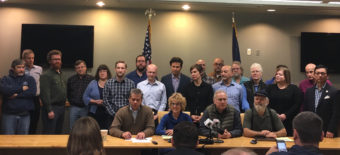
The new bipartisan House majority caucus. The leaders, seated left to right, include Majority Leader Chris Tuck, Rules Chairwoman Gabrielle LeDoux, Speaker Bryce Edgmon, and Finance Co-Chairman Paul Seaton. Nov. 9, 2016. (Photo by Andrew Kitchenman/KTOO/APRN)
The new bipartisan House majority caucus holds a press conference after forming in November. Southeast members are Juneau’s Sam Kito III, far left, Juneau’s Justin Parish, third from left, Sitka’s Jonathan Kreiss-Tomkins, center, and Ketchikan’s Dan Ortiz, second from right. (Photo by Andrew Kitchenman/KTOO/APRN)

The legislature, transboundary mining, timber harvest plans and a shrinking ferry system are among Southeast Alaska’s top stories of 2016.

November legislative elections significantly improved the region’s standing in the House.

Democrat Justin Parish narrowly beat incumbent Republican Cathy Muñoz in Juneau’s Mendenhall Valley district. That contributed to a statewide shift that put Democrats and their allies in charge of the House for the next two years.

Parish was among those promising to protect regional interests.

“From my seat there … I’ll able to quash any possible thought of a capital move,” he said.

He and Southeast’s three other representatives will all have majority leadership positions once they’re sworn in in January. Only one Southeast representative was in the majority during the past session.

The Taku loads in Sitka Sunday morning before sailing to Hoonah and Juneau. It was then tied up for repairs. Photo by Ed Schoenfeld.
The ferry Taku loads in Sitka in 2012. Now, it’s tied up and waiting to be sold or scrapped. (Photo by Ed Schoenfeld/CoastAlaska News)

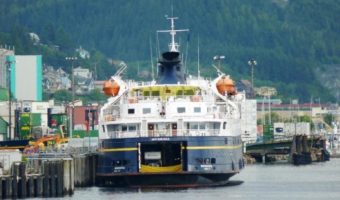
Driving on or off an Alaska Marine Highway ferry became harder in 2016, as budget cuts shrunk the number of sailings and two ships went into long-term storage.

The 11-year-old fast ferry Chenega was tied up in Tacoma with an uncertain future. And the 50-year-old Taku was docked in Ketchikan with the intent of being scrapped or sold.

Exploration companies in 2016 continued drilling to expand ore bodies at potential mine sites near the British Columbia-Alaska border.

And critics in Southeast kept pushing for restrictions on mines in transboundary watersheds that drain into the state.

That led state and provincial officials to sign a statement of cooperation in October promising more openness and increased environmental monitoring.

The Tongass National Forest makes up most of Southeast Alaska (Courtesy U.S. Forest Service)

Critics – and the state — said it was not enough and will continue pushing for a binding federal agreement.

Also in 2016, the U.S. Forest Service finalized long-debated plans to move Tongass timber harvests from old-growth to younger trees.

The industry said the plan, announced in December, would make future timber sales uneconomical. Environmental critics said the transition was too slow and didn’t protect enough fisheries and wildlife habitat.

In other news, Southeast Alaska’s regional Native corporation rejoined the fishing industry in May by investing in Independent Packers Corp., a Seattle processing plant.

Prince of Wales deer season extended, wolf season ended

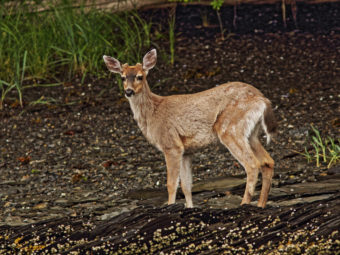
A Sitka black tailed deer in June 2014.
A proposed delay in the start of “doe season” is meant to protect fawns — but may not make sense biologically. (Creative Commons photo by Kenneth Cole Schneider)

Subsistence hunters seeking deer on Southeast Alaska’s Prince of Wales Island will have an extra month to hunt. But the island’s wolf season has been shortened.

Game Unit 2The Federal Subsistence Board extended the deer season through January in what’s called Game Management Unit 2. The season usually runs through December.

The later date only covers federally qualified subsistence hunters and only applies on federal lands.

U.S. Forest Service subsistence biologist Jeff Reeves said the season ends Dec. 31 for other hunters.

“This extension is new for Unit 2. But there are similar provisions that have existed up in Unit 4, which is the Sitka (and) the Admiralty-Baranof-Chichagof-Island areas,” he said. “The typical norm, though, is most deer seasons don’t run beyond the calendar year.The extended season does not raise the bag limit. Subsistence hunters continue to be allowed to take up to five deer and only one can be a doe.”

The Southeast Alaska Subsistence Regional Advisory Council recommended the extension after hearing from hunters. Reeves said it was later approved by the full subsistence board.

“One of their justifications for going ahead was that at that time the deer population seems to be healthy. The series of mild winters had been really good to the deer and that the deer harvest data is reflecting that deer populations seem to be good,” he said.

He said harvest tickets from this season will carry over into January. But hunters will need a new, 2017 license.

Another change was recently announced for the Prince of Wales Island game unit.

The Alaska Department of Fish and Game closed the area to wolf hunting and trapping starting Dec. 21.

Wildlife Conservation Regional Supervisor Ryan Scott said as of mid-December, Game Management Unit 2’s seasonal limit of 11 had nearly been taken.

“We had 10 wolves submitted for sealing, or check-in, which suggests we’re going to hit our quota very soon and we wanted to get the season closed and hopefully stay within the quota or at least not go over by too much,” he said.

The season usually runs December through March.

Scott said it also ended early last year due to concerns about a declining population. He said it seems to be recovering.

“We wanted to take it easy. We wanted to be careful with the population. However, all indications are right now that we are seeing an uptick in wolf numbers and that’s exactly what was anticipated,” he said.

He said the most recent population estimate for the island was 108.

Wolf hunting on Prince of Wales has been opposed by conservation groups.

A recent Audubon Alaska report said logging, hunting and road-building caused a 75 percent population decline over the past 20 years.

Wolf hunting and trapping has also been closed on Douglas Island, which is part of Juneau. Fish and Game said the allowable three wolves were taken. The closure was announced Dec. 21.

Alaska, British Columbia detail transboundary mine pact

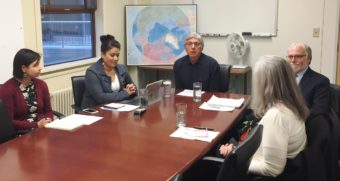
Lt. Gov. Byron Mallott opens the first teleconferenced meeting of a bilateral working group on transboundary mines Dec. 16. Shown are, from the left, Meghan Topkok, First Alaskans Institute; Barbara Blake, senior advisor to Mallott; Mallott; and David Rogers and Jackie Timothy, Department of Fish and Game. (Photo courtesy Governor’s Office.)
Lt. Gov. Byron Mallott opens the first teleconferenced meeting of a bilateral working group on transboundary mines Dec. 16. Shown are, from the left, Meghan Topkok, First Alaskans Institute; Barbara Blake, senior adviser to Mallott; Mallott; and David Rogers and Jackie Timothy, Department of Fish and Game. (Photo courtesy Governor’s Office.)

Alaska and British Columbia are working out details of how they will handle transboundary mine concerns. They’re figuring out how to coordinate the work of monitoring and permitting on both sides of the border.
A statement of cooperation between the state and the province signed in early October promised openness, transparency and increased environmental monitoring.

Now begins the work of meeting those goals.

Lt. Gov. Byron Mallott heads up the state’s effort to address concerns about British Columbia mines near rivers that flow into Southeast Alaska.

He said state and provincial officials met via teleconference meeting Dec. 16.

“We’re trying to create a big tent here, but with a very specific process of engagement and sharing and review and critical examination of all those things that we need to,” he said.

The state’s Department of Environmental Conservation will address water-quality concerns. Terri Lomax is a manager in the agency’s Monitoring and Assessment Program.

“We, of course, can do our testing on the Alaska side and we’re hoping our B.C. counterparts can do testing on the British Columbia side, but that hasn’t been determined yet,” she said.

Testing will create a record of what’s in transboundary river water now — with an eye toward changes that could threaten fisheries, wildlife and people.

“Some of the groups that are already doing monitoring are collecting water and sediment contaminates of concern, specifically like trace metals. That kind of information is going to really help us in deciding how to narrow down our focus and … how to pick the right parameters and methods to be looking at,” she said.

Those other groups include tribal governments in Southeast Alaska and northwest British Columbia. They’ll be asked to help develop the regionwide monitoring program.

8-26-15 B.C. Mines Minister Bill Bennett discusses the week's mine meetings as Lt. Gov. Byron Mallott and other state officials listen during a Wednesday press conference. (Photo by Ed Schoenfeld, CoastAlaska News)
B.C. Mines Minister Bill Bennett discusses transboundary mining as Lt. Gov. Byron Mallott and other state officials listen during a 2015 press conference. (Photo by Ed Schoenfeld, CoastAlaska News)

Other state agencies will work on protocols for input into B.C.’s permitting process.

Mallott said the state will also develop a website to share information about transboundary mines.

“You can never say nothing will drop through the cracks,” he said. “But at least we will have a process and a working relationship that is stronger and more focused and with a value construct that did not exist before.”

The state’s efforts accelerated last year after environmental, fisheries, tribal and community leaders pushed for active engagement with B.C. leaders.

One mine, the Red Chris, began operations in the Stikine River watershed last year. Another, the Tulsequah Chief, is closed and leaking pollutants into the Taku watershed. A half-dozen to a dozen others are being explored or considered for development.

Guy Archibald works with Inside Passage Waterkeeper and the Southeast Alaska Conservation Council.

“I think the process itself is helping make things safe. Any time Alaska and B.C. can communicate on these projects to each other and ask for expertise, I think is constructive,” he said.

But he said the state needs to do more than monitor water quality or put information on a new website. He said it needs to worry about more than mines. For example: new dams.

“Anything that brings the cost down for developing these mines, such as access to hydropower, makes their development that much more likely,” he said.

Other mine critics also say the state’s agreement with B.C. needs to go further.

Salmon Beyond Borders' Heather Hardcastle reacts to the week's mining meetings while Rivers Without Borders' Chris Zimmer, center, and the Douglas Indian Association's John Morris listen. (Photo by Ed Schoenfeld/ CoastAlaska News)
Salmon Beyond Borders’ Heather Hardcastle speaks during a panel including Rivers Without Borders’ Chris Zimmer, center, and the Douglas Indian Association’s John Morris in 2015. (Photo by Ed Schoenfeld/ CoastAlaska News)

Fisheries business owner Heather Hardcastle is with the group Salmon Beyond Borders.

“We would like to see enforceable protections and financial assurances that we will not be negatively impacted by upstream mining in British Columbia. And I still don’t see how the state of Alaska is pushing for those,” she said.

Hardcastle said future meetings following up on the transboundary agreement should be advertised and made open to the public.

State officials say more details will be available in January.

Mallott said a meeting of stakeholders, including mine critics, will happen within the next six months.

Salmon Beyond Borders and other groups continue to pursue federal involvement in the issue.

Hardcastle points to a longtime goal of invoking part of a treaty that governs U.S- Canada water conflicts.

“One way to get closer to such an agreement would be for the International Joint Commission to get involved,” she said. “But at this point we’d like to see any sort of true federal engagement on this issue and we just haven’t yet.”

Mallott said that’s on his agenda when he heads to Washington, D.C. And federal officials have been responsive, to a point.

In a prepared statement, British Columbia officials said the province will share equal responsibilities under the agreement. That includes water-quality monitoring.

They say tribal governments, called First Nations in Canada, will participate, as will the mining industry.

Budget leaves ferry schedule as is, for now

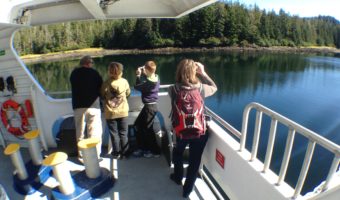
Passengers enjoy the scenery during a Sept. 3 fast ferry Chenega sailing between Sitka and Juneau. Sitka would lose most of its ferry service under a schedule based on a reduced budget proposed by Gov. Bill Walker. (Photo by Ed Schoenfeld/CoastAlaska News)
Passengers enjoy the scenery during a late summer fast ferry sailing between Sitka and Juneau. Budget cuts have reduced such runs. But the cuts may be leveling out. (Photo by Ed Schoenfeld/CoastAlaska News)

Gov. Bill Walker’s newly released operating budget requires no changes to the Alaska Marine Highway’s scheduled sailings.

Walker’s spending plan for the fiscal year beginning in July proposes a $2.8 million, or 2 percent, budget cut.
Spokesman Jeremy Woodrow said that came as no surprise to ferry schedulers.

“The proposed FY18 budget that was released by Gov. Walker reflects the ferry schedule that was proposed and issued and is up for reservations currently. So the passengers and customers can expect to see ferry service unaltered through the summer season,” he said.

When Walker released his spending plan Thursday, he began a months-long process of legislative debate. Final budget numbers won’t be known until the end of the session.

Woodrow said additional cuts would reduce future sailings.

“Those changes would likely be reflected in next winter’s ferry schedule or the following summer’s schedule, which does contain part of fiscal year 2018 in it,” he said.

Budget documents show the proposed cuts will eliminate about 180 marine highway jobs. That’s about a 14 percent reduction, comparing full-time equivalent positions.

The documents also indicate some jobs would be created when new Alaska Class Ferries go into service during the next budget year.

Woodrow said those jobs were assigned to the ferries Taku and Chenega, which are no longer being used.

“Most of those are unfilled. There’s a few of them where there’s actually positions staying. But there’s enough vacancies currently within the fleet for people to move into different positions on other ships,” he said.

The marine highway operates nine ferries serving 35 communities in the Southeast, Southcentral and Southwest parts of the state. That doesn’t include the two ships taken out of service.

Congress boosts plans for new Craig boat harbor

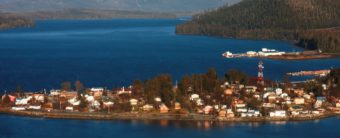
Craig, on Prince of Wales Island, is a large step closer to building a new boat harbor. (Photo courtesy Bob Claus)

A bill on its way to the president’s desk authorizes most of the money needed to build a new boat harbor in Craig. But the funding itself will wait for future congressional action.
The legislation includes about $29 million for the harbor in Prince of Wales Island’s largest city.

Craig City Administrator Jon Bolling said that’s the cost of planning and installing large breakwaters.

One conceptual draft of the design for a new Craig boat harbor. (U.S. Army Corps of Engineers image)

“They’re high-cost items. And they need to be in place first before any floats are constructed because the site is too exposed to add a float system in without the protection of the breakwaters,” he said.

About another $3 million in state and local funds are needed to install floats and related infrastructure.

The authorization comes from the Water Infrastructure Improvements Act, which passed the U.S. Senate on Saturday. It already passed the U.S. House.

It also authorizes federal spending for other Alaska projects, including harbor work at Elfin Cove, Valdez, Little Diomede and St. George.

Bolling said there’s only a preliminary harbor design. But it will include room for commercial and private boats of various sizes.

“It’s a mix of long, open runs of floats and conventional slips for various boat sizes from smaller boat length of 20 feet up to 60 feet long or greater,” he said.

Alaska’s congressional delegation pushed to include the funding authorization in the water bill.

Bolling said it’s a very important step toward construction.

Craig already has about 220 slips, plus transient moorage, in two existing harbors. The new harbor will be built at the old Craig Cannery site.

Engine trouble delays Alaska ferry Matanuska

The ferries Matanuska, right, and Fairweather, left, tie up at Juneau's Auke Bay Ferry Terminal May 19. 2016. (Photo by Ed Schoenfeld/CoastAlaska News)
The ferry Matanuska, right, docks at Juneau’s Auke Bay Ferry Terminal  earlier this year. It’s running late for a week after an engine problem caused a delay. (Photo by Ed Schoenfeld/CoastAlaska News)

The ferry Matanuska is sailing an altered schedule for about a week due to mechanical problems.

It will delay Juneau-to-Prince-Rupert sailings, which include stops in Hoonah, Sitka, Kake, Wrangell, Petersburg and Ketchikan. Haines is also affected.

Alaska Marine Highway spokesman Jeremy Woodrow said the problem is with one of the Matanuska’s two main engines.

“It wasn’t major but it was significant enough that the vessel had to only use one engine transiting from Wrangell to Ketchikan. That put the vessel behind schedule,” he said.

The ferry Matanuska docks in Wrangell, giving a passenger a chance to make a cell phone call. (Ed Schoenfeld/ CoastAlaska News)
The ferry Matanuska docks in Wrangell, giving a passenger a chance to make a cell phone call. (Photo by Ed Schoenfeld/CoastAlaska News)

“Then, when they arrived in Ketchikan they were able to repair the part overnight and then continue on their schedule.”

The ferry left Ketchikan on Monday about 12 hours behind schedule. That will delay port calls until Dec. 20. Woodrow said no Matanuska stops are being canceled.

The ferry carries up to 450 passengers and 85 vehicles. The 400-foot-long ship is more than 50 years old.

The Matanuska schedule includes a Saturday, Dec. 17, Christmas break shopping run from Kake to Juneau.

“That was noted in this schedule for Kake customers to see that that service is still planned to be delivered. Just a little bit behind schedule than previously was posted,” Woodrow said.

He said the run is similar to other special sailings for events, such as local festivals and basketball tournaments.

Site notifications
Update notification options
Subscribe to notifications