Patrick Holland got the call late Thursday telling him a heart was available, and he went into surgery at University of Washington Medical Center, said his wife, Haley Holland.
“ Now we can look forward to 10 years together, 20, 30 — I joke about wanting to see our 45th wedding anniversary,” she said.
The Hollands were married in 2006. They have four children together, all of whom were able to fly down on Friday, while Patrick was in the operating room.
“We landed at seven o’clock in the morning — we landed like 15 minutes early and at like 7:06 the surgeon calls me and says that surgery’s done,” Haley Holland said.
This was long-awaited news. Holland, 57, has had congestive heart failure since his late 20s. Three years ago, doctors told him he needed a transplant.
Many Alaskans heard Holland’s story last winter. The medical center told him Dec. 22 that a heart that was a perfect match was waiting for him in Seattle. He and his brother boarded a plane out of Fairbanks early the next morning, but it was diverted from Seattle by a terrible ice storm, and the plane turned around and landed in Anchorage. Holland had to let that heart go to another person on the transplant list. That week, he said, he decided to move to Seattle.
“Because I’m not gonna miss another chance; it’s not going to happen,” Patrick Holland said.
Holland has been living with a couple in Seattle’s Capitol Hill neighborhood close to the hospital for the last three months, while Haley and the kids stayed in North Pole. He tried to keep active.
“ You know, he came down here and got a part-time job working with clients with severe dementia. That’s just what he has a heart for,” Haley Holland said.
Since January, there were three times when he was called to the transplant center to receive a new heart, but they all fell through. Once before in March, Haley and the kids flew in only to hear the operation would not happen.
“We have been completely knocked askew with every aspect of our life,” Haley Holland said.
Since the transplant, she said she has been able to visit twice a day, and has had the children, ages 4 to 17, in, one or two at a time. She is learning what comes next.
“Well, it has just been replaced by a different uncertainty. Getting a heart transplant is replacing one disease with another,” she said.
She said she knows some patients don’t live to recover. There are rejection and complications.
“And that’s the life we’re facing now,” Haley Holland said.
Patrick Holland won’t be coming home to North Pole for several months. He’ll be in an ICU for three to four weeks, then move to a recovery facility called Transplant House for three to four months of occupational and physical therapy and cardiac rehabilitation.
Haley Holland anticipates being in Seattle about two more weeks for this trip.
“There is nothing different about being here from being at home in terms of laundry and dishes and feeding the kids and occupying their time,” she said. “Having the kids with me is probably the only thing keeping me from turning into a puddle of tears. I’m making sure that this is an adventure for them and not a traumatizing experience.”
She said she has much to be thankful for, and reminds people to register as organ donors.
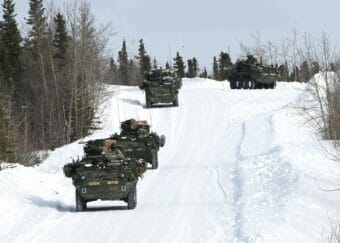
A group of Army vehicles travel along the Richardson Highway last year en route to the Donnelly Training Area near Fort Greely, where Joint Pacific Multinational Readiness Center-Alaska training exercises have been conducted in recent years. (Alexander Johnson/U.S. Army/DVIDS)
The Alaska-based 11th Airborne Division will host its first large-scale training exercise next week on ranges around Fort Wainwright and Eielson Air Force Base. That means more than 500 Army vehicles that’ll take part in the exercise will be traveling on the Parks Highway and the northernmost stretch of the Richardson Highway.
The exercise is called the Joint Pacific Multinational Readiness Center-Alaska, and this year it’ll be hosted by the 11th Airborne Division — not U.S. Army Alaska. That’s because the Army de-activated USARAK last summer and reactivated the 11th Airborne to assume command of Army Alaska-based troops and assets.
Paratroopers with the 1st Battalion, 501st Parachute Infantry Regiment, a unit that’s part of 4th Brigade, 25th Infantry Division formerly assigned to United States Army Alaska, conduct a Joint Forcible Entry Operation onto Donnelly Drop Zone near Fort Greely as part of last year’s Joint Pacific Multinational Readiness Center exercise. (Christopher B. Dennis/U.S. Army/DVIDS)
Observers have for years pointed out that Alaska-based soldiers frequently were deployed to faraway conflict zones in hot, arid places like Afghanistan and Iraq. Pennell says those rotations hindered the soldiers’ familiarity of how to operate in Arctic.
“We lost a lot of that knowledge, a lot of that ability, during the 20 years (when) we were focused primarily on rotating in to the global war on terrorism,” he said in an interview last week.
Another change in the exercise this year is the venue.
“The primary training area is going to be the Yukon Training Area, closer to Eielson Air Force, as opposed to the Donnelly Training Area, down near Fort Greely,” he said.
Army officials decided to move the exercises to the Yukon Training Area to determine whether it can accommodate large numbers of troops and equipment, he added. Some 8,000 soldiers and more than 500 military vehicles will take part in the exercise.
“In the past, we haven’t used it for this kind of a large-scale exercise,” he said. “So we’re wanting to put that area through its paces, as well as our forces.”
Pennell says participants in this year’s exercise will include special operations personnel, trainers from the Joint Readiness Training Center in Louisiana, and observers and soldiers with allied nations from Canada, Europe and Japan.
Trucks transporting troops and materiel for paratroopers with the 725th Brigade Support Battalion, 4th Infantry Brigade Combat Team (Airborne), 25th Infantry Division, stage near the Donnelly Training Area in preparation for last year’s Joint Pacific Readiness Multinational Readiness Center. (DVIDS/U.S. Army)
Military-vehicle traffic around Fairbanks, Parks Highway through April 6
Staging the exercises in the Yukon Training Area will mean the soldiers and equipment from Joint Base Elmendorf Richardson mainly will be traveling to and from Fort Wainwright over the Parks Highway and the northernmost 30 miles of the Richardson Highway.
“That doesn’t mean that you might not see a military vehicle over on the Rich,” he said, “but the Parks is our primary means of getting there.”
Convoys from JBER started rolling toward Fort Wainwright over the Parks Highway on Wednesday, and they’ll travel from Wainwright to the Yukon Training Area near Eielson and back over the Richardson Highway beginning next Wednesday. They’ll begin returning to JBER the following week, on April 6.
This computer-generated 3D model of Venus’ surface shows the summit of Maat Mons, the volcano that is exhibiting signs of activity. A new study found one of Maat Mons’ vents became enlarged and changed shape over an eight-month period in 1991, indicating an eruptive event occurred. (NASA/JPL-Caltech)
A University of Alaska Fairbanks scientist has found evidence of relatively recent volcanic activity on Venus. UAF Geophysical Institute professor Robert Herrick reviewed radar imagery of the surface of Venus collected over eight months in 1991 by NASA’s Magellan spacecraft and found evidence of lava flow at a vent on Venus’s largest volcano: Maat Mons.
“Not only is it 9 kilometers high, it covers an area that is over a thousand kilometers across, so we’re looking at a very small part of a gigantic volcano,” Herrick said.
A paper outlining the discovery was presented at the Lunar and Planetary Science Conference happening this week in Texas. Speaking during a press conference Wednesday, Herrick explained the time lag between collection of Venus imagery by Magellan and the identification of active lava flow on Maat Mons. He said the ability to screen the vast amount of imagery gathered by Magellan was initially limited by technology.
“The type of analysis that resulted in this discovery, really required the ability to pan around few hundred gigabyte data sets and zoom in and out,” he said.
Herrick’s co-author, NASA’a Scott Hensley, emphasized that there’s no algorithm to search out the geographic changes caused by lava flow.
“This is still a manual task,” he said. “So you do need that new technology for displaying things because we can’t write mathematical code that can search through all the data to find that.”
Herrick and Hensley’s research, which was published Wednesday in the journal Science, adds Venus to a short list of bodies in our solar system known to be volcanically active. Herrick says future Venus observation missions will likely document volcanic flows that have happened since those seen in the images captured by Magellan over 30 years ago.
University of Alaska Fairbanks Ph. D. student Kyle Smith services a seismic sensor in 2018 on the bank of the Tanana River in the Minto Flats area. (Photo by Carl Tape/UAF Geophysical Institute)
Earthquakes in the Nenana Basin in Interior Alaska last longer and feel much stronger than quakes of comparable magnitude in other places.
University of Alaska Fairbanks scientists are studying why.
It’s all about the reverberation.
Below the beautiful lakes and swamps in the Minto Flats region is a giant bowl, and it’s filled with gravel. UAF Geophysical Institute seismology professor Carl Tape said to imagine the flat surface of the land like the surface of the ocean, and if you removed the water, you’d see interesting things revealed.
“If you remove all this dirt that’s been deposited, there’s a lot of interesting features,” he said. “These deep bowls, depression, exists west of the town of Nenana, where the Tanana River kind of takes a turn and flows north, toward the Minto Flats area before it goes west and eventually into the Yukon. So in that area of Minto Flats, what looks very flat and normal at the surface has a lot of really interesting features beneath.”
Tape worked with graduate student Kyle Smith, placing 13 seismic monitors across the area over four years, from 2015 to 2019. In that time, they collected data from 48 local and regional earthquakes. The monitors, the first seismic stations installed in Minto Flats, are part of the Fault Locations and Alaska Tectonics from Seismicity project funded by the National Science Foundation.
“That area has not been really studied that much,” said Smith. “And we wanted to know how the basin moved, because people want to do a lot of projects in that region. So it’s good to know what happens when there’s a big earthquake.”
They found that the seismic waves get amplified as they bounce back and forth off the sides and bottom of the sedimentary basin. So people in the flats perceive the earthquakes as bigger than they actually are. They also incorporated discussions with people who live and work in Minto into their research.
University of Alaska Fairbanks Ph. D. student Kyle Smith installs a seismic sensor in 2015 in the Minto Flats area. (Photo by Carl Tape/UAF Geophysical Institute)
The basin west of Nenana and south of Minto is 56 miles long and 7.5 miles wide. It was filled in over millions of years with sediment brought by the rivers from the Alaska Range. Smith said it could be the deepest such basin in Alaska.
“ It’s up to seven kilometers deep, so that maybe about four miles,” Smith said.
That is deeper than Denali is high.
Map of the Nenana Basin and Minto Flats fault zone. Triangles show seismic stations that operated from 2015 to 2019 in the Tape/Smith study. (UAF Geophysical Institute)
The seismic monitors recorded earthquakes lasting longer on the gravel-filled basin than on harder ground. Both Tape and Smith noted the measured difference between the Nenana Ridge under the Parks Highway, and the flats below.
“The ridge between Nenana and Fairbanks, when you drive along that, you’re high up on pretty close to rock. The ground moves very differently in that kind of material than it does down in Minto Flats.”
“There’s certain places that, because of the exceptional topography below ground in this case, is big basin Bowl amplifies the ground motion and makes it last longer. And we know that because we put the stations out there to record earthquakes,” Tape said.
“The shaking is like 10 times less compared to if you were just downhill from that. So it’s pretty amazing how stark the difference is caused by whatever the underlying geology is,” Smith said.
Smith was raised in the Navajo Nation, got his Ph. D. at UAF, and is on a new research assignment in Taiwan.
Tape said many UAF scientists are targeting the basin for research.
“But the same features are what led, you know, like Doyon, for example, to drill exploratory wells and acquire geophysical data because of the prospects for oil and gas,” Tape said.
Although the research shows how the ground would likely move during certain kinds of earthquakes, Smith cautions that actually predicting earthquakes is a long way off.
“ We will have a better idea of how much the ground will be shaking from some kind of earthquakes, but that doesn’t tell us when and where the earthquake is occurring,” Smith said.
Smith will give a talk on the research at Sandia National Laboratories in May.
Daylight fades in Fairbanks in this view from Golden Heart Plaza downtown. (Marc Lester/Anchorage Daily News)
A man’s death while sleeping outside in Fairbanks a few days before Christmas, when the windchill was around 50 below, has highlighted a disturbing fact about Alaska’s second-largest city.
Fairbanks has no low-barrier shelter for people experiencing homelessness. Advocates say that leaves a gaping hole in the already-thin safety net Fairbanks has to help the unhoused survive winter in the coldest city of its size in the country.
ADN reporter Michelle Theriault Boots says 55-year-old Charles Ahkiviana’s death, in a snowbank not far from a grocery store, brought into focus a difficult truth, that living unhoused in Fairbanks can be deadly.
Listen:
The following transcript has been lightly edited for clarity.
Michelle Theriault Boots: It was just a clear case of, this person died because they were exposed to the elements. And I think it was just one of those things that we all kind of know, on some level, happens. But it was just put in such stark terms that it was hard to ignore. You know, this unhoused man died in a snowbank in weather that really no one can survive outside. And, you know, there were a lot of questions. Did he try to seek shelter? What was he doing out there? That’s what got us interested in looking. And talking to a few advocates up there, we found out that there is no, I guess what people in Anchorage might consider, a low-barrier shelter, a place where just anybody, regardless of if they’ve had some something to drink, if they’re on a substance, that anybody can just walk into and seek shelter for the night. And so that combination of weather that is deadly, frequently, and no low-barrier shelter, just got us curious. So we decided to go up there and see for ourselves.
Charles Ahkiviana, who lived unhoused in Fairbanks for years, died in December 2022. Troopers say his body was discovered in a snowbank. (Courtesy Kiatcha Nyquist)
Casey Grove: What does that mean to not have a low-barrier shelter? And, I mean, we’re sitting here in Anchorage, it’s not like Anchorage has done a great job of helping folks that are unhoused either, but there is a difference between those types of shelters, right?
Michelle Theriault Boots: Yeah. Fairbanks has something called the Fairbanks Rescue Mission, which is a very established organization. But there are some pretty stringent rules and guidelines you have to meet to get in the door. And that includes taking a breathalyzer and being sober — 0.0 sober — and taking a drug test to see if you’re on drugs. So they don’t allow people who are on any kind of substance, and that, you know, advocates would say, that’s a lot of the people who are seeking shelter. That’s a lot of the people who are, kind of, remain chronically unhoused or homeless in Fairbanks. And so while everybody agrees, or seems to agree, that the Fairbanks Rescue Mission does a lot of good and important work, advocates say there’s a huge hole in that safety net. And that would be a low-barrier shelter that accepts anybody. You can walk in anytime of night and day and just take refuge from the cold.
Casey Grove: And you were partnered up with photojournalist Marc Lester with the Anchorage Daily News. You and Marc went with folks to see how they were surviving in Fairbanks as unhoused folks, and Marc took some amazing photos that are a huge contribution to telling that story, I think. But describe it for me, you know, for the radio listeners, what did you see? What kind of things were people doing to survive?
Michelle Theriault Boots: Yeah, I mean, first we saw some tent encampments, where people had set up camps in, you know, greenbelts, little patches of forest. We were also taken to an abandoned house where people were squatting. It was just filled with stuff, filled with belongings probably. Who knows how many people had gone through there. It was dark, but it was somehow being heated, or an attempt was made to heat it, with just leaving the oven door open. And that looked like a pretty rough way to live. And then we talked to a guy named Scott who just described walking around all night. You know, people try to have bunny boots or as warm of shoes and coat as they can, and then they just keep moving, just constant motion. And then also, the strange logic is that to get into the sobering center, which is a warm, safe overnight place, you have to be drunk. And to get into the mission, you have to be sober. So a few people pointed that out to us, that those are the two options. And we really saw a lot of different attempts being made to provide safe shelter for people, but the system just isn’t developed enough to have, I guess, fully what’s needed.
Casey Grove: And speaking of the services like that, that people are able to provide in Fairbanks, you talked to the folks at the soup kitchen there. And there was a part in that story about how someone there told you, in terms of how these people are suffering, they just said look around, right? Tell me about that.
Michelle Theriault Boots: Yeah, I mean, the chef, Matt said, “Look around. A lot of the people who are here for breakfast are missing fingers due to frostbite.” It’s hard to imagine a more rugged, difficult place to be homeless, honestly, than Fairbanks. And the people we met, especially the unhoused people we met, who were very generous in talking with us and showing us how they live. Really, that’s true. It takes constant, kind of ingenious, hard work to be homeless in Fairbanks and to survive, and the climate is just so unforgiving. That margin between living a night and dying is, it’s really small, and I think that’s always on people’s minds.
Casey Grove: Yeah. And like you said before, what a lot of folks are saying is needed is a low-barrier shelter. So what’s going to happen with that? Are they on the path to getting something like that? Or no? What do you think?
Michelle Theriault Boots: You know, it sounded like there was some reason to think that things were moving in that direction. The City of Fairbanks has a housing coordinator who would really like to see a low-barrier shelter of some kind, but it’s not something that I think the city is going to take on itself, as has happened in Anchorage. And we have to remember in Anchorage, that’s a relatively recent development that only really happened during the beginning of the COVID pandemic. But I think that there’s an increasing understanding that what’s available is not sufficient.
Casey Grove: Gotcha. Yeah. You describe talking to these folks out in the street, you know, the guy that you mentioned that, to stay warm, would walk all night long. And they’re in a real risky situation, of course, and I wondered, as a reporter, we’re not supposed to get like, emotionally involved or invested or whatever. But did you wonder if that guy was gonna make it through the winter?
Michelle Theriault Boots: Oh, absolutely. I mean, I think every person that we talked to, people who were, again, generous with their time and kind to talk to us, you know, there’s always that thought and worry in the back of your mind. None of them really knew where they were going to spend that night. And so it’s impossible to know what the future holds. But I hope for the best for all of them. And I also know that some of the toughest people on the planet are people who are unsheltered in Fairbanks, Alaska, and finding a way to live and make it work.
A Fairbanks raven looks down on an observer at the Shopper Forum Mall in May 2020. (Photo by Hannah Foss/UAF)
Be careful what you say, ravens. Doug Wacker is listening to you.
Wacker studies animal behavior at the University of Washington Bothell. Since August 2022, he has been in Fairbanks, following ravens. When he hears them vocalizing, Wacker points at the big, black birds with a microphone attached to a plastic dish that resembles a giant contact lens.
Wacker is recording as much raven talk as he can in Fairbanks. He wants to find meaning, if any, in the squawks, rattles and water-droplet/computer sounds that so often come from those black beaks.
Many of Wacker’s recordings are the voices of members of the greatest local congregation of ravens he has found so far — at the Fairbanks dump.
“I never thought I would go do an academic sabbatical in a landfill,” Wacker said during a recent presentation.
Wacker wonders if there is any pattern in the array of sounds that come from a raven’s mouth. Over the years, researchers have identified up to 116 different vocalizations from ravens.
Doug Wacker walks a Fairbanks road last fall while pursuing ravens, the voices of which he is recording. (Photo by Kim Wacker.)
Though scientists who study ravens have debated that number, William Boarman and Bernd Heinrich described a few types of specific calls in a raven description they wrote for the Cornell Lab of Ornithology’s Birds of North America. The distinct calls were begging, vocal play, predatory alarms, demonstrative calls, knocking, comfort sounds, chase calls and mimicry.
Wacker is now recording the sounds of ravens (and their present cohorts bald eagles) at the Fairbanks landfill 24 hours a day. He is also recording at many other places opportunistically.
Wacker wants to further decode raven calls using machine learning, which he describes as using a computer to look for patterns.
He said humans are biased in their descriptions of sounds, noting that scientists have described the same call ravens use to announce they have found food as an aw, a kow, a ky and as a yell.
“We’re all calling the same call something different,” Wacker said.
He looks at raven calls with spectrograms — visual displays with colored peaks and valleys that spill over his computer screen. These allow him to compare the sounds using his eyes as well as his ears. For example, he can measure with precision the length of a raven’s call and the time between syllables.
A raven vocalizes on the west side of Fairbanks in April 2021. (Photo by Hannah Foss/UAF)
He hopes that as he uploads snippets of Fairbanks raven chatter, the machine-learning computer will separate raven calls into categories he would not have come up with himself.
For now, Wacker taps his brake and steps outside his car near Wendy’s, where he records ravens talking over the traffic on Airport Way.
With the help of artificial intelligence, he might gather enough raven talk during his sabbatical year to help us humans come up with a better idea of how our dumpster companions are communicating.
Which raises a question: Do we really want to know what ravens are saying about us?
Close
Update notification options
Subscribe to notifications
Subscribe
Get notifications about news related to the topics you care about. You can unsubscribe anytime.