Interior

Walker picks Fairbanks Four lawyer to serve as attorney general

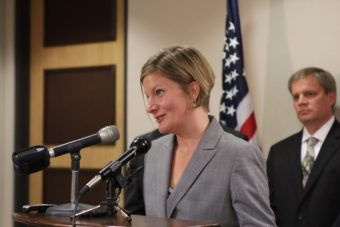
Jahna Lindemuth was named Alaska's attorney general by Gov. Bill Walker. (Photo by Graelyn Brashear/Alaska Public Media)
Jahna Lindemuth was named Alaska’s attorney general by Gov. Bill Walker. (Photo by Graelyn Brashear/Alaska Public Media)

Gov. Bill Walker announced Tuesday that Jahna Lindemuth will be Alaska’s next attorney general.

She replaces Craig Richards, who resigned abruptly last week.

Walker has announced four new cabinet members since mid-April. The vacancies began in February, when the education and natural resources commissioners resigned.

Walker praised Lindemuth’s professional success. He also pointed to her commitment to the state as a lifelong Alaskan, and as someone who’s done pro-bono work with the law firm Dorsey & Whitney on cases like the Fairbanks Four. That was the case of three Alaska Native men and a fourth Native American man who were convicted in a 1997 murder and were released last year after a judge vacated their convictions.

“Her passion for Alaska is really what I was struck by,” Walker said.

Lindemuth, an Anchorage resident, said her work on the Fairbanks Four case is among the most meaningful she’s done in her life. She also says she’s committed to justice for all Alaskans and it’s important to keep in mind that there are real people affected by every legal decision.

“I really am truly honored to be a part of that case,” she said. “I truly believe in the innocence of those four men and I’m really happy that they’re out of prison now and enjoying life like the rest of us.”

Walker considered Lindemuth for the Supreme Court seat that he named Susan Carney to in May. Lindemuth has represented Cook Inlet Region Inc., Arctic Slope Regional Corp. and ConocoPhillips Alaska.

Lindemuth stayed away from saying what her priorities would be as attorney general. She said it’s too soon – Walker only contacted her about the job late last week, after Richards resigned.
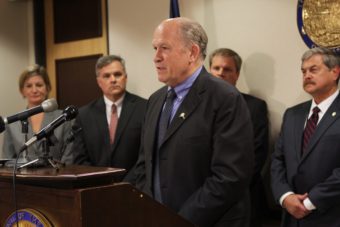
Gov. Bill Walker with (l-r) Jahna Lindemuth, Andy Mack, Michael Johnson and Walt Monegan
Gov. Bill Walker speaks, with Jahna Lindemuth, Andy Mack, Michael Johnson and Walt Monegan behind him.(Photo by Graelyn Brashear/Alaska Public Media)

Walker also introduced three other cabinet members who he’d previously announced: Natural Resources Commissioner Andy Mack, Public Safety Commissioner Walt Monegan, and Education Commissioner Michael Johnson.

Mack comes from private equity fund PT Capital. Monegan is a former public safety commissioner and was most recently the acting corrections commissioner.  And Johnson served as Copper River School District superintendent in Glennallen.

Mack said the state should be playing offense in making plans for projects like the proposed natural gas line.

Alaska Public Media’s Graelyn Brashear contributed to this report.
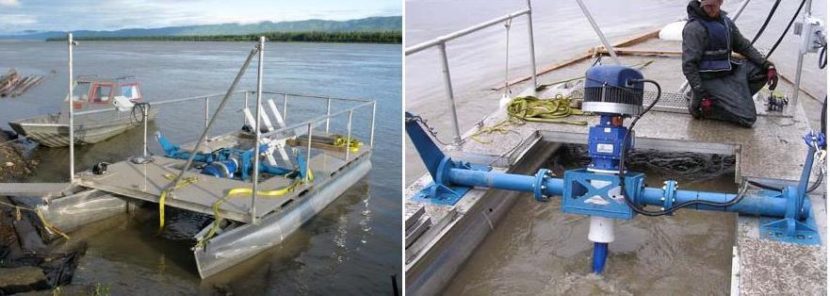
Further testing could bring hydropower to more Alaska villages

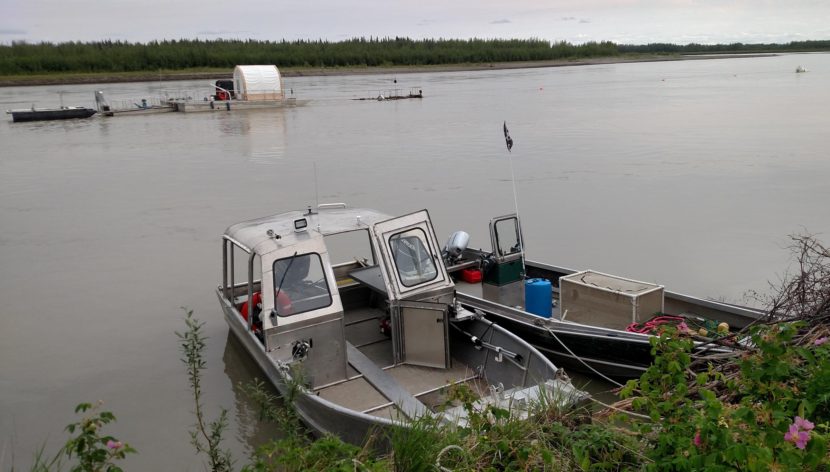
Left, the hydrokinetic turbine tested in Eagle shown laying on the deck of its platform barge and, right, submerged into the Yukon River. (Photos courtesy of New Energy Corp.)

Ever since researchers began field-testing in Alaska with small hydropower systems that generate electricity with a turbine submerged in a river, they’ve had to deal with such real-world setbacks as the generators getting hammered by logs carried along in the river’s current.

That’s what happened to hydrokinetic generators soon after they were submerged in the Yukon River at Ruby in 2008 and Eagle in 2010. But Jeremy Kasper and other researchers with the Alaska Center for Energy and Power say lessons learned from those tests helped them develop a structure called a “debris diverter” to protect the generators.

“It’s a big step forward,” he said. “I think it really opens up a lot of opportunities that kind of had shut the door after Ruby and Eagle.”

Kasper and his team working at a test site in Nenana are now focusing attention on other problems that have held back development of hydrokinetic-generating systems, which hold the promise of both providing renewable energy to remote communities and off-setting the cost of generating power with diesel-fueled generators – fuel that can cost 10 dollars a gallon, or more, in the Bush.

“The real issue is technological,” he said. “We’ve got to overcome these technological hurdles. And then we can start driving down the cost of energy.”

Most of those hurdles were cleared before the field tests in the Power Systems Integration Laboratory, a facility at the University of Alaska Fairbanks managed by the Alaska Center for Energy and Power, or ACEP.

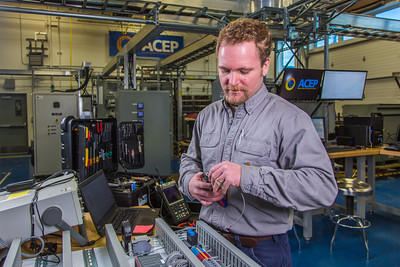
Marc Mueller-Stoffels, program director of ACEP's Power Systems Integration Program, in the Power Systems Integration Laboratory. He's also a research assistant professor with UAF's Institute of Northern Engineering. (Photo courtesy of the University of Alaska Fairbanks)
Marc Mueller-Stoffels, program director of ACEP’s Power Systems Integration Program, in the Power Systems Integration Laboratory. He’s also a research assistant professor with UAF’s Institute of Northern Engineering. (Photo courtesy of the University of Alaska Fairbanks)

“We see ourselves as kind of a last stop for technology before it can go for a long-term test deployment,” says Marc Mueller-Stoffels, who directs ACEP’s power systems integration program. The program tests systems that generate electricity from such renewable-energy sources as hydro, wind and solar and then helps develop technologies to integrate that power into remote communities’ microgrids.

“By troubleshooting a lot of the R&D issues in a laboratory’s controlled settings, we can create the worst-case conditions and see how the system interacts with the typical components of a grid,” he said.

Mueller-Stoffels says hydrokinetic technology is promising but needs more development before its industry is likely to begin manufacturing and marketing river-powered generators on a scale that will make such systems reliable and affordable – like what happened in recent years with wind- and solar-energy powered systems.

“I would say roughly the hydrokinetics industry is somewhere where the wind industry was in the ’80s,” he said.

Mueller-Stoffels says hydrokinetic technology developed in Alaska’s rigorous conditions will help researchers design systems that can be used worldwide.

State considers increasing ownership stake in Alaska LNG pipeline project

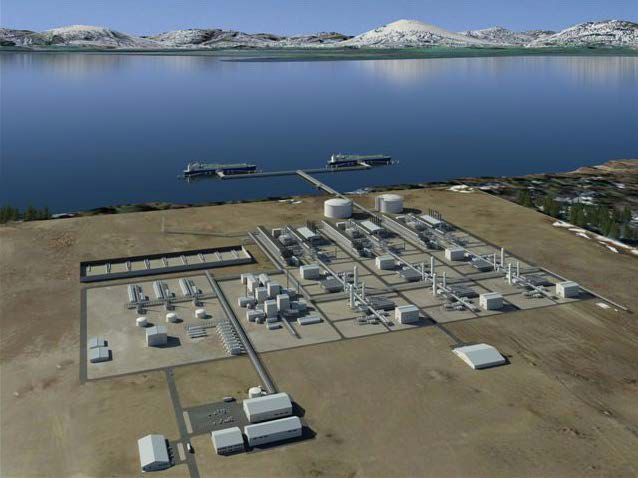
This illustration shows what a liquefaction plant could look like. (Image courtesy of Alaska LNG)
This illustration shows what a liquefaction plant could look like. (Image courtesy Alaska LNG)

Gov. Bill Walker’s administration is considering major changes to the Alaska LNG project, the effort to build a massive natural gas pipeline from the North Slope.

State officials said Tuesday the administration is considering increasing Alaska’s stake in the project — or even taking over ownership completely.

That would be a radical shift from the structure as it’s currently envisioned — and blessed by the legislature. Right now, Alaska holds a 25 percent stake, sharing ownership with the big three North Slope producers: ExxonMobil, BP and ConocoPhillips.

Keith Meyer started work as president of the state-owned Alaska Gasline Development Corp. last week. In an interview Tuesday, he said if the state increases its ownership, it would look for outside investors to fund the project.

“So this is significantly different from the way it was done (to date),” Meyer said. “However, it’s very similar to the way that most of the pipelines in the U.S. have been built, and also the way most of the LNG facilities now have been built.”

Both Meyer and Marty Rutherford, the acting commissioner of the Department of Natural Resources, said Tuesday that the state is discussing the change because the three oil companies have indicated they may not be ready to move the project forward next year as planned, as low oil prices have cut into their bottom lines. The final project is expected to cost $45 to $65 billion.

But both stressed that nothing has been decided, and the state is still in discussions with its three partners.

The administration is set to deliver its quarterly update on the project to the legislature on June 29.

Researchers fine tune mini-hydropower technology in effort to field system in villages

The hydrokinetic turbine being tested by UAF in Nenana is suspended into the Tanana River from the middle of three platforms, at left. The bouy in the upper right marks the point where the barges are anchored to the river bottom. The debris diverter is located between the bouy and barges. (Photo by Tim Ellis/KUAC)

University of Alaska Fairbanks researchers are helping develop small hydropower systems that don’t require building a dam but instead use a turbine anchored into a river to harness the flow of water to generate electricity for remote communities located far off the grid.

But before that could happen, researchers like Jeremy Kasper with the Alaska Center for Energy and Power must solve problems that have held back the development of so-called river hydrokinetic systems.

“There’s a lot of things involved in getting a turbine like this out in the water,” he said in an interview at the turbine test site along the Tanana River near Nenana. “And so we need to demonstrate that we can get these turbines out there for long periods of time.”

Kasper and his team have already solved one problem that’s plagued previous tests – protecting the turbine from being smashed by logs and other driftwood carried along by a river’s flow. The team last year designed and built a steel-frame “debris diverter” that shunts driftwood off to either side.

“Figuring out where things are going to go wrong, and how to prevent them — that’s what’s we’re doing.”

Kasper says they’re now studying how to control fluctuations in electricity generated by the turbine that are caused by the variations in the river’s flow, which makes the turbine’s blades turn at varying speeds.

“The first thought was ‘Oh, it (turbine) is constantly spinning. It’s just a river. It’s constant,’” he said. “Well, it’s not. The power output of these things varies incredibly rapidly. Since they vary so much, it’s actually turning out to be fairly complicated to integrate them into the grid.”

He says researchers are developing a control unit that will stabilize the fluctuating output of electricity.

“Basically, it takes the wildly varying voltage and current coming from the turbine and then conditions it, inverts it – turns it into an AC current.”

Kasper says the control unit is one of many technologies that’ll be required to make small hydrokinetic systems commercially viable and practical for such uses as powering remote communities.

Best ionospheric research station in the world seeks new purpose

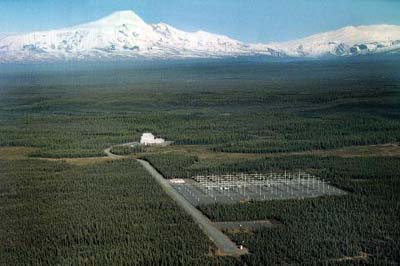
The HAARP facility near Gakona, Alaska. (Wikimedia Commons)

UAF took ownership of the High Frequency Active Auroral Research Program facility in Gakona from the Air Force last summer, and there’s optimism that the station, once destined for scrap, has a future.

The University of Alaska Fairbanks Geophysical Institute is tasked with revitalizing HAARP as a tool for conducting experiments in the earth’s ionosphere. Though the Air Force has completed its HAARP mission, institute director Robert McCoy stresses that the 25-year-old facility on the Tok Off remains the best of 4 ionospheric research stations in the world.

”It was started in ’89, but the final push was only a few years ago so it’s actually fairly new,” McCoy said. “And by a factor of ten it’s more powerful than the other ones around the world. It’s far more flexible than the other ones, so we just gotta get the word out.”

HAARP’s high power radio transmitter and antennas are used to stimulate the ionosphere for communications research and other work. McCoy said that could include testing over-the-horizon radar.

”What HAARP is a big HAM radio,” McCoy said. “And over-the-horizon radios, that’s what they are. Basically big HF (High Frequency) transmitters. So HAARP is flexible enough where the beam can be steered and it can be used in that mode. So we don’t want to use it as an over-the-horizon radar, but we’re talking to NORAD and NORTHCOM about an over-the-horizon test bed. And the problem is up here in the Arctic, the Aurora causes such problems. But HAARP has enough power to overcome the aurora.”

McCoy said that just one of the research possibilities federal agencies have expressed interest in conducting at the HAARP facility.

“The Department of Energy, the Naval Research Lab, DARPA,” McCoy listed. “The National Science Foundation has also come to us and wants to work with us.”

McCoy said the university is still awaiting permits and acquisition of the land the facility sits on in anticipation of demonstrating HAARP’s potential for customers next February. He said UAF has focused on making the $300 million former Navy and Air Force research facility more efficient by combining operations with the university run Poker Flat Rocket Range outside Fairbanks.

”We have a team at Poker costs way down,” McCoy said. “So now we have a smaller team at HAARP. We’ve combined them. As far as the science team, there used to be five people back in DC who would come out to run experiments. Our faculty on the seventh floor of the LV building of space physics, they can now run those experiments. So they’re doing research and they only have to be called on for a short time. So we’ve got those costs way down.”

McCoy said with other measures, like better insulating HAARP buildings, UAF hopes to cut yearly operating costs from $7 million, down to $2 million. The University of Alaska has given the GI 3 years to repay a $2 million start-up loan.

Ellis, Huggins and 2 other state senators won’t seek re-election

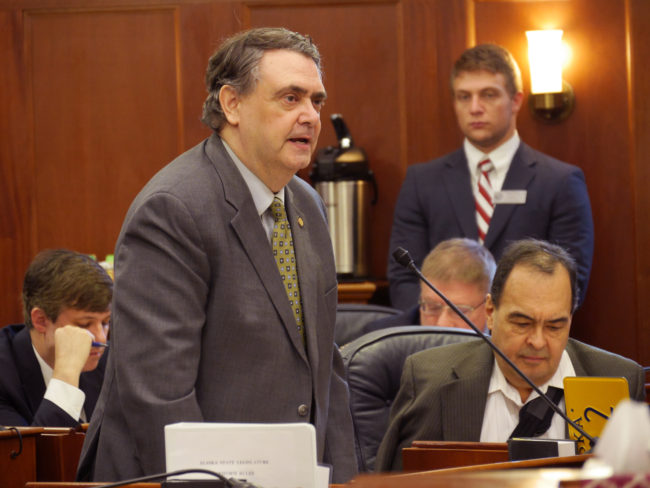
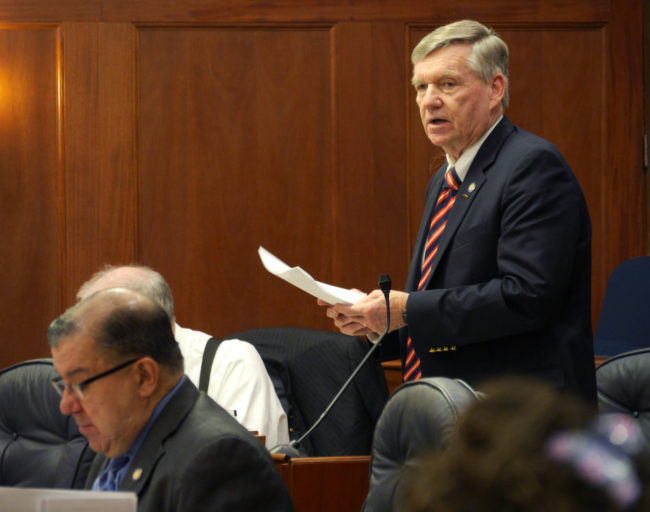
Anchorage Democratic Sen. Johnny Ellis and Wasilla Republican Sen. Charlie Huggins announced they won’t seek re-election.

Ellis and Huggins joined two other senators — Chugiak Republican Bill Stoltze and Anchorage Republican Lesil McGuire — in deciding against running again.

Ellis said he felt a sense of accomplishment from the legislature passing the criminal justice overhaul aimed at reducing recidivism and the number of nonviolent prisoners.

But he also expressed disappointment that the legislature hadn’t passed a plan to improve the state’s fiscal outlook. “I felt … a great sense of frustration about the lack of a fiscal plan – progress on a fiscal plan this year,” Ellis said. “I think it’s a failure of this legislature.”

Democrats Tom Begich and Ed Wesley are running to succeed Ellis. Republicans Wasilla Rep. Lynn Gattis and David Wilson are running for Huggins’ Senate seat.

Palmer Rep. Shelley Hughes is running against Adam Crum and Steve St. Clair for the Republican nomination to succeed Stoltze. The winner will face Democrat Samantha Laudert-Rodgers and nonpartisan candidate Tim Hale.

Anchorage Rep. Craig Johnson will face Jeffrey Landfield and Natasha Von Imhof for the Republican nomination to replace McGuire. Roselynn Cacy and Forrest McDonald are competing for the Democratic nomination for the seat, while nonpartisan candidate Tom Johnson also is seeking to succeed McGuire.

In addition to the three representatives who are seeking to move up to the Senate – Gattis, Hughes, and Johnson – two other Republicans aren’t running for re-election to the House. They are Mike Hawker of Anchorage and Kurt Olson of Soldotna.

Site notifications
Update notification options
Subscribe to notifications