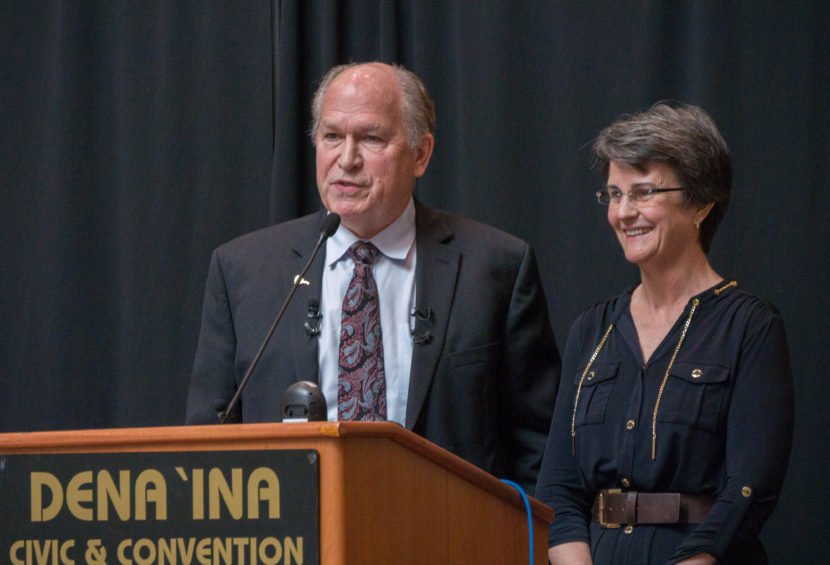
Gov. Bill Walker announces Susan Carney’s appointmentt to Alaska Supreme Court an Alaska Bar Association’s annual convention, May 12, 2016. (Photo courtesy Alaska Governor’s Office)
Gov. Bill Walker has appointed defense attorney Susan M. Carney of Fairbanks to the Alaska Supreme Court.
Carney is long-time defense attorney with the state’s Office of Public Advocacy.
“Susan brings a unique perspective to the bench. Her extensive work with clients in rural regions has given her insight on issues important to the Alaska Native community,” Walker said in a press release. “From reading the many letters of recommendation, it is clear Susan is highly respected, as she has been praised by members of opposing counsel.”
Carney will replace the five-person high court’s only female member, Justice Dana Fabe. Fabe’s last day is May 31; she’s retiring after more than 20 years with the court.
Walker announced Carney’s appointment at the Alaska Bar Association’s annual convention in Anchorage on Thursday.
“Once my head stops spinning, I look forward to the opportunity to do my very best to follow in the footsteps of Justice Fabe and Justice Rabinowitz and make Alaska the best it can possibly be,” Carney told the convention.
Walker said Carney has participated in more than 150 civil and criminal trials. She’ll leave her position as a supervising attorney in the Office of Public Advocacy in Fairbanks, where she has represented adults and juveniles in cases where a public defender isn’t available. She had also spent 10 years as a public defender.
Carney’s start date hasn’t been set yet. A swearing in ceremony will be planned.
According to the governor’ s office, Carney has a bachelor’s degree in history & literature from Harvard-Radcliffe College. She graduated cum laude from Harvard Law School. She also studied at Harvard Divinity School. She began practicing law in Alaska 27 years ago, when she clerked for Supreme Court Justice Jay Rabinowitz.
In the Fairbanks area, Carney is also an active volunteer. She coaches youth soccer, has served on the board of directors for Big Brothers Big Sisters of Alaska and Boys and Girls Club of the Tanana Valley.
Chair Peter Goldberg holds an orientation for first-time delegates to the Alaska State Republican Convention in Fairbanks, April 28, 2016. (Photo by Liz Ruskin/APRN)
The Alaska Republican Convention started Thursday afternoon in Fairbanks, where reporter Liz Ruskin with Alaska Public Media is following it. Alaska Public Media News Director Lori Townsend discussed the convention with Ruskin on Thursday’s Alaska News Nightly, which you can listen to here.
Here are some highlights:
About 400 people from around the state are at the Westmark in Fairbanks, and 160 of them are vying for 25 delegate slots to attend the national convention in Cleveland.
Party Chairman Peter Goldberg said a national Fox News television crew is at the convention and hinted at big news. “I’m not going to tell you what Fox News is here for, but it’s going to be exciting,” he said. “Suffice to say Alaska, the massive state with such a small population, might have a bigger influence on the selection for the Republican nominee for the presidency, than you might think. And the rest of the nation may find that out tomorrow.”
Ruskin thinks it has do with the state party’s rules binding delegates to a particular candidate, which affect whether Sen. Marco Rubio will be able to keep his delegates or not, even though he suspended his campaign. Under existing state party rules, those delegates must stay with their assigned candidate through at least two rounds of balloting in Cleveland. Ruskin thinks the State Central Committee is going to change those rules so the Alaska delegation will be more influential.
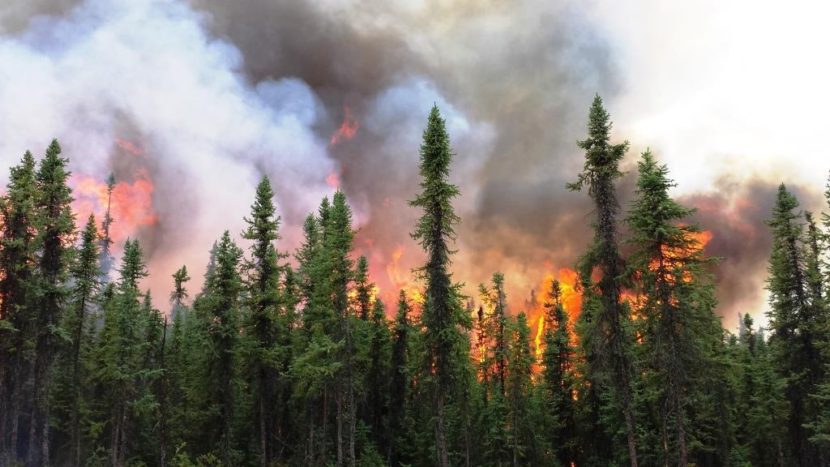
The Aggie Creek Fire located 30 miles northwest of Fairbanks on July 7, 2015. A lightning strike started it June 22. It consumed an estimated 31,705 acres. (Creative Commons photo by USFS)
University of Alaska Fairbanks researchers will play a big role in three newly funded climate change and wildfire studies.
Alaska Fire Science Consortium ecologist Randi Jandt said teams that include UAF based and trained researchers will focus on implications of increasing warmth and fire activity from a cross-disciplinary perspective.
“It’s often difficult to join up the world of research and academia with the world of actual on the ground fire management,” Jandt said.
One of the nationally funded research projects will employ computer modeling to better anticipate and address peak fire activity.
“When we get those really big years – like last year was a good example – it really strains and limits available resources for fire management,” said Jandt.
Another study focuses on improving fire weather forecasting.
“Especially the focus on some areas that have been slippery and hard to pin down before which would include lightning,” Jandt said. “Besides the forecasting, lightning storms is in the really early stages.”
The third study will consider broad ranging impacts of more tundra fires on the North Slope.
“Such as permafrost thaw which could affect infrastructure and plant succession and therefore habitat for the wildlife,” said Jandt. “And then there’s the whole carbon question.”
Funding for the studies comes from nearly a million dollars in grants from the National Joint Fire Science Program and the National Oceanic and Atmospheric Administration.
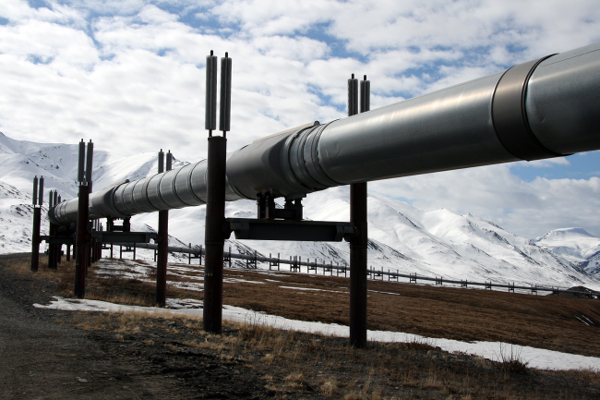
The Trans-Alaska Pipeline System is one of the world’s largest pipeline systems. (Photo courtesy of the Department of Natural Resources.)
The trans-Alaska pipeline is back in operation following a tank fire that shut it down for 9 hours on Wednesday.
Alyeska Pipeline Service Co. spokeswoman Michelle Egan said workers saw flames coming from a large crude oil storage tank at Pump Station 5 at the base of Atigun Pass in the Brooks Range around 2:20 p.m. Wednesday.
“And they called in the incident to our operations control center where we evacuated the area and immediately shutdown the pipeline,” said Egan.
Egan said firefighters went in Wednesday night and extinguished the flames. She said no oil was spilled and the tank was taken offline. The pipeline restarted at reduced flow rate at 11:30 p.m. Egan said operators have to be cautious ramping up throughput because Pump Station 5 provides pressure relief.
“Because we have the tank out of service we want to be operating at a lower flow rate until we can get crews on-site at each of the remote gate valves as a precaution,” Egan said. “In case we have to close valves ‘cause we don’t have that pressure release tank available to us.”
Egan said oil flow was expected to increase Thursday from about 400,000 barrels a day to about 530,000 barrels a day. She said it’s unclear what caused the tank fire but a team has been assembled to investigate the incident.
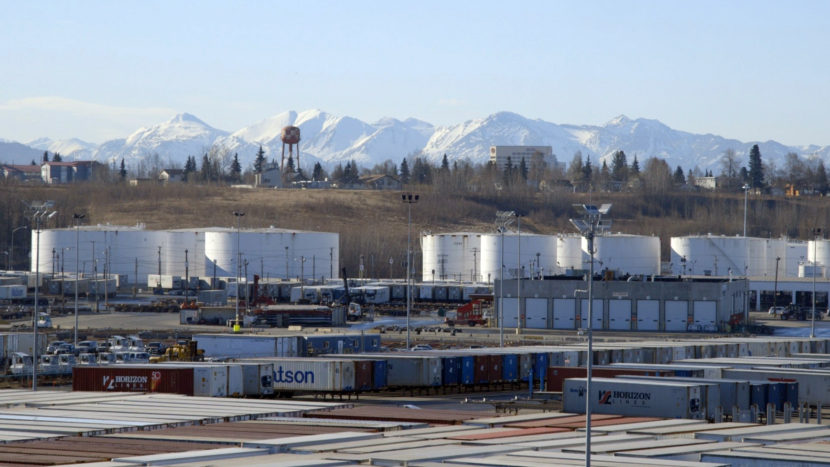
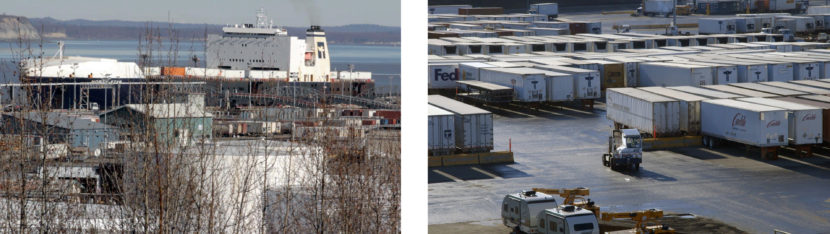
The cargo yard at the Port of Anchorage. (Photo by Eric Keto/Alaska Public Media)
An enormous share of Alaska’s food, fuel, and supplies come into the state through just a single access point: the Port of Anchorage. Even small communities in distant parts of the state rely on the steady flow of goods over the port’s docks. It’s a critical supply-chain that connects hundreds of communities, and is under threat from deteriorating infrastructure.
On a recent crystal clear morning, semi-trucks barreled up and down long drawbridges connecting the asphalt docks of the port to the belly of a massive container ship. Tractor-trailers hauled full 40-foot metal containers out from within.
Depending on how it’s categorized, as much as 85 percent of the waterborne freight reaching Alaska’s Railbelt comes through the Port of Anchorage. (Photo by Eric Keto/Alaska Public Media)
Twice a week, two cargo ships travel 66 hours from Tacoma, Washington, to dock at the port. This one is run by Tote Maritime, and for hours a frenzy of heavy equipment moves 485 containers onto shore. According to officials with the the city, the port, and the shipping companies, the unloading process here is fundamental for Alaska’s main supply chain.
Billy Godwin supervises operations at Tote Maritime. (Photo by Eric Keto/Alaska Public Media)
“Everything you see in the store comes up either on this ship, or the ship next door over there at Matson,” said Billy Godwin, operations supervisor for Tote. “Small amounts of stuff come up over the road, but pretty much everything that comes to Alaska comes in one of these two ships.”
For the Railbelt and Western Alaska, it’s these ships that haul up a vast spectrum of goods. As Godwin is talking we see trucks leaving the ship carrying pipes, heavy equipment, and a 20-foot v-hulled boat. In the parking-lot are about a dozen single-story modular houses.
“I believe we only had four today,” Godwin said, referring to the number off-loaded by longshoremen starting at 7 a.m.
Godwin drove up onto one of the ship’s five decks, filled with a chaotic ballet of trucks negotiating tight bends and somehow avoiding collisions. Containers were squeezed like Pez candies into every available corner of the vessel.
“It’s just a big parking garage in here for trailers,” he said calmly.
After parking, we walk up a few spiraling staircases to the bridge of the ship, which looks out over the port’s enormous staging area, packed with elaborate grids of containers arranged according to what has to be moved where at what time.
“No one ever sees what happens here,” Godwin said. He pointed out a row of refrigerated trailers beyond a knot of freshly disembarked new cars. The cooled containers are packed with perishables, and get priority heading to nearby stores, where they might be stocked by day’s end. Godwin ticks off other freight classes spread across the main cargo lot.
On average, a full-length Conex container loaded up with what’s called FAK: Freight of All Kinds, weighs 30,000 pounds. The volume of goods pouring off this one ship on a single morning is staggering.
“If you eat it, wear it, use it, or drive it, it’s on the ship,” said Grace Greene, vice president and general manager for Tote in Alaska, sitting in her office overlooking the company’s ship as it unloads.
Tote rents one of the three terminals that stands to be improved if funding moves forward for the port’s modernization project. Greene thinks Alaskans don’t always understand the Port’s role as a critical piece of infrastructure not just for Anchorage or Southcentral, but the whole state.
“85 to 90 percent of the freight that comes to the state comes here through the Port of Anchorage, comes on one of these ships, and then it gets distributed out either on trucks, on rail, or via air to nearly every single community in the state,” Greene said.
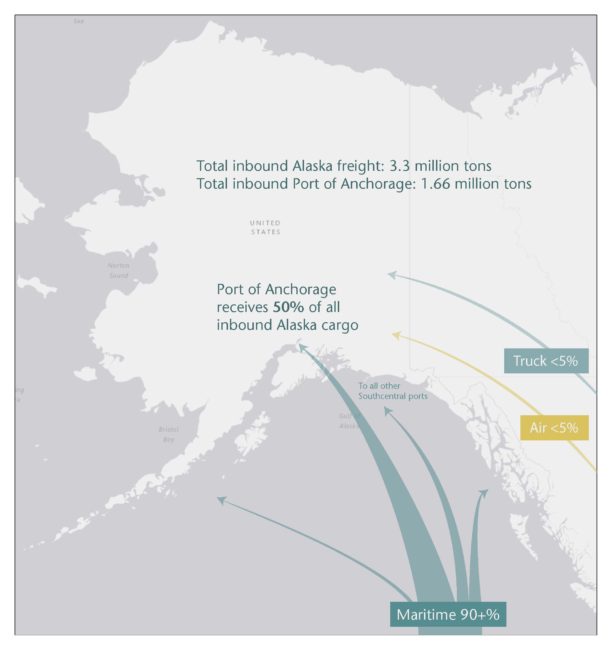
The Port of Anchorage’s inbound freight patterns. (Graphic courtesy Port of Anchorage)
That 85 percent figure doesn’t include certain construction materials, or account for goods barged directly to communities off the road system. Southeast Alaska, for example, received 90 to 95 percent of its freight by barge directly from the Lower 48, according to 2012 figures from the Southeast Conference.
When you look at the total amount of cargo coming into the state by air, road and over water, the port handles half of everything coming in, according to a 2016 analysis from the McDowell Group.
And while 32 percent of all the refined fuel consumed in Alaska moves through the facility, the McDowell report notes, “All aviation gas consumed within Southcentral and the Railbelt first enters the state through POA docks.” Though a small fraction of aviation fuel heads directly to communities beyond Anchorage, the port handles a “substantial majority” of it.
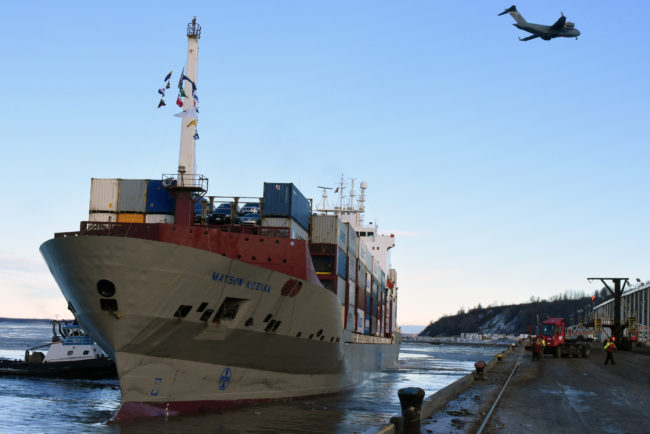
As if to stress that particular point, Greene is interrupted midsentence by a fighter plane flying overhead on a training run out of Joint-Base Elmendorf-Richardson.
An aircraft heading toward Joint Base Elmendorf-Richardson as Matson’s Kodiak container ship approaches the dock in February. (Photo courtesy Port of Anchorage)
“That’s fuel,” said Michael Thrasher, Greene’s senior operations manager.
What he means is that fuel for the jet planes out of Alaska’s two main military bases came through the port. That’s also true of the commercial jet fuel that supplies large airports like nearby Ted Stevens International, as well as the armada of small planes knitting together communities off the road system.
A few miles down the road is a breakdown center, which is something like a big sorting room filled with forklifts. The cross-dock facility is managed by Carlile, a trucking company owned by Saltchuk Resources Inc., the same parent corporation that oversees Tote. As trailers are backed up to the cargo bays, Operations Manager Tom Hubbard opens one of the containers from that day’s ship, and points out labels for where the products are bound.
“Fish House in Seward,” he said of a box sitting atop several piles of paper headed to an Office Max.
Of all the material shipped on a delivery like this one, 45 to 50 percent of it moves on to communities beyond Anchorage. Exact data on where freight moves is treated by companies as a trade secret. But estimates from the McDowell report suggest 15 percent of the cargo moving beyond Anchorage goes to the Interior, 10 percent goes to the Kenai Peninsula, 20 percent goes to the Mat-Su Valley, with the remaining quantities bound for Kodiak, the Aleutians and Western Alaska.
Regardless of whether shipments are headed next, Hubbard and his crew unpack the containers and re-organize them for delivery.
“We’ll do the same thing and then backfill these trailers to send them on to where they’re going next,” Hubbard said.
The whole operation hinges on ships being able to dock and unload at the port. And in part two of this series, we’ll look at why that key step is threatened as the port’s basic infrastructure erodes into the sea.
The state House and Senate are trying to work out their differences over a bill that would draw money from the Power Cost Equalization Endowment Fund.
The $900 million fund subsidizes the high cost of electricity in rural areas. Because the state government has a $4 billion deficit, some lawmakers have suggested drawing money from the fund to pay for other state costs.
Sen. Lyman Hoffman, D-Bethel, speaks in support of Senate Bill 196 on April 13 in this screenshot from the Gavel archive.
Bethel Democratic Sen. Lyman Hoffman crafted a bill that would limit the draw from the PCE fund to years when the fund earnings are more than what’s needed for the power cost equalization program. This program costs about $40 million per year.
But the House made changes to the bill. These changes made it less likely that excess fund earnings would be redirected back into the fund.
Those changes concern Hoffman. When it was time for the Senate to decide Wednesday whether it would agree with the House’s changes, Hoffman spoke up.
“They changed the formula on how the excessive earnings will be distributed,” Hoffman said. “And I believe that that formula will potentially put the fund in jeopardy and want to go back and revisit the differences between what the Senate has done, which is a more sound approach to the fund.”
As a result, there will be a conference committee to rewrite the bill so that both houses can agree to it.
Hoffman will be the Senate chairman of the committee, which will also have Eagle River Republican Sen. Anna MacKinnon and Fairbanks Republican Sen. Click Bishop. The House members will be chairman Dillingham Democrat Bryce Edgmon, Eagle River Republican Dan Saddler and Fairbanks Democrat Scott Kawasaki.
The Legislature formed the conference committee on what was an otherwise quiet day in the Capitol.
Close
Update notification options
Subscribe to notifications
Subscribe
Get notifications about news related to the topics you care about. You can unsubscribe anytime.