Interior

Rep. Young calls for state support of Sturgeon appeal

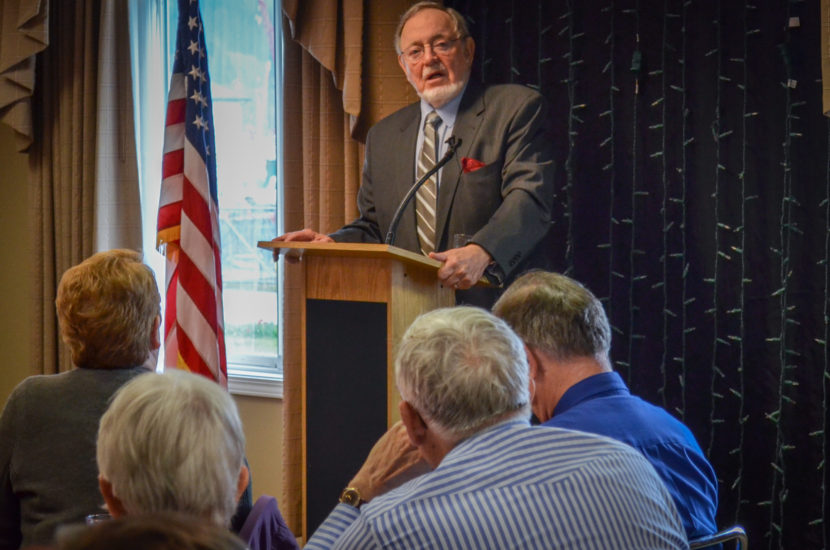
U.S Rep. Don Young speaks to the Capital City Republicans and Capital City Republican Women at the Prospector Hotel April 4, 2016. (Photo by Jennifer Canfield/KTOO)
U.S Rep. Don Young speaks to the Capital City Republicans and Capital City Republican Women at the Prospector Hotel. (Photo by Jennifer Canfield/KTOO)

Congressman Don Young called on Juneau Republicans on Monday to support legislative funding for John Sturgeon’s legal fight over operating a hovercraft in a national preserve.

Young also said that while he’s running for re-election, when the time comes for a successor, Alaskans should choose someone who’s young.

Young, 83, told the Capital City Republicans and Capital City Republican Women on Monday that it takes decades to build up seniority and effectiveness.

“Now, that’s something I want you to keep in mind. If you replace me someday, please get a younger person,” Young said. “Not that I have anything against mature citizens. I want you to know that. Just because you have to have someone that serves in the House for more than 25 years. And that’s a big dedication.”

Young said Congress is less effective than it once was. He said that’s because committee chairs have lost power.

“When I was chairman of transportation, I ran the Congress,” Young said. “I’m not braggin’ now, but I had 75 votes. I had Democrat votes, and I had Republican votes. They were loyal to the committee … if the speaker got frisky, and said, ‘You can’t do this, you can’t do that,’ I said, ‘You watch me.’”

Young used colorful language during his speech. He’s a former teacher, and he endorsed corporal punishment and criticized laws that prevent 15-year-olds from working.

“A lot of what we do is (done) incorrectly, as far as education goes. It’s requirements of the federal government to get the federal dollar,” Young said. “We’re hooked on this sugar tit, is really what it is. And we’re not educating our students. I will tell you. I don’t think I could teach today, because I can’t thump somebody.”

Young encouraged the audience to support state funding to back Sturgeon’s lawsuit. The U.S. Supreme Court recently handed Sturgeon a partial victory and sent his case back to the 9th Circuit Court of Appeals.

Young predicted that the federal appeals court won’t change its opinion, and the case will return to the Supreme Court.

Young spoke again in Juneau on Tuesday at a Native issues forum put on by the Central Council of the Tlingit and Haida Indian Tribes of Alaska.
Mountaineers see bad luck behind UAF class avalanche incident

Members of a University of Alaska Fairbanks mountaineering class are recovering after being hit by an avalanche in the eastern Alaska Range.  The incident has raised questions about the university taking students into the mountains.

The McCallum Peak climbing trip was the culmination of an 11-week mountaineering course. UAF spokeswoman Marian Grimes said the group, which included nine students and four instructors, was climbing up the Canwell Glacier off the Richardson Highway Saturday when the slide triggered.

USGS Canwell Glacier 2002
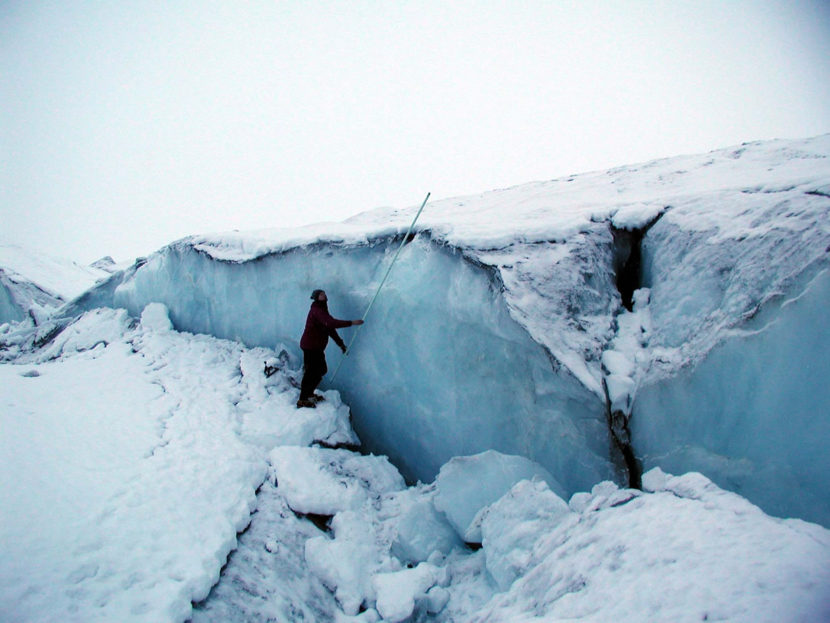
USGS’s Peter Haeussler prepares to measure the offset of a crevasse on the Canwell Glacier in November 2002, following a magnitude 7.9 earthquake that struck near Denali National Park. (Public domain photo by U.S. Geological Survey)

”Some people were partially buried in the snow,” Grimes said. “Some were on top of the snow.  There were two people who had their faces covered. The climbers who were free of the snow assissted them very quickly, uncovered their faces within the first about 20 or 30 seconds.”

Grimes said no one was seriously injured, but the climb was abandoned and the group returned to Fairbanks. UAF Director of Recreation, Adventure and Wellness programs Mark Oldmixon said snow conditions appeared to be initially OK to the instructors.

”They didn’t find any red flags: natural avalanches or shooting cracks,” said Oldmixon.

An Alaska Alpine Club trip to the same area was canceled. Volunteer leader Kellie O’Brien said she didn’t feel comfortable with conditions, given recent weather.

”Reviewing history of the weather in Alaska and knowing that we’ve had strange snow, and that it’s been inconsolidated,” O’Brien said. “And then to have the temperature so warm followed up by that fresh snow fall that passed through, I just have this sixth sense that it just was not stable conditions.”

O’Brien referred to a forecast posted earlier in the week to the Eastern Alaska Range Avalanche Center website, warning of instability. Oldmixon, who’s actively involved in the online center, maintains the forecast was stale.

”It shouldn’t be something we necessarily use as a go-no go five days later,” said Oldmixon. “So we felt comfortable still sending the trip.”

Alaska Avalanche Information Center education coordinator Sarah Carter was in the area teaching course the prior weekend, and some of her students posted the forecast. Carter agreed conditions shift quickly, and are localized, but cautions that the eastern Alaska Range snowpack has become generally less stable in recent years due to warmer weather.

”With the warmer systems moving through, there are multiple layers of stronger snow with facets between those layers.” Carter said.

Carter noted basic techniques, like only exposing one group member at a time to a slope to reduce risk, but she insisted on not laying blame relative to the UAF avalanche incident.

“There is an element of luck in the mountains,” said Carter.

UAF’s Oldmixon said his initial takeaway from the weekend accident is that the class fell victim to rapidly changing conditions, common in the mountains.

“My initial instinct is we didn’t do anything wrong,” Oldmixon said. “These accidents will occur and in this one there could have been 13 deaths.”

Jeff Benowitz is an experienced local alpinist and longtime UAF climbing gym instructor.

“The University of Alaska should not be in the mountain guide business,” said Benowitz. “We should offer mountaineering skill classes and we can do that on campus, and we do it very well.

The university’s Oldmixon said the avalanche incident will undergo thorough review and could result in program changes, but the initial priority is helping those involved recover from the slide.

After explosion, Healy power plant reopening is months away

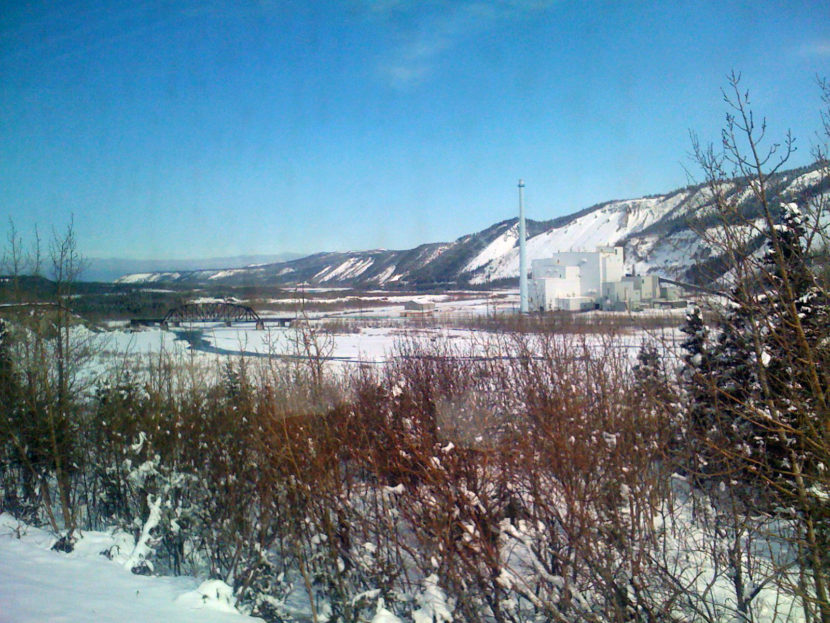
Healy clean coal power plant winter
Golden Valley Electric Association’s experimental clean coal-fired power plant in Healy, April 27, 2008. (Creative Commons photo by James Brooks)

It will be months before a Golden Valley Electric Association coal fired power plant comes back online. The plant, one of two Golden Valley operates in Healy, has been down since a coal dust explosion March 3. The incident is similar to two others that occurred during initial testing of the recently re-started power plant.

Golden Valley Electric Association vice president of power supply Lynn Thompson said the utility is still in the early stages of reviewing the March 3 explosion at the Healy 2 coal fired power plant.

“We believe that it’s gonna be a combination of events from probably equipment failure and instrument failure that led to this,” said Thompson.

The explosion happened within the plant’s coal pulverization and transport facility, and Thompson said at least one major component needs to be replaced.

“The mill exhaustion fan,” Thompson said. “That will be about fourteen weeks for … delivery to Healy.”

Thompson said a repair cost estimate is not yet available.  The $300 million Healy 2 power plant was built with state and federal support to test new coal burning technology, but it failed start up testing in 1999, and sat dormant during a prolonged legal dispute, until Golden Valley purchased it from the state in 2013 for $44 million.  The plant has since undergone major renovation. Thompson said the $190 million project includes work on the coal pulverization and transport facility.

“We’ve added additional safeguard equipment to see that these events don’t happen,” said Thompson. “It sounds like they’re going to have to resolve this coal feeder problem.”

Brian Litmans is an attorney with Trustees for Alaska, which successfully pushed for updated emissions controls at both of GVEA’s Healy coal power plants. Litmans said the explosion inspired him to review similar past problems at the Healy 2 plant.

“Back in 1999, GVEA did not want the facility,” Litmans said. “They were very concerned given all of the problems in the 90-day testing period including two major explosions in the coal feeder zone.”

GVEA purchased Healy 2 to help stabilize electric rates by relying more on low cost coal from the Usibelli Coal Mine in Healy. Litmans said the recurring coal pulverization and transport system problem raises concerns about cost-savings potential.

“At what point do you stop sinking good money after bad?” asked Litmans. “Those are important questions for GVEA and the repairer should know what it’s going to take to keep this facility online.”

Golden Valley will attempt to answer those questions, according to the utility’s Thompson.

“We have a forensic engineering team coming in to look at the problems that we experienced this time and so we will do a very thorough evaluation of the equipment and if we need to change procedures or add additional equipment to that system,” said Thompson.

Meanwhile, Thompson said a three-month shutdown scheduled for this summer for installation of new emissions controls has been moved up.

”To try to take advantage of this time we’ll be offline,” Thompson clarified.

GVEA’s other Healy coal plant continues to operate. Thompson said lost power output from Healy 2 represents about 30 percent of the GVEA load and is being compensated for with electricity purchased over the intertie, and generated at a Golden Valley oil-fired plant in North Pole.

Troopers dial back command post at Arctic Man event

A spokeswoman for the Alaska State Troopers says the agency will not set up a command post at the Arctic Man Classic race.

Megan Peters says troopers from Delta Junction and Glennallen will respond to calls as needed at the April 4-8 event.

Arctic Man is a race in which a downhill skier glides down a mountain, grabs a towline behind a snowmobile, gets pulled up a second peak and skis down to the finish line.

Organizers say the race last year attracted 13,000 fans at the venue off the Richardson Highway near Summit Lake.

Troopers in previous years have set a trailer with communications equipment and working space at the event.

Race organizer Howard Thies earlier this week said the race will have its own security.

Canadian company seeks to ship oil sands crude through trans-Alaska pipeline

Trans-Alaska Pipeline System 2005
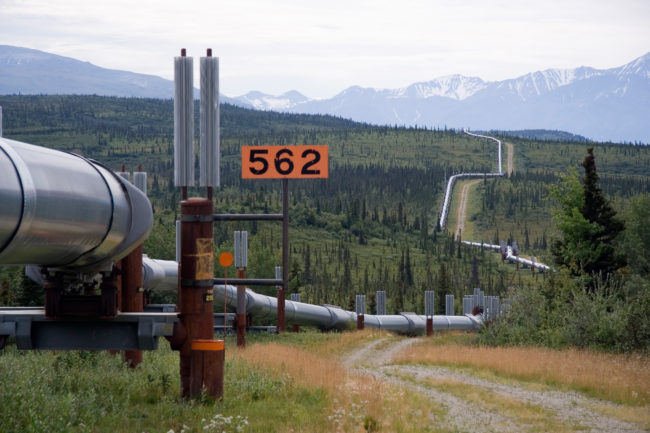
The trans-Alaska pipeline on Aug. 6, 2005. (Creative Commons photo by Luca Galuzzi)

A Canadian company is looking into the feasibility of building a railroad to Alaska to link with the trans-Alaska pipeline. The rail line would ferry Canadian oil sands to markets in Asia. The company has been pursuing the project for years.

Matt Vickers admits he’s touted the idea of shipping oil sands from Alberta to Alaska by rail for a long time.

Vickers is CEO of G Seven Generations, Ltd., a Canadian company. He hopes to load more than a million barrels a day from Fort McMurray, Alberta onto a specially built rail line to Delta Junction. From there it would be treated to enter the trans-Alaska pipeline to Valdez.

Vickers said the $35 million project got new life when the Alberta government funded a preliminary study for almost $2 million.

“A.E. Can, our engineering firm, were able to look at allowing our rail to be a class A rail along the 2,400 kilometer, or 1,600 mile, route,” Vickers said.

He said he’s spent much of the last six years getting buy-in from Canadian First Peoples and Alaska Natives impacted by the proposal.  If all goes to plan, Vickers said, crude from Canadian oil sands could be moving down to Valdez by 2020.

Tanana Chiefs recognize Denali and other interior name changes

Denali and hiker backpacker
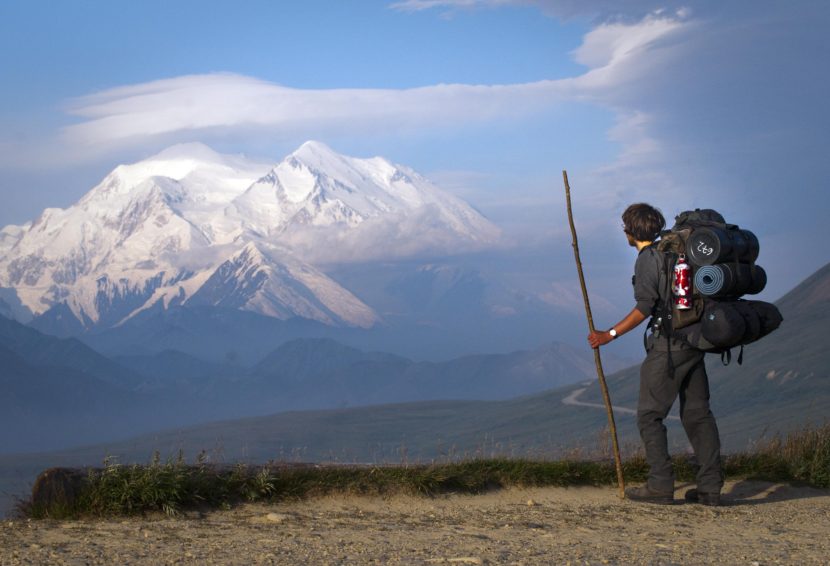
A backpacker looks at Denali in the distance. (Public domain photo by Kent Miller/National Park Service)

Renaming of North America’s highest peak from Mount McKinley to Denali was recognized Wednesday by federal and tribal officials at the Tanana Chiefs Conference annual meeting in Fairbanks.

U.S. Interior Secretary Sally Jewel took action last summer to formally rename Mount McKinley to its traditional Athabascan name Denali. President Barack Obama announced the executive action during his Alaska visit. It followed decades of congressional wrangling.

Michael Johnson, Jewel’s senior adviser for Alaska affairs, spoke about the name change in an address to Tanana Chiefs Conference delegates.

“This is a symbol, but it’s an important one ’cause it’s about respect,” said Johnson. “And that’s, I think, first and foremost why the secretary was happy to do it.”

Denali isn’t the only federally approved change to a traditional Alaska Native name. TCC President Victor Joseph noted three other recent interior region name changes made by Secretary Jewell.

“Black River, the traditional name was Draanjik, and that came through,” Joseph said. “And then when we’re looking at the Chandalar, it has two names that came and that’s T’eedriinjik and Ch’idriinjik, the east and west of the Chandalar river. And that means so much to us to have the original names come back to the areas that we have lived in forever.”

Joseph said Secretary Jewel made the river name changes at the request of Yukon Flats region residents. Celebration of the name changes was part of a potlatch that concluded the TCC annual convention.

Site notifications
Update notification options
Subscribe to notifications