Interior

At Arctic summit, climate change is inevitable and irreversible

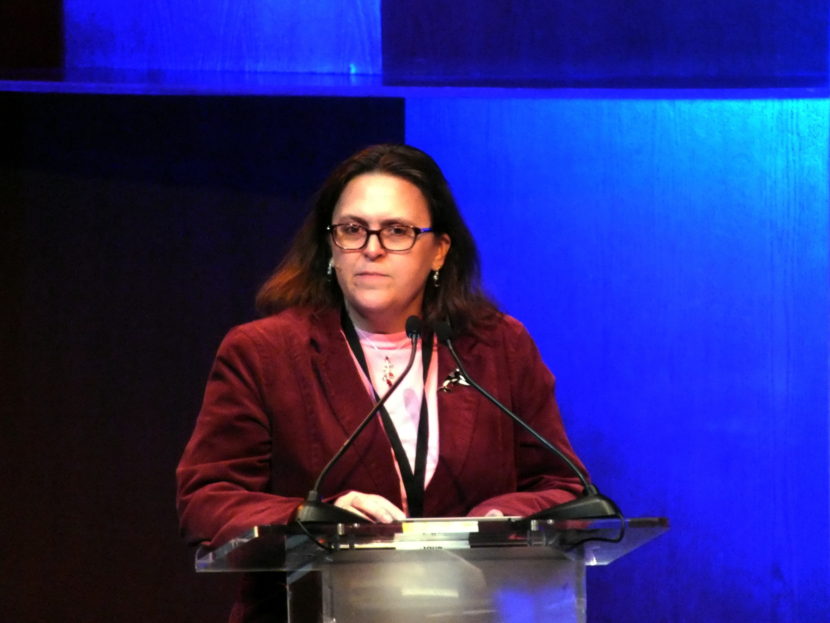
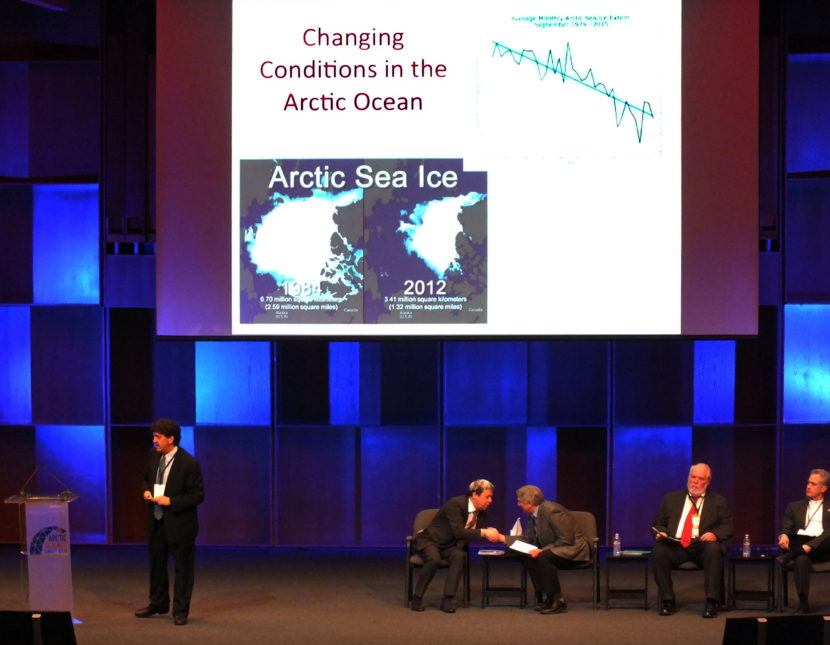
Ambassador David Balton delivers the keynote address during International Assembly Day during Arctic Science Summit Week in Fairbanks. Greenland's Minister Plenipotentiary Innuteg Holm Olsen greets Alaska Lt. Gov. Byron Mallott at center. David Kennedy, retired deputy under Secretary for Operations at National Oceanic and Atmospheric Administration, and Marcus Carson, senior research fellow at the Stockholm Environment Institute, listen at right.
Ambassador David Balton delivers the keynote address during International Assembly Day during Arctic Science Summit Week in Fairbanks. At center, Greenland’s Minister Plenipotentiary Innuteg Holm Olsen greets Alaska Lt. Gov. Byron Mallott. Listening at right are David Kennedy, retired deputy under secretary for operations at the National Oceanic and Atmospheric Administration, and Marcus Carson, senior research fellow at the Stockholm Environment Institute. (Photo by Matt Miller/KTOO)

The common theme among policymakers and scientists meeting in Fairbanks this week is that the Arctic is warming at an accelerating pace, and climate change is inevitable and irreversible. What happens in the Arctic doesn’t stay in the Arctic, and what happens in the mid-latitudes also affects the Arctic.

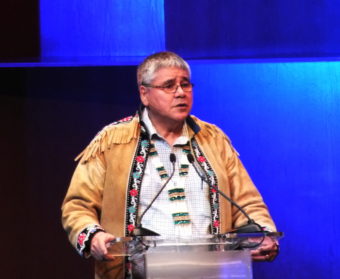
Steve Ginnis of the Fairbanks Native Association switched back and forth between Gwich’in and English as he welcomed a thousand people from 30 countries during International Arctic Assembly Day on Tuesday. Ginnis said climate change is affecting their way of life.
Steve Ginnis
Steve Ginnis of the Fairbanks Native Association. (Photo by Matt Miller/KTOO)

“It’s not a myth like some people might claim. It’s real. It really affects us up here, big time,” he said. “Our fish, returning of our king salmon, is affected with the warming of the ocean, ocean water among other things.”

Lt. Gov. Byron Mallott said his eldest son, a lifelong commercial fisherman in Yakutat, can’t reconcile his early experiences with current weather and ocean conditions.

“It doesn’t work anymore. He said, ‘I feel disoriented in my own place.’ He said, ‘All of those sixth senses that you brought to bear from your total work experience in this field really don’t fit anymore.’”
Robert Papp 031516
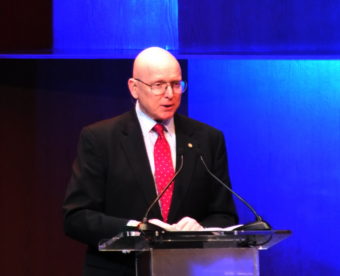
Retired Coast Guard Adm. Robert Papp. (Photo by Matt Miller/KTOO)

Retired Coast Guard Adm. Robert Papp, who is the State Department’s special representative for the Arctic, quoted a naval admiral who warned there is no sharp boundary line between safety and fatal danger. There’s no such thing as a blinking red light that warns ship captains before they head into bad weather.

“So, the analogy is there’s no little red light that’s going to go on and tell us when the Arctic has gone too far and is unrecoverable,” Papp said. “It’s going to be shaded. If there was a little red light, that red light is probably going on right now. How long must we wait to take appropriate action to make sure that we preserve this environment?”

Ambassador David Balton, the State Department’s deputy assistant secretary for oceans and fisheries, said Arctic nations have informally committed to not allowing commercial fishing in the ice-free waters of the Arctic Ocean. But a donut hole exists in the center of the ocean that is outside of any country’s jurisdiction. Other non-Arctic countries may want to fish there, soon.

“At least from the point of view of the United States, what we are trying to do is get all of these players to agree to a binding regime (as) enshrined in the principles of this declaration,” Balton said. “There should be no commercial fishing in this area until there is adequate science, and until there is some framework for actually managing the fisheries in place. I don’t know where this negotiation will take us. As we stand here today, this is an unanswered question.”

Inuuteg Holm Olsen is a University of Alaska Fairbanks graduate who now serves as minister plenipotentiary for Greenland representation at the Danish Embassy in Washington, D.C.

“The policy-science interface quickly can become a sensitive one,” Olsen said. It can either become too political if you have opposing agendas, which can be a hindrance to adopt policy in combating climate change. When we talk about the Arctic, there is a multitude of layers with a sizable presence of indigenous peoples that has to be incorporated in new ways of handling issues today.”

Olsen said scientists and policymakers should not work in isolation. They need to build trust to engage each other.
Lawmakers eye earnings of rural energy endowment to fund state budget

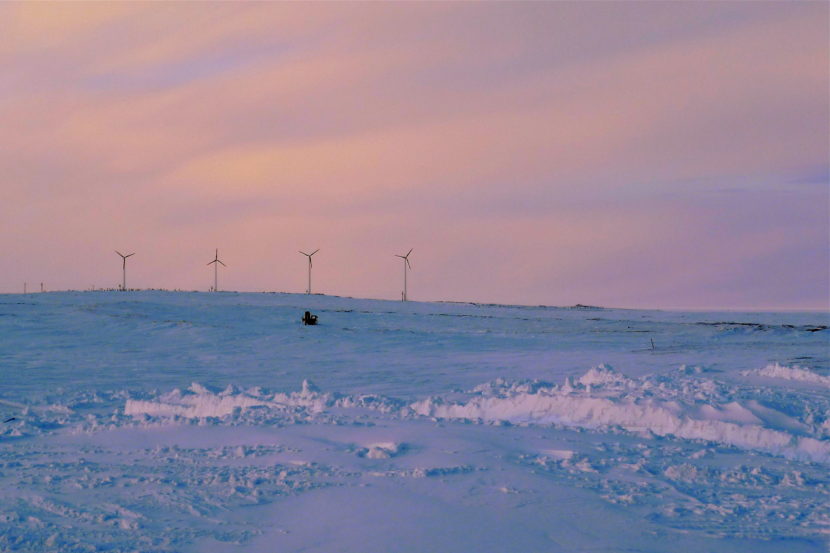
Wind turbines in Chevak
These four wind turbines in Chevak, pictured in March 2012, provide some renewable electricity to the village, but residents still pay high rates. (Creative Commons photo by Joseph)

Rural Alaskans can pay three to five times more for electricity than those in urban areas. That’s why the state launched the Power Cost Equalization Endowment Fund in 2000. It’s paid roughly $40 million annually to subsidize rural energy bills.

But some are questioning if the fund, now worth $900 million, should be committed to benefit only about one in nine Alaskans.

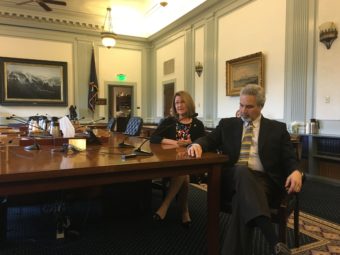
Senate Finance Committee Co-Chairpeople Anna MacKinnon and Pete Kelly discuss the budget. (Photo by Andrew Kitchenman)
Senate Finance Committee Co-Chairwoman Anna MacKinnon alongside Sen. Pete Kelly. (Photo by Andrew Kitchenman/KTOO)

Senate Finance Committee Co-Chairwoman Anna MacKinnon, an Eagle River Republican, said the state government could consider tapping the fund.

“You’ll see Power Cost Equalization come before us. There’s a billion dollars in that fund,” she said. “That billion dollars has been benefiting a selected group of Alaskans with Power Cost Equalization. But is that the highest and best use of those dollars now?”

MacKinnon is a sponsor of Senate Bill 196, which would rebudget fund earnings for other purposes. In years where fund earnings are greater than what’s needed for the Power Cost Equalization program, 60 percent of the excess earnings would go to the state government, 30 percent would go to renewable energy projects, and 10 percent would build up the endowment.

The fund lost money this year, so no excess money is available. It’s not clear whether MacKinnon and other lawmakers are looking beyond Senate Bill 196, to use the fund itself to help close the state’s budget shortfall.

Bethel Democratic Sen. Lyman Hoffman – another sponsor of the bill – sees Senate Bill 196 as a way to protect the fund’s principal while helping the state.

“So what we’re trying to do with this bill is to assure that during those high years, the fund only pay for its intended purpose – and if there are excess earnings, that those earnings be sent back to two different programs,” Hoffman said.

Rep. Bob Herron, another Bethel Democrat, said power cost equalization is fair to rural residents. He notes the endowment was started after the government paid for dams that provide power to cities.

Gov. Bill Walker wants to make sure that if changes are made to the fund, they’re considered along with his plan to close the budget shortfall. He wants to ensure everyone in the state shares the burden.

Walker expressed concern that the combined impact of Power Cost Equalization changes with Permanent Fund dividend changes would put too much of the burden on rural Alaskans.

“That’s why we have focused on a sustainable plan that is a broad-based plan, so that we take into consideration rural Alaska’s situation, which is unique versus urban Alaska,” Walker said. “We’ve tried to take all of that into consideration. That’s why one piece at a time doesn’t really work.”

The Senate Finance Committee heard testimony supporting Senate Bill 196 on Wednesday, but didn’t vote on the bill.

Alaska officials court Google’s driverless car industry

Google self-driving driverless cars
A row of Google’s self-driving cars spotted Oct. 2, 2015. (Creative Commons photo by Alan)

It may be awhile before ice road truckers become ice road computers, but one of Google’s top lobbyists was in Juneau on Thursday to talk about driverless cars.

Google state legislative affairs representative Ron Barnes wouldn’t commit to bringing autonomous vehicles to the Alaska anytime soon, saying Google’s engineers determine where the company tests its cars.

“We keep a list of places everywhere that might be somewhere we would need, but the engineering needs drive really where we go right now,” Barnes said. “And what new information do we need in order to make the software, make the cars more robust and their ability to handle driving scenarios.”

Barnes’ visit gave Fairbanks Economic Development Corp. project manager Jomo Stewart a chance to pitch the state as the ideal place for Google to test cars in cold weather conditions.

“Cold can be a real challenge, but it also can be an opportunity,” Stewart said, adding his agency promotes Fairbanks as “the most accessible, reliable and affordable place in the U.S. to do cold-weather testing.”

Palmer Republican Rep. Shelley Hughes said the state can be ahead of the curve in planning for driverless cars.

“There’s an opportunity. Right now, they have to work out how to manage those on ice and snow,” Hughes said. “I believe that if we can open the door to these kind of things – every bit and piece – that’s going to be a multi-billion dollar industry. If Alaska can just get a sliver of that economic pie, that will be good.”

Google’s driverless cars have driven more than 1 million miles on roads in California, as well as pilot projects in Austin, Texas, and Kirkland, Washington.

Scientists, policymakers converge in Fairbanks for Arctic Science Summit Week

Julia Gourley
Julia Gourley is the United States’ senior Arctic official on the Arctic Council. (Photo by Matt Miller/KTOO)

Hotels are booked up solid in Fairbanks this week, and rental cars are hard to find. Over a thousand people from 30 countries are in the Golden Heart City for a meeting of Arctic scientists and policymakers called Arctic Science Summit Week.

One highlight is a meeting of the Arctic Council, a multinational governmental forum created to address the Arctic’s pressing issues.

“Good public policy, including good foreign policy, which is the main work of the Arctic Council, must be based on facts on the ground, which is to say it must be based in reality,” said Julia Gourley, the United States’ senior Arctic official on the Arctic Council.

Gourley said they rely on good, solid science to tell them what is really happening in the Arctic. That science helps shape their recommendations that go to key policymakers in various Arctic nations.

It’s not just environmental science. Gourley said the Arctic Council recently heard about the latest in social science on the economy of the north, living conditions and human development.

“These kinds of social science studies, which have shaped the Arctic Council agenda over the years, really have contributed much to how we decide what we’re going to work on in the council,” she said. “And the social science work in particular has contributed to very real topics in the council such as mental wellness and suicide prevention, reindeer husbandry, the role of salmon as a key food source for the Arctic people, and other sociological aspects of living in the Arctic.”

The Arctic Council includes representatives from eight Arctic member nations and six permanent participant delegations from various indigenous groups. The permanent participants can provide input and advise the council on policy issues. But they do not have a vote.

The Arctic Council’s recommendations aren’t binding on participating governments.

There are nearly two dozen observers from other European and Asian countries, and intergovernmental and nongovernmental organizations who are also allowed to sit in on council meetings.

“I would argue that with the Arctic Council there’s a lot more dialogue going on with the nations that are engaged in Arctic dialogue than perhaps anywhere else,” said University of Alaska Fairbanks Vice Chancellor Mike Sfraga.

He’s leading the creation of a new Center for Arctic Policy Studies. Sfraga said the Arctic Council’s work does not seem to be colored by other worldwide conflicts and disputes like Crimea and Syria.

“There are personal relationships, there are nation relationships that still have yet to be damaged by other international issues going on,” he said. “The tensions are there. But in the north there seems to just be a very different dynamic, and it is driven — of course — by resource development. But it is also driven by the fact that we have people reliant on the land, it’s a place where we have traditionally cooperated before, and there just seems to be a willingness in the Arctic Council, a consensus-building body, that we will leave the Arctic alone, as much as you can, from other international dynamics.”

The Arctic Council started its three-day meeting behind closed doors Tuesday at UAF.

Also Tuesday, the Model Arctic Council wrapped up a seven-day meeting. Over 60 students from 13 countries crafted position papers and drafted policy recommendations on cruise ship tourism, managing maritime traffic in the Arctic, improving access to running water and sewer, and reducing suicide among various indigenous groups. Model Arctic Council members were surprised when they learned that their final paper, called the Fairbanks Declaration, will become the starting point for discussions among Arctic Council members next year.

The Arctic Science Summit Week also includes hundreds of scientists from around the world who are coordinating research on the effects of climate change on the rapidly changing Arctic.

As Iditarod teams push through McGrath, rest becomes strategic

Dallas Seavey in McGrath on Iditarod trail
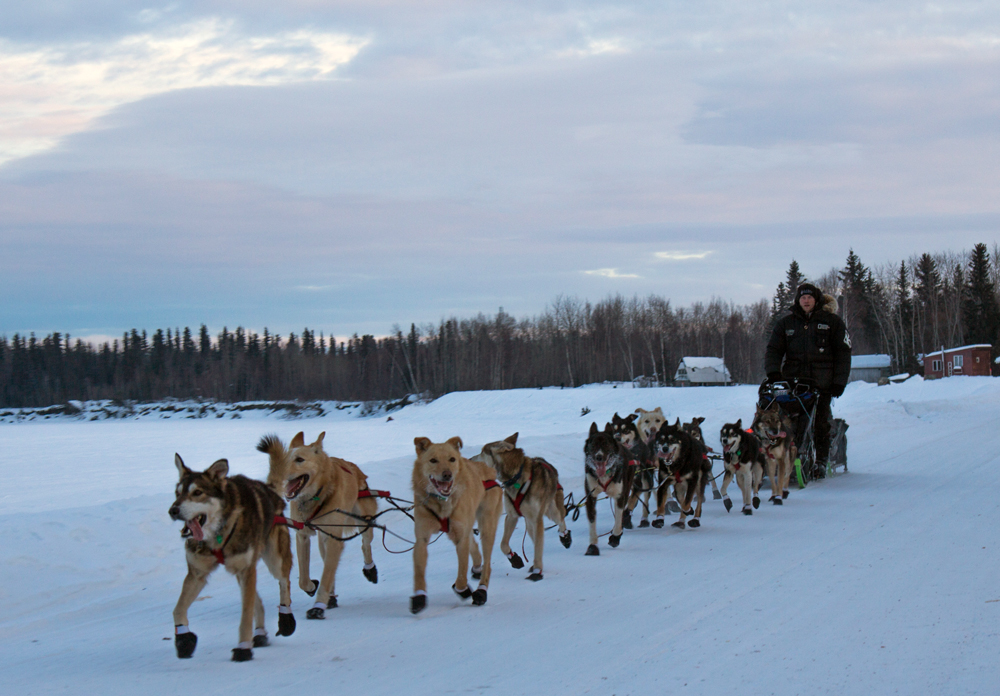
Dallas Seavey was the first Iditarod musher to enter McGrath on Tuesday. (Photo by Zachariah Hughes/KSKA)

Mushers have reached a point in the Iditarod where rest becomes strategic.

Tuesday night, a number of them opted to push their teams further down the trail, while others chose to hunker down for a mandatory 24-hour rest.

The majority of mushers who arrived first into McGrath, didn’t stay long, but some of their decisions earlier in the race, might offer clues about their race plans.

Brent Sass pulled ahead of the field after he blew through Nikolai.

Shortly after leaving the checkpoint, Sass stopped to camp in the midday sun for roughly four hours. That’s why it didn’t come as a surprise to see him quickly blow through the McGrath checkpoint.

“I’m just going through,” he said as he signed in and out and took off.

He wasn’t the only musher that opted not to stay.

Mitch Seavey told the crowd he was moving 100 miles an hour.

Iditarod musher Mitch Seavy pulls into McGrath
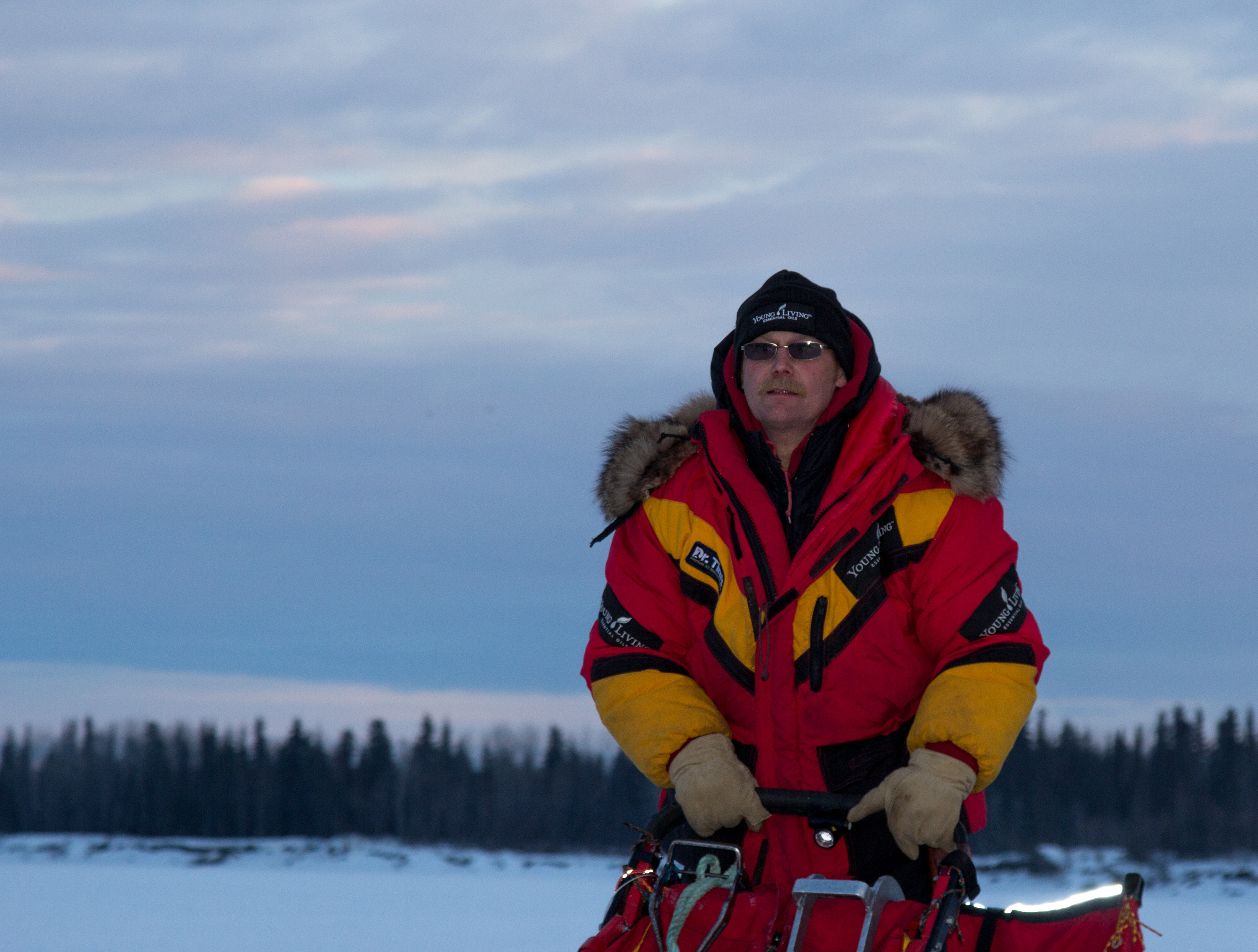
Mitch Seavey pulls into McGrath in second, just after Dallas Seavey, March 8, 2016. (Photo by Zachariah Hughes/KSKA)

“Feels like it. My feet are worn out from the brakes,” he said. He said his dogs were doing well. “I’m thrilled. This is fun!”

He took off with a wide smile, perhaps in part because the conservative musher was following a plan he has successfully executed before.

Aliy Zirkle quickly blew through as well, staying only long enough to share some jokes with the locals and accept a high five from one of McGrath’s many kids.

“It’s going great, the dogs are good, I’m good, I love Alaskan people,” she smiled as she sped away.

Zirkle is also following a schedule that’s similar to those she has run in the past. But that’s not the case for Noah Burmeister. He hasn’t driven a team in the Iditarod in a decade.

He spent a few minutes in the checkpoint talking over one of his dogs with Head Veterinarian Stu Nelson before he pulled his hook and took off down the trail for Takotna.

Burmeister also camped earlier in the afternoon. Perhaps he was hoping to move beyond Takotna before bedding his dogs down for 24 hours, or maybe he just wanted to rest in the middle of the day – sometimes mushers’ race plans aren’t always what they seem.

Iditarod 2016 map
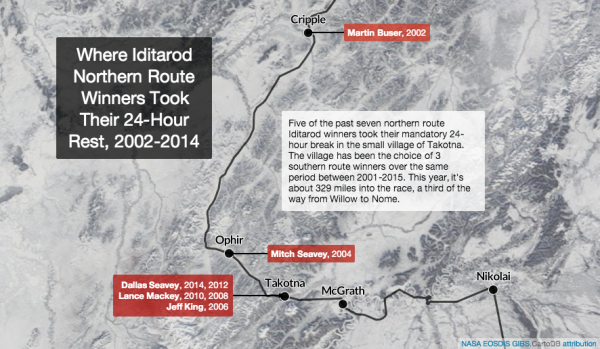
Takotna has proven to be a popular stop for winning mushers along the Iditarod’s northern route. (Graphic by Ben Matheson/Alaska Pubic Media)

Not everyone took off right away, however.

In fact, Wade Marrs pulled in, and promptly declared he’d be taking his 24 hour mandatory rest here. Marrs is battling a cold.

2016 Iditarod musher Wade Marrs stopping in McGrath
Iditarod musher Wade Marrs stopping in McGrath, where he declared his 24 hour rest on Tuesday. (Photo by Zachariah Hughes/KSKA)

“(I’ve) been coughing a lot and a lot and a lot, so hopefully we can get that taken care of,” Marrs said. “I just got some stuff from Dr. Carson here, nice guy, so hopefully that helps out.”

Still, that’s not why he decided to rest here.

“This was our plan, and I really like it at McGrath here,” Marrs said. “You get a lot of good attention from the vets, seeing as there’s not many teams here, you get a lot of attention from the volunteers, and good food and you don’t have a lot of people—too many people around you.”

But Marrs is an exception among the first dozen mushers to reach McGrath.

Those that didn’t shoot away, only stayed for a quick rest. Dallas Seavey was the first in, and surprised many when he opted to stay for three hours.

Lance Mackey was ninth into McGrath, and stopped for a little over two hours, splitting apart square plastic bowls frozen together and ladling a hot salmon and kibble broth to his dogs.

“How many people you know feed their dogs out of cat-litter boxes?” he said.

Mackey said it’s just a little easier to deal with some kinds of chores here.

“I just wanna be able to give ‘em a good break, a little break I should say,” Mackey said. “And I wanna fill my thermos and do some things I don’t really feel like doing in Takotna.”

Mackey said Takotna has too many distractions, and he plans on stopping there just long enough to grab supplies. Asked where he’d be taking his 24, Mackey was less than forthright.

“I would have to say … somewhere before White Mountain,” he said.

In a building by the checkpoint, Mackey downed soup at a table next to Jon Baker, who arrived right after him into McGrath. And Baker’s reasons for staying are part animal care, and strategy, but other reasons, too.

“I got family and friends that I wanted to visit, some things going on here that I wanted to be a part of,” Baker said.

Experienced mushers know to keep their options open, and set themselves up for a 24 our mandatory rest at more than one checkpoint.

For now, Baker said he’ll probably take his in Takotna.

300 miles in, Iditarod mushers must decide when to push, when to rest

Dallas Seavey in McGrath on Iditarod trail
Dallas Seavey was the first Iditarod musher to enter McGrath, March 8, 2016. (Photo by Zachariah Hughes/KSKA)

Iditarod dog teams have travelled more than 300 miles down the trail in the last three days.

Defending champion Dallas Seavey said they’ve reached a turning point in the race.

“This is getting to be far enough into the race where you’re going to start seeing some people pushing the pace start to fall back a little bit, but its’ going to be another three or 400 miles before you really see the separation happen,” he said.

Warm weather has been easy on mushers, for the most part.

Open water through the Dalzell Gorge made for wet feet, but there have only been a few minor bumps and bruises in the last day on the trail.

Brent Sass said warm weather has been great for his race plan.

“I’ve just been having a good time avoiding checkpoints,” Sass said. “I’ve been actually getting some sleep myself, because I can’t be social out there by myself.”

One musher who may have decided to socialize a little more is Hugh Neff. After a big push early, he was the first musher to declare his 24-hour mandatory rest in Nikolai.

“Obviously I pushed it pretty hard the first day, doing over 200 miles, so I’d say that’s different, but now I think we’re going to get more into just doing a more even run rest schedule,” he said.

Neff said some of his decisions to modify his race plan have to do with the younger dogs on his team.

“It’s a nice team, but I do have four yearlings in this team so I have to play off their youth and inexperience,” Neff said. “They’re really what I’m keying on.”

As for four-time champion Lance Mackey, he said the early part of his race has been a roller coaster.

“This race is the highest of highs and lowest of lows and you don’t exactly know when they’re going to take place,” he said.

Mackey had a rough couple of days from the start line through the Alaska Range.

“I haven’t had a good clean run in a nice long time and that was my objective and it didn’t look like it was going to start that way,” Mackey said.

But Mackey seemed to be in better spirits in Nikolai.

He said his plan is to push on beyond the teams already bedding down for their mandatory 24-hour rest.

Site notifications
Update notification options
Subscribe to notifications