Lone moose at Coal Creek Camp in the Yukon–Charley Rivers National Preserve. (Public Domain photo from the National Park Service)
Natural factors are credited with growing the moose population in the Yukon-Charley Rivers National Preserve. Preserve wildlife biologist Mat Sorum said the latest data from moose population surveys conducted every three years, show more moose in a 3,000 square mile corridor along the Yukon and Charley Rivers.
“There was a 13 percent increase since the last survey and on average 38 percent more moose over the long term average throughout the park,” said Sorum.
Sorum said the survey area is far from areas where the state conducts predator control and he attributes the moose population increase to major wildfire and flood activity last decade.
“Good quality moose habitat often occurs 10 to 30 after a fire because of the regrowth and regeneration of the willows or birch,” Sorum said. “Secondly, there was a large flood about five years ago and there was a lot on the river bed and so that’s probably promulgated new growth of willows.”
Sorum says there’s been a similar increase in the adjacent Yukon Flats Refuge, cautioning that although conditions are conducive to more moose, the Yukon-Charley Rivers Preserve population is still considered low density, well less than one moose per square mile.
The legislature on Friday narrowly approved former Fairbanks North Star Borough Mayor Luke Hopkins to serve on the board responsible for developing the Alaska gas pipeline.
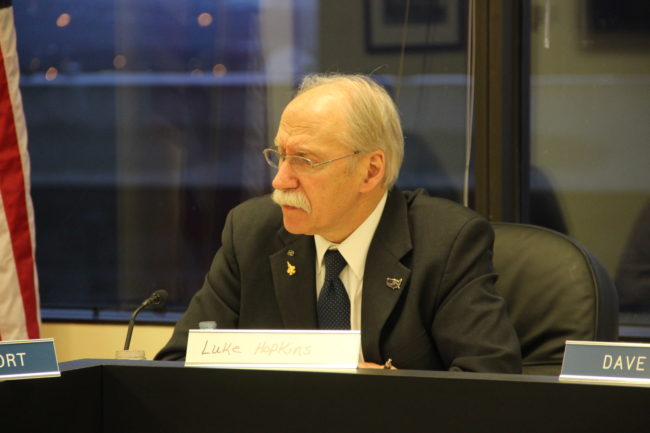
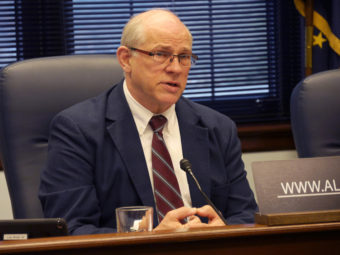
Luke Hopkins. (Photo by Rachel Waldholz/APRN)
A joint session of both houses voted 31-27 to confirm Hopkins to the board. Gov. Bill Walker appointed Hopkins in November, after overhauling the board.
Fairbanks Democratic Rep. David Guttenberg said Hopkins’ experience is what the AGDC board needs. Hopkins is Guttenberg’s brother-in-law.
“Luke’s got a long history of getting things done — or trying to get things done — with the pipeline,” Guttenberg said.
Eagle River Republican Rep. Dan Saddler opposed Hopkins. He questioned whether the AGDC board is following the right direction. He referred to former AGDC President Dan Fauske’s ouster.
“The personnel changes in the staff and the board at AGDC give me cold comfort that the organization’s effort is to achieve the model which I believe is in the best interest of the state,” Saddler said.
The legislature also confirmed Dean Williams as the commissioner of the Department of Corrections. It voted by a wider margin to confirm Williams, 49-9.
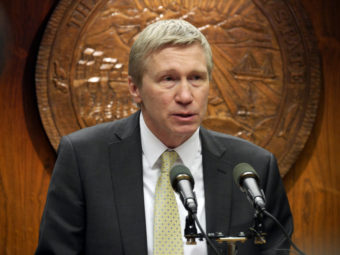
Corrections Commissioner Dean Williams. (Photo by Skip Gray/360 North)
His appointment has been controversial. The corrections officers union opposed Williams. Union officials say an administrative review co-written by Williams was unfair to the officers.
But North Pole Republican Sen. John Coghill said Williams is the right man for making changes in the department.
“This is a job that is needed to be done for a lot of years, so I’m going to support him,” Coghill said.
Anchorage Democratic Sen. Bill Wielechowski said Williams’ review didn’t give the public an accurate view of officers’ work.
“This has severely, severely damaged the morale and the public’s impression of our correctional officers,” he said. “And the problem is a number of things in that review were seriously, seriously taken out of context.”
The legislature confirmed dozens of other appointments. The only person rejected was Hope resident Guy Trimmingham to the Board of Game. Opponents said his interest in sightseeing was inappropriate for a board that promotes maximizing wildlife for consumption.
A legislative committee voted Thursday to cut the University of Alaska’s budget by $50 million.
The conference committee voted 5-1 to adopt the House version of the university budget, which cuts $35 million more than the $15 million cut proposed by Gov. Bill Walker.
The portion of the budget directly controlled by the legislature would be $300 million, as opposed to Walker’s proposed $335 million.
University leaders have said the deeper cut could eliminate up to 500 jobs and lead to tuition rising by as much as 15 percent.
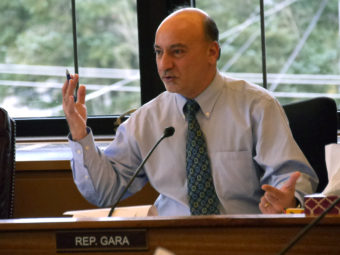
Rep. Les Gara, D-Anchorage, during discussions about the state operating budget in March. (Photo by Skip Gray/360 North)
Anchorage Democratic Rep. Les Gara said the cut would lead to young people leaving the state. It will also cost grants from private foundations. Gara is the committee’s only minority-caucus member.
Fairbanks Republican Sen. Pete Kelly said the cut is proof that in challenging times, everything is on the table.
The Senate Finance Committee is looking to re-route money from the Power Cost Equalization Endowment Fund to replace the Community Revenue Sharing program that the state government started when oil prices were higher.
The concept arose from a concern over Senate Bill 210, which would reduce the amount that municipalities receive in revenue sharing. Without a source of revenue other than the state’s annual budget, this program – which legislators want to rename community assistance – would disappear.
That’s where the second Senate Bill 196 comes in. The bill originally was written to use excess money from the Power Cost Equalization Endowment Fund to offset some of the state budget. But under a new version, this money would instead go to assist communities.
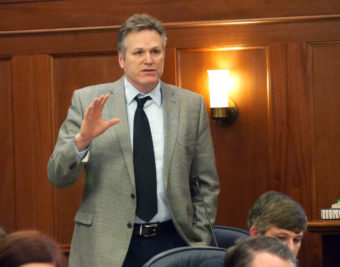
Sen. Mike Dunleavy, R-Wasilla, speaks during a floor debate last month. (Photo by Skip Gray/360 North)
Some legislators wanted to use more — if not all — of the fund this year. Wasilla Republican Sen. Mike Dunleavy asked why this isn’t happening.
“We’re experiencing a $4 billion hole. There’s a billion dollars in this fund,” he said. “Why wouldn’t we use this fund to at least backfill some of the deficit?”
However, under the latest versions of both bills, the $930 million PCE fund would continue to be used primarily for a program to help rural electric ratepayers. In years when the fund earns more than the roughly $40 million that’s needed for that program, up to $30 million would go to community assistance and up to $25 million would go to rural, bulk fuel and renewable energy programs.
Bethel Democratic Sen. Lyman Hoffman supports both bills. He doesn’t want to spend the PCE money all at once on the budget.
Hoffman said the fund could provide a lasting source for both power cost equalization and community assistance – as long as the main PCE fund remains intact.
That will help communities that have come to rely on revenue sharing while taking pressure off the state budget.
“If the dollars were taken, there would be a one-time use, and people in rural Alaska would end up paying substantially more in electric costs,”
But not all municipalities are happy about the change. Anchorage would receive $5.7 million in the coming year, which is $9 million less than the revenue sharing in the past. In future years, Anchorage would receive no more than $2.3 million.
Anchorage Mayor Ethan Berkowitz’s chief of staff Susanne Fleek-Green says it will cost residents more in taxes or reduced services. The municipal government had budgeted for a $5 million reduction, and must make up the gap.
Sen. Lyman Hoffman, D-Bethel, during a Senate Finance Committee meeting on March 29. (Photo by Skip Gray/360 North)
“To counteract the effects of this legislation, the municipality will have to add to the additional burden being felt by property owners in the municipality,” she said. “This bill effectively is shifting an additional $4 million to property taxpayers in Anchorage, Eagle River, Chugiak, Girdwood and all other parts of the municipality.”
Under the latest changes, municipalities would receive $30 million in community assistance, compared with $50 million in Gov. Bill Walker’s budget.
Rural communities are largely protected from community assistance cuts. An extreme example is Aleutians East Borough, which receives nearly $10,000 for every one of the 39 residents who lives in unincorporated areas.
Every community with fewer than 500 residents would receive at least $400 per person in state assistance.
Alaska Municipal League Executive Director Kathie Wasserman says she’s can support using the Power Cost Equalization Fund for community assistance. But the reduced amount of aid – combined with a formula that benefits some place more than others – puts her in a difficult position.
“I’ve just had trouble with the formula that’s presently in place,” she said. “No matter which direction the Alaska Municipal League goes, whether to support the formula or not support, I throw a number of my municipalities under the bus, so that’s why we’re just not taking a position on the formula at this point.”
Both houses have until Sunday to act on the bills.
Correction: A previous version of this story misstated the amount Anchorage would receive under the legislation.
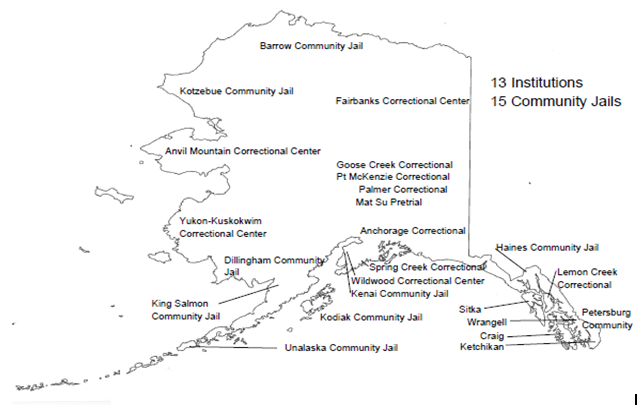
A map of current community jails and DOC corrections facilities.
The state Senate voted 16-2 Saturday to pass a bill overhauling Alaska’s criminal justice system.
The bill would divert nonviolent offenders from prison toward alternative programs. It shifts the focus of bail from people’s ability to pay to the risk they present. It also creates a re-entry program in the Department of Corrections to help reduce recidivism. Senate Bill 91 also reduces sentence ranges and expands parole.
Sen. John Coghill, R-North Pole, at a Senate Majority press availability in March. (Photo by Skip Gray/360 North)
North Pole Republican Sen. John Coghill said the Alaska Criminal Justice Commission laid the groundwork for the bill.
“If less people are coming into jail reoffending, that’s less crime,” Coghill said. “And that’s what our aim is here. The aim here is not necessarily cost savings, but we can’t afford to do what we’re doing right now. So we’re kind of bumping up against the cost and the unacceptable returns on what’s going on in Alaska.”
The Department of Corrections forecasts the bill will save a lot of money — $90 million would be saved in the next six years by diverting people from prison. And potentially hundreds of millions in reduced social service costs since people will be working instead of being in jail.
Law enforcement unions and some victims’ rights advocates oppose the bill. They say it jeopardizes public safety and worsens victims’ trauma.
Chugiak Republican Sen. Bill Stoltze opposed the bill.
“I really think, in many aspects, this bill got too big to fail,” he said. “It could be several bills that were dealt with in different iterations.”
Supporters pointed to research showing that similar measures in other states have reduced the chance that people will re-offend.
Sen. Peter Micciche, R-Soldotna, supports the bill and said the current system makes low-level offenders better at being criminals while incarcerated, rather than being reformed. The bill would reinvest some of the savings toward social assistance programs, to help them succeed in finding work.
“What we’ve tried to do is provide intervention and reinvestment while they’re inside, and hopefully have these folks ready to succeed when they’re released. This is not the end. Although it’s a paradigm shift, we’ll be monitoring the success of the changes we’ve made and make sure it delivers the results that we expect it to see delivered.”
The House Judiciary Committee is scheduled to discuss the bill Monday, putting it on track for a vote by the full House later this week.
The Senate passed a bill Thursday to allow people to carry concealed firearms on University of Alaska campuses.
Sen. Pete Kelly, R-Fairbanks, debating the merits of his Senate Bill 174. The bill would deny the University of Alaska the authority to regulate the possession of guns and knives on campuses. (Photo by Skip Gray/360 North)
Bill sponsor Fairbanks Republican Sen. Pete Kelly says students would be safer if there were more guns on campus.
Kelly quoted professors from other countries who opposed the measure, Senate Bill 174.
“‘Well, if I’d have known this would be the case, I never would have taken this job,'” Kelly recalled them saying. “Or, ‘If this bill is enacted, I’m considering quitting.’ Now, almost everyone that heard that — good ol’ fashioned Americans — the same thought was going through our, their mind, because I talked to them later, and repeat after me: ‘Don’t let the screen door hit you in the …’ You know the rest of the phrase.”
University leaders asked legislators to amend the bill so the university maintained more of its ability to regulate guns. While Kelly agreed to some amendments, he opposed others.
Anchorage Democratic Sen. Berta Gardner opposed the bill. She noted that the late U.S. Supreme Court Justice Antonin Scalia recognized that firearm restrictions in schools and government buildings were legitimate.
“The University of Alaska is a government building. It’s also a school. The Alaska State Capitol is a government building. We ban weapons in this building,” she said. “Why do we think it’s incumbent upon us to not allow or trust the Board of Regents to regulate their buildings in the same way we regulate our own?”
The vote was 13-5. Majority caucus Senators Click Bishop of Fairbanks, Lyman Hoffman of Bethel, and Gary Stevens of Kodiak joined Juneau Democratic Sen. Dennis Egan and Gardner in opposing the bill.
The House Education Committee will hear the bill next.
Close
Update notification options
Subscribe to notifications
Subscribe
Get notifications about news related to the topics you care about. You can unsubscribe anytime.