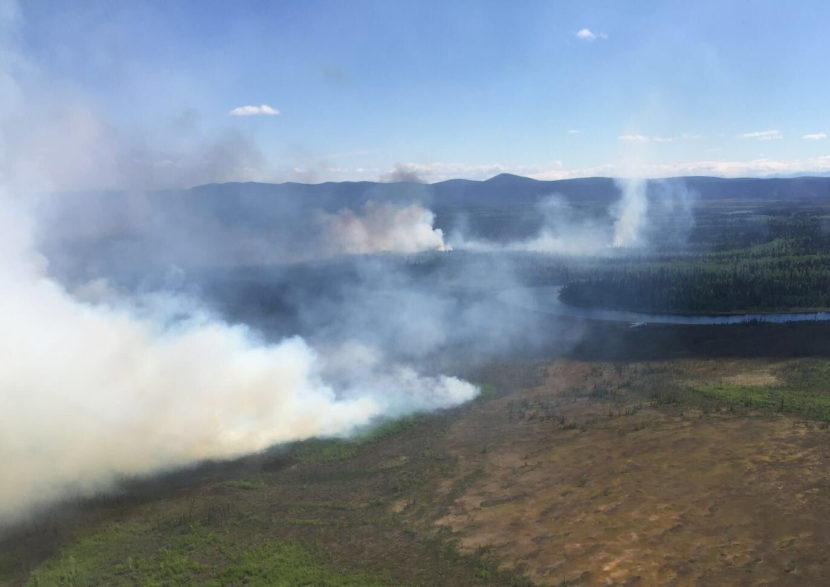
A photo of the Medfra Fire taken on Monday. (Photo courtesy of Alaska Division of Forestry)
Dozens of firefighters are battling a wildfire northeast of McGrath that has grown rapidly over the past few days.
Tim Mowry is a public information officer for the Division of Forestry.
“There’s three fires actually,” Mowry said. “There’s two fires that are substantial and then there was another hot spot that was picked up and those have all merged into one fire now: The Medfra fire, which we’re estimating currently approximately 8,130 acres. So it’s grown considerably as a result of those fires merging together.”
Mowry said the Division of Forestry has four crews on the 8,000-acre fire, including smokejumpers and nearly 80 personnel.
The Medfra fire was first reported Sunday morning.
Fire managers said the wind shifted Tuesday, turning the spread of the blaze back toward McGrath. Mowry said the crews are primarily trying to protect Native allotments, including a cabin, just south of the fire.
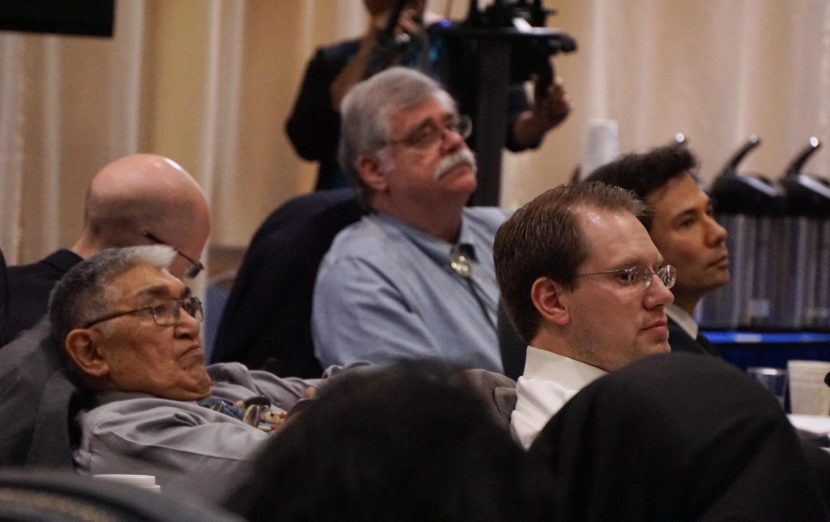
Reps. Ben Nageak, D-Barrow, Kurt Olson, R-Soldotna, Lance Pruitt, R-Anchorage, and Neal Foster, D-Nome, watch as a budget-related vote is tallied in the Terry Miller Gym in Juneau, May 31, 2016. (Photo by Jeremy Hsieh/KTOO)
The legislature passed a state budget that prevents layoff notices going out to state workers Wednesday. But that budget could draw $3.2 billion from the state’s piggy bank, the Constitutional Budget Reserve. It’s not clear how Gov. Bill Walker will respond to a spending plan that doesn’t address Alaska’s long-term state fiscal imbalance.
After weeks of quiet, behind-closed-doors negotiations, the legislative conference committee on the budget passed a funding plan for the fiscal year that starts July 1. That action set the stage for both the House and Senate to vote on the budget Tuesday. The vote came ahead of a Wednesday deadline, preventing thousands of layoff notices from being sent to state workers.
Conference committee chairman Sen. Pete Kelly, R-Fairbanks, said this session will provide lasting budget savings, due to overhauls of Medicaid and criminal justice. Under the proposed budget, total spending – including federal funds – would fall from $9.3 billion this year to $8.8 billion in the coming year.
“Our goal was to cut somewhere (around) $400 million, $500 million,” Kelly said. “We’re over a $400 million reduction. And as we said before, those reductions will continue into the future, because of the reform bills.”
House Minority Leader Chris Tuck, D-Anchorage, highlighted money that was restored to the budget, including funds for senior benefits, early education, the University of Alaska, and the Alaska Marine Highway.
House Minority members have supported changes to the oil and gas tax system that would cut subsidies to producers. But Tuck said the top priority was preventing layoff notices.
“Now that we got this off the table – now that we’re no longer threatening state employees – it’s time to get to work and fix Alaska’s future,” Tuck said.
Rep. Les Gara, D-Anchorage, said it wouldn’t have been appropriate to use the budget as leverage to pass oil and gas tax changes.
“You can’t leverage other peoples’ votes by saying, ‘I’m going to shut down government if you don’t give me the oil tax bill I want,’” Gara said. “Those things have to be decided on their merits.”
But the lack of progress on reaching a comprehensive fiscal plan to stabilize the state budget for future years is a concern for many residents. That’s according to Rasmuson Foundation President and CEO Diane Kaplan. Foundation surveys found Alaskans want the legislature to adopt a comprehensive plan this year.
Walker has proposed a series of new taxes and tax increases, as well as cuts to oil and gas tax credits. Kaplan says Alaskans would like to see the legislature do more than pass the budget.
“In the long-term, nothing is being done this session – other than the modest budget cuts – that puts us in a good position to have a bright economic future for any Alaskans …,” Kaplan said. “This is not a sustainable way to operate the state of Alaska – using reserves.”
The potential $3.2 billion Constitutional Budget Reserve draw would be more than 40 percent of the entire $7.75 billion fund. And it would be nearly a fifth of all savings that the state can spend, including the Permanent Fund earnings reserve.
One party that will be keeping a close eye on what the state government does in the coming weeks is the bond-rating firms. Standard and Poor’s analysts have said negative pressure on the state’s credit rating could intensify if the legislature doesn’t make structural changes.
San Francisco-based S&P analyst Gabe Petek said his firm is watching for what happens next.
“We have not viewed the state’s fiscal structure as sustainable over the longer term,” Petek said. “And so, we’ve been watching to see if the legislature could reach an agreement on some package of reforms that would put the state’s finances on a more sustainable trajectory.”
While Majority Caucus legislators have said they would bring pieces of Walker’s fiscal plan up for votes, it’s not clear whether any will pass.
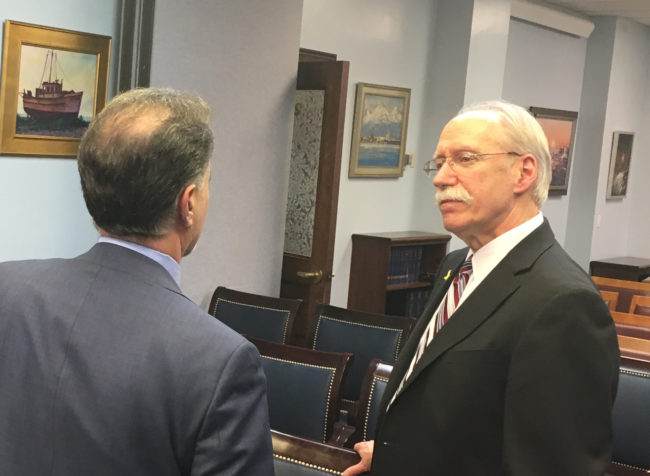
Former Fairbanks North Star Borough Mayor Luke Hopkins discusses the Alaska Gasline Development Corp. with Sen. Peter Micciche in March. (Photo by Andrew Kitchenman/KTOO & Alaska Public Media)
One of Gov. Bill Walker’s allies overseeing the effort to build a natural gas pipeline has resigned, and plans to run for state Senate.
Former Fairbanks borough mayor Luke Hopkins, a Democrat, announced his resignation from the board of the Alaska Gasline Development Corporation in a letter to the governor Wednesday. He is expected to challenge North Pole Republican John Coghill, the Alaska Senate majority leader.
Hopkins was narrowly confirmed by the legislature in April. He said he is resigning to avoid politicizing the gas line board during the campaign.
In his resignation letter, Hopkins said he was prompted to run by a lack of leadership in Juneau. “Whether it be balancing the budget, providing stability and certainty for our critical industries, or supporting our university, the legislature has utterly failed Alaskans,” he wrote.
In a statement, Walker said he would begin the process of finding a replacement soon.
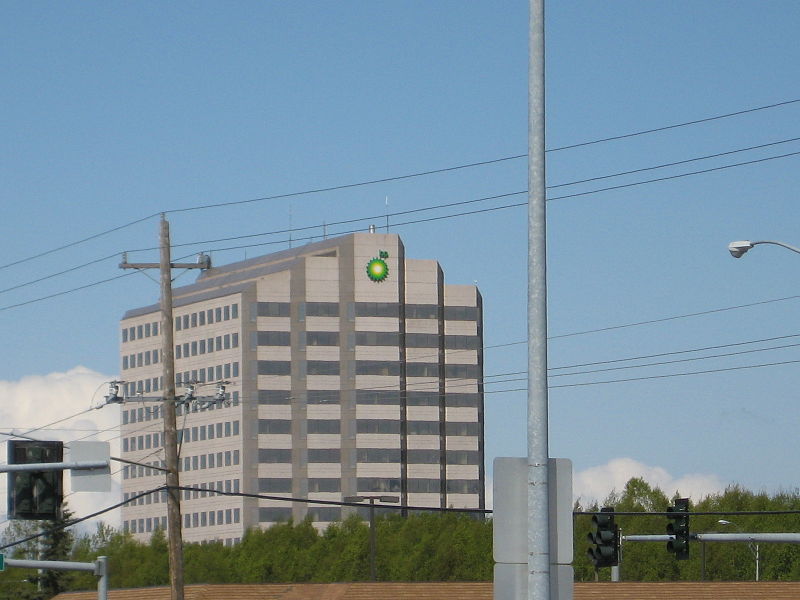
BP announced Monday that it’s selling its midtown Anchorage building. In a statement, the company says the sale will “reduce costs and free up capital, allowing BP to focus on its core business.”
BP will become a tenant in the building rather than the owner.
Spokesperson Dawn Patience declined an interview request about the sale.
The building was opened in 1985 and is assessed at more than $80 million.
State labor economist Neal Fried is reluctant to draw any major conclusions on the future of Alaska’s oil industry based on the sale.
“I guess it’s not a big surprise, given prices, and also — of course — they have lots of other expenses that have hit them over the years,” Fried said.
On May 17, 2015, John Kavairlook, Jr. was shot and killed in the parking lot in front of Walgreens after an altercation at the Rock N Rodeo Bar. He is one of the cases Fairbanks police are seeking help with using a new website. (Photo courtesy of City of Fairbanks)
May 17 marked the anniversary of the shooting death of John Kavairlook Jr. outside of the Rock n Rodeo Bar in Fairbanks.
Based on witness accounts and video surveillance, police initially went after four suspects in connection with the incident. Two of those suspects have been apprehended and remain in custody, awaiting trial.
Even though one suspect is facing murder charges, the alleged shooter remains at large.
John Kavairlook was originally from the village of Koyuk. He graduated from the Galena Interior Learning Academy in 2010 and subsequently trained as a plumber in Fairbanks.
On May 16, 2015, he took his wife Shalene to the Rock N Rodeo on the Old Steese Highway in Fairbanks for their first night out after the birth of their daughter Kinley roughly a month earlier. Charging documents suggest that Kavairlook tried to defend his wife from one of the four suspects. A fight broke out in the bar, and the men were ejected.
Shortly after, in the parking lot, one of the suspects retrieved a 9 mm Glock pistol from a silver SUV and shot Kavairlook multiple times, before all 4 suspects fled the scene.
In October, U.S. Marshals and local police in Selma, Texas apprehended Anchorage’s Joel Roland Joseph, charging him with first and second-degree murder in connection with Kavairlook’s death. At his arraignment in December, Joseph pled not guilty.
According to court documents, Joseph – despite the murder charges looming over him – is not the individual who allegedly pulled the trigger that night. Fairbanks Police Detective Peyton Merideth said.
“You don’t have to be the shooter to be charged with murder, depending on what your actions were in the case,” Merideth said. “Each case is different, of course. His level of participation in the homicide, his level of culpability raised his level to that charge.”
Joseph’s attorney Steve Wells disagreed with Meredith.
“What they have done is charge him under a theory that he essentially aided or abetted or encouraged someone else to do that,” Wells said. “We dispute that.”
Instead, Wells claims that Joseph had no interest in elevating what began as a fight in the Rock n Rodeo Bar to a homicide.
“Our defense is that Joel Joseph didn’t want him dead, or didn’t solicit his death or encourage this death or do anything to aid or abet the other fellow who did pull the trigger,” Wells said.
The identity of the alleged shooter, who remains at large, has not been revealed publically.
If Joseph knows who fired the shots that killed Kavairlook, Wells said that he doesn’t have to tell.
“Anybody has a legal right not to provide that information, Wells said. “As far as whether Mr. Joseph has that information and the extent of what he knows – that is all part of what this case is about.”
Anchorage resident Demarius Hinson was also arrested in connection with the Kavairlook shooting. Police tracked him down in Orlando, Florida last October, and arrested him on charges of hindering prosecution.
Police also arrested Joel Joseph’s older brother David in Anchorage on charges of hindering prosecution. It was David Joseph’s 9mm handgun that was used in the shooting, which he reported to police as stolen, allegedly after a phone conversation between the Joseph brothers shortly after the incident.
That leaves two people who were allegedly involved in Kavairlook’s death unaccounted for – including the man who likely fired the gun. Witnesses and video surveillance footage depict the men as African-Americans in their 20s or 30s, who traveled from Anchorage to Fairbanks shortly before the incident.
Detective Merideth said that the search for the at-large suspects continues.
“We are still trying to get information from the public to help identify these people,” Merideth said. “There could be things happening behind the scenes as well to get the identity of the other two people involved in the homicide. Everything is being done that can be done to try to identify the other two people and we are still very optimistic that the other two people will be identified.”
Both Hinson and Joel Joseph remain in custody at the Fairbanks Correctional Center. They are scheduled to stand trial for the homicide of John Kavairlook in August, though Wells is skeptical the trial will happen so soon after the initial arrests and indictments.
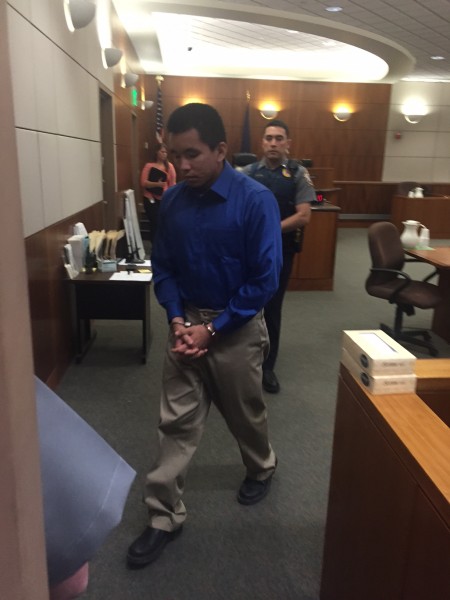
Nathanial Kangas after his conviction of the murder of two police officers (Photo by Dan Bross/KUAC)
A Tanana man has been convicted of first-degree murder for killing 2 Alaska State Troopers. Nathanial Kangas, 22, shot Sergeant Scott Johnson and Trooper Gabe Rich on May 1, 2014, as they tried to arrest his father at the Kangas home in Tanana.
Jurors spent fewer than 6 hours deliberating following a week of testimony, which included eyewitness accounts and audio recordings of the killings.
A jury of 5 women and 7 men entered a Fairbanks courtroom packed with the slain Troopers families and friends, including numerous fellow law enforcement officers. Judge Paul Lyle read the juror’s decision finding Nathanial L. Kangas guilty of murder in the first degree.
Kangas appeared subdued and somber as he has throughout the weeklong trial. Aggravating factors were applied to the verdict. District Attorney Greg Olsen says that should increase the sentence Kangas receives.
“Ultimately, the sentence is up to the judge,” Olsen said. “But under the statute, if you commit first-degree murder and the jury makes a special finding like they did against a uniformed or clearly identifiable police officer doing their duty, it’s a mandatory 99-year sentence. No eligibility for parole.”
Kangas was also found guilty of assault for pointing a gun at Tanana’s VPSO, and tampering with evidence for disposing of marijuana in the house after the killings. He was found not guilty of tampering with the officer’s service weapons, a charge his father, Arvin Kangas was earlier convicted of. A sentencing scheduling hearing is set for Friday. Olsen expects the case to be appealed.
Close
Update notification options
Subscribe to notifications
Subscribe
Get notifications about news related to the topics you care about. You can unsubscribe anytime.