GLENNALLEN — A 55-year-old passenger riding in a sport utility vehicle died Tuesday night in a one-vehicle crash on a remote interior Alaska road.
Helen West of Slana died as she was being transported to a hospital after the crash.
Alaska State Troopers say West was a passenger in an SUV driven by 29-year-old Vanessa Murphy of Slana on Nabesna Road about five miles south of the Tok Cutoff.
Murphy was driving east when she lost control.
The SUV entered the ditch and rolled, ejecting Murphy and West.
Slana emergency responders transported both women.
Troopers say Murphy died on her way to the Gulkana Airport, where a LifeMed aircraft was waiting to transport her to a hospital.
Three races for open seats have drawn a quarter of all spending by state legislative candidates ahead of the primary election Tuesday. (Creative Commons image by Moritz Wickendorf)
State legislators who aren’t running for re-election have created openings drawing big spending ahead of the primary election Tuesday.
A quarter of all spending by legislative candidates has been in just three races for open seats, but it isn’t clear whether those who’ve spent the most will be able to convert that into votes.
The races to replace Anchorage Republican Lesil McGuire and Democrat Johnny Ellis in the Senate have drawn the most spending this year.
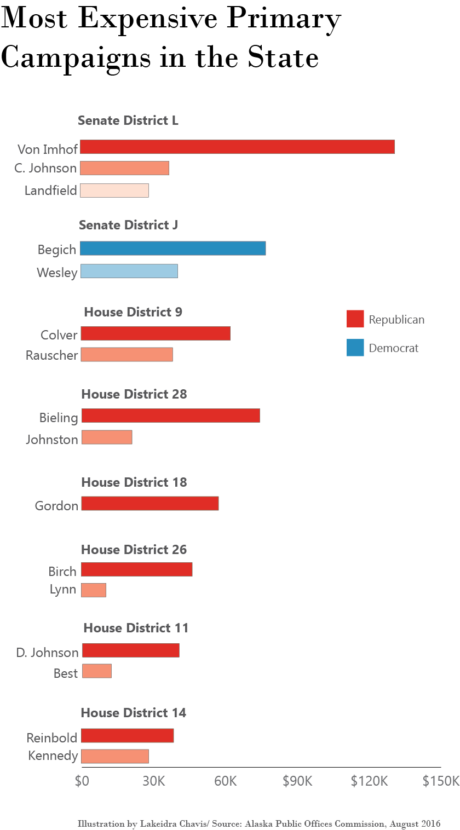
Republicans Natasha Von Imhof, Rep. Craig Johnson and Jeff Landfield are running to replace McGuire. Von Imhof has spent more than any other candidate this year, $131,000.
Von Imhof has been able to draw financial support from many individual donors, she said.
She attributes that to both her positions on putting state spending on a sustainable footing and the contact she’s had with many Alaskans through her work on the Rasmuson Foundation board and through commercial lending.
“I’ve visited many of the industries that fuel our state’s economy, including visiting mines,” Von Imhof said. “I’ve been on oil rigs, I have been on cruise ships, fishing vessels. I’ve seen the timber industry at work.”
Through Tuesday, her campaign spent twice as much as Johnson, $37,000, and Landfield, $29,000, combined.
While Johnson said spending is always a concern, he feels good, based on face-to-face contact with constituents.
“As I go door to door, I haven’t seen the negatives, and quite frankly, I haven’t seen $130,000 worth of spending out of Natasha,” Johnson said. “I mean, we’ve got a week left, and I don’t know where she spent her money.”
Johnson added that there will still be plenty of spending in the next week, so the snapshot of spending through Tuesday is incomplete.
Landfield is spending his money more efficiently than the other two candidates, he said.
“I have my Make Alaska Great Again hats, which are kind of a Trump parody gimmick – and people love those,” Landfield said. “And I got these really unique signs up in Anchorage that are really different. I mean, everything about my campaign is different. So I can spend a dollar and, for Craig or Natasha – especially Natasha – they have to spend probably $5.”
The second most expensive race is between Democrats Tom Begich and Ed Wesley, to replace Sen. Johnny Ellis.
Begich said his many years of community involvement led to individuals contributing to his campaign.
“Many of those are folks that have not given at all in the past and have worked with me, whether it’s neighborhood work, or whether it’s some justice work I’ve done, or just general work I’ve done in communities in the past,” Begich said.
Wesley is concerned about the amount of spending in the primary. He’s spent the seventh-most of any statehouse candidate, but only a little more than half of his opponent. He said he’s turned down money from labor unions and other groups.
“Special interest money has created fear and greed in the legislature, and has an undue influence on our legislature,” Wesley said.
The Republican primary race to replace Anchorage Rep. Mike Hawker is the fourth most expensive race. That race pits Ross Bieling against Jennifer Johnston.
Other expensive primary races have major implications for the future of state finances. The third-most expensive race is the Republican primary between Representative Jim Colver and challenger George Rauscher, both of Palmer.
The Colver-Rauscher race has been at the center of more than a third of all independent expenditures in favor or opposing candidates this year. It’s fueled by labor unions and corporations. When independent expenditures are added to campaign spending, the challenger Rauscher has benefitted more than the incumbent Colver.
Overall campaign spending on legislative races is up slightly from the same point in the last election, when the race for governor was at the top of the ballot.
This might be an only-in-Alaska problem: A restaurant in Fairbanks that has told customers since 2013 it was serving reindeer tenderloin was actually giving them elk.
The Pump House has been fined $50,000 by the state for mislabeling the meat.
The parent company of the restaurant agreed to pay the criminal fine, donate $10,532 to three non-profit food groups and publically apologize.
Restaurant co-owner Vivian Bubbel said an advertisement with the apology ran Saturday in the Fairbanks Daily News-Miner.
The restaurant would have no additional comment, she said.
The state Department of Environmental Conservation investigated.
An employee reported the restaurant had not served reindeer in the years he worked there and the restaurant manager confirmed the use of elk.
The menu described reindeer tenderloin as “similar to caribou and raised in Western Alaska where they are harvested by the Native people.”
A recreational vehicle crashed into the back of a tour bus Sunday on the Richardson Highway, or Alaska Route 4, injuring more than a dozen people.
The northbound bus was making a left turn off the highway to the Princess Lodge in Copper Center, when the RV hit it, according to Alaska State Troopers.
The accident occurred at mile 101 on the Richardson.
13 bus passengers were taken to hospitals by ground or air ambulance, Trooper spokesman Tim Despain said. Two Life Flight airplanes and a helicopter assisted in the transport. Despain said there is no word yet on the severity of the injuries.
The driver of the RV was Jesse Johnson, 47, of Anchorage. It wasn’t clear whether Johnson will face citations.
Three passengers were in the RV. The bus, operated by North Pole Tours of Fairbanks, carried 32 passengers.
ANCHORAGE — The only road into Alaska’s Denali National Park is expected to completely reopen Tuesday if the weather cooperates and steep terrain nearby remains stable.
A mudslide July 31 closed the road a mile beyond the Eielson Visitor Center, where most tour buses turn around to return to the park entrance.
The slide put an estimated 8,000 cubic yards of material on a 100-foot section of the road and covered it about 10 feet deep.
Park officials in an announcement say steep terrain and near-record rain in July that saturated fine-grain, ancient volcanic ash contributed to the slide.
Park geologist Denny Capps says slides may become more common as permafrost melts and weather events become more intense.
Buses have been allowed past the slide area twice daily.
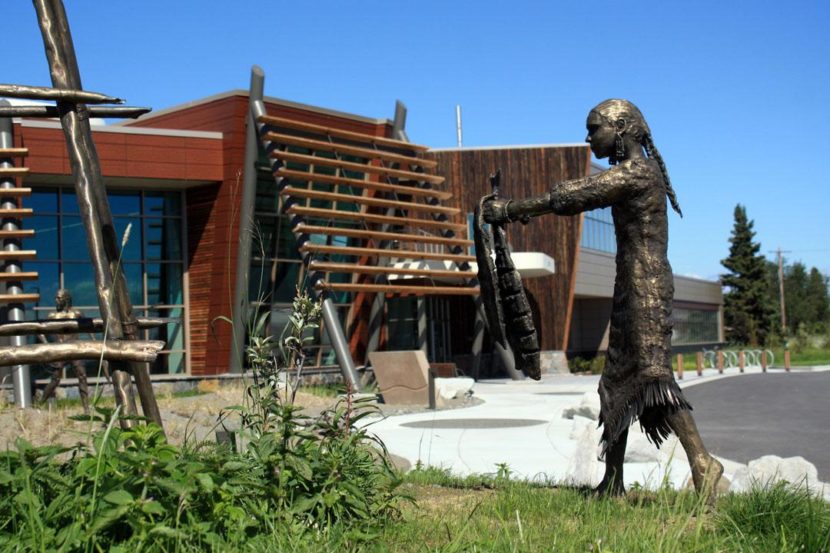
A “Łuq’a Nagh Ghilghuzht” sculpture by Joel Isaak depicts traditional Dena’ina life at fish camp outside the Kenaitze Indian Tribe’s new Dena’ina Wellness Center in Old Town Kenai. (Photo by Patrice Kohl/Redoubt Reporter)
Alaska got a glowing report in a checkup from a top federal health care official. Though there are issues that need further treatment and support, communities showed a healthy dose of innovation in delivery and integration of care.
Mary Wakefield, acting deputy secretary for the U.S. Department of Health and Human Services, toured Alaska from Aug. 1 to 4, visiting Barrow, Fairbanks, Circle, Anchorage and Kenai. But she wasn’t bringing a prescription from Washington. Instead, she got ideas for the treatment of health care in rural communities that can be brought to other areas of the country.
“I’ve seen some phenomenal examples of Alaska Native and American Indian communities that are really focused on comprehensive services that are delivered effectively and very efficiently on behalf of their communities. So there’s some wonderful examples to draw from this state and from these communities and try to think about how we might apply some of these examples in other parts of the United States,” Wakefield said.
HHS provides funding for a wide range of community services. A big part of the department’s presence in Alaska is through Indian Health Services, which funds facilities and programs administered through Native tribes throughout the state.
During her visit to Kenai on Aug. 4, Dr. Wakefield toured the Kenaitze Indian Tribe’s Head Start program, elder center, tribal court and Dena’ina Wellness Center, which offers medical and dental care, behavioral health services and a wide variety of general health and wellness programs. The center provides care to Alaska Native and American Indian people. Behavioral health services are available to anyone in the community.
Jaylene Peterson, executive director of the Kenaitze Tribe, says it was an honor to meet with Dr. Wakefield.
“This is an unprecedented visit. It was an amazing time that we were able to share with the deputy secretary, and we were able to show her what we’ve been able to accomplish with funds that have not always met the true need. So we’ve been blessed by this trip. I believe that she has learned much about the Alaskan community and why things are so different and more challenging here in an Alaskan setting,” Peterson said.
Peterson hopes the visit will help remove some stumbling blocks that come with HHS funding. She says that some of the reporting and training requirements can be onerous.
“I don’t disagree that we should be accountable for the funds that we receive, but sometimes it can be a lot more than should be required. So, there are ways that I believe that we can be smarter with our money,” Peterson said.
Primarily, though, the tribe wanted to show its holistic approach to health care.
“It’s just phenomenal. The leadership, the commitment, the approach that is innovative in terms of the integration of a wide range of services on behalf of the people who are served here is absolutely exceptional,” Wakefield said.
Before her trip to Kenai, Wakefield participated in a summit in Wasilla on opioid abuse.
“It is an absolute epidemic in every state the across the country, including right here in Alaska. And there are some pretty serious problems in communities within the state that are really adversely impacting families and putting special burdens on law enforcement, (and) special burdens on health care providers,” Wakefield said.
She says the Obama Administration is focusing efforts on making sure health care providers have the clinical skills necessary when prescribing opioids, closing the gap between people who want treatment and access to that care, and making sure people who have overdosed have immediate access to life-saving medications.
Among its many social services, the Kenaitze Tribe offers a chemical dependency recovery program.
Close
Update notification options
Subscribe to notifications
Subscribe
Get notifications about news related to the topics you care about. You can unsubscribe anytime.