FAIRBANKS — A top administrator for the city of Fairbanks has been charged with driving under the influence of alcohol or drugs and leaving the scene of an accident.
The Fairbanks Daily News-Miner reports chief of staff Jeff Jacobson was arrested Thursday after knocking down a light pole and signs and continuing on at high speed.
Jacobson is the former mayor of North Pole and a former chief of staff for a Fairbanks North Star Borough mayor.
Jacobson told police he took a prescription drug and was in bed but received a call from his son, who needed his wallet before boarding a flight.
Police say Jacobson’s breath alcohol content measured .024, below the legal driving limit of .08.
Online court documents do not list an attorney for Jacobson.
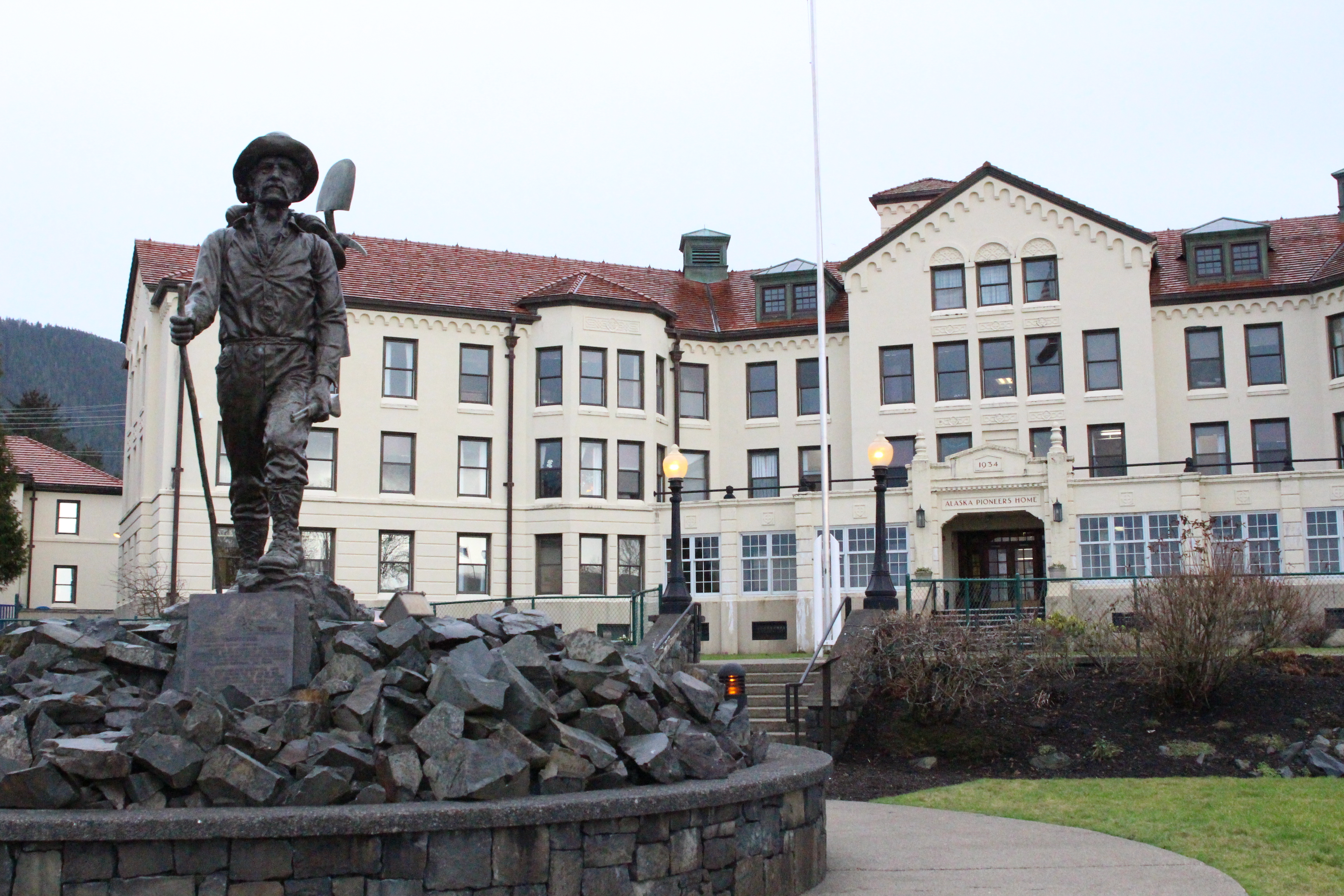
The Sitka Pioneer Home was the first such facility. It and others in Ketchikan, Juneau, Anchorage, Palmer and Fairbanks have lost staff due to budget cuts. (Photo by Emily Kwong/KCAW)
Alaska’s Pioneer Homes have stopped accepting new residents, at least for a while. It’s one more impact of state budget cuts.
The state’s six homes usually serve about 440-450 Alaskans at any given time.
State Pioneer Homes Division Director Vickie Wilson said reduced funding is dropping that number by about 30, or 7 percent.
“They are beds that we are not filling because we don’t have adequate staff to be able to ensure good, safe care,” she said.
Wilson’s agency has lost 30 positions, mostly because of attrition. And since senior care is labor-intensive, fewer people can be housed.
Jacque Farnsworth and Jack Brandt play for Juneau Pioneer Home residents earlier this year. (Photo by Lisa Phu/KTOO)
That means the homes, three in Southeast and three in the Railbelt, can no longer accept new residents in the highest category of care. It’s called Level 3, and it’s pretty much like a nursing home, with 24-hour, hands-on assistance.
“Right at the moment, it’s all six of them. No one’s taking any of the level 3s right at this point,” she said.
More than half of all residents, and a large number of applicants, are in that category. Two lower levels, different types of assisted-living care, require less staffing.
Wilson said seniors seeking such care might have a chance to get a bed. But, probably not right away.
“We would look carefully at their level of care and see if we could manage them with the staff that we have,” she said.
“This is devastating,” said Ann Secrest, communications director for the Alaska branch of AARP, a nationwide senior advocacy group.
She said Alaskans are living longer and staying at home as late as they can. But there comes a time when more care is required. So pioneer home cuts remove a much-needed option.
“The majority of individuals are cared for at home. There are approximately 120,000 and 128,000 Alaskans who serve as unpaid family caregivers. So there’s going to be more of a burden put on those unpaid family caregivers throughout the state,” she said.
Alaska, overall, falls far short of providing the care its seniors desire.
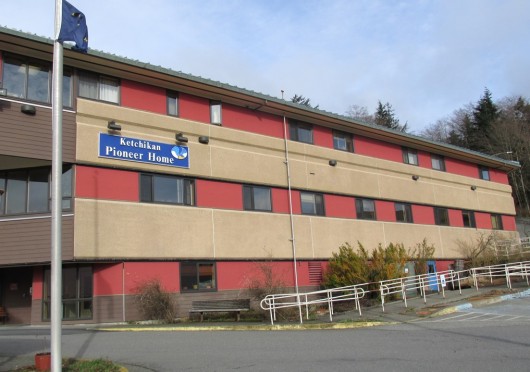
The Ketchikan Pioneer Home is one of six in Alaska caring for older residents. (Photo by KRBD)
“We have the fastest growing senior population in the nation, by percentage. There’s nothing much we can do about that,” she said.
She said it’s no surprise pioneer homes are facing cutbacks. But she objects to those who say reductions don’t have to affect services.
“Some people call it the low-hanging fruit. I don’t. We’ve already cut all of that off. We’re now into the mid-level branches,” she said.
Residents, or their families, do pay for part of their care. Charges run from about $2,500 to $7,000 per month.
The state considered turning the homes over to the private sector to save money. But it’s dropped that idea, though services such as pharmacies could still be privatized.
Of course, beds open up as residents die. Pioneer Homes Director Wilson said 20 to 25 percent of beds become available each year.
That could allow more new residents in. But Wilson said that’s only if funding remains the same.
“Being a realist, as we take cuts, we will continue to have to consider that more beds will have to be cut,” she said.
Even in better times, it’s hard to get into a pioneer home. As of mid-summer, close to 600 people were on the active waiting list.
The inactive list, those waiting until they’re in greater need, is much larger.
Note: Finding residential care is just one of the challenges facing older Alaskans and their families. CoastAlaska’s Aging Southeast series, produced earlier this year, describes other concerns.
A poll watcher helps Newtok resident Bosco John, 27, vote during Tuesday’s election. It was the village’s first time using a digital machine. (Photo by Mareesa Nicosia, The 74)
Alaskans ejected as many as five incumbents from the House in the primary Tuesday. And they also rejected two House members who tried to move up to the Senate.
But not many people showed up to vote: It was the lowest turnout for a primary in state history.
Three Republican incumbents and two Democrats who caucused with the Republicans trailed their opponents in a primary that drew only 15 percent of voters, not counting outstanding absentee ballots.
House Majority Leader Charisse Millett attributed both incumbents’ headwind and the lowest-ever turnout to the same factor – low oil prices that have hurt Alaska’s economy and the state budget.
“When you are in a deficit, I think … it’s depressing,” Millett said. “People want to get and vote for, you know, candidates that are upbeat, and it’s hard to be upbeat in this environment.”
A lack of highly competitive statewide races also contributed to the low turnout.
Millett, who was unopposed, said it was a tough year to run for re-election.
“People are looking for someone to blame for the falling oil prices and … a sitting legislator is an easy target,” Millett said.
It’s not yet clear how the primary will affect the balance of power in the Legislature.
If the current totals hold up and Republicans continue to hold the majority, then they will have to do so with two fewer Democrats joining them — Bob Herron of Bethel was defeated by Zach Fansler, and Benjamin Nageak of Barrow trails Dean Westlake of Kotzebue (by five votes).
Casey Reynolds, who edits the political blog The Midnight Sun, said this year’s special sessions kept incumbents in Juneau and away from their districts. With the apparent losses of Herron and Nageak, he sees the chances of a bipartisan coalition increasing.
“A bipartisan organization is more likely today than it was before the election,” Reynolds said. “And the general election is going to be very important. It’s really going to be the deciding factor on this one.”
One Republican who showed a willingness to cross party lines lost.
George Rauscher defeated Republican Rep. Jim Colver in a district that sprawls from Valdez through parts of Palmer to Big Delta.
Business groups targeted Colver after he voted to reduce oil and gas tax credits.
Other incumbents who lost include Wes Keller of Wasilla, defeated by David Eastman, and Bob Lynn of Anchorage, defeated by Chris Birch.
Rauscher had said Colver was likely to join a bipartisan coalition with Democrats, though similar comments aimed at other candidates didn’t succeed.
In Palmer, Richard Best lost after making a similar charge against DeLena Johnson. And Homer incumbent Paul Seaton won, despite, he said, being subjected to disturbing and unfounded charges..
“It was the most negative campaign I’ve ever seen on the lower peninsula,” Seaton said.
State Republican Party spokeswoman Suzanne Downing said the party has room for improvement in turning out voters in the November general election.
“Every single district could improve their voter turnout, and I think as a party we’re going to work a lot harder on that for the general,” Seaton said.
Rep. Lora Reinbold won the Republican nomination for her seat. (Photo by Anne Hillman/Alaska Public Media)
The only legislator who isn’t a member of either caucus – Eagle River Rep. Lora Reinbold – was re-elected. The Republican caucus expelled her in 2015 after she refused to support a caucus-backed budget. She says she wants to rejoin the caucus and work with them to set their principles for the next term.
“And alls I’m asking is that we stick with those principles,” Reinbold said. “And that’s why it’s really important, the team that we send down there. And we’re just hoping that we’re lock-in-step and stay under the umbrella of our principles.”
While most competitive races were in the House, the state’s most expensive race was in an Anchorage Senate district, where Natasha Von Imhof defeated Rep. Craig Johnson and Jeff Landfield.
Another representative, Lynn Gattis of Wasilla, was defeated by David Wilson in her attempt to move up to the Senate. Rep. Shelley Hughes succeeded in winning the Republican nomination to succeed Sen. Bill Stoltze.
Tom Begich defeated Ed Wesley to be the Democratic nominee to succeed Sen. Johnny Ellis in his Anchorage district. Forrest McDonald defated Roselynn Cacy for the Democratic nomination to face Von Imhof.
In the House, Jennifer Johnston defeated Ross Bieling, who ran the best-funded House primary campaign, to be the Republican nominee to succeed Rep. Mike Hawker in Anchorage. Gary Knopp defeated three opponents to be the Republican nominee to succeed Rep. Kurt Olson in the Kenai Peninsula. And Don Hadley deated Lisa Vaught to be the Republican nominee to face Democratic Rep. Ivy Spohnholz in Anchorage. Colleen Sullivan-Leonard will be the Republican nominee to succeed Gattis in Wasilla. And incumbent Republican Representatives Dan Saddler, Liz Vazquez, Lance Pruitt, David Talerico and Mark Neuman defeated challengers.
The state Division of Elections still has to count absentee and questioned votes, and the results will remain unofficial until they’re certified in early September.
Anne Hillman of Alaska Public Media and Shahla Farzan of KBBI contributed to this report.
Sonia Sotomayor, the first Latina appointed the nation’s highest court, spoke Sunday at the University of Alaska Fairbanks during a UAF Summer Sessions event.
U.S. Associate Supreme Court Justice Sotomayor addressed a capacity audience in Fairbanks.
”I understood then that I had to live every minute of my life as fully as I could,” Sotomayor said.
Sonia Sotomayor shared a very human perspective on the Supreme Court. The 62-year-old traced her path to the nation’s highest court, from her New York City upbringing, where she said she took charge of her life at a young after being diagnosed with diabetes and given an uncertain health future.
Sotomayor went on to become an outstanding student, graduating from Princeton and Yale, and working her way through the legal system, ultimately being appointed to the Supreme Court by President Barack Obama in 2009.
She said she initially felt like an outsider, but learned from other justices, including John Paul Stevens who she said emphasized the importance of speaking out.
”Because there is a pull in a group setting, in a collective, for people to try to agree with each other. And that’s not unimportant. But every once in a while, you have to make a statement because it’s important to say.”
The opposite of a stern judge, Sotomayor spent the hour-and-half event walking around the Davis Concert Hall, answering questions, while shaking hands and sometimes hugging and taking pictures with audience members.
Sotomayor fielded a range of questions submitted over the summer.
She singled out curiosity, when asked what the most important attribute is for a high court justice.
”Experts in the sciences and medicine and every human endeavor come to court to ask us to answer their questions. And the only way we can do that is, do we have sufficient curiosity.”
Sotomayor also was asked about her experience as a woman on the male dominated high court. She reiterated a story told to her by fellow justice Ruth Bader Ginsberg.
“There’s a lot of moments I say things at conference, and it’s like I’m not heard. And somebody will come after me, and they say exactly the same thing and all of a sudden it’s brilliant.”
Sotomayor emphasized the importance of women projecting their voice like an actor or singer, and being assertive, noting she’s considered tough.
”I’m a pussycat inside. So it’s really hard when people say they’re scared of me because I can’t understand why. At least myself I can’t understand why. But I do think that I’ve been blessed with an assertive personality.”
Asked to give advice to Alaska Native students entering university, Justice Sotomayor pointed to the significance of shared values, saying there is nothing innately wrong with the majority.
”It is a majority because that’s the way life is. They’ve been here. They grew this community. They’ve created this world. Learning about it will teach us some things that will be valuable for our Native villages or for our Native homes. And some things we can look at and say ‘You guys got it wrong.’”
Sotomayor also will participate in a public “conversation” sponsored by the Alaska Bar Association on Wednesday, Aug. 17, at the Dena’ina Civic and Convention Center, the Alaska Daily News reported.
FAIRBANKS — Rules for cannabis cafes outside Fairbanks will be delayed for three months.
Fairbanks North Star Borough on Thursday put the matter on hold.
The state Marijuana Control Board says cannabis cafes will be allowed as attachments to retail pot stores.
But borough assembly members say they want state regulations in place before they decide what to do locally.
Assemblyman Matt Cooper proposed the delay. He says he feels as if local officials are currently operating in a vacuum.
The borough is considering zoning rules for cannabis cafes that would require notification to neighbors, a public hearing and a planning commission vote.
The delay on adopting rules applies only outside of Fairbanks and North Pole. Those cities have their own marijuana regulatory powers.
Close
Update notification options
Subscribe to notifications
Subscribe
Get notifications about news related to the topics you care about. You can unsubscribe anytime.