A display of Alaska sea salt products. (Tash Kimmel/KCAW)
An article by Fairbanks writer Amy Loeffler will appear in the prestigious national anthology “Best American Food Writing,” which will be released next week by Harper Collins.
“Human beings have really evolved to have this mineral be a very fundamental part of our body chemistry,” Loeffler said. “We literally would die without salt.”
Loeffler is a science writer. Her story chosen for the 2023 edition of Best American Food Writing is about the science of salt in relation to sex and love throughout human history.
“We typically do associate love and sex and everything that has to do with romance as being sweet. And doing research, I found some scholarship — you’re really talking about the nitty gritty of sex and lovemaking, you’re talking about a lot of things that are made with salt and are salt-inspired,” she said.
Amy Loeffler (Robyne/KUAC)
To explain a little of the effects of salt on the human brain, she spread out a sampler of foods and salts for a tasting.
“So, what happens when you put salt on fruit? In tropical countries, where there’s a lot of fruit, people tend to salt their fruit because sodium ions interact with your tongue to tamp down bitterness. They neutralize the taste buds that receive bitterness, and the fruit actually tastes sweeter when you salt it,” Loeffler said.
She says that, when she met a chef who was drying out water from the Atlantic Ocean to make her own sea salt, it inspired Loeffler to research the different types and tastes of salt.
Soon she was writing about salt and attracting the attention of chefs and foodies like former New York Times food editor Mark Bittman, who edited the articles in this year’s edition of Best American Food Writing. She says salt is a mundane mineral, but we can’t live without it. It is also a cosmic element ound in space and star matter.
“I went down this huge rabbit hole learning about salt,” she said. “How has salt figured into human history? And it really has been a prime ingredient in human culture and existence, including sex.”
The book comes out on Oct. 17, but Loeffler’s article was first published last year, in Whetstone magazine.
Kenzie Englishoe stands by an idle fish wheel once used by her community in Gwichyaa Zhee on Aug. 31, 2023. (Matt Faubion/Alaska Public Media)
In August, MacKenzie Englishoe returned home to a place she’s never actually lived.
Englishoe is 20 years old, a student at the University of Alaska Fairbanks. As summer waned, she packed her bags and boarded a nine-passenger plane for the hour-long flight to her mother’s hometown: Gwichyaa Zhee, also known as Fort Yukon, a village of less than 500 people on the upper Yukon River. The plan is to move here permanently.
“I feel like I’ve been waiting my whole life to come back here and be in my community,” Englishoe said.
For Englishoe, this move has been a long time coming. Her mother’s family has lived in Gwichyaa Zhee for generations, but Englishoe herself grew up with her dad and brother near Chandalar Lake, in a remote stretch of the Brooks Range. She moved to Fairbanks when she was 12 to attend school. But she visited regularly. Gwichyaa Zhee is where she feels most rooted.
Like most of the village, Englishoe is Gwich’in. She grew up deeply connected to the land up at her father’s cabin near Chandalar Lake, trapping and hunting from a young age. But she feels like she missed out on being in the village, among her people.
“I just wish I had a little bit more of a stronger connection to [Gwichyaa Zhee] when I was younger,” she said.
Now that she’s back, she’s making up for lost time.
Gwichyaa Zhee sits on a flat network of dirt roads that hug the Yukon River. The speed limit is 15 miles per hour, and most people greet each other as they pass.
“Everybody here waves to each other,” Englishoe said, driving through town the day after she arrived. “We’re pretty much all family here.”
Running errands, she runs into relatives and elders: at the local AC store, the post office and during open house at the school.
“I’m back for good,” she told each one with pride.
The town of Gwichyaa Zhee. (Matt Faubion/Alaska Public Media)
But Gwichyaa Zhee today is very different from the village she remembers visiting as a kid.
Life here used to revolve around salmon. The first kings would arrive in late June, swimming up the Yukon River from the Bering Sea to their spawning grounds. Chum salmon would follow in late summer. Both species had struggled for decades. But four years ago, the runs abruptly collapsed, with fewer fish than ever returning to the Yukon River. State and federal fishery managers have all but shut down fishing for communities like Gwichyaa Zhee ever since.
Researchers say climate change is driving the collapse, as warmer river and ocean water temperatures wreak havoc with the salmon’s biology and prey species. Residents say it’s made life here unrecognizable. For Englishoe, it means she can’t participate in the very culture and traditions she came home to learn.
Along the bank of the Yukon River, at the edge of town, it’s quiet. That’s not what August used to feel like, Englishoe said.
“Everyone would be hopping on boats to go to fish camp or visiting each other, or giving fish to each other, smoking fish together,” she said.
Now, on the riverbank, half a dozen fish wheels lie idle, in what Englishoe calls the “fish wheel graveyard.”
Twenty feet across, the fish wheels look like big windmills, with nets that would scoop fish out of the river as they swim upstream.
“You could tell they’re getting kind of old, and a little bit more fragile,” Englishoe said, picking through the tall grass growing up through the nets.
Standing on one of the toppled wheels, she imagined what it was like when fishing was allowed.
“You would probably sit right here and you would just watch the nets catch the fish,” Englishoe said. “I bet my grandpa was just smiling, watching it, knowing that he was going to be supplied for the winter.”
In Gwichyaa Zhee, salmon are more than just food — they’re culture and community.
Englishoe’s uncle Michael Peter is second chief of Gwichyaa Zhee. He said going to fish camp is how young people build a connection to their family and their heritage. It’s an essential part of passing on traditions.
“You take your kids out, teach them and show them what we were taught,” Peter said. “We were taught how to cut and preserve and smoke fish.”
Peter has kids of his own who haven’t been to fish camp in years. He worries that knowledge is being lost for the next generation, including young people like Englishoe.
“She’s still learning how to cut fish. And she hasn’t really been to fish camp,” Peter said.
“I wish I could go to fish camp,” Englishoe said.
Kenzie Englishoe (right) with her uncle Michael Peter outside their home in Gwichyaa Zhee. (Matt Faubion/Alaska Public Media)
As a kid, she wasn’t around enough to learn to use a fish wheel and catch salmon herself. And now that she’s finally here full time, Englishoe worries she never will.
Every generation of her family before her has fished on this river. And now it’s her turn and she can’t.
“It’s hard,” she said. “I almost feel like I’m missing a part of myself.”
This loss has fueled a sense of purpose. Englishoe said she feels a responsibility to help save her community from existential threats like climate change. She’s become an advocate for climate justice and Indigenous rights. She serves as an Arctic Youth Ambassador, a program through the U.S. Fish and Wildlife Service that helps young Alaskans spread awareness about challenges in their communities. This spring she was chosen as an Emerging Leader for the Tanana Chiefs Conference.
She’s particularly focused on fighting for more Alaska Native control over fishery management.
It’s a lot of pressure: advocating for action on climate change and more tribal sovereignty. She’s considering putting her undergraduate studies on hold to take a position in the village mentoring youth.
“It’s overwhelming, but I’m happy to do it,” Englishoe said.“Because if our generation doesn’t do it, then there’s no one to be able to get that fish back for our future. It’s something that we have to do now.”
On a rainy September morning, Englishoe sat with her grandfather, Sonny Jonas, at his kitchen table with a cup of coffee. Photos of their family going back generations line the wood-paneled walls of his house.
For years, Jonas taught kids in Gwichyaa Zhee how to fish and make fish wheels. If Englishoe had grown up here, or if fishing were open now, he’s the one who would have taught her.
Jonas has watched climate change transform the Yukon Flats, just in his lifetime. It’s not just the salmon. Thawing permafrost has caused houses to cave in. He says summers are unrecognizably warm.
Sonny Jonas (left) at his home in Gwichyaa Zhee sharing stories of his younger life with his granddaughter Kenzie Englishoe. (Matt Faubion/Alaska Public Media)
“There’s a lot of changes around here, I’ll tell you,” Jonas said.
The changes are alarming, he said. But he sees hope in his granddaughter.
“I’m glad for what she’s doing right now,” Jonas said. “She’s really trying to get into our culture. And I’m really proud of her for that.”
As for Englishoe, she’s still learning that culture — and she’s determined to keep it alive, for herself, and future generations.
“That’s why I moved back. Because I know this is where I’m meant to be and I’m meant to have my future family,” she said. “And try my best to give them a better life.”
A gate sign at Fort Wainwright (Eve Baker/Fort Wainwright Public Affairs)
Two Fort Wainwright-based soldiers were killed and a dozen others were injured Monday in a military vehicle crash near Salcha.
John Pennell, a spokesman for the Army’s 11th Airborne Division, said the two soldiers who died were among 17 in a tactical vehicle that crashed on the way to the Army’s Yukon Training Area on Monday morning.
“There was a driver and assistant driver, and then 15 soldiers were traveling in the back in the transport area, and at some point the vehicle left the road and turned over,” Pennell said.
According to an Army statement, the injured were transported by road and air to Fairbanks Memorial Hospital. Pennell said two of the more seriously hurt were subsequently flown to Anchorage.
He says the names of the soldiers killed in the crash will be withheld, pending notification of their families.
Alaska State Troopers, the North Pole Fire Department and Eielson Air Force Base assisted in the response.
An investigation is underway to determine the cause of the crash, which occurred as the season’s first snow fell across the region.
An aerial view of Fort Yukon Alaska on Tuesday evening, August 29, 2023. (Matt Faubion/Alaska Public Media)
Without salmon, Gwichyaa Zhee is missing its heart.
“It’s just no good,” said Linda Englishoe, sitting on the sofa in her house not far from the Yukon River. Englishoe is an elder who has lived in the village for her entire life.
There are signs of fall in Englishoe’s house — a pan of apples and cinnamon on the stove, a tray of lowbush cranberries waiting to be processed. Fall usually also means the arrival of chum salmon on their journey upriver, but this year, the run is a fraction of the size it once was.
Without fish, Englishoe said, nothing in the village is the way it’s supposed to be. The smokehouses, normally full of salmon drying for the winter, are empty. Even the smell of town is different.
“It used to smell so good, smelling those fish,” Englishoe said. “Ooh, I used to just sit outside, smelling.”
The town of Fort Yukon on Thursday, August 31, 2023. (Matt Faubion/Alaska Public Media)
Gwichyaa Zhee is the Gwich’in name for Fort Yukon. The village sits on the upper Yukon River 150 miles northeast of Fairbanks. It’s home to less than 500 mostly Gwich’in Athabascan people, many of whom are related and have deep ties to other communities all along the river and into Canada. Small homes, many with large moose antlers mounted above the door and snow machines or four-wheelers in the yard, sit on a sprawling grid of dirt roads and flat tundra. People here are used to sharing food with one another.
Life in Gwichyaa Zhee revolves around the Yukon River, which is wide and braided where it passes by town. Its silty waters barely make a sound winding through scalloped islands and sandbars. This river used to be full of fish and busy with families traveling back and forth from fish camp, Englishoe said.
“Everyone would visit each other along the river,” She remembered.
Now, the riverfront is quiet, except for a few hunters heading out to try for moose.
The Yukon river on Tuesday, August 29, 2023. (Matt Faubion/Alaska Public Media)
Englishoe is one of the 15,000 people living along the Yukon River who are feeling the effects of the salmon collapse, from the Bering Sea to the river’s headwaters in Canada.
The river’s once-strong king salmon run has been on a long, slow decline since the 1990s. Chum salmon runs have also been unpredictable. But in the last four years, both species’ runs abruptly crashed.
Researchers are still unsure exactly what is driving the collapse. Scientists say climate change probably plays a big role, raising the temperature of river water and potentially affecting the availability of prey species at sea. Many people along the river also blame bycatch from the Bering Sea trawler fleet and commercial salmon fishing along the Aleutian chain.
This year, the king salmon run was less than a fifth of its normal size. This summer, for the fourth year in a row, fisheries managers closed almost all king and chum fishing along the Yukon River in Alaska to try to ensure as many fish as possible make it to their spawning grounds.
That means, in Gwichyaa Zhee, there’s no salmon to eat, and no salmon to put away for the winter.
Michael Peter outside his home in Fort Yukon morning. September 1, 2023. (Matt Faubion/Alaska Public Media)
Michael Peter worries about young people — his kids — losing a part of their identity.
Peter is second chief of Gwichyaa Zhee. He grew up learning to cut fish from his grandmother. Summers at fish camp connected him to his community, the river and his family from a young age. But now, he said, instead of spending the summer working together on the river, people are at home.
“A lot of our young people are kind of lost, because of not having our traditional foods and showing them our traditional values, and teaching them, going to fish camp,” Peter said.
For him, fish camp served as a “spiritual awakening,” Peter said. He worries younger generations are missing out on their opportunity to carry on the tradition.
The salmon collapse has also made daily life harder. Without fish, people have to rethink what they eat. Many families are hunting more, Peter said, but fueling up a boat to hunt for moose or shoot geese can cost $9 per gallon. Grocery shopping at the local AC store costs three times what it would in Anchorage.
Year-round work is limited in Gwichyaa Zhee, and Peter said, without fish it’s hard to make ends meet.
“A lot of people are migrating to the city,” he said.
For people in Gwichyaa Zhee, the salmon collapse is just one of a cascade of outside threats.
Recent floods destroyed fish camps up and down the river. Floods like that could become more common, as climate change drives more unpredictable spring river breakups and extreme weather. Peter also worries that oil development like the Willow project and proposed mining in the Brooks Range will threaten caribou herds his community relies on for subsistence. These projects do have support from some communities and Alaska Native leaders, even as Peter and others see them as threats.
“It seems like we’re being attacked all at one time, without any consideration for our future — our kids, our land, our animals, our air, our water, our climate,” Peter said. “The earth can only sustain so much.”
Peter and other residents want Alaska Native people to have more control over how the river and other resources are managed. Currently the U.S. Fish and Wildlife Service and Alaska Department of Fish & Game set limits on subsistence fishing when the runs don’t meet the escapement goals and quotas set out in a decades-old treaty with Canada.
Peter represents the Yukon Flats in the Yukon River Intertribal Fish Commission executive council which develops recommendations for fishery management. He and other Yukon residents are pushing to establish tribal co-management rights for Yukon River salmon. They’re looking at the Kuskokwim River where 33 federally-recognized tribes work in partnership with state and federal agencies to make management decisions, as a model.
“We shouldn’t have to struggle to survive, but we’re survivors, and we’re resilient,” Peter said. “We’ve been here, we’re not going nowhere, and this has always been our home. And who are the better managers of the land than the people themselves?”
Jennifer LaBar heads off on the 300-mile 2023 Yukon Quest. (Lex Treinen/KUAC)
The Yukon Quest Alaska has revised its 2024 race plan. The organization has decided not to run a 550-mile race like it did last February and is instead falling back to a 300-miler for its premier event.
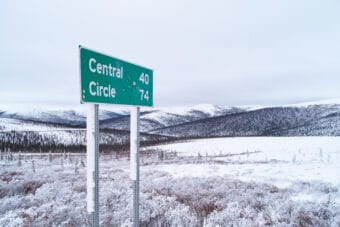
Quest Executive Director Lisa Nilson said a Fairbanks to Circle and Central race trail has been modified in response to musher feedback to include 25 miles on the Yukon River, instead of returning to Central via Birch Creek.
“The rough area around Birch Creek gets pretty cold, so we eliminated that and we wanted to make sure and get back on the Yukon River so the 300-miler basically starts in Fairbanks, heads over to Circle and then the part after that is new trail,” Nilson said. “So it goes back to Central to have the finish there, and the new trail is what touches on the Yukon River instead of Birch Creek.”
The Quest will also host 200- and 80-mile races, both starting in Fairbanks.
“The 200-mile qualifier finishes in Central and the 80 is to Two Rivers and back just like last year,” she said.
The traditional 1,000-mile Yukon Quest International Sled Dog Race between Fairbanks and Whitehorse has not been held since 2020. It was initially canceled due to pandemic restrictions, but was canceled again last year due to a dispute between Canadian and Alaska side race organizers over dog rest requirements.
Nilson said the Quest has not given up on running longer races.
“Our goal is to hopefully make up with Canada someday and communicate with them and coordinate with them, but right now our main focus is definitely — especially with the 2024 race coming up — is just to make sure that we’re putting together an amazing race, we’re building up the sport, we’re encouraging young mushers to sign up,” said Nilson.
Nilson, who was hired last month, said she’s focused on building sponsor and community support so longer races can be held in upcoming years. Quest organizers have announced a minimum 2024 300-mile race purse of $30,000, but Nilson said she’s working to increase the amount prior to the Feb. 3 start date.
Sign-ups for the 2024 Yukon Quest races open on Saturday, Sept. 30, at the Yukon Quest Alaska race headquarters in downtown Fairbanks.
Two F-35s, with an F-16 parked in the middle, at Eielson Air Force Base on April 21, 2020. (Sean Martin/354th Fighter Wing)
Federal officials have selected a contractor to install and operate a small, self-contained nuclear power plant at Eielson Air Force Base. The contract is subject to clearing regulatory hurdles, but if all goes according to plan, the microreactor will be up and running within five years.
Assistant Air Force Secretary Ravi Chaudhary announced the selection of a Silicon Valley-based firm as its prospective contractor for the Eielson microreactor during a Thursday meeting in Schaible Auditorium at the University of Alaska Fairbanks.
“I am super proud to announce the notice of intent toward selection of our first microreactor technology to Oklo Incorporated,” Chaudhary said.
The announcement marked a milestone in a process that began a nearly three years ago, when the Air Force announced its intention to site a microreactor at Eielson. The contract won’t be awarded until the process is completed and the federal Nuclear Regulatory Commission issues a license. But Oklo special projects senior director John Hanson says his company is ready to go.
“We’re extremely excited to be here,” he said. “We’re honored to be selected for this project, and really excited to get started.”
Eielson 354th Fighter WingcommanderCol. Paul Townsend says base personnel also are enthusiastic about the pilot project.
“Team Eielson is happy to partnership with these individuals to move this forward,” he said in an interview after the event. “It’s an exciting time.”
Townsend said the microreactor will help the 354th, which flies and maintains advanced F-35 jet fighters, to accomplish its mission. He says the technology that’s led to development of the small, self-contained reactor serves as an example of the kind of innovation that Air Force Chief of Staff Gen. Charles Brown says is essential to maintaining military superiority in the 21st century.
“General Brown tells us ‘Accelerate, change or lose,’ and we’re definitely leaning forward to help accelerate change and bring a tremendous capability to the state of Alaska,” Townsend said.
Chaudhary emphasized the microreactor’s ability to provide reliable energy without producing climate-changing carbon emissions. He’s the assistant Air Force secretary who oversees of the service’s energy, installations and environment issues. He said Eielson was chosen for the pilot project in part because of its strategic location in Alaska, from which the two squadrons of F-35s can quickly get to trouble spots in the Indo-Pacific region and elsewhere.
“You have an energy source — local, within the installation — that allows you to get those two critical fighter squadrons in the air and executing their business, executing their mission,” he said.
Chaudhary says the 5-megawatt facility would provide energy resilience in the form of backup power for the base’s 72-year-old coal-fired heat and power plant. And because Eielson also buys electricity from Golden Valley Electric Association, the microreactor would allow the base to unplug from the grid in case the utility came under cyber-attack.
“So having redundant systems is critical to that mission,” he said.
Besides providing backup power, Chaudhary said it also will enable the Defense Department to learn how the system could be used at other installations. Eielson is the first U.S. military installation to get a commercialized and licensed microreactor. The pilot project was mandated in the 2019 National Defense Authorization Act. And he says it will benefit the state of Alaska.
“This will the first state that can actually hold a license,” Chaudhary said, “and that’s no small task, to hold a state and federal license for the execution and operation of a microreactor.”
But before it goes online, Oklo must complete the microreactor licensing process. Nuclear Regulatory Commission Safety and Licensing Project Manager Stephen Philpott says that likely won’t be done ‘til the end of 2026. The company could begin testing the facility the following year and unless problems arise, the system could begin operating in 2028.
Close
Update notification options
Subscribe to notifications
Subscribe
Get notifications about news related to the topics you care about. You can unsubscribe anytime.