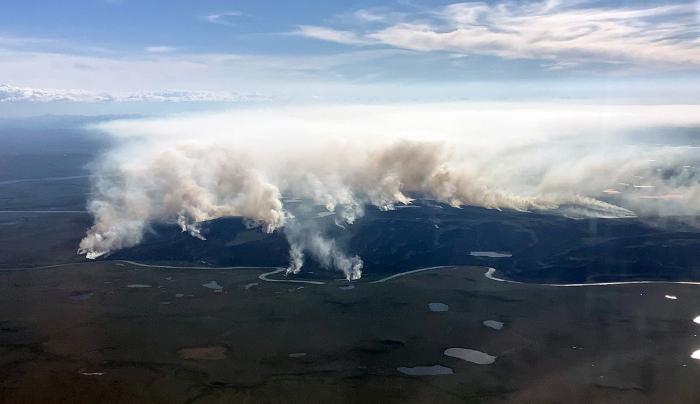
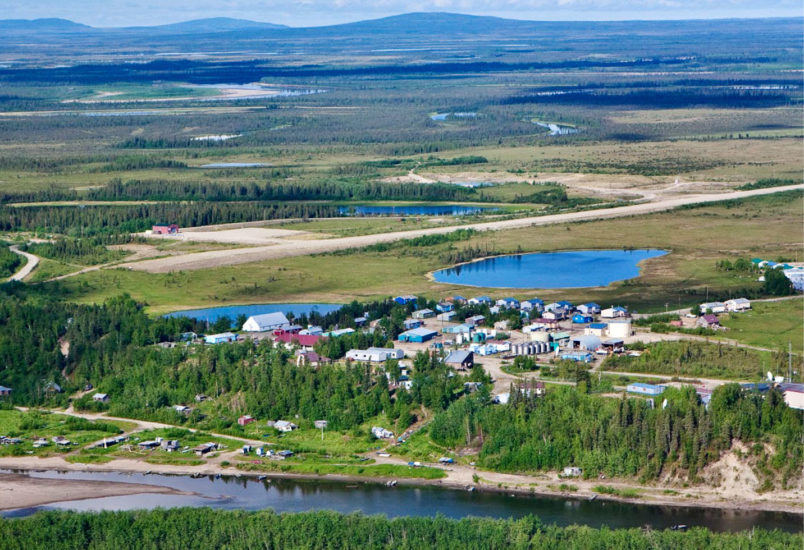
The Noatak River Fire is an estimated 11,000 acres and burning in the Noatak National Preserve about 120 miles northeast of Kotzebue. Smoke from it and the nearby Tutak Creek Fire are impacting numerous communities to the southwest. (Courtesy of Ryan McPherson, BLM AFS)
On Tuesday night, the state of Alaska saw thousands of lightning strikes.
“Most of the 3,800 lightning strikes were concentrated in the Northwest Arctic,” said BLM Alaska Fire Service spokeswoman Beth Ipsen.
Those lightning strikes sparked more than a dozen new fires in the region.
Ipsen says there are several communities in close proximity to new fires. A fire popped up about 27 miles northeast of Kivalina, where Ipsen says it might run into a local Native allotment.
“There’s some smokejumpers that are prepping that Native allotment in case that fire does threaten it,” Ipsen said.
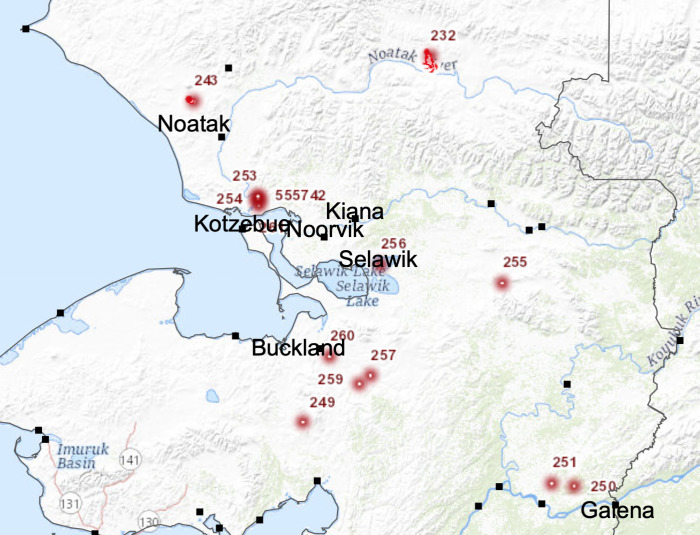
Two other villages near fires are Selawik and Buckland. Ipsen says a team of smokejumpers deployed to the Canyon Creek Fire about six miles southeast of Buckland. The fire near Selawik is burning at Niglaktak Lake, about two miles away from the village. But Ipsen says the fire is burning on a peninsula.
“We don’t believe that it’s going to do anything, impact the neighboring community because it is surrounded by water,” Ipsen said.
Map of fires burning in the area include new fires (numbers 250-263) that started on June 22, 20121 after lightning rolled through part of Western Alaska from Galena north to the Kobuk River Valley. (Graphic courtesy of BLM Alaska Fire Service)
Another five wildfires started near the mouth of the Noatak River, with a dozen smokejumpers deployed to the Mulik Hills and Hugo Creek Fires. The two are about a mile apart.
Ipsen says the biggest fire in the state has been burning in the Noatak National Preserve, about 120 miles northeast of Kotzebue.
“An estimated 11,000 acres,” Ipsen said. “And that estimation is from satellite imagery.”
She says right now, the fire isn’t threatening any buildings or allotments, and the fire service is letting it burn out naturally while keeping an eye on it.
Ipsen says temperatures have been warm, but the forecast should shift by Thursday.
“We do have rains forecasted starting Thursday and Friday — there’s I believe a 70% chance in some areas,” Ipsen said. “So that’ll definitely help with the fires.”
Any wildfires can be reported to BLM Alaska Fire Services by calling 1-800-237-3633 or to your local authorities by calling 911.
Aaron Phillips is an MMA fighter originally from Kotzebue. (Photo by Dodge Sports)
When most people think about Alaska, they think about hunting and fishing, wilderness and harsh conditions, subjects typically portrayed on the wide swath of TV shows depicting “reality” in Alaska. But a new spin on reality TV has come out of Kotzebue, with Aaron Phillips fresh back from filming “The Ultimate Fighter TUF29.”
Phillips says growing up in a remote, rural Alaska community is a difficult thing to explain to anyone who hasn’t spent time in those areas. Especially one as far-flung as Kotzebue.
“The weather here, I feel like, made me a lot tougher, my mental game a lot tougher than most people,” Phillips said. “I think a lot of people around here are really tough in their own way.”
Especially when you “gotta put on all of your clothes in the morning just to take out the dog,” Phillips says.
After wrestling in high school and college, he came back to Kotzebue where he was living a normal life, working and staying in shape. That all changed when he started boxing with his older brother, Kelson.
“If he’s gonna do it, you know, why don’t I?” Phillips thought to himself.
After trying his hand in the boxing ring, Phillips decided MMA was a better fit for him due to his wrestling background and he got a spot in an amateur match. A few Alaska Fighting Championship bouts later, he was hooked, and so were the talent scouts who accelerated his career right past amateur fighting.
“They asked if I wanted to go pro and I didn’t know any better,” Phillips said.
Phillips says the lead-up to a fight can be a much harder battle than anything that happens once the cage door closes.
“There was a lot of anxiety and stuff going into weigh-ins and going into the fight. My mind always rushes to ‘things can go really bad, Aaron, why are you doing this?’ The feeling of going up there is kind of like being on that Slingshot ride. When I’m in there, it just kind of goes away,” Phillips said. “That fear and everything. It’s just like, all right, we’re here. This is the fun part. In the buildup to a fight, I have all that anxiety and stuff, which kind of helps me grow as a person outside of MMA.”
The closest thing Kotzebue has to a fighting gym is the community rec center, where Phillips spent a fair amount of time but he says he has done the majority of his training alone in his Mom’s garage on his own equipment. He mainly learned about MMA fighting by relentlessly studying YouTube videos.
“It’s a lot about putting a lot of hours into it in the last three years,” Phillips said. “There are a lot of things you can do to stay in shape like a lot of the stuff could be like Rocky Balboa stuff you know. Like going out and doing chores that can help out.”
After three years of training in very unconventional ways, Phillips was doing well in the AFC ranks. He decided to apply to be on “The Ultimate Fighter TUF29” reality TV show with the hope that it would give him the exposure he needed to ratchet his fighting career up to the national level. Prior to knowing if he’d be on the show, he left Kotzebue for Denver and trained for a month with his management team, Dodge Sports.
“Four or five days before [filming was scheduled to start] they just let us know and they were like ‘alright, pack your bags and get ready to go to Vegas,’” Phillips said.
Once Phillips arrived at the “TUF house,” he began to realize just how different his journey to the show was from the other fighters. The others had access to professional fighting gyms, trainers, and mentors.
“I’m up here like shadow boxing for an hour and a half by myself,” Phillips said.
Aaron Phillips (center) walks to the Octagon prior to his middleweight bout against Andre Petroski during the filming of The Return of “The Ultimate Fighter” at UFC APEX on April 29, 2021, in Las Vegas, Nevada. (Photo by Chris Unger/Zuffa LLC)
But coming from such an isolated and rugged place also prepared Phillips in ways that the others might not have experienced.
“Not having phones [during filming] I think really played a big mental game on a lot of people,” Phillips said. “Not having a phone or TV or anything to kind of drown out the emotions and feelings of just being in a house with 16 guys you’ve got to fight.”
Sixteen fighters out of more than a thousand applicants were selected to join the show, which started airing June 1 and continues for 12 episodes every Tuesday night on ESPN+.
“It’s really a catapult for any fighter to be on that show,” Phillips said. “For me, it’s been an amazing experience.”
Phillips said it was a bit of a bummer that he didn’t know he was going to be on the show sooner because he could have shown off where he was from more, but that was his only complaint.
“After the show, we’ll be able to pick and choose our battles,” Phillips said. “It’s been a grueling process but I’ve loved every minute of it. I think I’m ready for skydiving now.”
Phillips, his girlfriend Amelia, and their three dogs are planning on moving to Houston, Texas where he will train at a gym with a friend he made on the show. He’ll be focusing full-time on training as a fighter and is eager to see what opportunities come his way after his experience on “The Ultimate Fighter.”
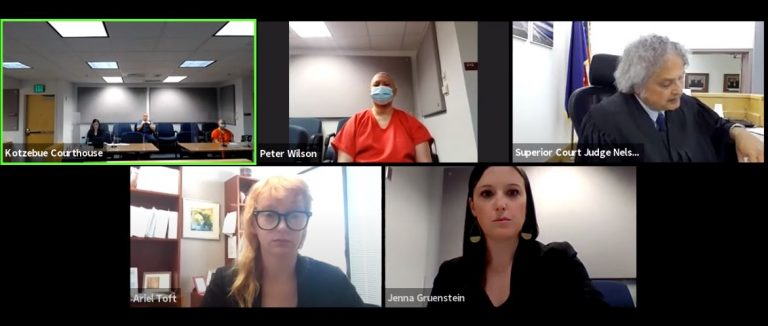
Peter Wilson’s (top center) change of plea hearing was held virtually through a Zoom meeting. (Screenshot of State of Alaska YouTube stream)
A Kotzebue man has pleaded guilty to the 2018 murder and sexual abuse of 10-year-old Ashley Johnson-Barr. The accused faces a prison sentence of up to 99 years.
On Sept. 6, 2018, Ashley Johnson-Barr disappeared after playing at a Kotzebue playground. Investigators say she was found dead outside of Kotzebue days later after being kidnapped from a local playground and sexually assaulted outside of her hometown. Kotzebue resident Peter Wilson was arrested and charged later that month with five counts including murder and sexual abuse of a minor.
Wilson’s trial date was scheduled for July, but attorneys negotiated a plea deal this month for Wilson to plead guilty to two charges, one for murder and one for sexual abuse of a minor. If accepted by the court, the plea comes with a sentence of 198 years in prison, with 99 years suspended.
During a change of plea hearing Monday, Judge Nelson Traverso informed Wilson, now 44 years old, that taking this plea would mean not going to trial.
“You understand that you’re giving up a very important constitutional right, which is to have 12 people decide, beyond a reasonable doubt, whether or not you should be convicted of these charges? Do you understand that?” Traverso asked Wilson.
Wilson said he did.
Ashley Johnson-Barr. (Photo courtesy of Kotzebue Police Department)
Johnson-Barr’s death rippled across the state, generating outrage over the high rates of violence against Alaska Native women and children. Last year, Gov. Mike Dunleavy signed a law commemorating March 12 as Ashley Johnson-Barr Day in the state. The governor said the day, which coincides with Johnson-Barr’s birthday, serves as a reminder to keep Alaska children safe from violence.
Through the almost three-year process, Johnson-Barr’s parents have waited for a resolution to the killing of their daughter. Speaking on behalf of them, prosecuting attorney Jenna Gruenstein said that the parents were satisfied with the plea.
“I think just from our conversations, hopefully I’m not speaking out of line, having the certainty of this being done more quickly, and having a resolution in place, means a lot to them,” Gruenstein said.
Wilson’s attorney did not respond to requests for comment.
Though some charges have been dropped as part of the plea, Gruenstein said Wilson would still have to admit wrongdoing.
“Mr. Wilson is agreeing to admit all of the conduct that was alleged in the information in that grand jury underlying indictment, including conduct that pertained to any counts that were dismissed,” Gruenstein said.
Wilson’s sentencing is scheduled for September 21. He faces 99 years in prison.
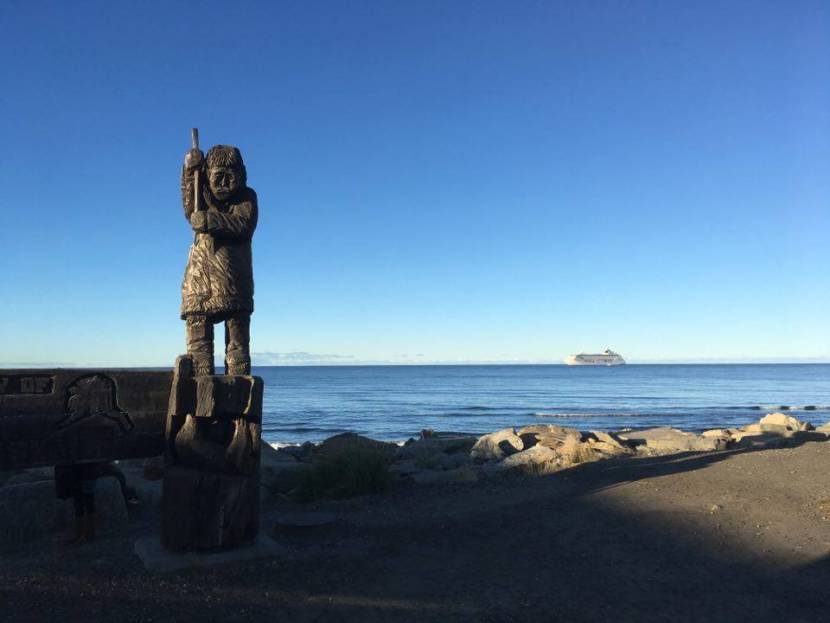
The cruise liner Crystal Serenity anchored offshore at Nome, 2017. (Gabe Colombo/KNOM)
City Manager Glenn Steckman gave the announcement at a June 14 city council meeting.
“Our cruise ships have cancelled out for the rest of the year,” Steckman said. “We were holding out hope, but Robin Johnson [of Nome Discovery Tours] told us it was not going to happen, and it was confirmed by [Harbormaster Lucas Stotts.]”
Steckman says Nome’s five cruise visits, each with 100-150 passengers onboard, were all cancelled.
Jen Martin with Lindblad Expeditions says the cancellations were caused in part by issues with docking in Provideniya. Russia’s ports are currently closed to tourists for the summer season. Unable to find an alternative itinerary, Lindblad cancelled their Nome visits, which included the National Geographic Orion.
“We tried extremely hard to make these voyages happen but found ourselves with no alternative options,” Martin said.
Lindblad Expeditions says these cancellations likely will not change next year’s expected cruise schedule for Nome.
The Native Village of Shungnak (Photo courtesy of Northwest Arctic Borough)
The Northwest Arctic Borough village of Shungnak has not had any gasoline since April and is looking at a long wait for a new fuel truck.
Shungnak is about 280 river miles east of Kotzebue, up the winding Kobuk River. The only year-round access is a 150-mile airplane ride. You can also get there by river in the summer and snowmachine in the winter. The roughly 270 residents get their gasoline from the Shungnak Native Store, but the store hasn’t been able to supply any since April. Tribal administrator Kathy Custer says the village is facing several logistical challenges.
Fuel is delivered to the village by air in the winter and Glenda Douglas, the manager of the Shungnak Native Store, said the 70s-era vintage fuel truck they used to transport fuel from the airport to the store has been broken down since last year.
“The one that we did have was very old,” Douglas said.
Douglas said the first summer barge is scheduled to arrive in the village later this week with a fresh fuel supply, which can be transported to the tanks without a truck.
“Crowley usually brings their own line that runs from the barge to our tank farm,” Douglas said.
But there are a few more hurdles still in the way. The gasoline pump at the store isn’t operational.
“The stove oil side is good,” Douglas said. “It’s just our gas side that isn’t working right now.”
Douglas says that while they work on fixing the gas pump, village residents have been traveling ten miles up the river to get fuel in Kobuk.
An additional problem Shungnak residents face is the fuel they do have is contaminated with water. Douglas said there are two gasoline tanks at the Shungnak Native Store and workers have transferred all of the contaminated fuel to one tank, so they can refill the clean tank with the fresh fuel shipment arriving by barge. She said she hopes the store can get someone to Shungnak to help them clean the water-fouled tank before too long.
A new fuel truck will have to travel by air to the village, adding to the overall expense, as there will only be one more barge coming in the fall.
“They’d fly it here to Shungnak because we missed the barge,” Douglas said. “Unless we’re able to wait for this fall.”
Douglas says the Native Village of Shungnak is working on a grant to purchase a new fuel truck. The village will likely face another fuel shortage this winter if these issues can’t be addressed in the coming months.
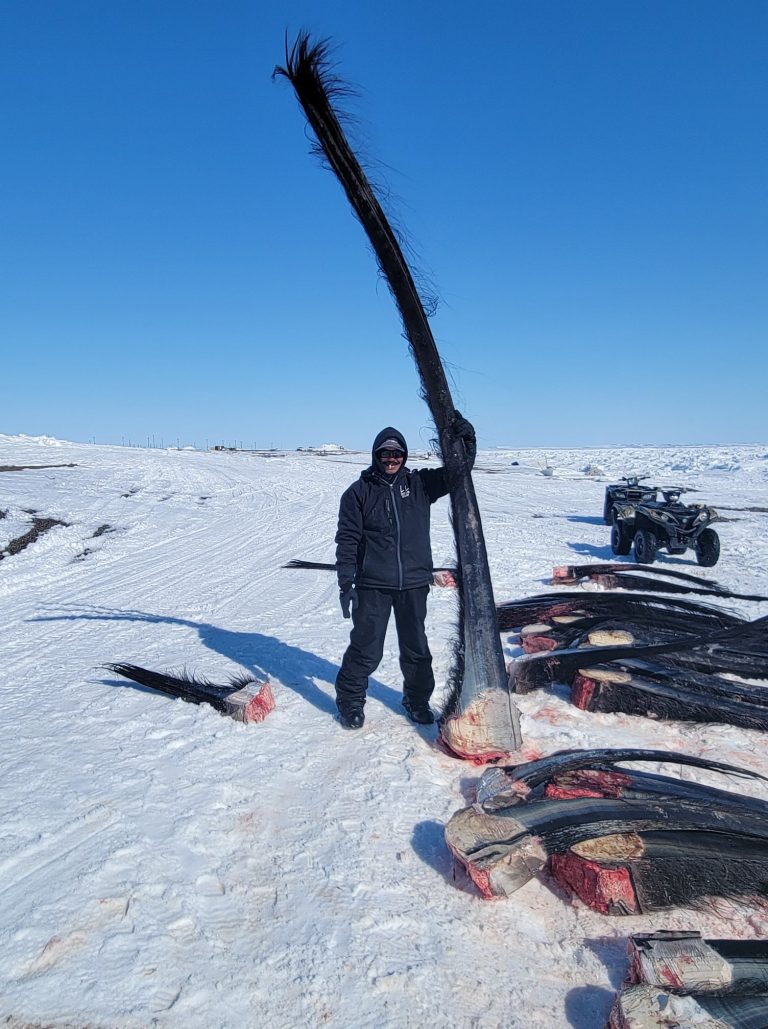
Guy Omnik stands with the baleen from Russell and Andrea Lane’s whale. (Photo courtesy of Guy Omnik for the Alaska Arctic Observatory and Knowledge Hub)
This weekend kicks off the Qaġruq Whaling Festival in Point Hope. Every year, people come from around the region for a three-day feast to celebrate the annual subsistence haul of the whaling season.
Rex Rock Sr. says he’s been whaling his whole life. The 60-year-old Point Hope captain says this year’s whaling season kicked off in early spring.
“Early April we went out,” Rock said. “The lead was further out this year.”
Rock explained the lead is the term for the crack in the sea ice that hunters follow to track the whales. He says this year’s lead was about seven miles outside town.
“We were able to get there,” Rock said. “I was happy that Russell and JJ Lane were able to land the first whale. They always say once you strike and land the first whale, everything else is going to fall into place.”
Point Hope whaling captains ended up landing 11 bowheads this year, a great year in Rock’s book.
With the hauling period over, Point Hope is preparing for the three-day Qaġruq Whaling Festival. Rock says over the first two days, captains will haul the whaling boats up and show off their crews flags before cutting up the whale for the large communal feast.
“First is what we call qalgi, the second day the avarriqirut, and then the third day we have an all-day cookout,” Rock said. “So we invite everybody to come up and sample all the food that we’ve been blessed with this spring.”
For many Inupiaq residents of Northwest Alaska, this year’s Qaġruq will be the first major community event since the COVID-19 pandemic began.
“I don’t think it feels much different,” Rock said. “Because we feel blessed when we go out to whale and provide for our community. Not only our community, but cousins in the outlying villages. Definitely we share the whale with everyone, everyone that wants a taste.”
Qaġruq begins on Sunday and will conclude Tuesday evening.
Close
Update notification options
Subscribe to notifications
Subscribe
Get notifications about news related to the topics you care about. You can unsubscribe anytime.