No flooding is expected from the heavy rain that fell in the Juneau area on Thursday and early Friday.
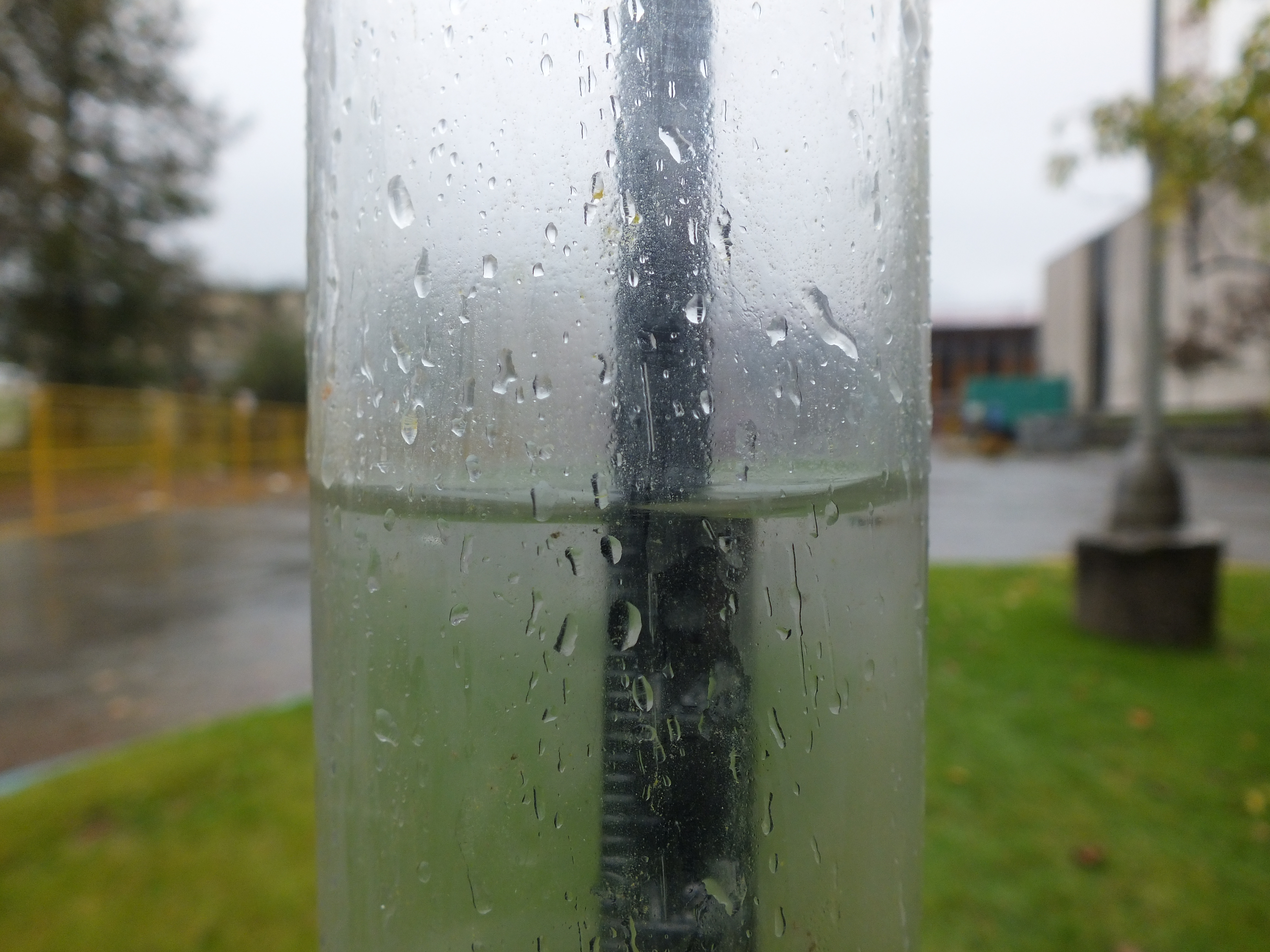
Ed Liske of the National Weather Service said they recorded .93 inch of rain over 24 hours at their office on Back Loop Road. About .95 inch fell at Auke Bay, .88 inch at Montana Creek, and nearly an inch fell at the Juneau International Airport over 24 hours. A rain gauge located in downtown Juneau recorded 1.51 inches during the 24-hour period that ended at 9 a.m. on Friday.
Rain gauge located in downtown Juneau reads 1.51 inches of rainfall on Friday morning, Sept. 20, 2013. Photo by Matt Miller/KTOO News
Liske says the rain came from a 972 millibar system or the first significant fall storm that has moved into the Southeast Alaska Panhandle.
Most of the high winds of gusts of 60 miles per hour or higher were recorded in the vicinity of Ketchikan, Hydaburg, Annette, and Metlakatla which prompted the National Weather Service to issue wind warnings for that area.
A view of the interior scaffolding and temporary supports for the State Libraries, Archives, and Museum (SLAM) project that is being built behind the current Alaska State Museum. Photo by Matt Miller/KTOO News
Astute observers of the State Library, Archives, and Museum project in downtown Juneau may have just noticed that the structure is now being built higher, much higher than this summer’s construction efforts.
“The community is going to start seeing that second floor wall section go on, which is as tall as the first floor,” said Bob Banghart, Deputy Director of the Division of Archives, Libraries, and Museums.
So, people are going to start paying attention. This is really a large building.”
Banghart has a suggestion for estimating the expected size of SLAM:
If you look at the crane, you look at the cab where the operator sits, count down three sections of the crane frame, that’s the approximate height of the building.”
On Wednesday, a pumping vehicle with an articulated boom pipe reached into the interior of the structure to pour concrete for the second floor slab as a chain of cement trucks came and went from the construction site.
Concrete form panels are already being erected to extend the walls even further up for the vault that will become the main storage area for artifacts.
The first of the current Alaska State Museum’s permanent exhibits on the second floor will be dismantled and packed up starting on October 7th. That will continue through February 28th when the Museum closes to the public.
Once (the current Alaska State Museum) is empty, it will be removed. Then they will add the other two-thirds of the construction project.”
The current Alaska State Museum includes about 24,000 square feet of space. By comparison, the new SLAM structure will be nearly 116,000 square feet. The parking lot will add another 64,000 square feet of space.
We’re pretty much on-schedule, on-budget, where we hope to be.”
A construction worker at the current top of the State Libraries, Archives, and Museum (SLAM) project spreads out a cover to protect equipment and materials from the blowing rain on Friday morning. A newly-installed concrete form panel can be seen at the left. Photo by Matt Miller/KTOO News
Meanwhile, the Eagle Tree will return in the new structure. Banghart suggests that patrons and community members were very adamant about continuing with that exhibit.
Also planned for installation in the new building or on the grounds will be Science on the Sphere, the sculpture Nimbus in a restored form, and — hopefully — two of the current museum’s distinctive exterior side panels with the Pacific Northwest Native formline design. Banghart said that the recovery of two complete panels may be difficult.
We’ll have more on the project coming up next week on KTOO’s Morning Edition.
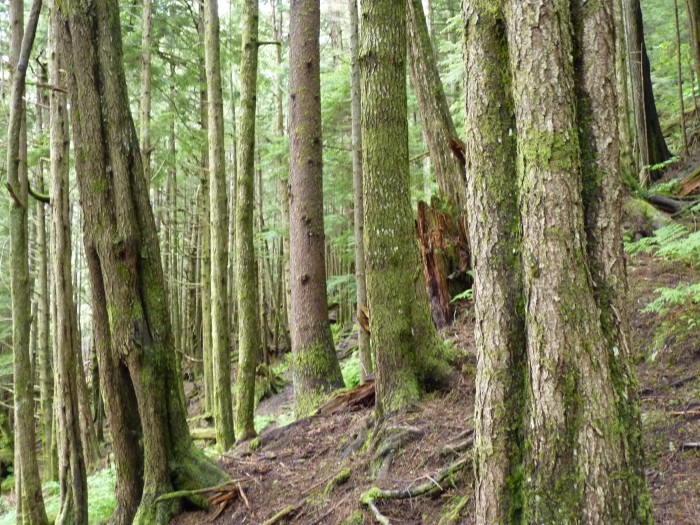
Second-growth trees cover a Tongass National Forest hillside in southern Southeast Alaska. A proposal from the Southeast Conference could use newer forested areas to replace old-growth habitat. (CoastAlaska News photo.)
The Southeast Conference wants to change the way the Tongass National Forest is managed.
The regional development-advocacy organization is developing a strategy to grow the timber industry and create jobs, while maintaining environmental protections. It announced the plans at its annual meeting Sept. 17-18 in Sitka.
Conference leaders say the U.S. Forest Service is failing to do its job.
That, in the organization’s view, is to sell enough timber to support a strong, regional, wood-products industry.
Southeast Conference Executive Director Shelly Wright.
“We’re trying to open up the landscape to a management strategy that is changing over time,” says Shelly Wright, executive director of the Southeast Conference, which is made up of business, government and tribal leaders, as well as interested individuals.
“Rather than set aside a big chunk for logging and a big chunk for no logging, open up all of the regulated set-asides and use it as a flexible forest,” she says.
National monuments, designated wilderness and some other protected areas would stay the same. Buffer zones would still be required near beaches, streams and rivers.
But Wright says many other parts of the Tongass would be open for multiple – and sometimes changing – uses.
“A stand of trees doesn’t have to be 150 years old to be habitat. Different habitat is good for different times of year and different kinds of animals. So we want them to … actively manage and monitor all parts of the forest for habitat and economic development,” she says.
“I think they’re looking backwards to recreate the glory days of timber on the Tongass, which unfortunately are over,” says Andrew Thoms, executive director of the Sitka Conservation Society, which has been part of the forest management debate.
Sitka Conservation Society Executive Director Andrew Thoms.
“The Tongass produced a record number of salmon this past year that created a ton of jobs and a ton of economic activity from the fisheries. I think that the Southeast Conference wants to ignore the fact that all these salmon come from the forest and that they’re produced because of the protections that we have on the salmon streams,” he says.
And, by the way, he says the forest does take 150 years – or longer – to fully mature.
The existing Tongass management plan has been developed over years of public debate. It’s attracted attention from national environmental organizations and has been driven in part by policy calls from Washington D.C.
So what does the Forest Service think about the conference’s idea?
“I believe that it’s a legitimate proposal,” says Tongass Forest Supervisor Forrest Cole.
He hasn’t seen the conference’s strategy, though he’s talked to its authors. He says it could be considered if it’s submitted during the process of reconsidering Tongass policies.
Tongass Forest Supervisor Forrest Cole.
“I believe over the life of the current forest plan we’ve looked at 30 or 40 different alternatives. And I’m guessing if that if we get into a modifying of the plan in the near future, we’ll look at a wide variety again. So having a recommendation from Southeast Conference for looking at alternatives is a welcome proposal for us,” Cole says.
Canadian timber consultant Don Reimer provided the research to back up the conference’s approach.
He says it could increase timber jobs from about 500 to more than 2,000 over a number of years. And he says it would save taxpayers’ money.
“We think that it would be able to eliminate most of the cash drain that you have on the Tongass, because you’d now have an active timber program like you used to have in the past that should pay for the restoration work and some of that stuff that needs to be done instead of having a drain on the treasury,” he says.
Southeast Conference leaders acknowledge their approach could be a hard sell.
That’s why they hired Willis Lyford of Anchorage-based Porcaro Communications to spread their message.
“We need to change the debate and the discussion about the timber industry in Alaska. And that takes a lot of hard work and research and a lot of study and people who are experts,” he says.
The company recently polled Southeast and other Alaskans to gage their views of the industry.
He shared results indicating strong support for logging, including its expansion. But it also showed concerns about environmental damage and other impacts.
Southeast Alaska has more residents – and more jobs – than ever.
That’s according to a report released during the Southeast Conference’s annual meeting in Sitka.
Meilani Schijvens of Juneau-based Sheinberg Associates assembled the report, called Southeast Alaska by the Numbers. (Read the report.)
She says Southeast has finally come back from the 1990s timber-industry crash. It’s also largely recovered from the more recent global economic recession.
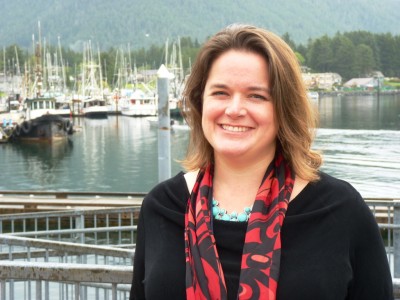
Analyst Meilani Schijvens stands by Sitka’s Crescent Harbor and lightering dock. She told the Southeast Conference fishing and tourism are growing in the region. (Ed Schoenfeld/CoastAlaska News photo)
“Nearly every single economic indicator in the region is up and continuing to rise. It has taken nearly two decades, but the Southeast Alaska economy is now in a cycle of growth and is stronger than ever,” Schijvens says.
The report says the region added 2,800 residents from 2010 to 2012, the period studied. The total population hit 74,423.
Schijvens says Juneau grew the most. Ketchikan, Sitka and Haines attracted many of the other new residents.
“The largest group moving here are the 20-somethings. This group is particularly having trouble in the Lower 48 job market. They move here for jobs in the summer in the visitor industry and they stay because they have no jobs to go to,” Schijvens says.
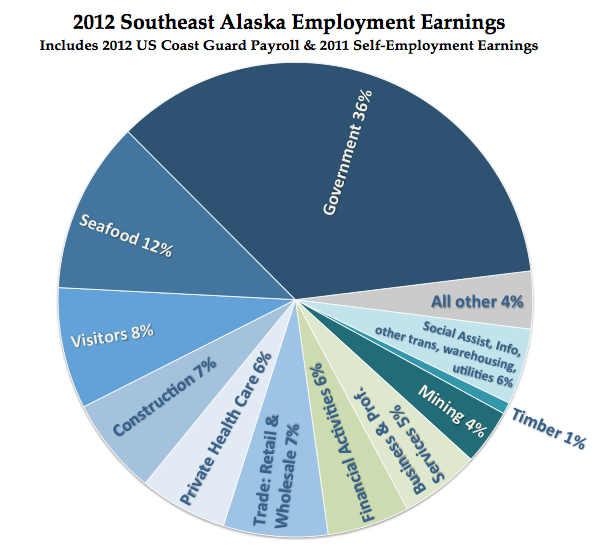
She says Southeast’s payroll topped $2 billion for the first time in 2012, a 10 percent increase over two years.
Those wages went to 46,000 people, which is also a record.
“Leading the way were gains in mining, professional and business services, the visitor industry, construction and the Coast Guard,” she says.
The report projects the tourism, mining and health-care industries will continue to grow in future years. It says the seafood sector will remain about the same. And government and timber will shrink.
The search is still underway for an Alaska pilot and small plane missing for the last eight days.
A single Civil Air Patrol aircraft started searching on Tuesday in an area north and west of Yakutat.
Five other CAP aircraft currently positioned in Cordova and an Alaska Air National Guard C-130 are taking a break for routine maintenance and crew rest.
“We’re also kind of waiting on the weather to clear up,” said Alaska National Guard spokesman Lt. Bernie Kale.
All of the aircraft are expected to return to the air on Wednesday.
Kale said there has been no discussion about suspending the search.
CAP aircraft have done grid searches while the C-130 has focused on high-altitude searches over steep terrain.
So, all the way to Whittier and then west of Yakutat. We have done searches from the last known point and we’ve spread out since then to cover a very wide area since there was no ELT or GPS coordinates of the aircraft.”
No physical objects have been found yet, but electronic signals were detected on Friday. Kale says the origin or location of the signals could not be determined by the C-130 crew.
47-year old Alan Foster of Eagle River and his single-engine Piper PA-32 disappeared on the afternoon of Sept. 9th after departing Yakutat. He was headed to Merrill Field in Anchorage.
When Filipinos hear “Alaska,” often the first two things that come to mind are milk and basketball.
(Composited from photos by @Doug88888 and Ion Botezatu via Flickr Creative Commons)
That’s according to the Philippines’ recently appointed honorary consul to Alaska, Jenny Gomez Strickler.
It turns out, the Philippines-based Alaska Milk Corporation sells milk in the country and sponsors the Alaska Aces — not Anchorage’s minor league hockey team, but a professional basketball team in the Philippines. Neither the milk nor the basketball team have a meaningful connection to the 49th state.
That means if Alaska wants to make inroads in trade with the Philippines, the state has a lot of work to do. In 2012, less than 1 percent of Alaska’s exports ended up in the Philippines, according to census data.
Jenny Gomez Strickler, Philippines honorary consul to Alaska
But Strickler says connections are being forged that could help build a market for Alaska seafood, and even liquefied natural gas.
The Juneau resident and retired Alaska Department of Commerce and Economic Development worker spoke to the Juneau World Affairs Council on Wednesday. In her new honorary role for the government of the Philippines, she’s part bureaucrat, and part international trade facilitator.
She’s trying to make the case that “Alaska” should mean “seafood” in the Philippines.
“The Philippines is a fish-eating country,” she said. “Yet its fish is imported from other countries. And its imported salmon is farmed salmon.”
Strickler, Juneau Rep. Cathy Munoz and the governor’s office are trying to put together a seafood festival in Manila next year to show the country what Alaska has to offer.
Strickler shared an anecdote about a missed connection that networking at the festival might fix. A former Juneau resident brought some Alaska seafood to Manila for his friends to try. One of samplers happened to be a hotel owner.
“The business owner enjoyed it so much, he said, ‘If I get this from you, can you guarantee me X amount throughout the year, or a portion of the year?’ He looked him straight in the eye and said, ‘I can’t, cause I’m not a fisherman.’”
She said they’re working on a pitch to get support from the Alaska Seafood Marketing Institute.
Strickler also said she was on a recent conference call between Philippines Ambassador Jose Cuisia Jr. and state officials. The ambassador said he’s putting together a team to visit Alaska and investigate opportunities to import liquefied natural gas.
Finally, Strickler said Aklan State University in the Philippines is interested in sending instructors to the University of Alaska Southeast through an exchange program. They want to learn about saltwater fisheries.
Strickler said she expects that arrangement to come together after the Juneau Assembly adopts a sister city proclamation linking Juneau and Kalibo, the capital city of the Philippine province Aklan.