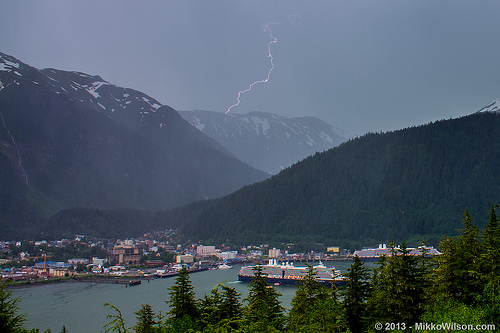
Lightning captured during Monday’s thunderstorm over Juneau. Photo copyright Mikko Wilson, used with permission
Juneau was not the only Southeast location to report thunder and lightning strikes on Monday afternoon. Kimberly Vaughan of the National Weather Service office in Juneau said they detected thunderstorm activity and lightning strikes as early as 2:30 p.m. on Monday. She also explained how thunderstorms occur in the Panhandle.
The Coast Guard is searching for a missing crewman from the fishing vessel “Swift.” The 34-foot boat is reportedly based in Juneau, but state records show it registered to a Sitka captain.
The Coast Guard received a call for help shortly after midnight Tuesday.
The 57-foot Pacific Horizon discovered the Swift in Icy Strait. Crew members found no one aboard, and notified Coast Guard Sector Juneau. The Coast Guard reported the Swift’s position at about 40 miles west of Juneau.
A helicopter crew from Coast Guard Air Station Sitka found one of the Swift’s two crewmen on a beach, near his overturned skiff. The other member of the crew remains missing. The Sitka helicopter, as well as a response boat from Juneau and the Coast Guard Cutter Liberty are aiding in the search. The Civil Air Patrol joined search and rescue efforts Tuesday morning.
The missing crewman is reportedly wearing a gray hooded sweatshirt and black rain pants. Further details on the crewmen, including their names and ages, were not yet released by the Coast Guard.
National Weather Service meteorologist Geri Swanson says at the time the Coast Guard received the call for help, Icy Strait was experiencing 15-to-20-knot winds under cloudy skies. But earlier in the evening, the region experienced a series of moderate thunderstorms, including winds up to 37 knots. The National Weather Service issued storm warnings to mariners throughout the evening, urging them to find safe harbor.
Original story at June 18, 2013 6:20 a.m.
The Coast Guard was out searching this morning for a man who went overboard Monday night.
The unidentified deckhand, wearing only a gray sweatshirt and raingear, either jumped or fell into the water from the fishing vessel Swift after midnight Monday in Excursion Inlet.
The skipper of the boat chased after the crewman in a dinghy, but he could not find him.
The Coast Guard on Tuesday morning searched with H-60 helicopter from Sitka and a 45-foot boat from Station Juneau.
Petty Officer James Fangman of the Coast Guard Command Center in Juneau says the skipper, who was in an immersion suit, was medavacked to Bartlett Regional Hospital for treatment of mild hypothermia.
The vessel Swift is anchored up with no one on board.
Sen. Lisa Murkowski speaks in Sitka earlier this year.
Alaska Senator Lisa Murkowski’s version of the Sealaska lands bill has passed out of its only committee of referral.
That’s a major step toward a Senate floor vote.
But there’s no guarantee it will move any further in Congress. Its best chance is as part of a package of lands legislation. Read details of the bill.
Murkowski told the Senate Energy and Natural Resources Committee today that it’s the result of years of negotiations.
“And I recognize it has created tensions within our communities. But we have worked aggressively and tirelessly with all of the stakeholders, not just Sealaska and their shareholders,” she says.
The bill is co-sponsored by Alaska Senator Mark Begich. A similar measure by Alaska Representative Don Young passed out of the House Natural Resources Committee earlier this month.
The Southeast Alaska Conservation Council has endorsed the legislation as a reasonable compromise.
But other critics – including environmental, sportsmen’s and small-community groups – continue to oppose the bill. They say Sealaska wants to trade marginal acreage it can already claim for the most valuable timberlands in the Tongass National Forest.
Andi Burgess is rainforest program director for the Alaska Wilderness League. Her group is particularly concerned about an area on the south end of Prince of Wales Island.
“One of the most productive salmon streams in the Tongass is in Keete Inlet. It’s an area identified by Audubon and Trout Unlimited scientists as being one of the most high-value watersheds,” Burgess says.
The bill would allow the regional Native corporation to choose about 68,000 acres of timberlands from within the Tongass.
Around another 1,600 acres would be transferred for renewable energy and ecotourism development or preservation as cemetery and historic sites.
The total, a little more than 70,000 acres, is less than the 85,000 Sealaska has said it’s entitled to.
Murkowski points to acreage that would gain new protections under the bill.
“It will help the Sealaska region’s timber industry grow, while at the same time we’re working to protect more than 150,000 acres of habitat for fisheries and wildlife,” she says.
Juneau-based Sealaska has about 22,000 shareholders. More than half live outside Southeast, but have family ties to the area.
Point Baker resident Don Hernandez issued this statement in response to the legislative action:
“There is a lot of heartache out here right now. We find it hard to believe that a Senate committee would support a bill that so unfairly benefits a special interest. Murkowski and Begich are touting all the ‘compromises’ that were made, but the only thing that was compromised was their duty to look out for the public interest over the special interest of Sealaska Corp. The bottom line, after all the deal making, is that some of the best forestland on the the Tongass will be clearcut and will never be the same, and no amount of conservation protections written into the bill will change that. One of those watersheds is near and dear to our communities and it will be a tremendous loss if this bill were to pass the full Senate.”
Alaska Senator Lisa Murkowski’s version of the Sealaska lands bill has passed out of its only committee of referral.
The legislation, co-sponsored by Alaska Senator Mark Begich, was one of a dozen measures marked up this morning during an Energy and Natural Resources Committee hearing.
The bill allows the regional Native corporation to choose about 70 thousand acres of mostly timberlands from the Tongass National Forest.
There’s no guarantee it will move any further in Congress. Its best chance is as part of a lands legislation package.
A similar bill sponsored by Alaska Representative Don Young was marked up last week in the House Natural Resources Committee.
Sealaska already has rights to chose more acreage in the Tongass. But it says logging those lands could damage watersheds and hurt fish and wildlife.
Critics say Sealaska wants to trade marginal acreage for the most valuable timberlands. They also say logging those areas would also hurt fish and wildlife, as well as damage nearby residents’ livelihoods.
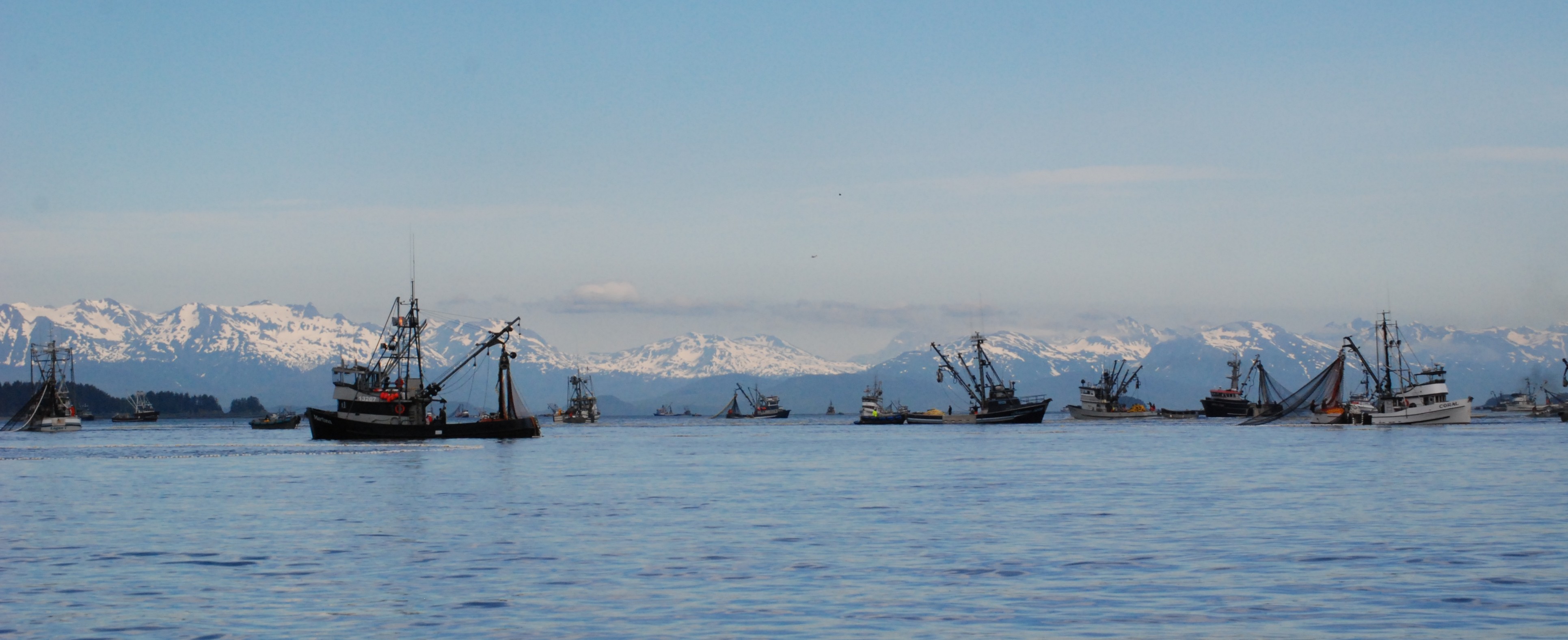
Part of the purse seine fleet outside of Juneau’s Amalga Harbor last July. (Photo by Dave Harris/ADF&G)
Traditional commercial net fisheries in Southeast Alaska will kick off the season Sunday.
Bill Davidson is Fish and Game’s regional coordinator for commercial fisheries in Southeast. He says he’s looking forward to a productive year for both gillnetters and seiners.
“It should be a high value fishery for the fleet and the industry participating in the fisheries if runs come in as expected and prices hold up as strong as they’ve been recently,” he says.
This year’s pink salmon harvest forecast is 54 million, which is double last year’s forecast. Since 2006, Davidson says pinks have established an every-other-year cycle of strong and weak runs.
“Last year was the weak cycle and this year’s going to be the strong cycle. But there’s always curve balls thrown at us from Mother Nature so we don’t really know until we actually get into it. We’ll be ready and industry will be ready.”
Estimates for chum salmon are higher than last year’s. The majority of chum come from hatchery programs and Davidson expects a considerable fishing effort for the species.
In contrast, the king salmon forecast is low. And Davidson isn’t sure about the sockeye run.
“The parent year for sockeye was very weak, however that really doesn’t tell us what’s going to happen this year. It could be better than it was five years ago this year, and that will just be known in season,” he says.
2011 was the highest value total salmon fishery on record in Southeast with commercial fishing boats getting $200 million. Davidson’s hopes are high and thinks this season could surpass that.
The Sealaska building in Juneau. (Photo by Heather Bryant/KTOO)
The Sealaska Corporation is trying to renegotiate its land settlement under the Alaska Native Claims Settlement Act. The company hopes to select nearly 70,000 acres and revive the all-but-shuttered logging industry in the Tongass National Forest.
Congressman Don Young’s bill would let the company do just that.
“If we don’t pass this bill, they will select lands with old grown timber and harvest the old growth timber,” he said at a committee markup Wednesday afternoon.
Sealaska has been trying to select new acres for decades. If it does not, it still has the rights to land around a number of Southeast Native villages.
The Alaska Congressional delegation has repeatedly introduced the land transfer legislation but failed to pass it out of Congress.
At the House hearing, no members showed any opposition to the bill when it was introduced, so passage was a foregone conclusion. Young nodded and winked at the few Democrats who voted in favor.
As the reading clerk read the tally, Sealaska CEO Chris McNeil, who was flanked by two lobbyists in the back row, grinned.
Afterword, he said he’s happy with the movement of the bill and he predicts will pass this Congress.
“We’re expecting a markup in the Senate, possibly next week,” he said. “If it’s reported out, they’ll both be postured in a more favorable plan than it has been in the past.”
McNeil said this go-around, the corporation has the calendar on its side because it’s still relatively early in the Congressional term.
Not everyone is excited by the movement. Some, like Myla Poelstra, say Congress settled the issue back in 1976, and now Sealaska is trying to pick and choose prime logging lands.
Poelstra, who lives in Edna Bay on Kosciusko Island, said the community has about 65 year round residents. And in the village are two small scale commercial saw mills that rely on small timber sales and restoration contracts from the Forest Service.
“Sealaska is taking those same lands. It’s economic dislocation in order to give Sealaska better timber,” she said in a Wednesday phone interview.
Poelstra said the most recent legislation would allow Sealaska to take over land two miles outside of town. Poelstra runs the Post Office and general store in town and worries Edna Bay would be decimated if this land transfer goes through. Businesses, she said, need to see economic viability to operate in such a small, remote community.
“Once the numbers drop below thresholds that are practical for maintaining a business – and that’s for phones, internet – those services no longer exist,” she said. She predicted the school would likely close, too.
Poelstra, like everyone else, is left waiting.
The Senate version is slightly different from Young’s bill, but it’s expected the differences can be tweaked. There’s no indication either version will make it to the floor anytime soon.
Close
Update notification options
Subscribe to notifications
Subscribe
Get notifications about news related to the topics you care about. You can unsubscribe anytime.