The search has been suspended for a missing boater from a vessel that sank Thursday night in central Southeast.
The fishing vessel Tanya Faith, described as an aluminum drop bow landing craft that was used as recreational vessel, sank near Cape Ommaney at the southern tip of Baranof Island. Three people on board the vessel attempted to swim to shore using float coats or life jackets.
One survivor, identified as 46-year old Dennis Monroe of Montesano, Washington, was picked up from the beach by the F/V Otter on Friday morning. Monroe was taken to Sitka for possible medical treatment.
Coast Guard watchstanders said they only received a report of the sinking after they were notified of Monroe’s rescue on Friday.
The body of another missing boater was found by a Good Samitaritan vessel in open water about seven miles offshore due west from the southern tip of Baranof Island on Saturday afternoon. Identified as 44-year old John Reid, he was described as unresponsive and transported to Sitka by a Coast Guard H-60 helicopter. Troopers say his relatives have been notified.
Debris from the vessel was found, but not the third boater who was identified as Fred Swenson of Montesano, Washington.
The U.S. Coast Guard says searchers included H-60s from Sitka, a C-130 aircraft from Kodiak, and a Canadian Coast Guard DeHavilland Dash 8. A Civil Air Patrol aircraft and the USCG cutter Chandeleur also participated in multiple searches of the coast of Baranof Island that covered over 1200 square miles.
The trio was reportedly left Sitka on Thursday to fish for sockeye salmon in the Redfish Bay area.
According to Alaska State Troopers, the boat overshot the bay and they had to turn around. Rough waters swamped the drop bow style boat and caused it to sink.
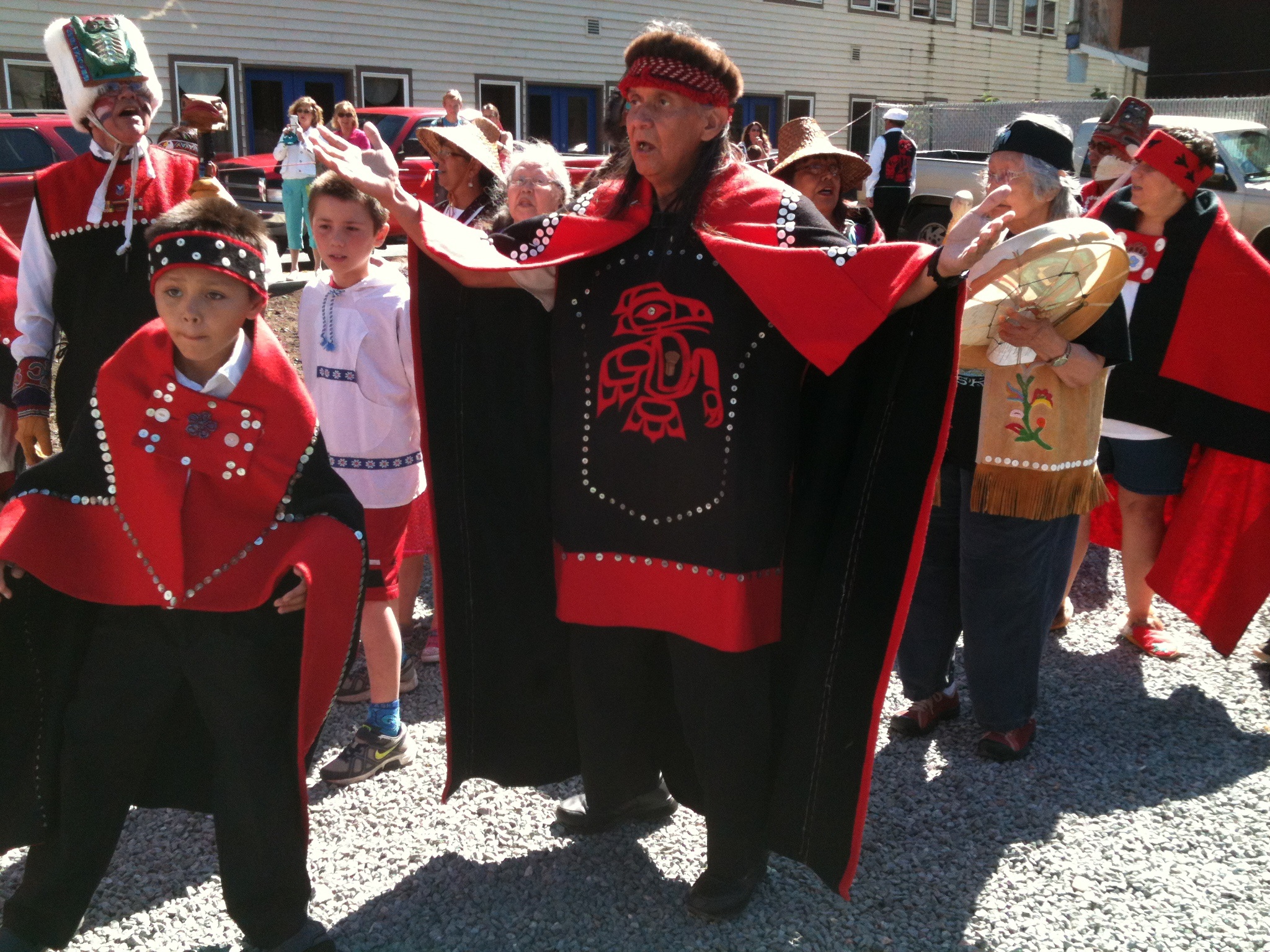
Members of the Yees Ku Oo dance group perform before and during the groundbreaking for the Walter Soboleff Center at Seward and Front Streets in downtown Juneau. Photo by Matt Miller/KTOO News
Local, state, and Native officials, and Native elders donned hard hats and picked up shovels on Thursday afternoon to break ground on a new cultural center planned for downtown Juneau.
Former Juneau mayor and former Sealaska corporation chairman and CEO Byron Mallot heads up the group raising funds for the center’s construction.
This is what ANCSA is all about. To create another giant step in Alaska’s Native peoples contributing their strength and their essence, their beauty, their values, their traditions, and their heritage to all Alaska and even to the nation.”
First Lady Sandy Parnell spoke on behalf of Governor Sean Parnell who attended the event, but who could not speak because of laryngitis.
“Like Dr. Soboleff himself, let this center stand for peace and understanding, for mutual respect and honor, for working together to lift all people up. That, by lifting people up, it will communicate to the world the values of Alaska and the values of Dr. Soboleff.”
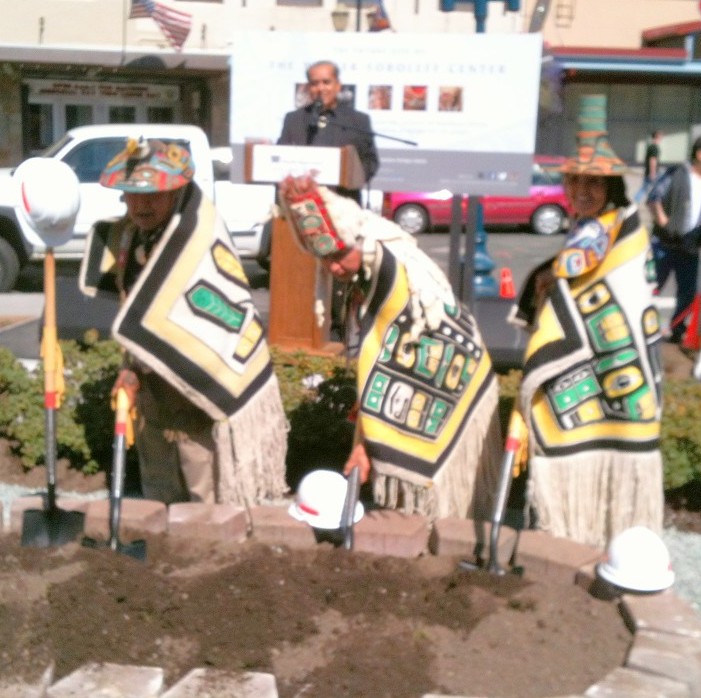
Governor Sean Parnell (from left), Sealaska Heritage Institute Trustee Chair Marlene Johnson, Sealaska CEO/President Chris McNeil, and Juneau Mayor Merrill Sanford break ground for the new Walter Soboleff Center in downtown Juneau. An architectural model of the center sits on a table at the far left. Photo by Matt Miller/KTOO News
Dr. Soboleff’s sons Ross, Walter Jr., and Sasha also participated in Thursday’s groundbreaking.
And for those things which we hold dear in our hearts, it is so grateful to have this unfold before us in the name of our dad, Dr. Walter Soboleff.”
Selina Everson, past Grand Camp president, represented the Alaska Native Sisterhood:
We have progressed from our Tlingit box of culture to a building that will carry on Dr. Walter Soboleff’s legacy. We have come a long way. We have a long way to go.”
Everybody gets their digs in. Eagle Clan Leader David Katzeek (from left), Paul Marks of the Raven Clan, and Rosita Worl of the Sealaska Heritage Institute participate in the groundbreaking with their own form of Tlingit hard hats as Sealaska Chairman Albert Kookesh watches in the background. Photo by Matt Miller/KTOO News
Other speakers included Albert Kookesh, Chairman of the Sealaska Board of Directors; Chris McNeil, Sealaska CEO and President; Juneau Mayor Merrill Sanford, Juneau Representative Cathy Munoz; Ed Thomas, President of the Central Council of Tlingit and Haida Indian Tribes of Alaska; Eagle Clan Leader David Katzeek, and Paul Marks who provided the Raven response. A letter from Juneau Representative Beth Kerttula and Juneau Senator Dennis Egan, who could not attend the groundbreaking, was read during the ceremony. The Yees Ku Oo dance group performed before and during the event.
Sealaska Heritage Insititute officials say they have raised about 75-percent of the funds needed for the $20 million project. Some of that money included state and CBJ appropriations, or grants from the Alaska Native Education Program or the Cruise Industry Charitable Foundation.
Completion is expected for the end of 2014.
The center’s proposed site, previously known as “The Pit” or the “Hole in the Ground,” was turned into a temporary park after Sealaska corporation acquired the vacant lot and donated it to the Sealaska Heritage Institute. The space used to be site of the Endicott Building or the Skinner Building which burned down almost exactly nine years ago.
The Reverend Doctor Walter Soboleff was a Presbyterian minister, and spiritual and cultural standard bearer of the Tlingit people. He passed away two years ago at the age of 102.
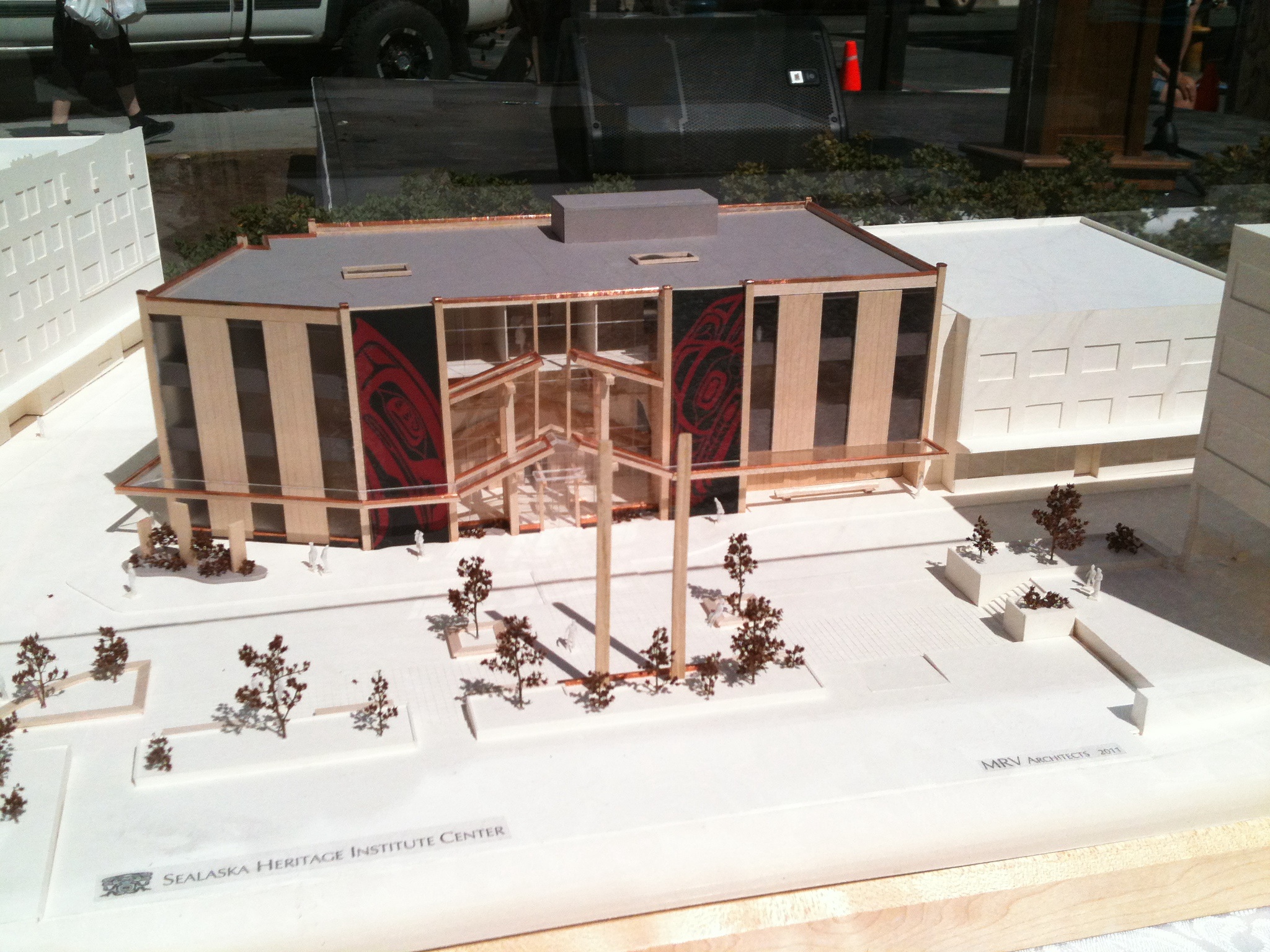
Architectural scale model of the proposed Walter Soboleff Center was on display at Thursday’s groundbreaking ceremony. Photo by Matt Miller/KTOO News
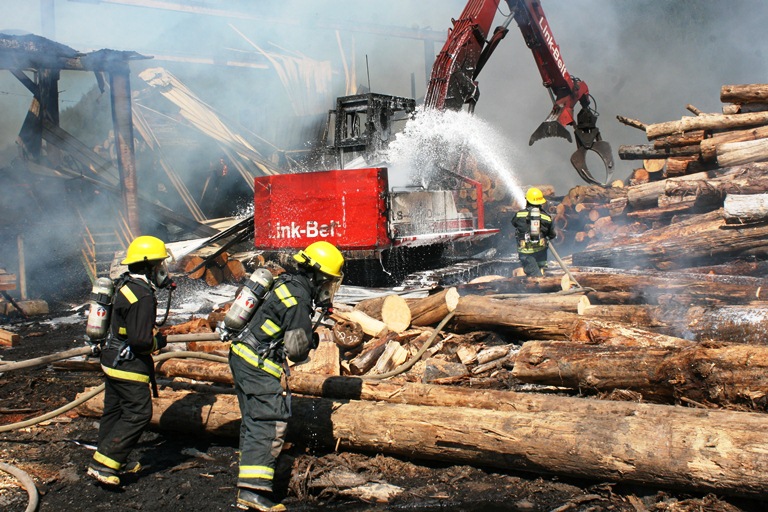
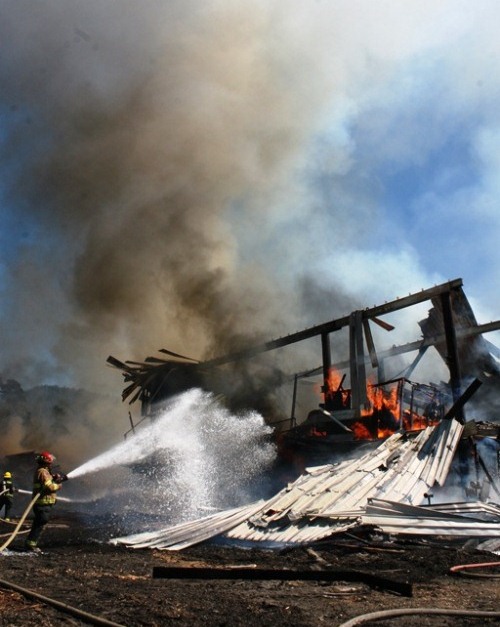
Wrangell firefighters battle a blaze at Mike Allen Enterprizes on Zimovia Highway. Photo by Greg Knight, Wrangell Sentinel.
One of the last major sawmill operations in Wrangell has been destroyed by fire.
Mike Allen Enterprizes burned to the ground in Tuesday’s mid-afternoon fire at 13 Mile Zimovia Highway.
The distance as well as unreliable phone service made firefighting a challenge.
That portion of Zimovia Highway was under heavy construction and down to a single lane with pilot vehicles.
SECON was the first to respond with a tanker truck. SECON workers helped emergency responders get to the fire by directing traffic and getting other vehicles off the road.
The Wrangell Volunteer Fire Department used three engines and three tankers to fight the fire, leaving one fire engine and crew in town, according to Fire Chief Tim Buness.
Photo by Greg Knight, Wrangell Sentinel.
“We received the call at 2:08 p.m. and twelve minutes later the first engine arrived from the substation,” he said. “Eighteen minutes after the initial call the trucks from town arrived. We had 35 volunteers and five retired firefighters on-scene.”
It took about six hours to wrap up the fire.
Wrangell was once a power in the Southeast Alaska timber industry. But as the industry declined, the larger mills closed.
Mike Allen owned the operation, a small community mill and one of the last two substantial milling operations in Wrangell. Allen made dimensional lumber of desired wood species, filling mostly local orders.
It’s not every day that an entomologist discovers a brand-new insect. And University of Alaska Fairbanks graduate student Jill Stockbridge wasn’t even looking for one.
She was on northern Prince of Wales Island, happily collecting bugs for her master’s thesis, which focuses on how logging practices affect beetles and spiders. Stockbridge used a couple different kinds of traps to gather her bugs, and then took all the samples back to Fairbanks to sort and study further.
That’s when she found it. Again and again. A mystery bug.
I didn’t even know what it was. I don’t think it’s a beetle, I don’t think it’s a fly. It looks kind of like a flea, but it doesn’t look like a flea”
Stockbridge said her adviser, Derek Sikes, was out of town at the time, so she just set the unknown bug aside. When Sikes got back, Stockbridge brought out the insect.
“His impression was that he was kind of disappointed in me, and just telling me, ‘Well, at this point in your career, you should know exactly what you’re looking at. I felt kind of ashamed,” she said, laughing.
Sikes, an entomology professor and curator of insects for the UAF museum, admits that he was a little surprised that Stockbridge couldn’t figure it out.
“I said, ‘What? You don’t know the order?’” he said. “And then I look at it, and I wasn’t sure what order it was. That’s just a real shocker for an entomologist to not really know what order something is.
With so little information about this insect, they turned – like many of us do these days — to social media. Turns out, there’s a bunch of other bug experts who are on Facebook, and often use that tool to identify critters. So, Stockbridge and Sikes posted some photos, and eventually were able to identify the genus, Caurinus.
“Then we started figuring, there’s only one species known from this genus, Caurinus dectes,” Stockbridge said. “But since that was found in Oregon and Washington, and that’s a little over a thousand kilometers away from POW, we started thinking, ‘Maybe we have a new species, so we should start doing some work on it.’”
They did some genetic comparisons, and found a 7-percent difference, which Stockbridge said is in the “gray area” when determining whether you’re looking at a separate species. Then they examined it under a microscope to look for clear physical differences, but that didn’t really tell them much, either.
“So, I signed up for a scanning electronic microscope class,” she said. “That’s a type of microscope that lets you get really up close to these insects so that you can try to find really tiny differences.”
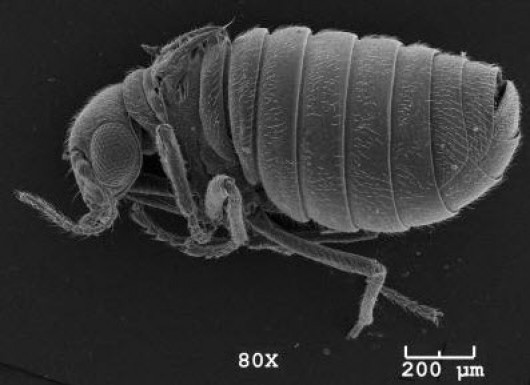
With the help of that extreme close-up view, Stockbridge determined that the two species do have some obvious differences. The males have different numbers of lenses in their eyes, and the females from Prince of Wales have a shallow notch on their bodies, while the Oregon version has a deep notch. It’s not a huge difference, but it’s enough.
“So yeah. From there, we just decided, ‘Well, what do we want to name it?’”
“At first I wanted to name it after myself,” she said. “But then my adviser was like, ‘That’s kind of arrogant.’”
So, they decided to honor the Native tribes of the island, and use the Tlingit word for “ancient,” tlagu; an appropriate name for a very old species.
At first glance, the tlagu could easily be mistaken for a flea – they even hop when you touch them — but don’t worry. They eat liverwort, a moss-like vegetation, rather than blood. Sikes said the similarities are striking enough that the new bug might be a long-lost relative of the modern blood-sucker.
“It’s about the same size as a flea, shape, color, but it’s not a parasite,” he said. “It’s a wild, plant-feeding, probably close relative to the fleas.”
He said they sent some samples to another lab, which will look more closely at the possible relationship.
Sikes noted that this new bug is among 300 species of arthropods that are found only in Alaska. More than that: So far, Caurinus tlagu has been found only on Prince of Wales Island. But, he said, now they know what to look for, and how to collect it.
“So now that we know how to find them, we can expand the search, and look at other islands in Southeast, look on the mainland, and just see how far and wide it’s distributed,” he said. “I expect it’s distributed much wider than the north of Prince of Wales where we found it.”
POW does have some special characteristics, though. Some species found there suggest that when the rest of Southeast was buried under ice, there were pockets of open land, allowing bugs – such as the Jurassic-age Caurinus tlagu – to survive glaciation.
Stockbridge collected the bugs over four summers. The last summer, they had the help of Lauren Russell, an entomologist who identified the Oregon version of Caurinus.
During her annual trips to POW, Stockbridge stayed in Coffman Cove, which she said welcomed her warmly.
“I really like that small community,” she said.
The people there are super nice, and anytime I visit there, they say, ‘Oh, the bug lady is back!’ So that’s my name down there. The bug lady.”
The bug lady says that the discovery of Caurinus tlagu will form an interesting chapter in her master’s thesis, which she hopes will be done in time for her to graduate next spring.
In a half-hour meeting on a Sunday afternoon, the Alaska Redistricting Board unanimously agreed on a new electoral map.
The process of drawing the state’s political boundaries has been going on for nearly three years. Along the way, board members described it as a struggle, Democrats characterized it as gerrymandering by a Republican-dominated group, and the courts deemed it unconstitutional.
Board member Bob Brodie expressed relief at the idea the prospect of Sunday’s meeting being the board’s last.
“It wasn’t an easy job in the beginning, and it wasn’t any easier later.”
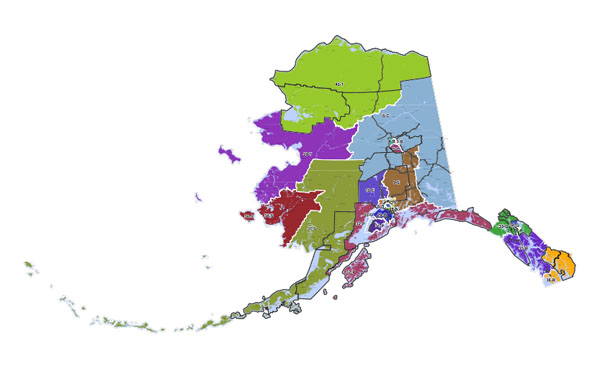
The new plan is partially based on a proposal from the Native corporation Calista, and there are some major changes from the temporary map used in the 2012 election. It gets rid of a controversial district that mixed some Fairbanks area residents with rural Alaska; it removes Petersburg from Juneau’s Senate district; and it reconnects the Aleutian chain. All of those issues had been raised as constitutional concerns, and board attorney Michael White said at the meeting that the new map addresses those legal claims.
The map also opens up a Senate seat in the Mat-Su area by placing Eagle River Republicans Anna Fairclough and Fred Dyson in the same district, and it creates a new House seat in the Interior by putting North Pole Republicans Doug Isaacson and Tammie Wilson in the same political boundaries.
During Sunday’s meeting, board members complimented each other on finalizing a new map, and they discussed the challenges of complying with both the Alaska Constitution and the federal Voting Rights Act. The act, which is meant to protect the influence of minority populations, was partially struck down by the Supreme Court last month. Board member Jim Holm spoke critically of giving special treatment to Native voters.
“I find it to be disconcerting that we so many times try to allow people to have extra voting rights versus people who are just plain Alaskans. I’ve been here 67 years, and I’m an Alaskan. I may not be an Alaska Native, but I’m a native Alaskan.”
The map will now be submitted to the courts for approval as part of an ongoing lawsuit.
A state antitrust lawyer says a proposed merger may pit the commercial shipping equivalents of David against Goliath in Southeast Alaska.
The plan, announced in April, involves three shipping companies: Seattle-based Alaska Marine Lines, Seattle-based Northland Services, and Sitka-based Samson Tug and Barge. AML’s parent company, Lynden Inc., wants to buy AML competitor Northland Services.
If that was the end of the plan, Lynden would have a monopoly on shipping in Southeast.
It’s Assistant Attorney General Ed Sniffen’s job to review the merger plan, negotiate fixes to the anticompetitive parts, and if necessary, fight it out in court.
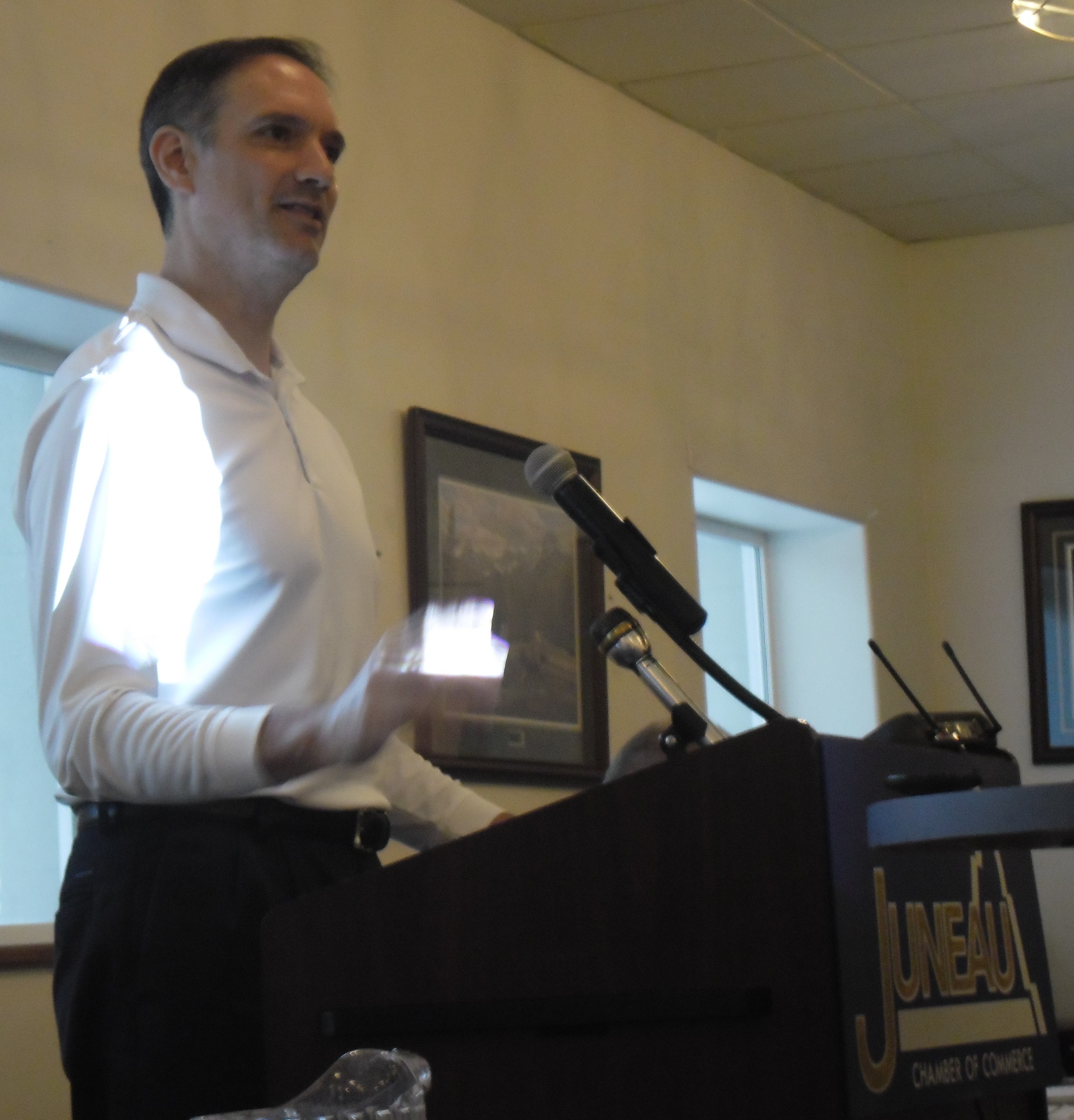
Assistant Attorney General Ed Sniffen addresses the Juneau Chamber of Commerce on July 11. (Photo by Jeremy Hsieh/ KTOO)
“Competing with someone like Lynden is a tough thing to do,” he said Thursday, speaking to the Juneau Chamber of Commerce. “I mean, they’ve been around, they’re big, they know what they’re doing. You get someone like, you know, Samson coming in, trying to swing at Goliath a little bit. And you want to make sure they’ve got a big hammer so when they hit him, he feels it.”
Though Sitka-based, Samson right now doesn’t operate elsewhere in Southeast. Samson Vice President Cory Baggen says the company only has about 10 employees in the panhandle, all of them in Sitka. However, Samson announced plans to expand its service in Southeast the same day Lynden announced its intent to buy Northland.
“I think that the competition is going to be as stiff … as it is today with Northland, and normally competition tends to keep the prices down,” said AML President Kevin Anderson. “You know, we’re not going into this thinking we’re going to lose any customers. And if we have to battle for them to keep them, so be it.”
Many details of the vetting and deal making are under wraps – at least until the Department of Law files something in court – but the parties have essentially said that Northland won’t be wholly absorbed by Lynden. Instead, Northland may be carved up between Lynden and Samson in service of the smaller company’s Southeast expansion.
For example, Baggen said Samson is eyeing Northland’s current location on Channel Drive as its future port in Juneau. And if everything goes forward, she says her company will probably pick up 40 or 50 of Northland’s employees in Southeast.
That last “if” brings it back to the Department of Law. Baggen says Samson won’t start investing and expanding until the merger’s greenlit. But the merger may not be greenlit until AML actually has new competition in Southeast.
Samson Tug and Barge Vice President Cory Baggen
“I don’t want to set it up, and put a warehouse in with 25 doors and be all ready for nothing, and the consent degree doesn’t go through,” Baggen said. “So, it’s kind of a chicken-egg thing right now.”
AML’s Kevin Anderson says his company’s intent with the purchase of Northland is not to monopolize shipping in Southeast, but to expand in Seattle by acquiring Northland’s property there, and to become a full service Alaska seafood packager, carrier and marketer.
“The thing that Northland does extremely well is that they’re out in the west –Bristol Bay, Kodiak, and Dutch Harbor, I mean, some of the biggest fish runs in all of Alaska –we couldn’t play in that game,” he said.
He also says it’s been an “extremely painful” process.
“We’ve been involved in this process now for, I don’t know, close to a year. And it doesn’t seem like we’re getting any closer. It’s just one thing after another. And the amount of time and effort it takes on a lot of people’s part to put something like this together is unbelievable,” Anderson said.
Sniffen says the Department of Law hopes to have something filed in October, which would open a 60-day public comment period. Ultimately, a judge would have to sign off of on the deal. If the department can meet that timeline, Sniffen says the parties would likely know by the new year if the merger can go through.
As far as her company’s characterization as David, Baggen was lukewarm.
“I think that the history of Southeast Alaska has shown that small companies can be viable and successful and can do a really good job here, so, even though it might be a good – sort of a good analogy, I think, I think it’s OK,” she said.
That history includes echoes of another David and Goliath story. When Lynden, originally a trucking company, first got into Alaska shipping, Anderson says Lynden wasn’t taken seriously because Foss Maritime was the giant.
Close
Update notification options
Subscribe to notifications
Subscribe
Get notifications about news related to the topics you care about. You can unsubscribe anytime.