Southcentral

Unnerved but unharmed, Anchorage residents tidy up after 7.1 quake

Municipal Light and Power crews work on digging through cement to reach a malfunctioning transformer knocked out during the earthquake, interrupting power to the 5th Avenue Mall. (Photo by Zachariah Hughes/KSKA)

An earthquake shook Southcentral Alaska around 1:30 a.m. Sunday morning–with tremors felt from Two Rivers to Juneau. The most extensive damage appears to be on the Kenai Peninsula. The 7.1 earthquake was centered about 50 miles west of Anchor Point in Cook Inlet.

In Anchorage, Portage and the Mat-Su Valley the earthquake knocked out power to thousands of homes. By midday Sunday, electricity had been restored to all but a handful of homes.

Though some Anchorage residents seemed unnerved, it wasn’t enough to disrupt errands and shopping plans.

Shortly after opening at 11 a.m., just about every store in the 5th Avenue Mall remained shuttered and dark.

“The power is out, due to the earthquake,” said Kari Skinner, director of marketing and business development for the mall. Skinner buzzed between floors and back hallways, eyes scanning her phone as she answered questions from bewildered patrons.

“Due to safety concerns most stores have elected not to open,” she said.

The quake knocked out the mall’s transformer, which is buried under the sidewalk on 4th Avenue. Crews from Municipal Light and Power set up a small armada of trucks to dig up the pavement and replace the equipment.

Two department stores in the building have a different power source and opened, as usual, letting in a steady flow of shoppers. Among them, Sue Doherty.

“I’ve lived her for 25 years, so it’s not like I’m not used to earthquakes, but this was a biggie,” Doherty said, standing outside the darkened Apple store where she’d come to get her phone fixed.

When the quake woke Doherty up in her east side home, it wasn’t the intensity but duration, about half a minute, that unsettled her. Still, she was out running errands because she sees a seismic event like this as par for the course.

“We live in Alaska and things are gonna happen. This is an earthquake zone, and we’re strong people, we can make it,” she said.

Soon after we spoke the lights flickered back on in some of the shops, and dozens of Mac computers glowed to life all at once.

One Alaskan slightly upset to miss the quake was Anchorage Mayor Ethan Berkowitz, who has been weathered into Washington D.C. since Friday, following a conference for hundreds of mayors in the nation’s capital.

“There’s nothing quite like having snow and not having the gear to get around in it,” Berkowitz said by phone.

Early in the morning, the mayor received reports from City Manager Mike Abbott on damage spotted by crews from the Fire Department and utility companies as they responded to calls.

Berkowitz explained that in the big picture Anchorage fared well.

“I was relieved that nothing calamitous had occurred, I mean, this is very different than if it had been a full-blown emergency,” he said.

There are disaster response plans in place that would have kicked in had the quake reached emergency status, he said. Concerns remain over seismic damage to infrastructure at the Port of Anchorage, but so far things appear ok: A regularly scheduled Matson barge was able to dock Sunday morning.

As for the mall, stores are expected to be back to normal Monday.

Alaskans take to Twitter with photos, jokes after 7.1 earthquake

An earthquake of magnitude 7.1 struck the southern coast of Alaska early Sunday, the U.S. Geological Survey says. The quake, which was centered just over 160 miles southwest of Anchorage, hit at 1:30 a.m. local time (5:30 a.m. EST), waking up many residents of Alaska’s largest city.

It was followed by dozens of aftershocks, according to the Alaska Earthquake Center.

The Nationl Weather Service’s Tsunami Center says there’s no anticipated risk of a tsunami, due to the depth of the quake.

Monica Gokey of Alaska Public Media reports that residents from Fairbanks to Juneau posted on social media that they felt the earthquake. Initial reports didn’t indicate any severe damage, she says: ” Shortly after 2:00 a.m., the Anchorage Police Department reported that it has not received any major reports of damage or injury as a result of the strong earthquake.”

Thousands of people have lost power and 22 homes have been evacuated over concerns of a potential gas leak, local TV station KTUU reports.

On Twitter, Alaskans who were rudely awakened by the shaking used the hashtag #akquake to share their photos and stories — and their jokes.

https://twitter.com/AlyseGalvin/status/691227377431543808


Copyright 2016 NPR. To see more, visit http://www.npr.org/.
Read original article – January 24, 2016 10:18 AM ET

7.1-magnitude earthquake strikes Cook Inlet, no tsunami expected

The Alaska Earthquake Center is reporting a 7.1 magnitude earthquake struck the Cook Inlet at 1:30 a.m.

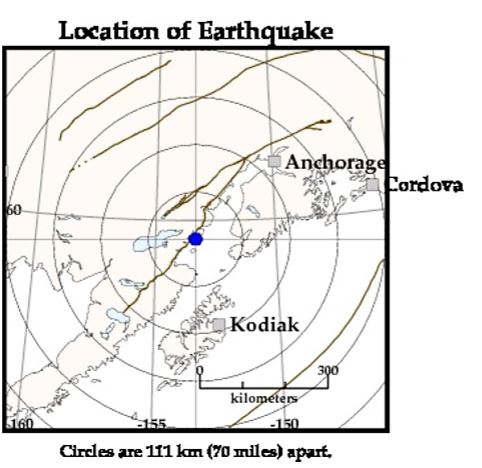
Earthquake map 1/24/2016
A map of the 7.1-magnitude earthquake that struck Cook Intlet around 1:30 a.m. Sunday, Jan. 24, 2016. (Courtesy Alaska Earthquake Center)

The National Weather Service’s Pacific Tsunami Warning Center issued a statement saying no action is required for tsunami risk: “BASED ON ALL AVAILABLE DATA … THERE IS NO TSUNAMI THREAT BECAUSE THE EARTHQUAKE IS LOCATED TOO DEEP INSIDE THE EARTH.”

Anecdotal damage reports are circulating on social media of intense shaking and scattered power outages.

AFD Dispatch is very busy with reports of gas odors, alarm systems sounding, broken water lines, etc. Isolated reports…

Posted by The Anchorage Fire Department on Sunday, January 24, 2016

The 7.1m earthquake at 1:30 am caused several outages including our entire Douglass substation in Willow and Hospital…

Posted by Matanuska Electric Association on Sunday, January 24, 2016

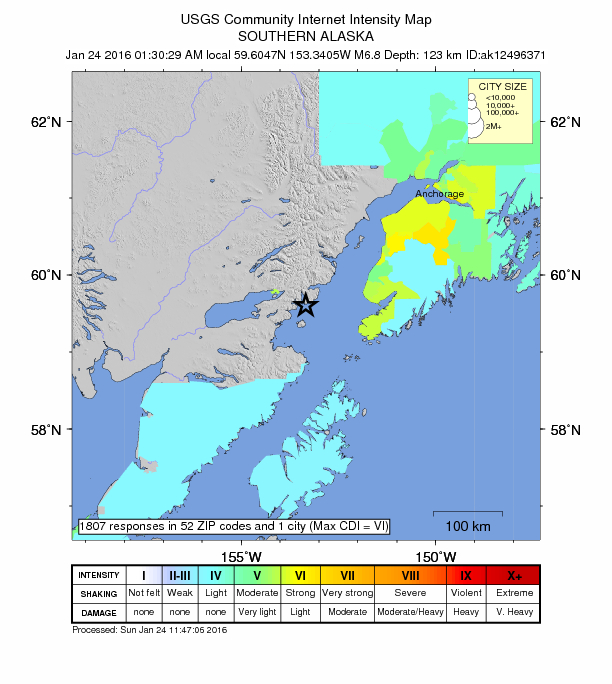
As of 2:47 a.m. Alaska time, the U.S Geological Survey had recorded more than 1,800 reports about the earthquake from across 52 ZIP codes.

USGS earthquake feel map
(Image courtesy USGS)

This is a developing story, check back for updates.

New tech and political clout put toward homeless campers

The Anchorage Mayor’s office is throwing its weight behind initiatives to end homelessness, a problem the administration says has intensified in recent years. As social service providers gather data on homeless individuals, they’re pairing new technology with an increased level of political support.

Just after 8 a.m. Thursday morning, city homelessness coordinator Nancy Burke stooped toward a snowy tent in the woods by Chester Creek, waking 58-year-old Duane English, who’s been camping in the area for the last month.

Chester Creek Trail Entrance in Anchorage
An entrance to the Chester Creek Trail where Nancy Burke and others set out ahead of the annual point in time homelessness survey. (Photo by Zachariah Hughes/KSKA)

“My name’s Nancy,” Burke said. “I was wondering if we might visit with you?”

“Visit me for what?” English asked back from inside the tent.

Burke explained it’s part of a survey to figure out how many people are living outside of permanent shelter.

“Well why you gotta come now?” English asked, frustrated.

“We come in the morning because we wanna make sure people are in camp,” Burke responded almost cheerfully.

English tells her she should come back later. Burke is persistent, though, offering coffee and supplies.

“Can we leave some socks?” she asked towards the end of the short exchange, eventually handing a thick pair to English.

Burke and others are going to homeless camps across town to touch base with people about the upcoming point in time survey, an annual event where officials and volunteers try to get a census of who is living on the streets. This morning she’s joined by a small gaggle of guests, including two police officers, a radio reporter and Mayor Ethan Berkowitz.

“This is my first time doing the count,” Berkowitz said in a parking-lot by the trail as plows cleared away snow.

Berkowitz campaigned on overhauling how the city deals with homelessness. In the months since, his administration has directed money toward a supported housing project, re-established the homelessness coordinator position, and built capacity in city hall for coordinating with nonprofits.

When asked why he was here, Berkowitz said he wanted to see homelessness firsthand.

“Some administrations ignore problems hoping that they’ll go away. That’s not been a good solution for homelessness,” Berkowitz said. “Our effort is going to be to identify individuals who are on the streets or living in the camps, there’s only 300 or 400 people like that, we can get this done.”

That identification step is key in the administration’s strategy. Burke is in charge of an aggressive push towards the Housing First model, getting folks into homes and rental units as a starting point for plugging them into services, employment, and help.

Before all those steps, however, officials and nonprofit employees need solid information on how many people are are homeless and what their needs are.

“It will give us an idea of where folks are in the community,” Burke said, “so that we can allocate resources to do outreach and to find people and see what they need to get assistance back into housing.”

To get better at that information gathering, officials have switched from paper surveys to an app.

“So, your age, gender, race,” Burke said, scrolling through the app’s questions on her phone. “Homeless information: How long have you been homeless? And then we have some questions about whether people were homeless when they moved to Anchorage or moved to Anchorage and then became homeless.”

Individuals have to give a signature in a field at the bottom of the survey before the GIS mapping coordinates are transferred to the Homeless Information Management System. Location data cannot be gathered without explicit consent.

The administration’s model depends not just on identifying and mapping people, but knowing each person’s name and needs.

Terry Chubin supervises Homeward Bound, a transitional housing program within the Rural Alaska Community Action Program. She’s done outreach work for years, and said getting people plugged into resources comes from building a relationship.

“We just introduce ourselves. And sometimes it takes a few times going back and giving out a lot of socks, bus passes, McDonald’s gift-cards–whatever we have–and then just building that trust and that rapport with the person,” Chubin explained. “Because if you just go in and go ‘here you go’ and leave–you’re not doing anything.”

The point in time survey is Wednesday, Jan. 27. Information for volunteers can be found through the Anchorage Coalition on Ending Homelessness or by contacting the mayor’s office.

Anchorage real estate market remains stable despite low oil prices

Despite dismal revenues from declining oil prices, the state’s largest real estate market remains strong.

In an annual presentation to city officials on property values, Anchorage’s municipal assessor Bryant Robbins showed a steady rise in overall property values.

Residential units are the bulk of Anchorage’s property tax base–assessed this year at $25.53 billion, a growth of about 3.5 percent over last year. On average, homes sold at $11,888 above their assessed values, indicating a healthy market, according to a spokesperson for the Mayor’s Administration. The average sale price in 2015 was $366,592.

New construction was down slightly from the year before by three percent. The total number of residential and commercial units brought online is still about half what it was in Anchorage before the financial crash in 2008.

Anchorage’s real estate market has historically tracked closely to the price of oil. That trend has come apart over the last year, as the per barrel price has plummeted to record lows, but the city’s total assessed property values have continued on a modest climb upwards.

Former Juneau woman missing since New Year’s Day in Anchorage

Former Juneau resident Linda Skeek went missing in Anchorage Jan.1. (Photo courtesy of Anchorage Police Department)

A former Juneau woman has gone missing in Anchorage. Linda Skeek, 32, was last seen at her home in south Anchorage on New Year’s Day.

According to a public announcement from the Anchorage Police Department, Skeek left her home on foot after a fight with her husband. She was reported missing Jan. 4.

Skeek, whose maiden name is Sheldon, moved to Anchorage from Juneau in April and still has many friends and family members in Southeast. Skeek’s family told Anchorage police that she had left for the weekend before but would always return by Sunday so she could go to work the next day.

On Nov. 30, Skeek filed for a protective order for herself and two children against her husband. She withdrew her petition for a permanent protective order 10 days later. Skeek’s mother Laura Sheldon says the two had a fight but had resolved it.

Skeek is 5′ 10″, about 200 pounds, with brown hair and brown eyes. She was last seen wearing a black coat, red vest and red skirt.

Anyone who knows of Linda Skeek’s whereabouts are asked to call the Anchorage Police Department at 907-786-8900.

Site notifications
Update notification options
Subscribe to notifications