The Alaska Department of Fish and Game is looking at trimming 30 positions next year in budget cuts.
Deputy Commissioner Kevin Brooks gave an overview of the department’s budget to the House Finance Committee last week.
“Like, I think, most of the department you’ve seen, there was pretty steady growth for about a 10-year period. For the last three years we’ve seen a pretty significant decline,” Brooks said.
In three years, the department has cut 100 positions, Brooks said. The cut in the current budget year was about $14.7 million. Another $7.5 million is proposed in the governor’s budget for the budget year that begins in July.
Reductions so far have been accomplished through attrition and in bringing back less seasonal jobs. But future cuts are going to be more difficult.
“In the ’17 budget, we’ve notified over 30 employees since the first of the year that their positions are slated for elimination by June 30. We’re spending the next five months working with them, trying to place them in other jobs, if we can. Some people are choosing to retire,” Brooks said. “Our goal was to not have anybody laid off. I don’t know that we’ll make that.”
Brooks said the department has undertaken administrative cuts and efficiencies to limit impacts to programs in the field. And he said that revenue offsets have helped limit impacts to programs.
There are two pieces of legislation in the works that would help raise revenue for the department. House Bill 137 would increase fees on fishing and hunting licenses. And House Bill 251 would assess an additional 1 percent tax on the commercial fishing industry.
HB 137 awaits attention in the Senate Resources Committee. And HB 251, raising commercial fishing taxes, faces the House Fisheries Committee.
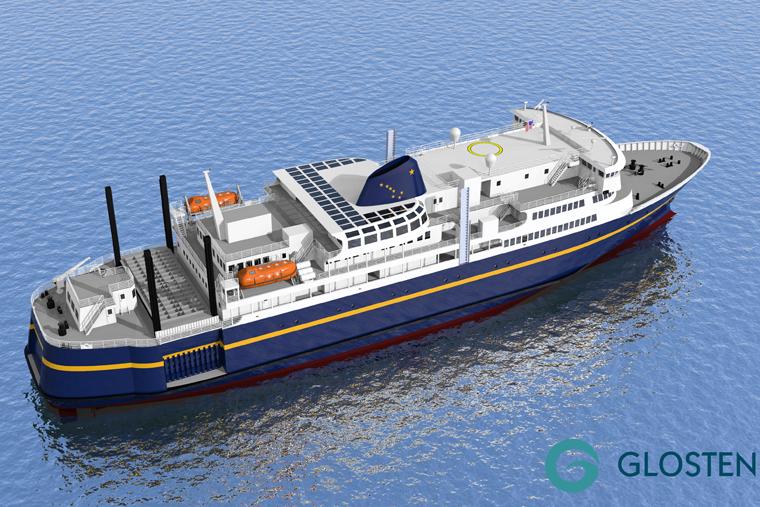
A rendering of the ferry designed to replace the Tustumena. (Image courtesy Alaska Department of Transportation & Public Facilities)
The state Department of Transportation has a design for the ship that will replace the ferry Tustumena.
DOT Deputy Commissioner Mike Neussl said the new design focuses on two key issues. First, to make the new ferry carry as many people and vehicles as possible. The second goal was to make it small enough and shallow enough to use all the docks and shore side infrastructure used by the Tustumena right now.
“Both of those design criteria were put in. The design is complete but the process going forward is to get that design into construction, build a vessel, put it into service and replace the existing Tustumena on its runs with a new more capable vessel,” said Neussl.
The Tustumena has served communities in southcentral and southwest Alaska for a little more than 50 years. The ferry’s home port is in Homer and it regularly travels to 13 ports between Homer and Unalaska.
Neussl isn’t sure when construction will start on the new ferry or how long it will take. He said a vessel of that size typically takes at least two or three years to build. He said it depends on contract terms with the shipyard doing the work.
“As a comparator, the Alaska Class Ferries being built out in Ketchikan … the construction period was intentionally lengthened to drive the cost of those ferries down. Instead of having three ship builders working around the clock to try and build it as fast as possible, you work on it at a slower pace,” explained Neussl.
Neussl said none of those decisions have been made for the Tustumena and the construction contract has not been opened up for bidding.
He said the new ship is estimated to cost around $237 million and about 90 percent of that money is expected to come from the federal government through Alaska’s Statewide Transportation Improvement Plan or STIP.
“That is the mechanism by which all projects compete for those federal funding dollars. … That provides millions of dollars for the State of Alaska for federal aid projects. Highway projects, marine highway projects, dock replacement projects,” Neussl said.
The rest of the money would come from the state. He said the vessel is listed among the projects seeking STIP funding but it’s listed in fiscal year 2019.
“Which is quite a ways down the road. Our job now is to pull that forward through the amendment process to get it funded through that process and out for construction … hopefully sooner rather than later. That’s where the project currently stands,” said Neussl.
Neussl said once the new ferry is built, the old Tustumena will be sold to either continue sailing under a new owner or it will be used for scrap.
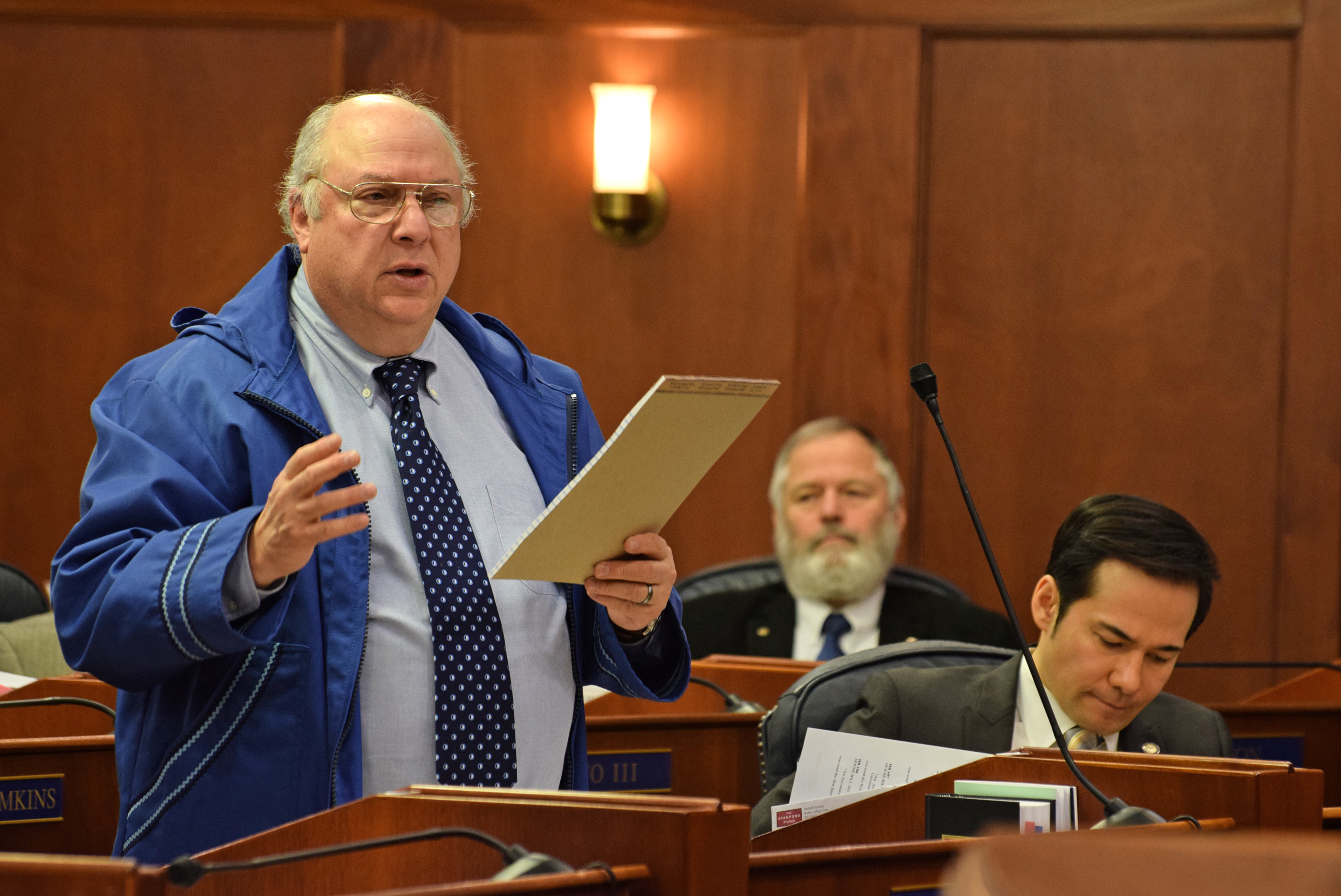
Rep. Max Gruenberg, D- Anchorage, addresses the Alaska House of Representatives, Feb. 2, 2015. (Photo by Skip Gray/360 North)
Longtime Rep. Max Gruenberg died Sunday in Juneau. The Anchorage Democrat was 72.
Gruenberg gained bipartisan respect for his skill in crafting legislation.
He was the senior member of the House. He served during two separate periods, from 1985 to 1992 and again since 2003.
Gruenberg was born and raised in San Francisco. He was an Eagle Scout. And he served in the U.S. Navy in Vietnam.
A retired family lawyer, Gruenberg sponsored the law that provides Silver Alerts to locate missing, vulnerable adults. Another Gruenberg law requires the removal of asbestos from schools and public buildings.
Gruenberg served twice as the House majority leader. He was the minority whip in the current session.
Gov. Bill Walker ordered that flags by lowered for both Gruenberg and U.S. Supreme Court Justice Antonin Scalia.
Walker said Gruenberg’s death is a significant loss for all of Alaska.
Anchorage Democrats will submit three potential replacements to Walker, who will choose one. House Democrats will then accept or reject the choice.
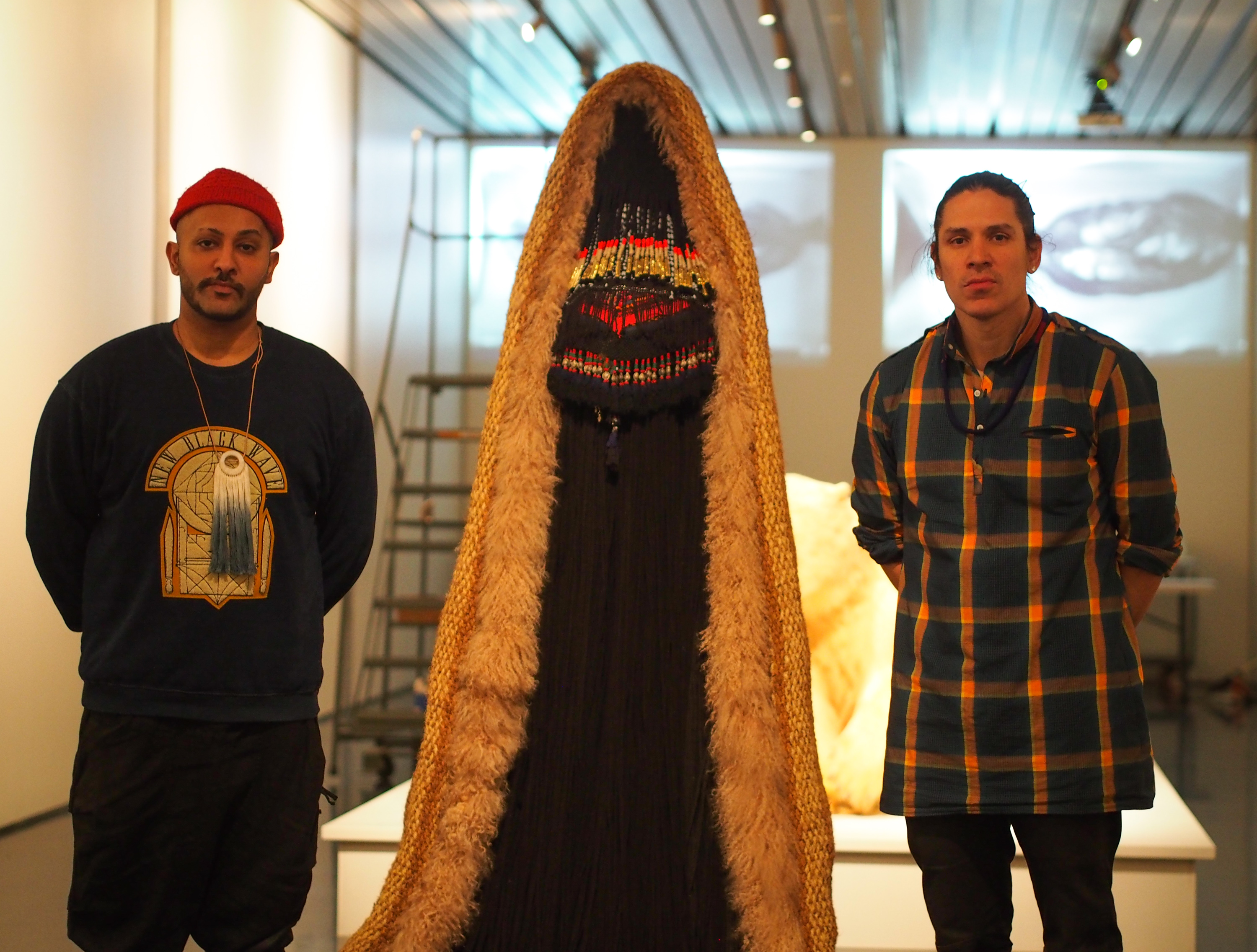
Nicholas Galanin, right, with his collaborator Nep Sidhu standing beside a piece in the “Kill The Indian, Save The Man” exhibit. (Photo by Zachariah Hughes/KSKA)
A few hours before his first solo show at the Anchorage Museum was set to start, Nicholas Galanin walked past workmen and collaborators putting the final touches on an array of installations, ranging from a performance piece to a taxidermic polar bear.
Galanin is a Sitka-based artist behind the provocative new exhibit “Kill the Indian, Save the Man.” He stopped in front of a multidisciplinary piece called “A Supple Plunder.” A projector shows slow-motion footage of a bullet ripping through ballistic gel. Beneath are nine clear human torsos set to be be stacked on pedestals like classical busts.
“Unanagan men were bound together – 12 were bound together and shot to see how far the bullet would penetrate,” Galanin said. “Nine dropped.”
The incident is cited as part of the atrocities during Russian colonization in the Aleutian islands in the 1760s.
Galanin’s collaborator on the piece was his brother Jerrod, who said it was an emotional experience recreating the grim history the work draws from in the artistic process.
“We set up all nine of these in a line and we took a shot. It was exciting. I think we even laughed,” he said. “It’s easy to do that with a torso without any head. And I can only imagine the Russian that did this probably laughed, too, and thought it was funny. And I don’t understand that. I don’t know how you can get to that point where you can do that.”
The idea of having collaborators in a solo-show is just one of the confounding gestures Galanin and his partners weave into the exhibit, which has been in the works for about a year. All together, the pieces are an arresting mix of conceptual criticism, technical finesse and beauty that verges at times on the grotesque. One of Galanin’s co-creators, interdisciplinary artist Nep Sidhu, said all the works bound together by the show’s title and theme.
“Hence the idea of ‘Kill the Indian, Save the Man’ – it’s an impossible notion,” Sidhu said.
Sidhu and Galanin are both part of Black Constellation, a collective of artists stretching across the West Coast and parts of Canada. Together the artists dressed four mannequins in an opulent but unsettling mix of garments. One wears a Chilkat robe over a cascade of winter jackets–a comment Sidhu said, on the epidemic of missing indigenous women in Canada.
“Looking at a lot of missing persons reports, you would often come across the one thing that they had in common,” Sidhu said. “Winter jackets. You know, ‘Last seen wearing a red winter parka.’ Winter jackets, over and over.”
Using traditional and indigenous artistic forms like a Chilkat robe to make a statement about the present is hardly revolutionary. But the Anchorage Museum is taking big steps to collapse any distinction between those traditional forms and modern art as its long been curated in formal spaces.
“I think those boundaries feel very arbitrary now,” said Julie Decker, the museum’s director. “Putting all the voices together and saying, ‘This is Alaska’s media, and these are the arts that are working here,’ feels better.”
Decker stood in front of works that are part of the the new All-Alaska Biennial, a film projected on a wall behind her, and a wood carving ringed in feathers to her front.
Calling the Biennial new isn’t quite accurate. It was created by combining two shows that for decades have been distinct. In the past, the All Alaska Juried Exhibition was for so-called modern artworks like formal painting and sculpture, and on alternate years the Earth, Fire, and Fibre show assembled masterworks from so-called traditional forms like weaving and ceramics. But the museum is experimenting in how it sees and supports a shifting definition of “modern” within the arts.
“I think art is changing, the way we define media is changing, and all artists are working and experimenting in a lot of different forms,” Decker said. “This is a survey of contemporary art of this place at this time.”
A third solo show, “Stick and Puck” by Anchorage artist Mike Conti, looks critically at the culture around ice hockey. Together, the new exhibits explore what modern art means today in Alaska. All three are on display at the museum through April 10.
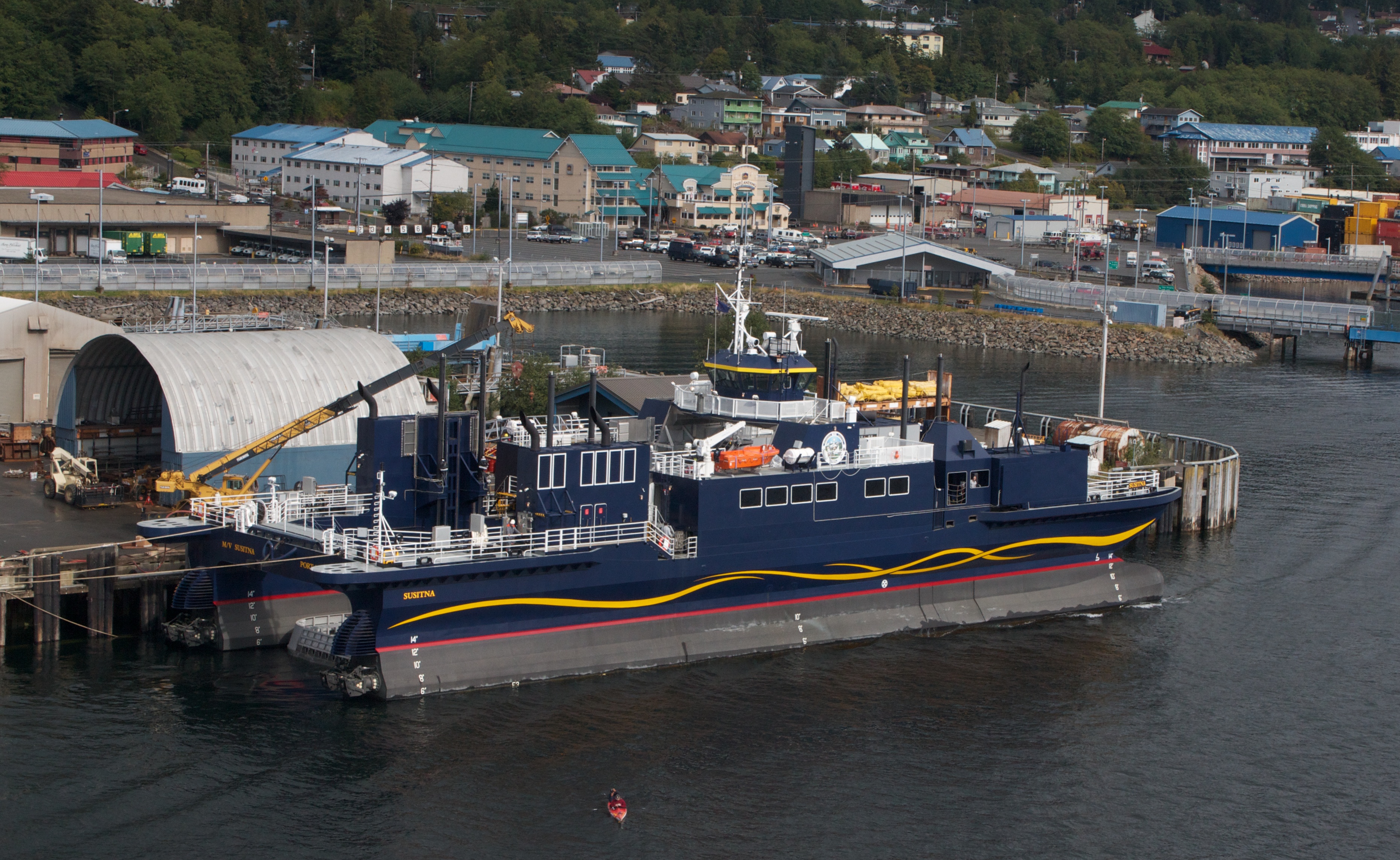
The ferry M/V Susitna being outfitted in Ketchikan for delivery to Anchorage in August 2010. It is a catamaran ice breaking ferry. (Creative Commons photo by Jay Galvin)
The Matanuska-Susitna Borough’s ailing and unused ferry Susitna is headed to Seattle on the end of a tow rope, after the latest developments in the vessel’s years-old saga.
At a special meeting Tuesday hastily called by borough Mayor Vern Halter, new information was presented about the cost of the repairs necessary to satisfy a potential buyer.
In early December, the borough assembly accepted a down payment of $250,000 for the purchase of the vessel from the Philippine Red Cross. The deposit is to be used to help pay for repairs on three ruined ferry engines. At the same December meeting, the Assembly approved spending $870,000 from borough reserves to complete the engine repairs. Insurance is expected to reimburse the $1.1 million total.
But there’s a new snag.
“The $1.1 million fix is slightly north of $3 million,” said Borough Manager John Moosey.
An insurance company engineer’s analysis indicates a need for a complete rebuild of all four engines on the ship, which cannot be done in Ketchikan. So tug operator Foss will tow the Susitna to Seattle for $100,000.
Moosey said the borough has a March 31 deadline for completing the repairs. It’s a deadline they can’t hit. Borough Port Director Marc Van Dongen said repairs would take 60 to 90 days, and sea trials must be completed before the sale.
Assemblyman Steve Colligan wanted a contract with the buyers before any action on the ferry move.
“I don’t think we should do anything unless the buyer is going to agree, and we have a date out there far enough so that we know 100 percent, you’re going to get that work done. Otherwise, we should cut our losses now. … Scrap it,” Colligan said. “We would be better off spending $500,000 to send it to the scrapyard.”
But the assembly approved a motion by Assemblyman Dan Mayfield that would allow the ferry to be towed to Seattle as soon as possible, with its final fate to be determined.
“The vessel has been sitting in Ketchikan for quite some time, without a lot of action to proactively repair it,” Mayfield said. “So we need to show good faith both to our insurance company and to the Red Cross that we are going to proceed with repairs.”
The assembly also directed manager Moosey to seek an extension from the Philippine Red Cross on the final sale date.
Mayfield said the borough’s maritime insurance company has not guaranteed full payment for the repairs. He said some expenses are being questioned. But, he said, the Susitna would not be a total loss between insurance and the sale price of the ferry.
Mayfield said if the sale falls through, the vessel could be scrapped, and there are more resources to do that in Seattle than Ketchikan.
The ferry Susitna is expected to exit Ward’s Cove in Ketchikan in the next couple of days, weather permitting.
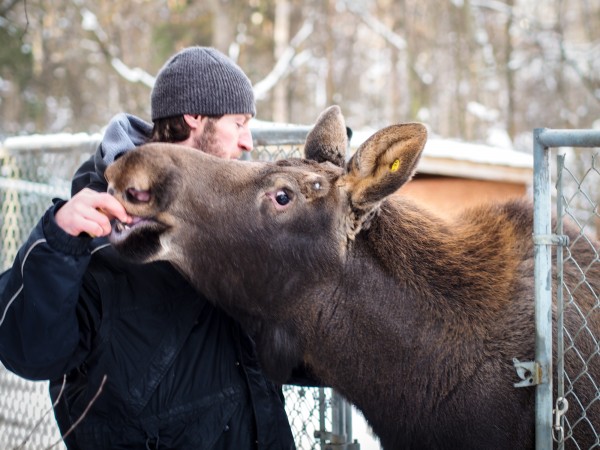
Zookeeper Timothy Lescher feeds a frozen banana to Uncle Fudge, a one-year-old moose he’s helped raise. (Photo by Zachariah Hughes/APM)
If you’ve ever wanted to feed a snow leopard, a moose, or a pack of wolves, this year you’ve got a chance. Albeit, for a tidy sum.
It’s part of a package deal at the Alaska Zoo, one piece in a funding strategy particular to non-profits in the high north: Finding ways to bring in extra cash during the long, lean winter months ahead of tourist season.
On a recent Monday afternoon, zookeeper Timothy Lescher split a side of caribou ribs with a hand-saw.
“I think we got probably nine pieces here, which is a good number.”
He stuffs assorted chunks of carcass into a black trash-bag, and gets ready to toss piece after piece over the fence to a hungry pack of wolves.
“Looks delicious, doesn’t it?” Lescher asked as the wolves whined nearby.
“Is that moose scapula?” I asked.
“Yes,” he replied. “The wolves, they like everything.”
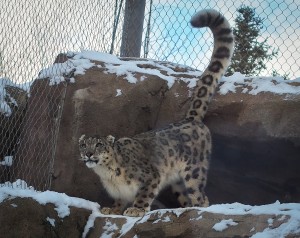
Nakai is the only snow leopard at the zoo. Lescher says they hope to get him a companion, but the wait-list for endangered snow leopards makes that unlikely within the next year. (Photo by Zachariah Hughes/APM)
The five loping lupines are just a few in the long list of Lescher’s animal wards: Brown bears, the snow leopard, dall sheep, trumpeter swans, among others.
“I also take care of the petting zoo animals,” he added.
It’s like parenting a barn full of kids, even though some are on opposing sides of the food-chain. Lescher has made peace with the gentle contradiction that is zoo-keeping wild animals. The wolf pack is kept alive on a diet made up partially of donated meat scraps that come–quite feasibly–from cousins of a nearby adolescent moose named Uncle Fudge, that Lescher raised from the bottle.
When we stop at Uncle Fudge’s pen he lunges excitedly at his keeper’s palm for pieces of frozen banana.
Likewise, Lescher is unfazed by the pacing and growls that greet us when we step into the chilly lair of a leopard.
“You just wanna make sure you stay against this wall, because he will jump up on this fence,” Lescher tells me.
“Ok,” I heed.
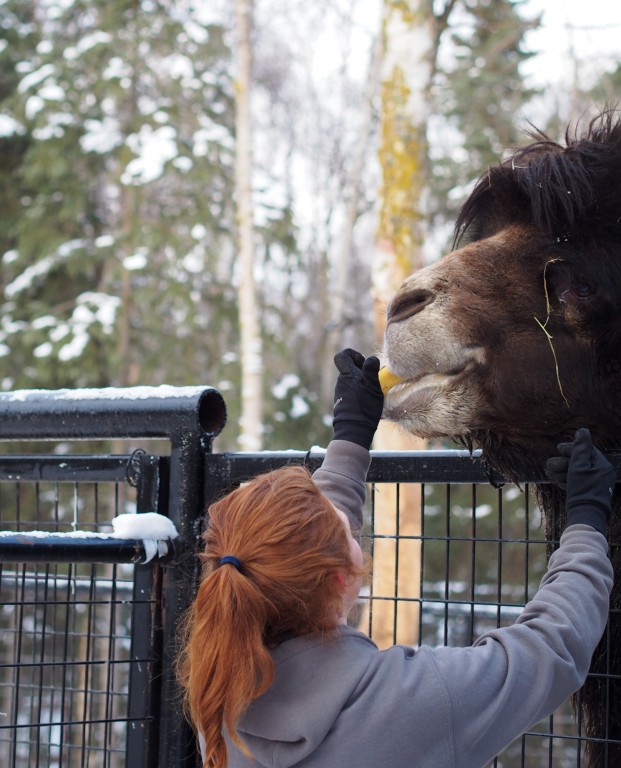
Lescher is giving me a behind-the-scenes tour of the zoo as part of a special program called “Keeper for a Day.” For $200 a person you shadow the zookeepers for five hours, feeding fruit to shaggy Bactrian Camels, watching the wolves get walked on chain-leashes, or watching Nakai the snow leopard nibble lunch from Lescher’s finger-tips.
In the wild, Nakai would be stalking blue sheep, ibexes, or Tibetan yaks in the Himalayan mountains. Today he’s getting high-grade hamburger.
“That’s all bud,” Lescher tells the elongated feline, who gives a very relatable growl as the meat runs out.
Nakai has the coloring and musculature of a very buff house-cat blown up to the size of a coffee-table. Plus a three-foot long tail for balancing on snowy boulders. His globular eyes are captivating, and when the food is gone his head bobs up and down tracking my movements in a flattering but unsettling way.
“Keep your back against the wall, is what I tell people, and you’ll be fine,” Lescher adds.
Nakai is the only snow leopard at the zoo. Lescher says they hope to get him a companion, but the wait-list for endangered snow leopards makes that unlikely within the next year. Photo: Zachariah Hughes.
Angelica Evans feeds fruit to a male Bactrian camel at the Alaska Zoo. (Photo by Zachariah Hughes/APM)
For animal super-fans this is the sweet nectar of first-hand experience the Alaska Zoo is leveraging to help pay its bills.
“The zoo is actually comprised of like six different businesses,” said Jill Myer, the zoo’s development director.
At the standing desk in her office, overlooking the alpaca pen, she ran through line after line of the organization’s expenses.
“$125,000 dollars a year–I mean, that’s just to basically care for the animals,” Myer said. It covers things like toys, husbandry, and food.
“That doesn’t seem as huge as I thought,” I replied.
“It doesn’t, but then you need to continue on: A lot of the care of the animals comes into staff.”
It turns out, the most expensive zoo creatures are the keepers. The biggest expense in the budget is salaries and benefits for employees. It costs more to cover human medical insurance than buy all the animal food.
There are other challenges that make funding a sub-arctic zoo a little–let’s say, unique. Most of last fiscal year’s $2,936,700 in last year’s revenues came from admissions during the summer, when tour buses and cruise ships unleash a steady torrent of visitors. The zoo even extends its hours.
“It’s Alaska, and there’s light, and you can come to the zoo in the middle of the night and there’s animals still up and roaming around,” Myer excitedly explained.
Unfortunately, because the zoo specializes in cold-weather creatures, they aren’t exactly in their element during tourist season. The tigers get sluggish, and if the mercury climbs too high the bears demand special accommodations.
“When it gets over 70 degrees we start trucking in ice, and so they just lay in the ice and they’re so thankful.”
Winter is when the most of the mega-fauna are a bit more out and about. And they aren’t the only ones. With the bears hibernating, the hours reduced, and fewer visitors wandering around, the keepers have extra time too.
The Keeper for A Day program is a way for the zoo to leverage its biggest assets–the allure of the animals and the expertise of the keepers–to make extra money when the grounds are under utilized. They also rent the zoo out for weddings and host special programs. None of these revenue streams take in that much–Keeper For Day brought in just $15,500 last year. But that buys a snow leopard a lot of hamburger meat.
Offering programs that get more enthusiastic patrons to spend on unique experiences isn’t unique to the zoo. It’s part of a strategy non-profits and cultural institutions across the state use to cultivate buy-in. Keeper for a Day is a refined extension of the Alaska Sealife Center’s annual gala or museum events increasingly aimed at a younger, hipper set.
Ann Hale directs development at the Anchorage Museum, and has more than two decades of experience funding non-profits in Alaska. The fundraising profile exists at peer institutions in the Lower-48, but amplified in Alaska.
“Because the economy here is reliant on summer tourism,” Hale said sitting in her office, overlooking no animals. “It may be more unique for us than it is in other states or other communities.”
Like the zoo, the Anchorage Museum collects the majority of its admissions revenue during the three-and-a-half month summer window. Alaska non-profits have to plan accordingly for the non-tourist season, according to Hale.
Lescher, the zookeeper, is less concerned with the finances than a longer-term set of goals when it comes to programs like Keeper for a Day.
“I see as many adults as I do kids. Sometimes they’re aspiring zookeepers, sometimes they’re just people that have an intense interest in wildlife or in animals in general.”
He thinks that if a zoo can get people invested in a relationship with Nakai the leopard or Uncle Fudge the moose, that serves their larger mission of animal conservation.
Close
Update notification options
Subscribe to notifications
Subscribe
Get notifications about news related to the topics you care about. You can unsubscribe anytime.