Southcentral

Crowded Nanwalek school has no plans for expansion

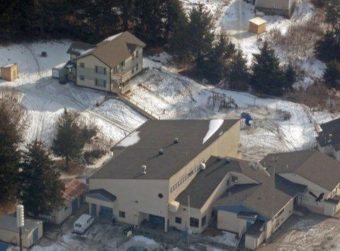
An aerial photo of Nanwalek School. (Photo by Ron Keffer)

Nanwalek School is nearing 150 percent capacity, but the Kenai Peninsula Borough School district has no plan to expand the facility. It’s so crowded that next year, the principal plans to move one class into a re-purposed garage.

Nanwalek is an Alutiiq and Sugpiaq community near the southern tip of the Kenai Peninsula.

Principal Nancy Kleine tours me through Nanwalek School where somewhere between 75 and 85 students, depending on enrollment at any given time, are packed into a building that is supposed to hold 60. She points out the room that’s the biggest problem.

“This is our secondary science and math room,” said Kleine.

The room is full with the current 21 middle school students, but over the coming years, Kleine says, the class will become even more crowded – next year and especially in two years due to an even larger projection of middle school students.

”And this is the room that is going to be a little bit too small as the population grows for our kids. Right now, it’s plenty big for the kids in here, but you can see that when you add, put 30 kids in here, it would be too small,” said Kleine.

And that’s why Kleine is repurposing a garage.

“This was in the past … it’s been I think a shop and woodworking area. We don’t currently offer woodworking, so the district is going to purchase a Conex which will go out into the corner of the property out there and all of this stuff that’s out here will go into the Conex and this room will get some flooring and be a room for kids to be able to learn in,” said Kleine.

John Kvasnikoff, the First Chief of Nanwalek, says his people have been trying to get the Kenai Peninsula Borough School District to do something about their overcrowded school for a long time.

“I know we’ve been overcrowded for years and it’s like we’ve been asking what’s going to happen, you know? And they’ve never really said anything and it’s getting serious,” said Kvasnikoff.

The school was built before statehood by the Bureau of Indian affairs in 1958. There’s been no expansion at the school since an addition in 1977. But the population of Nanwalek has continued to grow. According to census data, Nanwalek’s population has nearly doubled since the state started keeping track in 1990.

Kvasnikoff, who has three children attending the school, says he believes the crowding is beginning to have a negative impact on students.

“It’s hurting our kids; they don’t have any room for them. We’ve been saying it for years. It’s…we’ve kind of been like out of site out of mind,” said Kvasnikoff.

The remote community’s concerns about crowding and requests for expansion were ignored by the District while they were flush with money, says Kvasnikoff. Now that the problem is getting worse, there are no funds due to declining oil revenue. Residents are frustrated, he says, after years of sitting on the sidelines watching other schools around the region get fancy facility upgrades.

“Look at Seldovia, they have way less kids than we do and they have this nice pool,” said Kvasnikoff.

Julie Cisco, Director of Planning and Operations for the District says Kvasnikoff is right.

“What we need to do is build or add onto. But as you mentioned and everybody’s aware, there’s no funding. And we’re not allowed to bond. The legislature took away our bonding for five years, if not more. So we don’t really have a way to do anything,” said Cisco.

According to the formula used by the Alaska department of education, Cisco says the school is way over capacity.

“By the square footage calculation, Nanwalek is 138 percent over capacity right now. The building is rated for 60 students and the associated staff that goes with that. And we’re, I think, just over 80. We’re estimating it’s going to be 150 [percent capacity], this coming year,” said Cisco.

Cisco notes that in addition, the state formula does not include the high number of intensive needs students at the school, which often require an aide and additional space for learning activities.

Kvasnikoff says he believes Nanwalek will continue to grow.

“We could use a regular sized gym, more classrooms – they need more classrooms and you know they need more other stuff, not just classrooms. Keep our kids fit and we want them to participate. We’re growing and growing and we’re going to keep growing,” said Kvasnikoff.

And, even though there’s no money right now, he wants to see an expansion plan from the district so that the problem is addressed as soon as funds become available.

Public pushes back against House’s proposed budget cuts

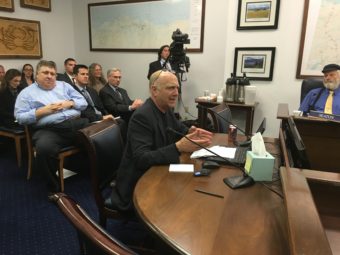
A crowd representing a variety of interests gathered in the House Finance Committee room during public testimony on the state budget, Feb, 29, 2016. (Photo by Skip Gray/360 North)

Alaskans giving public testimony this week on the House’s budget proposal oppose cuts to many areas.

The Republican-led majority released a budget proposal this week that included $145 million more in cuts than Gov. Bill Walker’s budget. It would reduce spending on everything from public libraries to senior benefits.

Roughly 100 people testified Monday and Tuesday on the budget.

The cuts include reduced grants to mental health and addiction treatment programs.

Residents also opposed cuts to prekindergarten, public libraries and the University of Alaska. And they said they want the House to avoid cuts to senior benefits and public broadcasting.

Juneau resident Kara Nelson directs Haven House, a faith-based home for women leaving prison. She opposed cuts to behavioral health grants.

“There are over 120 people today alone that died from an accidental overdose in our nation,” Nelson said. “That is an Alaska Airlines flight that died every single day, and that was in 2015. And so I urge you that we are trying to lessen the beds in our prisons, but we have no supports already to support the well-being of our people.”

Elizabeth Ripley, executive director of the Mat-Su Health Foundation, shared her concerns over behavioral health cuts.

“Cutting behavioral health grants will only reinforce the current system that drives people to seek care in the emergency room,” Ripley said. “A 2013 data analysis shows that Mat-Su Regional Emergency Department had five times the number of visits than our community mental health center. These visits to one hospital cost Alaskans $23 million in 2013, not including doctor, EMS or police costs.”

Kodiak Public Library Director Katie Baxter urged House Finance Committee members to restore funding for the Online With Libraries, or OWL, program. It funds high-speed internet connections and receives federal funds — known as E-Rate — that match state contributions.

“I am here to urge you to restore the governor’s funding of $761,800 to restore the OWL internet connectivity program,” Baxter said. “This program is an intricate system that is cost efficient that involves local and federal funding. By eliminating the OWL program as the house subcommittee has done, now we are leaving federal E-Rate dollars on the table. And I for one really don’t want to do that.”

The House Finance Committee will hear more public testimony Wednesday and Thursday.

Energy industry leaders reject oil and gas tax hikes

The top energy industry lobbyist in Alaska denounced Gov. Bill Walker’s proposed oil and gas tax changes on Monday.

Alaska Oil and Gas Association President Kara Moriarty told the House Resources Committee that companies can’t afford higher costs when oil prices are low.

“If you want the policy of Alaska to be to raise taxes on an industry that has negative cash flow, then that’s your prerogative, but what we’re saying is that that policy will impact their investment and production,” Moriarty said.

Walker proposed raising the minimum oil and gas tax from 4 to 5 percent. He also wants to eliminate some tax credits for drilling and exploration.

The changes would reduce the state government’s $3.5 billion deficit by $500 million.

Rep. Geran Tarr, an Anchorage Democrat, asked Moriarty to reconcile industry concerns with the actions of some companies, such as Hilcorp, which gave employees $100,000 bonuses last year.

“How can you expect the Alaska public to react to information like that?” she asked.

Moriarty said Hilcorp honored a long-term commitment to their workers with the bonuses. She added that other major employers have been laying off workers in Alaska.

Armstrong Oil & Gas Inc. Chairman Bill Armstrong testifies (Photo by Andrew Kitchenman)
Armstrong Oil & Gas Inc. Chairman Bill Armstrong testifies on Feb. 29, 2016 (Photo by Andrew Kitchenman)

Armstrong Oil and Gas Chairman Bill Armstrong said other states have had stable oil and gas taxes. But Alaska has made several changes over the past decade, making it more difficult to invest.

He said most countries have been cutting taxes on energy companies.

“They’re all making things better, with the exception of three countries that I could find: Congo, Madagascar, and Tanzania. And Alaska,” Armstrong said. “Three countries and a state. So, to make things worse when things are bad is, you’re kind of in rare company.”

The committee will hear testimony from more industry executives on Tuesday.

So far, no more ferry system cuts

The Alaska Marine Highway System made it through one step in the legislative budget process without further cuts. But those could come later.

The House Finance Subcommittee on the state Department of Transportation budget did remove $2 million in general funds. That’s the pot of money that pays for most state operations.

But the committee replaced it with the same amount from a separate fund made up of earnings from ferry tickets, sales and other revenue.

A sign along Juneau's Glacier Highway points to the Auke Bay Ferry Terminal (Photo by Ed Schoenfeld/CoastAlaska News)
A sign along Juneau’s Glacier Highway points to the Auke Bay Ferry Terminal (Photo by Ed Schoenfeld/CoastAlaska News)

Juneau Democratic Rep. Sam Kito III is one of the panel’s seven members.

He said the change should prevent deeper service cuts on top of those made by the governor.

“But it’s not a sustainable source in the long term. So the department is going to need to figure out how to try and generate revenue as opposed to relying on the system fund for that support,” he said.

Ferry officials have said they’re streamlining operations to reduce the impacts of cuts. But there are limits.

The governor’s budget, released in December, included about $142 million for the fiscal year starting in July. That’s a $5 million cut for the ferry system.

It’s about 8 percent lower than the current budget year and about 11 percent less than the previous one.

The House Finance Transportation Subcommittee considered, but rejected, further ferry cuts during a Thursday meeting.

The budget could undergo further changes in the full Finance Committee, as well as on the House floor. It will follow a similar process in the state Senate.

Rep. Dan Ortiz, a Ketchikan independent on the budget subcommittee, hopes it won’t change.

“While it might be just another step in a downward trend for the ferry system, ultimately there has to be a decision that says, ‘No, we’ve gone far enough,’” he said.

Last year, budget cuts and mechanical breakdowns led to changes in the busy tourist season schedule. That caused some visitors to cancel sailings, as well as lodging and excursions in port communities, as well as others around the state.

Transportation spokesman Jeremy Woodrow said this summer’s ferry schedule anticipates the budget cuts made by the governor and upheld by the committee.

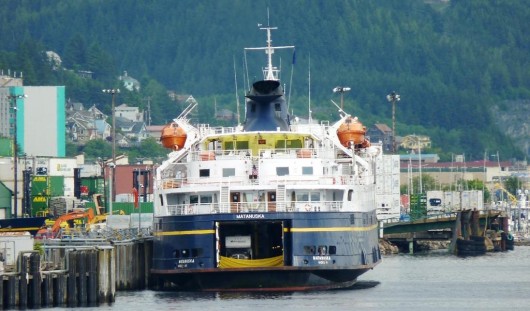
The state ferry Matanuska tied up at Alaska Ship and Drydo
The state ferry Matanuska ties up at the Ketchikan shipyard. (Photo by Ed Schoenfeld/CoastAlaska News)

“It’s our intention as a department to not make any changes to the summer schedule. We don’t anticipate that would alter any service that we’ve already planned for the summer of 2016,” he said.

The committee did reduce the budget for Transportation Department vehicle replacement by 10 percent. The statewide cut totals $1.3 million.

Kito said that could affect some very basic services.

“I am concerned about what that’s going to mean for snowplowing, especially places like the Haines Highway, some places around Juneau and the Skagway Klondike Highway,” he said.

Under the budget plan, each of the department’s three regions will see proportional cuts.

Subcommittee looks for $35 million cut to University of Alaska

The House Finance University of Alaska Subcommittee recommends cutting $35 million from the university’s budget for the upcoming year.

Combined with Gov. Bill Walker’s proposed $15 million cut, the university would lose one in seven dollars in state funding.

The subcommittee also voted to support consolidating the university’s three campus administrations by the end of the year.

The Board of Regents has nominated Jim Johnsen for UA president. (Photo courtesy of University of Alaska)
University of Alaska President James Johnsen (Photo courtesy of University of Alaska)

University President James Johnsen has proposed cutting administrative costs and streamlining programs, but the subcommittee’s cuts go much further.

“I don’t have a problem reducing administrative costs and generating – getting those revenues over into our academic programs,” Johnsen said

But to combine the accreditations of all three campus this — formally merging them into one institution — in 10 months would be impossible, he said.

“That’s a big deal. That’s not going to happen in 2016,” he said. “But to reduce administrative costs across the system, we can definitely do that.”

The subcommittee voted for the cuts five-to-two Wednesday. Supporters of the cut noted that including federal and other funds, the university’s budget is $875 million.

Johnsen said he’s glad the cuts didn’t go even deeper. Subcommittee Chairwoman Tammie Wilson, a North Pole Republican, had initially wanted a $47 million cut but scaled it back after hearing from university leaders.

Johnsen said he’ll fight for more money before the Legislature completes the budget.

“I appreciate the move the committee made” to restore $12 million, he said, adding that subcommittee members said the recommendations are the beginning of the budget process.

“I’m still disappointed, however, in the outcome of this proceeding,” he said. “But knowing there’s a process to move forward with, we’ll continue to press it.”

The House Finance Committee will vote on the recommendations before the full House votes. The university regents ultimately decide how the budget will be spent.

State trims $7 million from gas pipeline budget

State officials have put a number on how much they will trim from next year’s budget for marketing liquefied natural gas from the proposed pipeline: $7 million.

That’s the cut Governor Bill Walker’s administration will make to its budget request. It reduces the number of companies marketing gas to customers in Asia from three to one.

Deputy Commissioner of the Dept. of Natural Resources, Marty Rutherford, gives an overview of the Alaska Liquefied Natural Gas Project in House Finance, Feb. 23, 2016. (Photo by Skip Gray/360 North)

State Deputy Natural Resources Commissioner Marty Rutherford told the House Finance Committee Tuesday the change reflects slow negotiations with the state’s three pipeline partners, as well as the low price of gas.

“The commercial negotiations have not moved as expeditiously as we would have wished, um, and recognizing the reality of the environment we all are living in,” the state made the budget change, she said.

The state originally asked for $35.7 million for the AK LNG project in the coming budget year. Now it’s asking for $28.7 million.

While negotiations are slow, the state still faces a tight window for completing the project.

Between seven and nine years from now, many contracts in Asian countries will be up for renewal.

Rutherford said some of these contracts won’t be renewed because the current suppliers are tapped out.

“And growth for LNG demand is fairly flat,” she said. “It’s not forecast to grow at a very strong rate over the next 10 years. So trying to respond to that market window, if you will, is a very critical issue for the state of Alaska.”

Walker and leaders of ExxonMobil, BP and ConocoPhillips announced last week that they’re exploring options to advance the pipeline. They said they’ll provide more details next month.

Site notifications
Update notification options
Subscribe to notifications