Mushers in the 44th Iditarod Trail Sled Dog Race participated in the ceremonial start to the race in downtown Anchorage Saturday. (Photo courtesy of Alaska Public Media)
The 44th Iditarod Trail Sled Dog Race kicked off with the ceremonial start of the race in downtown Anchorage Saturday.
At 85 mushers, it’s one of the largest fields the race has ever seen.
This year, race officials had to shorten the traditional 11-mile course to just three miles out of safety concerns stemming from a lack of snow in town. The Alaska Railroad donated the freighting costs to move more than 300 cubic yards of snow from Fairbanks to the streets of Anchorage.
The Municipality of Anchorage also strategically stockpiles snow throughout winter to aid in Iditarod efforts every March.
On Friday night, with street closures throughout the truncated trail, dump trucks unloaded large mounds along the route towards Mulcahy stadium.
Snow conditions along the festive streets Saturday morning were decent, with temperatures hovering in the 20s keeping the slush at bay.
The official restart is in Willow on Sunday, with the first musher scheduled to leave at 2 p.m.
A local Homer resident discovered two large tentacles washed up on an Anchor Point Beach Wednesday.
Homer resident Ginger Frizzell found this five-and-a-half-foot-long tentacle on a beach near Anchor Point Wednesday, March 2. (Photo by Ginger Frizzell)
Homer resident Ginger Frizzell found this five-and-a-half-foot-long tentacle on a beach near Anchor Point Wednesday, March 2. (Photo by Ginger Frizzell)
Homer resident Ginger Frizzell found this five-and-a-half-foot-long tentacle on a beach near Anchor Point Wednesday, March 2. (Photo by Ginger Frizzell)
While beachcombing, Ginger Frizzell found what appeared to be two cephalopod arms that measured over 5 and ½ feet in length. A local biologist told the Alaska Dispatch News that he believes the tentacles belonged to a giant red octopus, a common species in the Cook Inlet and Gulf of Alaska waters. This octopus can have tentacles that weigh 70 pounds and are as long as 14 feet.
This isn’t the first time that Frizzell says she has come across tentacles on the beach. She told KBBI that in April 2014 she found similar tentacles washed up on Bishop’s Beach in Homer.
Frizzell has lived in Homer for two years, and she says she is always “out and about” with her camera. Since Wednesday evening, Frizzell’s Facebook posting of the tentacles has been shared nearly 3,000 times.
The snowless parking lot outside Alaska Mountaineering and Hiking in Anchorage’s Spenard neighborhood. (Photo by Zachariah Hughes/Alaska Public Media)
It’s been a terrible winter for Anchorage by just about every measure.
Warm weather systems have turned what little precipitation has reached the municipality into rain and ice, ruining many of the recreational activities residents wait all year to enjoy. Few people’s livelihoods in Anchorage depend on reliable winter conditions. But there may be a hazard to the city’s economic health if winter-loving outdoor enthusiasts decide dark, icy winters aren’t worth sticking around for.
It’s dusk on an icy slope in Russian Jack Park on the east side of town, as 9-year-old Andrew Harmon solemnly puts on his skate skies.
“The conditions right now, we really can’t work with it too well,”he said.
Junior Nordic ski practices this season have been moved around to different trails in search of a bare minimum of usable terrain.
“Basically, there’s like, no snow,” Harmon explained. “Mostly ice and some leaves.”
For him, one of the big problems is it hurts a lot if you fall. For his dad, Art Harmon, who’s coached Junior Nordic for years, it’s a separate set of issues.
“The main difference is that you have to be really flexible with your plan,” Harmon said inside the park’s chalet as young skiers started arriving.
This winter, Harmon has had to adjust what he’s teaching, even putting lessons about ski fundamentals on hold if conditions don’t comply. But flexibility also means a lot more logistical coordination.
On training days, coaches like Harmon leave messages on a hotline for parents and get instructions on which park will host that day’s practice.
“So again, we’ll be at Russian Jack, and we’ll see you at 6:15,” the phone recording crackles.
Harmon said even though an extra 20 minute commute to, say Hilltop on the south side of town, is hardly a catastrophe, and it makes a difference for families.
But for retailers in Anchorage, those same dismal Nordic conditions are less about inconvenience than survival. Some of the most popular winter activities – ones that demand some consumer investment – have dropped off a cliff.
“Last year, as everybody knows it was a very grim winter,” recalled Marcy Baker, who has worked at Alaska Mountaineering and Hiking in the Spenard neighborhood for 30 years. After getting burned last year, the store took a gamble on this season.
“We decided we were going to plan on another poor winter and inventory accordingly. So we only have two big down parkas left in the store,” Baker said, standing before a meager sales rack. “Which is smart.”
It wasn’t just coats. AMH scaled back its overall inventory for winter clothing and equipment.
Many of their core customers haven’t given up on outdoor recreation, though. It’s been a good year when it comes to equipment for ice, whether that’s ice skates for snowless creeks and lakes, or cleats for staying upright on hikes.
“Everybody that’s come in, they’re kind of grumbling a little bit, but they’ve all adapted to do something. The Nordic skating has been joyful and the backcountry skiing’s been good,” she said.
There’s no debating it’s been a bad year for fans of winter weather in Southcentral, but measurements and the causes are multifaceted. Not only was there a record-breaking snow drought, but Anchorage has seen about a third of its average winter moisture. And the precipitation that made it within the boundaries of the municipality has mostly been rain, caused by higher-than-normal temperatures from all the warm air moving up from the southeast.
“And that’s locked out a lot of the more typical – and what we would consider seasonable – cold for a large part of the state, especially southcentral,” said National Weather Service meteorologist Dave Snider.
The causes of that warmth, though, are less straightforward. The Blob, El Nino, micro-climates over surrounding maritime areas, fluctuations in the jet stream 30,000 feet up in the sky – all of these are contributing this year. And though the last three winters have been relatively warm and low on snow, Snider points out that when he moved to Anchorage in the 2011-2012 winter, Anchorage hit a record and had about 5 feet of snow above its average. The consistent trend is less uniformly directional than one of diminishing consistency.
“In the last several years the variability of winter has been pretty broad,” Snider said.
What this means for the character and psyche of Anchorage is a little less certain. An open-ended survey by the Anchorage Economic Development Corp. asked almost 1,275 questions about why they live in Anchorage and why they might leave. One of the most recurrent themes in the answers was recreation. People love the hiking, the skiing, the proximity to whatever outdoor fun can be dreamed up.
For coach Harmon, that means adapting ski practice if need be. On a recent evening, he had his junior Nordic children step out of their bindings for a scavenger hunt.
“A couple of them said, ‘This is the most fun we’ve had at Junior Nordic,’ and we weren’t even on skis,” Harmon said. “I try to hold on to those things because you can be bummed out here about the lack of snow, but as an Alaskan I want to have the feeling that no matter what the weather I can go out and enjoy myself.”
The best medicine for a dreary winter, for Harmon and others in Anchorage, is adaptation. And if all else fails, there’s always hope that next year might be better.
Apache has pulled their optimistic promotional video about its Cook Inlet venture from their YouTube page.
Here’s a transcription of the opening lines of the video, which was published in November 2012:
“They said she was a dying oil field, they said her best days were behind her. They had all but written the obituary for Alaska’s Cook Inlet. But where others saw decline, the Apache Corporation saw opportunity. Now with cutting edge technology, strong financial backing and determined attitudes, the Apache Corporation is on the threshold of rewriting the destiny of Cook Inlet.”
Original story | 7:55 p.m. March 3, 2016
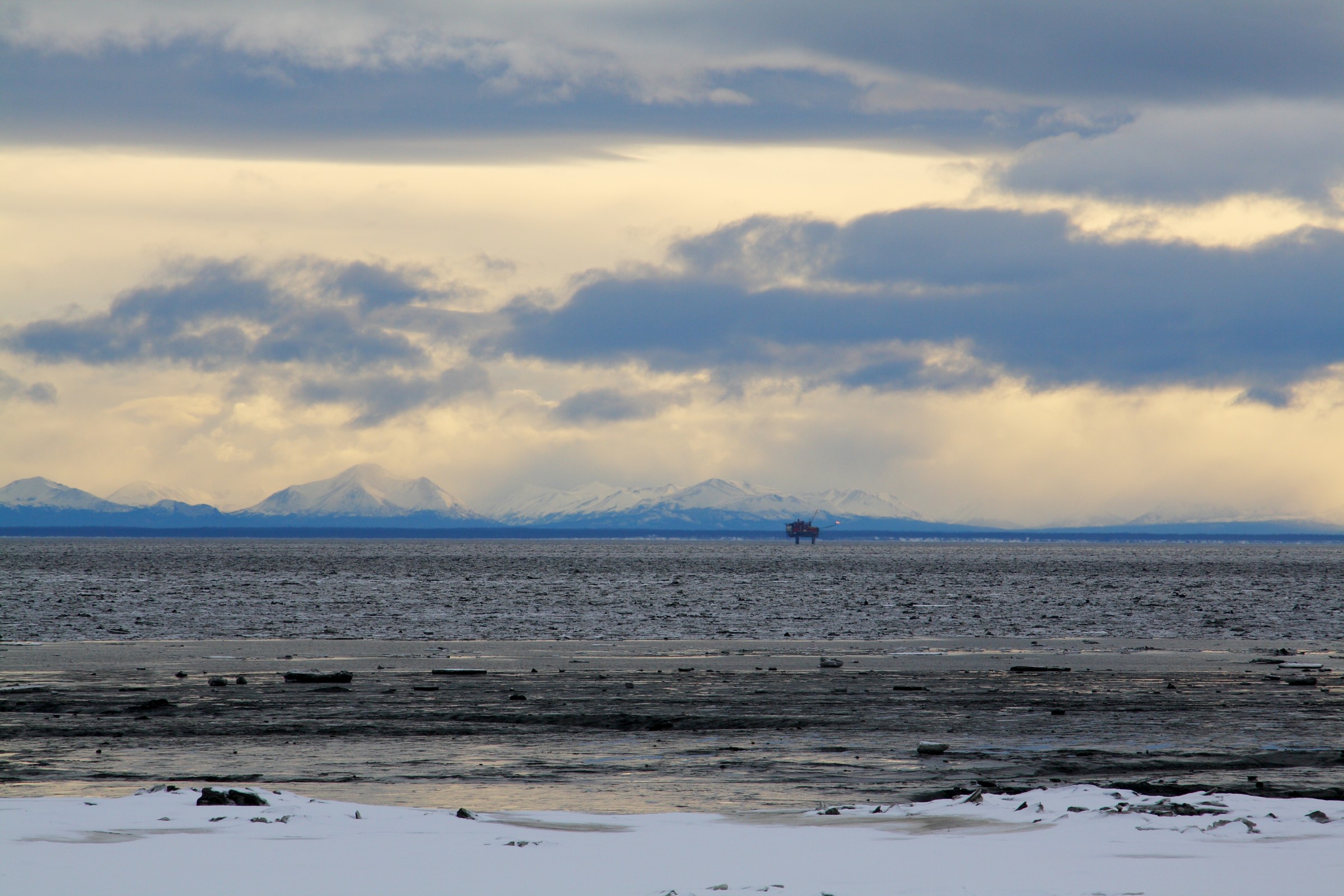
An oil rig in Cook Inlet, Feb. 22, 2009. (Creative Commons photo by hig314)
The oil and gas company Apache Corp. is pulling out of Alaska, citing low oil prices.
The company is one of the largest leaseholders in Cook Inlet, where it has been exploring for oil since 2010. In an emailed statement, a company spokesperson said Apache is slashing spending for the coming year by 60 percent and halting work in several regions, including Alaska.
“Due to the current downturn, Apache has had to significantly scale back operations and spending,” wrote Castlen Kennedy, the company’s vice president for public affairs. Kennedy added that the company is “focusing our limited dollars on specific international opportunities and strategic testing in North America.”
“Operations we are suspending as a result of the downturn include our Alaskan activities,” she wrote.
Kennedy said the company expects job losses to be “minimal,” since Apache has been scaling back operations in the state for the past year.
Apache is an independent oil and gas company based in Houston, with operations across North America and in the U.K. and Egypt. Last week, the company reported a net loss of $23 billion in 2015.
The company was bullish on Cook Inlet in this 2012 video.
As legislators make cuts to the state’s budget, they’re looking to draw money from various state funds to cover costs. But changes drawing money from the fund to help rural Alaskans pay utility bills – and cutting money to local governments — are raising concerns.
The House Finance Committee is considering a budget bill that would cut state government spending $418 million more than the $100 million in cuts Gov. Bill Walker proposed.
House Bill 256 would change the source of funding for two budget items. A $76.7 million payment to the Teachers’ Retirement System would be paid from a fund for college scholarships and grants.
And $24.7 million for the University of Alaska would come from the Power Cost Equalization Fund, rather than the operating budget.
Big Lake Republican Rep. Mark Neuman said the proposal draws on available funds to meet the committee’s priority: balancing the state’s budget. Neuman is the committee’s co-chairman.
Rep. Mark Neuman, R-Big Lake, at a House Majority press availability, Jan. 22. (Photo by Skip Gray/360 North)
“We’re still in the first innings here,” Neuman said. “We’re trying to make sure we’re setting up the budget for the final decisions that we have to do.”
The Teachers’ Retirement System would receive money from the Higher Education Investment Fund, which was started four years ago with $400 million. It was launched to fund Alaska Education Grants, which are for post-secondary students with unmet financial needs and Alaska Performance Scholarships for students with high grades.
If the state draws out similar amounts annually to the proposed $76.7 million, the fund would be exhausted in a few years. Neuman said he expects all current grant and scholarship recipients to continue to receive the money.
The $24.7 million for the university is a small share of the overall $900 million Power Cost Equalization Fund.
But the proposal concerns Newhalen resident Evelynn Trefon. She’s a board member for a small regional electric co-op, whose customers benefit roughly $90 per month from cost equalization.
“Power cost equalization was set aside as a fund to help rural Alaskans and it wasn’t designed to help the University of Alaska,” Trefon said. “They need to look at the budget situation and figure out their own source of revenue funding. And power cost equalization is essential for rural Alaskans.”
Neuman said drawing money for the university this year shouldn’t have any effect on PCE payments.
“This was excess funds. It’s funds that weren’t needed to make the mandatory, statutory payment for power cost equalization,” he said. “It has no effect on paying PCE or any future payments.”
The House Finance Committee also cut a $35 million payment that Walker planned for community revenue sharing. If this change is kept, it would be the second straight year that the state didn’t add money to the revenue sharing program.
Without more money, the program fund would be so low that there could be no revenue sharing in two years.
Alaska Municipal League Executive Director Kathie Wasserman is concerned about the issue. She noted that rural areas depend on the money to provide basic services.
“The large communities – it will impact them. The small communities, it could devastate,” Wasserman said. “And then, when you look at the other cost shifting that is going on, due to the budget crunch that we have, I’m not sure how some municipalities are going to make it through.”
Neuman said he’s aware of the concern, and the committee would like to make changes that would make revenue sharing more secure.
“Everything is on the table right now,” he said. “I’m certainly cognizant of the needs of a lot of the communities in the state of Alaska, particularly the small, rural villages across Alaska, and their ability to do their governmental functions. And, yes, we’re certainly taking those under consideration.”
The committee also cut $25 million from the Public Employee Retirement System. That money could be restored in the next week based on the details of a state actuarial analysis of the pension obligations.
And it proposed a cut of roughly $25 million for the AKLNG pipeline project. Committee members want more details about how the money would be spent before budgeting it. Walker asked for the money to prepare the pipeline’s front-end engineering and design work.
This week, the committee has been hearing public testimony on the budget from residents statewide, ahead of a vote on the budget. It would then head to a vote by the full House before being considered by the Senate.
Kayla Epstein, widow of Rep. Max Gruenberg, shares memories of her husband during a memorial at the state Capitol on Feb. 17. (Photo by Skip Gray/360 North)
Since Rep. Max Gruenberg died in mid-February, a committee room’s been named after him. It’s part of his legacy. But his legacy is being contested in one area — the legislative records he left behind.
Kayla Epstein, his widow, wants control of his records, but she’s been blocked. She hopes the documents help the bills Gruenberg was working on become law.
“He was working on a lot of legislation that he was not even intending to follow through with himself, but (planned on) giving to other legislators on both sides of the aisle,” Epstein said. “And I’d like to find those. That’s part of his legacy, too, making sure that those get into the right hands.”
However, lawyer Doug Gardner wrote in a memo that Gruenberg’s papers were protected by legislative immunity. Gardner directs the nonpartisan Legislative Services Agency’s Legal Services office.
Anchorage Republican Rep. Craig Johnson cited Gardner’s opinion in denying Epstein access to the records.
The state followed the same rules when Palmer Republican Rep. Carl Gatto died in 2012.
But Epstein disagrees with that interpretation. She notes legislative immunity in Alaska is based on a similar provision in the U.S. Constitution.
“In the federal government, when a legislator dies, their papers are sent to their heirs within 90 days,” she said. “That is their rules. Our rules are based on the federal rules. There really is no reason that I haven’t gotten Max’s papers.”
Legislators are talking about changing the rules, so that they will indicate what they want to happen to their records if they die in office.
Ohio State University law professor Steven Huefner has studied the issue of legislative immunity. He said the precedent for how to handle records after a legislator dies in office isn’t clear.
“What I think is important is to give members, before they pass on, an opportunity to decide what their wishes are,” Huefner said. “Obviously, you’ve got a problem here, because that didn’t happen, so in this instance, it’s tricky. But I think members ought to be able to decide ahead of time that they want their papers to become public.”
Epstein said she plans to file a request for the records soon.
Close
Update notification options
Subscribe to notifications
Subscribe
Get notifications about news related to the topics you care about. You can unsubscribe anytime.