Southcentral

West High senior to defend Alaska’s national Poetry Out Loud title

West Anchorage High School senior Shannon Croft takes a deep breath, then begins reciting John Keats’ “When I Have Fears That I May Cease to Be.”

Her recitation of John Keats’ poem on Tuesday won her the state championship of Poetry Out Loud. It’s a classroom-based poetry program and this year, more than 3,600 students from 29 schools across Alaska participated.

As state champion, Croft received a $200 cash prize, a $500 stipend to buy poetry books for her school, and an all-expenses paid trip to Washington, D.C., for the national competition in May. Last year, West Anchorage High School student Maeva Ordaz, now a freshman at Columbia University, won the national competition.

Thunder Mountain High School freshman Briannah Letter didn’t advance past the state finals this year, but she still got something out of the experience. Poetry Out Loud is also a chance to practice something many students dread — public speaking.

“You should’ve seen me right before I went up for the school competition. My heart was pounding. I was breathing really heavily,” Letter said. “I realized that after the school competition and the district competition, I felt a lot better standing in front of those people. After this, I’ll be a lot more comfortable with my voice through a microphone and talking to people in general.”

Letter’s mentor, Thunder Mountain English teacher Barbara Maier, said Poetry Out Loud is about encouraging students to develop memorization, analysis, and public speaking skills.

“Kids grow just by standing up and presenting something to their peers,” Maier said. “Poetry Out Loud is a defined list of poems that have been chosen because they can be presented well. There’s that safety that no matter what they choose there’s something in that poem that a kid has to discover. They’re digging into really good literature and then playing with it standing up and presenting.”

And, for Letter, it started out as a finals week assignment. By February, Letter had advanced through school and district Poetry Out Loud competitions, beating out more than 50 students for the chance to represent Juneau at the state competition.

With finalists traveling from as far away as Shaktoolik and Unalaska, the state finals were also a chance to visit the capital city. Before the competition, finalists heard guest lectures from local artists, visited state representatives at the Capitol, and toured the Governor’s Mansion.

Alaska state champion Shannon Croft heads to Washington, D.C., for the Poetry Out Loud national finals May 2 to 4. Croft will represent Alaska and defend Ordaz’s title.
Should some state ferry routes be privatized?

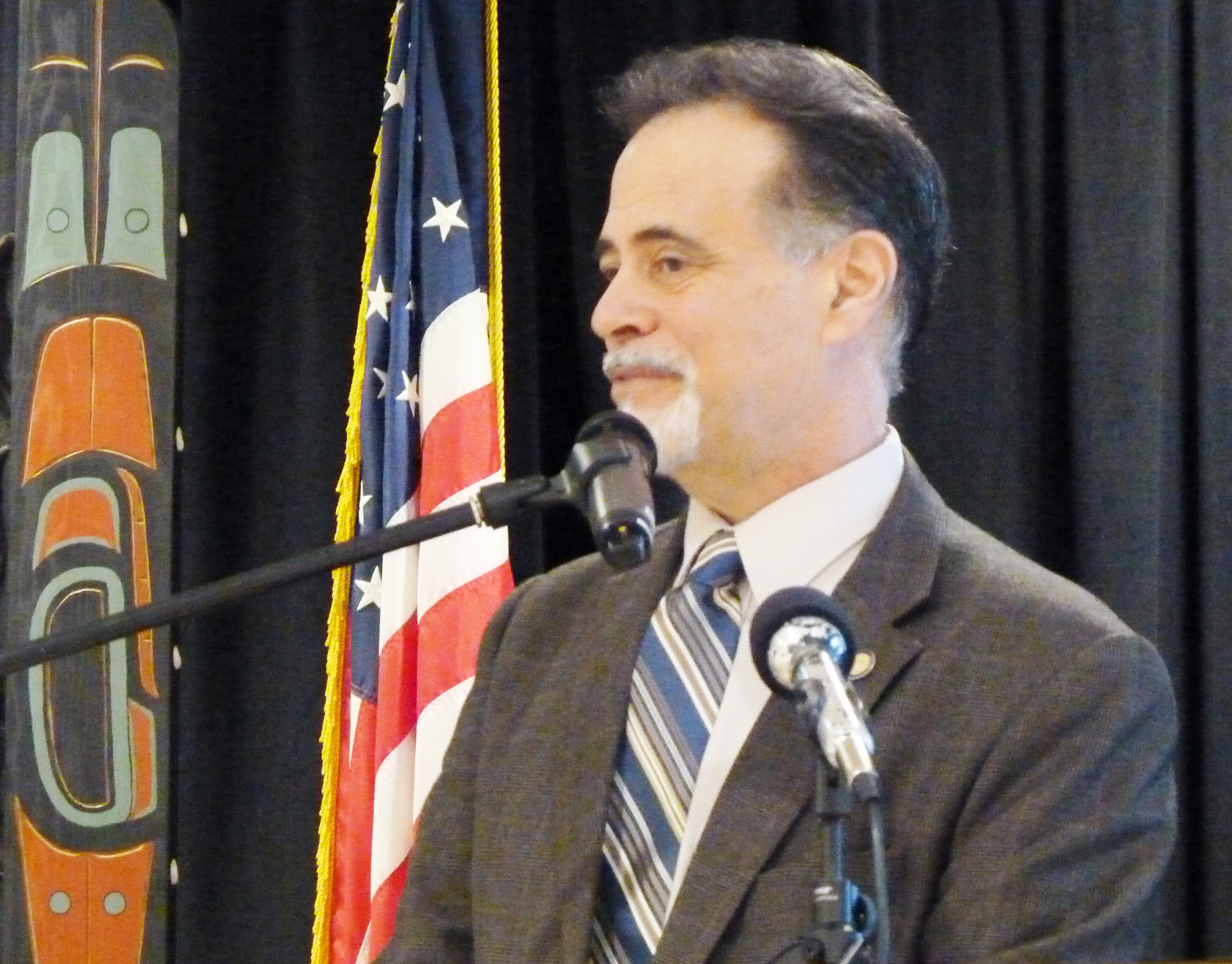
Sen. Peter Micciche talks about ferry system budget cuts and privatization at the Southeast Conference meeting in Juneau on March 15, 2016. (Photo by Ed Schoenfeld)
Sen. Peter Micciche talks about the ferry budget at a Southeast Conference meeting in Juneau on Tuesday. (Photo by Ed Schoenfeld/CoastAlaska News)

A state lawmaker with a significant role in transportation funding decisions says parts of the Alaska Marine Highway should be privatized.

Sen. Peter Micciche is a member of his chamber’s Finance Committee and oversaw crafting of its transportation budget.

He said the ferry system should consider management changes.

“I think parts of the system should be privatized. I think Prince William Sound is the perfect example of some fairly local runs that should be privatized,” he said at a Juneau meeting of the Southeast Conference, a regional development organization.

The Soldotna Republican also chairs the Senate Transportation Committee, which oversees roads, airports and ferries.

Micciche said he doesn’t advocate privatizing the entire ferry system.

“Keep the long runs, the longer routes, in control of the state. Privatize the smaller ones. And the cost savings could go to reliable service for the communities that absolutely depend on a state-run portion or segment of the ferry service,” he said.

The idea’s already being considered in several coastal areas.

Haines and Skagway officials want to study the feasibility of a Lynn Canal ferry authority connecting their communities with Juneau.

Alaska Marine Highway System Capt. Mike Neussl addresses the Southeast Conference Mid-Session Summit in Juneau on March 15, 2016.
Alaska Marine Highway System Capt. Mike Neussl addresses the Southeast Conference on Tuesday. (Photo by Ed Schoenfeld/CoastAlaska News)

Marine Highway Capt. Mike Neussl told the Southeast Conference it’s a possibility. He said he’s also met with those interested in taking over Prince William Sound routes, such as Cordova, Valdez and Whittier.

“If a public entity, not necessarily a private entity, but an entity other than the … Alaska Marine Highway System was interested in operating a ferry service there, I think the state would enter serious negotiations with them to discuss vessel transfers, facility transfers and assistance to have them do that as opposed to the state doing that function,” he said.

One part of the marine highway already separated from the larger system.

The Inter-Island Ferry Authority has run a ship between Hollis, on southern Southeast’s Prince of Wales Island, and Ketchikan for about 15 years. It’s a nonprofit operation, run by a board of community representatives.

Most of its revenue comes from the fare box. But it has also received state subsidies most years.

Senate cuts $63 million more from budget than House

The Senate voted 16-4 Monday on a state government budget that goes $63 million deeper in cuts than the House budget.

That’s mainly because the Senate voted for $100 million in executive branch cuts that aren’t allocated.

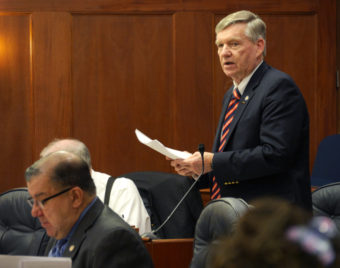
Sen. Pete Kelly, R-Fairbanks, wraps up the discussion on the state operating budget shortly before it was passed out of the Senate, March 14, 2016. (Photo by Skip Gray/360 North)
Sen. Pete Kelly, R-Fairbanks, wraps up the discussion on the state operating budget shortly before it was passed out of the Senate. (Photo by Skip Gray/360 North)

Fairbanks Republican Sen. Pete Kelly said the Legislature can work out the specifics before the end of the session.

“This $100 million was mostly recognition of those kinds of structural changes — Medicaid reform is a pretty good example,” Kelly said. “Somewhere in the neighborhood of $31 million this year and … over $100 million each year after that.”

Before the vote, minority caucus Democrats proposed an amendment to eliminate the unallocated cut.

They also proposed restoring money for several different programs, including Permanent Fund inflation proofing, senior benefits and prekindergarten. They wanted to pay for some of these programs by reducing spending through cuts to oil and gas tax credits, and reducing spending on several stalled infrastructure projects.

All of the amendments failed.

Anchorage Democratic Sen. Berta Gardner said the state can afford to fund the education measures she included in one amendment.

“This amendment chooses education and Alaska’s children over projects that may once have been a great idea but that we simply can’t afford anymore,” Gardner. “The amendment restores pre-K education, Online With Libraries, the teacher mentor program, and the unallocated $10-million university cut.”

The cost of Gardner’s amendment would be offset by cuts to the Knik Arm Crossing, the Susitna-Watana hydroelectric dam, and the Ambler mining district road.

Eagle River Republican Sen. Anna MacKinnon said it would be wrong to use cuts in spending on construction projects to pay for budget items that will pop up every year.

“We have tough decisions to make, and I appreciate scrubbing the budget and looking at one-time funding to fulfill re-occurring costs, but it’s just not the way to do business,” MacKinnon said. “You do not take one-time money, and invest it in re-occurring costs. It just means we’re going to face the same battle next year.”

The two houses will resolve the differences between their versions of the budget through a conference committee. The Senate bill includes $25 million more for the University of Alaska. But it would cost less than the House in other areas, including $8 million less for Health and Social Services and $7 million less for transportation.

Before the conference committee is assigned, both Houses will consider major changes to oil and gas tax credits and the Permanent Fund, as well as the Medicaid and criminal justice overhauls.


Community fights back against Seldovia land buyouts

Zane Henning, a friend of Greg Davis, with Backer’s Island in the background. (Photo by Quinton Chandler/KBBI)

Over the last eight years, a California man has snatched up dozens of parcels of land in the small community of Seldovia, on Kachemak Bay.

His work on that property has dragged him into legal disputes with the city of Seldovia and some of his neighbors.

During Greg Davis’ first years in Seldovia, residents were concerned about the amount of property he was buying, but they weren’t overly alarmed.

Bretwood Higman says he met Davis about five years ago. He didn’t see him much after that, but Higman’s father became good friends with Davis. Then in the summer of 2015, Higman says Davis’ tone in town started to change.

“He seemed to have this vision, and he talked about this, this vision of improving Seldovia and coming in from the outside buying … he talks about buying properties because they were ugly and improving them, cleaning them up,” Higman said.

Davis owns 42 pieces of property, inside and outside of Seldovia city limits, through his family business Precious Earth. Seldovia residents say that’s a lot of land for one man, especially in a town that recorded a population of only 233 people in 2014.

“To make it into a soundbite: he came and tried to buy a town and it doesn’t want to be bought,” Higman said.

Higman’s family owns beach property surrounded by Davis’ land. They can access it by water and by walking the beach during low tide. But for about 35 years, Higman says, the family has mainly used a trail that crosses Davis’ land.

Higman says Davis recently told his family he didn’t want them to use the trail anymore. Last year, Davis put up a no trespassing sign. Higman’s mother crossed Davis’ property at least twice after that but the police declined to intervene. Higman says from there, things escalated.

“He sent this email where he lays out very clearly this threat of physical violence that he would take the law into his own hands and he’s threatening that against my family,” Higman said.

Most other residents in town agree. Jeremiah Campbell bought the Boardwalk Hotel in Seldovia about three years ago. He says Davis made a lot of other residents mad when he burned down a historic cabin that sat on his Backer’s island property. He says it wasn’t environmentally friendly.

“(He) burned it for a period of about four days, just a plume of black smoke,” Campbell said. “The community wasn’t real happy with that.”

There are also hard feelings over a road Davis was building out to the island. Residents worried the work could damage critical habitat. Davis and a friend also blocked part of what the city considers to be a public road after discovering it cut through a corner of one of his properties.

The city of Seldovia ordered them to move the barricades, and they refused. Now the city is suing to force them to comply.

“Property lines in Seldovia are weird like a lot of small towns in Southeast and stuff,” Campbell said. “So a lot of folks have gotten together and said, ‘hey, no harm no foul. If you’re good I’m good and we’ll just let it be. You’ve got your shed on my property my fence is on your property.’”

But, Campbell says, Greg Davis doesn’t feel the same way.

Davis himself didn’t want to be interviewed for this story, but he wrote in an email that his mission is, “to as quickly as possible, create the greatest good, for the most people…”

Zane Henning is one of Davis’ only supporters in town. He’s the friend who helped Davis set up the barricades. He says there’s nothing wrong with what they did because it isn’t a road, it’s private property.

“When you own property, you can do with it what you want as long as it’s within the regulations of the city code … property rights and property boundaries have been embedded in our constitution,” Henning said.

Henning says he and his wife live right in front of the property Davis and the city are fighting over. They don’t understand why so much of the town doesn’t like Davis.

“Because there’s been this underlying tone throughout town…it’s not underlying it’s clear and aboveboard,” Henning said. “I mean everybody makes statements all the time that they don’t like Greg Davis.”

Henning says some of that dislike goes back to the amount of property Davis owns.

“There were 42 people that didn’t want to be here anymore and Greg bought their properties. It’s great for them. He likes real estate. He thinks that this is one of the most beautiful places he’s ever been in the world. And so he’s buying property,” Henning said. “He’s got the money to buy the property and when he gets a good deal on a piece of property, he buys it. I don’t see the negative.”

Higman says Davis is basically fighting a battle against the town and he has no idea how it’s going to end.

“I think the thing that Greg completely doesn’t see and I wish he could is that Seldovia is a pretty awesome place,” Higman said. “We’ve been doing all right.”

Higman says if Davis felt the same, he might have a better relationship with his neighbors.

Senate OKs bill to factor credit scores into home and car insurance premiums

Car insurance illustration
(Creative Commons image by Pictures of Money/CheapFullCoverageAutoInsurance.com)

When Alaskans renew their car or homeowners insurance policy, insurers can’t use their credit history to determine their rate without their approval. That’s unlike all other states, where good credit means lower premiums and bad credit means higher premiums.

But the state Senate passed a bill this week that would bring Alaska in line.

Supporters of Senate Bill 127 said this will benefit most people in the state; opponents are concerned about the impact on low-income residents, rural Alaskans and minorities.

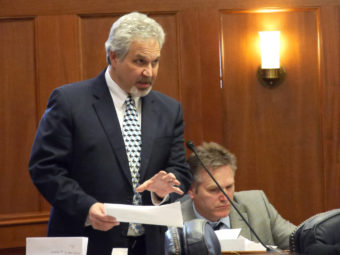
Sen. Charlie Huggins, R-Wasilla, discusses House Bill 75, the Marijuana use and regulation bill in the Alaska Senate, Feb. 24, 2016. He was explaining changes to the bill that were made in committee shortly before it passed the Senate. (Photo by Skip Gray/360 North).
Sen. Charlie Huggins, R-Wasilla, sponsored a bill allowing credit histories to be used in auto and homeowner’s insurance. (Photo by Skip Gray/360 North)

Bill sponsor Sen. Charlie Huggins, a Wasilla Republican, said it’s a no-brainer.

“This is a simple bill,” he said. “Very simply, we become one of 50 states that allow, when you’re renewing your auto or your home insurance, credit scoring to be used. And the overwhelming majority of Alaskans will benefit.”

But Anchorage Democratic Sen. Bill Wielechowski noted that those with worse scores could see their rates more than double.

“The people on the lower end of the income scale who can least afford it will see their rates increase under this bill,” he said. “Insurance is not an option in this state. You can’t drive a car without it. You can’t get a mortgage without it. Our economy is sputtering. Lots of people will suffer if this bill passes.”

Wielechowski pointed to studies showing that bad credit scores can increase car insurance premiums more than bad driving.

He added that a 2003 state report raised concerns about the effect of using credit scores on rural and older Alaskans, as well as minorities.

But Sitka Republican Sen. Bert Stedman said the bill would benefit many rural residents.

“I’d like to benefit from this, for a lot of my constituents — the ones that have good credit, that work hard, play … the economic game squarely,” Stedman said. “I don’t think they should be paying for people that don’t.”

The bill wouldn’t apply to health insurance. And the bill protects residents whose credit is harmed by family deaths, divorces, military deployments and catastrophic events.

The Senate passed the bill 15-5. The House will now consider it.

Victims’ rights advocates push for changes to criminal justice bill

Blind Lady Justice with scales
(Creative Commons photo by Marc Treble)

Victim’s rights advocates and some legislators have raised concerns about a bill that would overhaul Alaska’s criminal justice system.

The measure would reduce arrests and prison time for nonviolent offenses. It also would help prisoners re-enter society.

The bill has a lot of bipartisan support. It draws on recommendations from the 13-member Alaska Criminal Justice Commission. It spent more than a year considering ways to reduce recidivism and take pressure off of the need to build more prisons.

North Pole Republican Sen. John Coghill sponsored the bill. He said the legislation would reduce the state’s prison population by 21 percent over the next 10 years, saving the state more than $400 million.

Coghill also has worked to include input from victim’s rights advocates, who are worried the the reforms benefit offenders at victims’ expense.

Emily Haynes testified in Juneau that a man who sexually assaulted her could be released soon due to the bill. That’s because he accepted a plea bargain that reduced the severity of his conviction.

“I oppose this bill. It’s going to have a direct impact on my life,” Haynes said. “Five years ago I was a victim of a violent sexual assault and the offender will be eligible for release immediately under your proposal. For the past five years, I’ve been fighting this case.”

And Butch Moore of Anchorage asked that the bill require those convicted of murder to have minimum sentences at least as long as those convicted of rapes. His daughter was killed in 2014.

The bill prevents those convicted of sex crimes and domestic violence offenses from being released early.

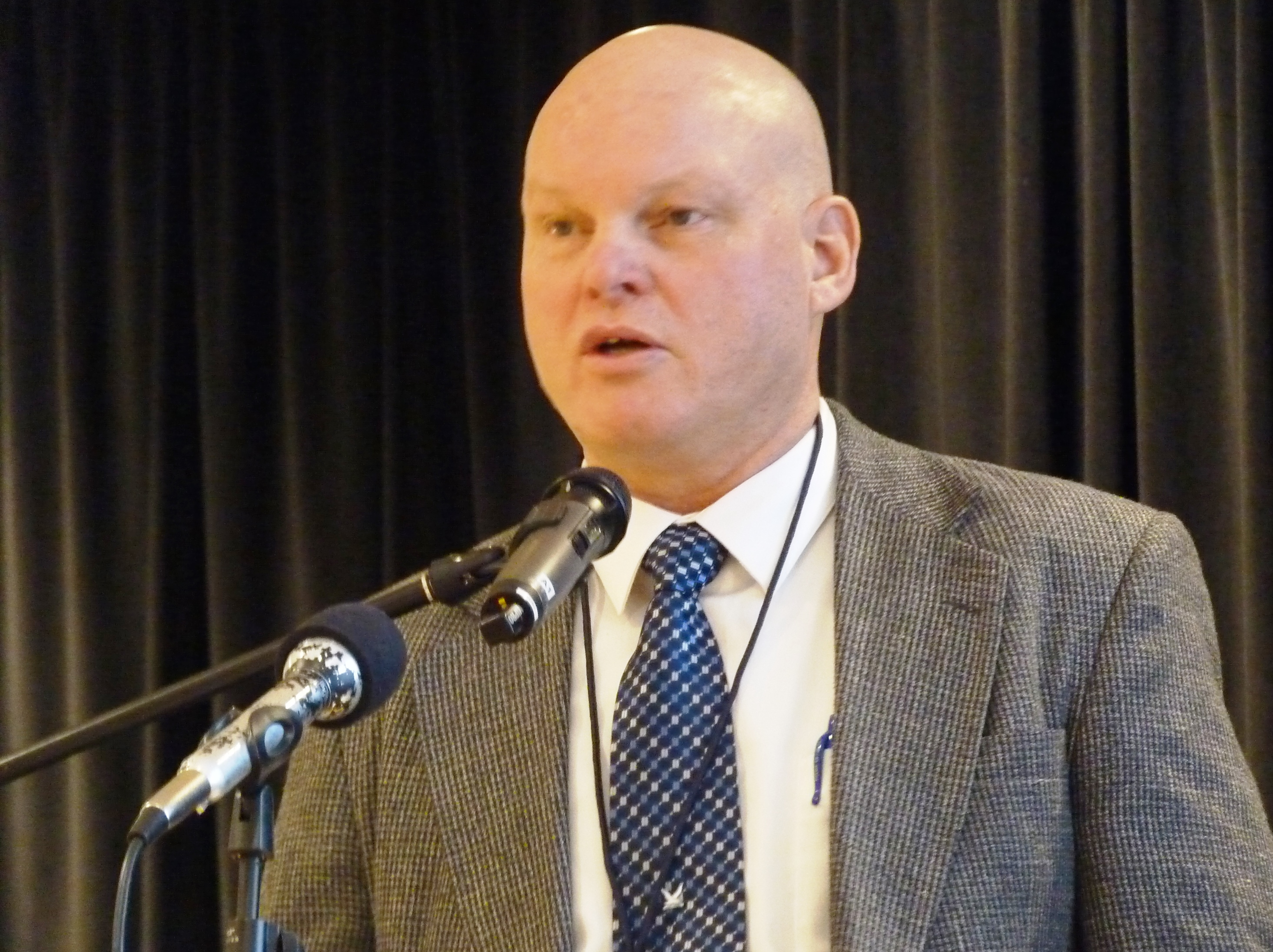
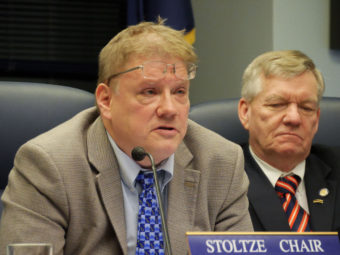
Sen. Bill Stoltze
Sen. Bill Stoltze, R-Chugiak, chairs the Senate State Affairs Committee. (Photo by Kyle Schmitz/360 North)

Chugiak Republican Sen. Bill Stoltze supported more changes to the bill at a recent hearing.

While the commission included a police officer and heard testimony from victims’ rights advocates and corrections officers, Stoltze said law enforcement and victims didn’t have enough input on the legislation. He chairs the Senate State Affairs Committee.

“Well, I think the rights of victims have been improved,” Stoltze said. “I don’t think they were really that well considered through the commission process. I think they were invited but not that welcomed there. And the Office of Victim Rights, which has very in-depth expertise, really didn’t get meaningful input until the bill got to this committee.”

The Senate State Affairs Committee amended the bill to require the Department of Corrections notify victims of offenders who are eligible for release under the bill. The committee made a series of amendments and voted to advance the bill.

Supporters of the legislation have credited the Pew Charitable Trusts with providing much of the research and national expertise that supported the commission’s work.

But Stoltze said the nonprofit foundation has had too much influence over the bill.

“I haven’t fallen under the talismanic influences of the Pew Charitable Trusts,” he said. “I am interested in the fiscal savings. But I think the public has not been well enough informed of the details about that crime bill.”

But supporters of reform are concerned that some of the changes are weakening the bill.

Grace Singh, assistant to the president at the Central Council Tlingit and Haida Indian Tribes of Alaska, criticizes a provision that requires that those who’ve had their convictions suspended still have their charges listed on the CourtView website.

“This significantly discourages self-sufficiency, and it puts them in a more desperate position, which will not discourage crime or recidivism,” Singh said.

The Senate Judiciary Committee will hear the bill next.

Site notifications
Update notification options
Subscribe to notifications