Southcentral

Homer rescue group sues city animal shelter alleging free speech violation

A Homer cat rescue group has filed a lawsuit against the Homer Animal Shelter, the shelter manager and the Homer Police Chief. Judy Price alleges the shelter manager started blocking her attempts to rescue cats for Clear Creek Cat Rescue after she commented on how the city-run facility could be improved. Price believes her constitutional rights are being violated.

Right after she gave constructive criticism at a public meeting about the city-run animal shelter in Homer this past January, Price says she was banned from rescuing cats there. She says she was just throwing out ideas.

“Suggestions for ways to improve the shelter – to use more volunteers, to have a more open adoption policy, to have a rescue agreement with the rescue groups. Just general ways to make a shelter work better and to get the animals adopted more quickly,” said Price.

The next day shelter manager Cheryl Bess, who runs the shelter as a contractor through Coastal Animal Care, wrote an email to a city clerk saying that Price was harsh on shelter management.

“I certainly have no intention of working with this individual, and just wanted to be clear on that,” Bess wrote.

Price has worked with Clear Creek Cat Rescue to find adoptive homes for cats in Homer for seven years. She’s been working as the rescue coordinator in Homer to find foster homes for cats for two years.

Clear Creek is a network of volunteers across the state that matches stray cats with foster homes and finds them adoptive homes. The non-profit group rescues cats from places as far away as Dutch Harbor in the Aleutian chain. They have foster homes in Anchorage, Eagle River, Wasilla, Kenai, Soldotna and Homer. Price says Clear Creek adopted out about 500 cats in 2015.

Price says she hasn’t been able to pick up rescue cats from the shelter to place into foster homes ever since the incident.

“Clear Creek Cat Rescue was denied the right to rescue at the Homer Shelter anymore, even though we have been rescuing there for a couple of years because I made comments at a public meeting,” said Price.

And that’s a violation of her constitutional right to free speech, argues Price – and to use public facilities. Price says rescue groups around the country are dealing with similar problems.

“This kind of thing has been going on across the country for years now. Rescue groups have been suing shelters. There was even the Hayden Act in California that was passed for this exact reason, saying that shelters cannot deny certified 501(c)(3) rescues the right to rescue because they spoke out about a problem at the shelter or for any reason,” said Price.

Price alleges in the lawsuit that a shelter volunteer used the city shelter Facebook page to defame her and Clear Creek Cat Rescue. Price also alleges that a cause of the lawsuit was that her written public testimony was removed from public meeting minutes at the request of the shelter manager. Price and the rescue are being represented by Price’s husband attorney Paul H. Bratton.

Price says she’s hopeful her case will be resolved quickly so that Clear Creek can begin helping cats again. She says the shelter needs new guidelines to improve their operations. One of her concerns is that animals are being euthanized at higher numbers than they would be if the shelter worked more closely with rescue groups.

“I think that Homer shelter could be a no-kill shelter. I think if we had a more open adoption policy and if the Homer Shelter manager could work with the rescue groups more freely, there would be five cats in that shelter right now instead of 30 or 40, or whatever is there,” said Price.

But she says if the situation is not resolved through the lawsuit, she’ll push for something like California’s Hayden Act in Alaska.

“I don’t think that we should have to pass a law that people can have free speech and still have access to public facilities, but if that’s what it takes, then that’s what we should have,” said Price.

The City of Homer was contacted for this story along with Police Chief Mark Robl who is ultimately responsible for the shelter – they’re both named in the lawsuit. They declined to comment for this story.

Cheryl Bess, who manages the shelter through Coastal Animal Care and is also named in the suit, returned an email saying she was surprised that KBBI was pursuing a story about the lawsuit and that she would not be commenting either. The city has until February 29th to file a response.
University of Alaska regents hear pushback on restructuring plan

Last week, the University of Alaska Board of Regents released a plan to reorganize the UA system into three focused campuses and heard reaction from the public.

In light of state budget cuts, the draft Strategic Pathways plan released Tuesday is meant to cut costs by focusing each of the three main UA campuses into certain disciplines.

The proposal defines the University of Alaska Anchorage as the “metropolitan university,” responsible for health, policy and social sciences. The University of Alaska Fairbanks would be the “research university” for science, engineering and rural development. The University of Alaska Southeast is labeled the “liberal arts and sciences” university, focused on fisheries, mining, and interdisciplinary environmental studies. The plan also retains a few core programs, namely education and management, across all campuses.

While the draft plan offers few details about which non-core degree programs would be eliminated, more than a dozen people expressed concerns in Fairbanks on Thursday that their area of interest could be impacted.

“I believe the presence of a robust music theater and fine arts curriculum at the University of Alaska Fairbanks has been a foundation upon which the arts community in Fairbanks has been built,” Jack Wilbur of Fairbanks told the Board. “And I’m concerned that the Strategic Pathways concept as presented might undermine that foundation.”

Others were concerned that narrowing UAF to an engineering school would harm other research areas.

“UAF is not an ivory tower,” said Douglas Cost, a doctoral student with the International Arctic Research Center. “It is a location of real-world problem solving by faculty, adjuncts and graduate students in their research and teaching. In order to help Alaskans deliberate, debate and shape the next 25 years, the importance of interdisciplinary collaboration and outreach must be supported.”

The Strategic Pathways draft doesn’t give estimates of cost savings. But it does contain some specific and ambitious goals for student achievement, including increasing the proportion of Alaskans hired into Alaska teaching positions from 30 percent to 90 percent. The plan also seeks to increase the percentage of graduates in STEM fields from about 4 percent to 6 percent, as well as boost the number of graduates in health occupations.

The plan imagines three phases of restructuring, beginning this spring and finishing around 2019.

In a letter sent to UA faculty and staff Tuesday, President Jim Johnsen said the Board of Regents wouldn’t make any final decisions in their meetings for the week.

House wants details on impacts of oil, gas tax changes

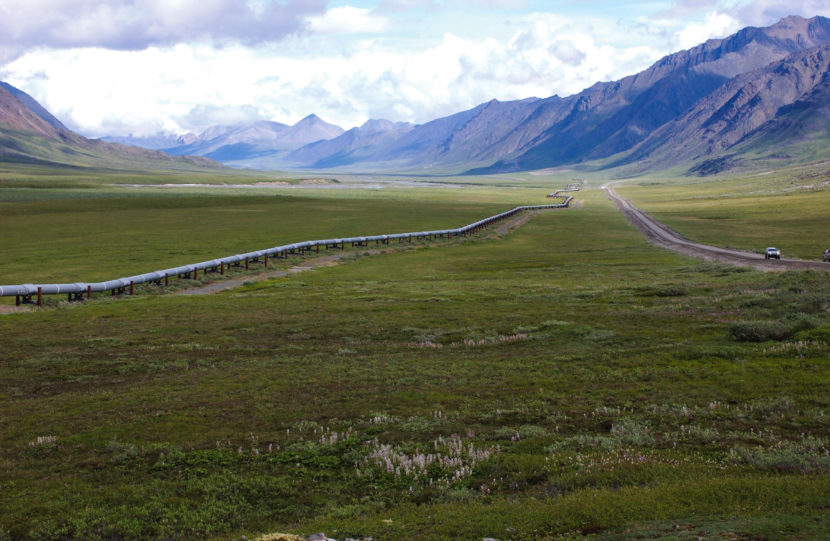
Trans-Alaska Pipeline
The trans-Alaska pipeline in the northern Brooks Range of Alaska in June 2007. (Public domain photo by U.S. Geological Survey)

As Alaska’s Legislature digs through Gov. Bill Walker’s budget proposal, a prime focus is the overhaul Walker put forward for oil and gas taxes.

By reducing tax credits and increasing minimum production taxes, Walker aims to shave $500 million off the state’s budget shortfall.

House members question whether Walker’s administration has done enough analysis of the oil and gas tax changes – as well as other tax increases the governor has proposed.

Speaker of the House Mike Chenault, a Nikiski Republican, said it’s important for legislators to study economic models showing how the changes will affect the state.

Rep. Mike Chenault, R-Nikiski, at a House Majority press availability, Feb. 18, 2016. (Photo by Skip Gray/360 North)
Rep. Mike Chenault, R-Nikiski, at a House Majority press availability Feb. 18, 2016. (Photo by Skip Gray/360 North)

“They were told basically they have no modeling – or that they were working on modeling. Well, it’s hard to put together a tax bill if you don’t have modeling,” Chenault said.

The state didn’t conduct statistical modeling before Walker proposed the tax changes.

State Revenue Commissioner Randall Hoffbeck said officials focused on the fact that the state is committed to paying oil and gas companies more in tax credits than it has to spend.

But state officials did talk with oil and gas company executives about which tax credits were most effective.

Hoffbeck said the process of deciding how to change tax credits had three steps.

“One is, you know, which credits didn’t necessarily work the way they were intended. Either they didn’t get used or really the return on the credits weren’t all that we had hoped that they would be,” Hoffbeck said. “And secondly, you know, which credits worked really well, and may have accomplished their purpose. And then, of course, the remaining is the credits that are still seen as critical moving forward.”

Speaker Chenault is not convinced. He said the fate of Walker’s proposed tax increases depends on the information the House receives.

“How those come out – which ones  pass or not I can’t tell you until we at least hear them, understand them, make sure the administration understands the consequences of the actions that we take as far as public policy for the state of Alaska — and that’s going to take time,” Chenault said.

Hoffbeck said more information will be available next week on the economic effects of the tax changes.

Health care officials pitch transformative mental health, addiction treatment reforms

Valerie Davidson and John Sherwood in committee
Health Commissioner Valerie Davidson testifies on a Medicaid reform bill in committee, April 15, 2015. Also pictured: Deputy Commissioner Jon Sherwood. (Photo by Skip Gray/360 North)

Medicaid is one of the biggest drivers of Alaska’s state spending.

At the same time, Alaska has the nation’s highest suicide rate and a growing problem with opioid addiction.

State leaders believe they can lower the long-term growth in Medicaid costs and make Alaskans healthier mentally and physically. They plan to do that by better coordinating  behavioral health care — the treatment of mental health and addiction.

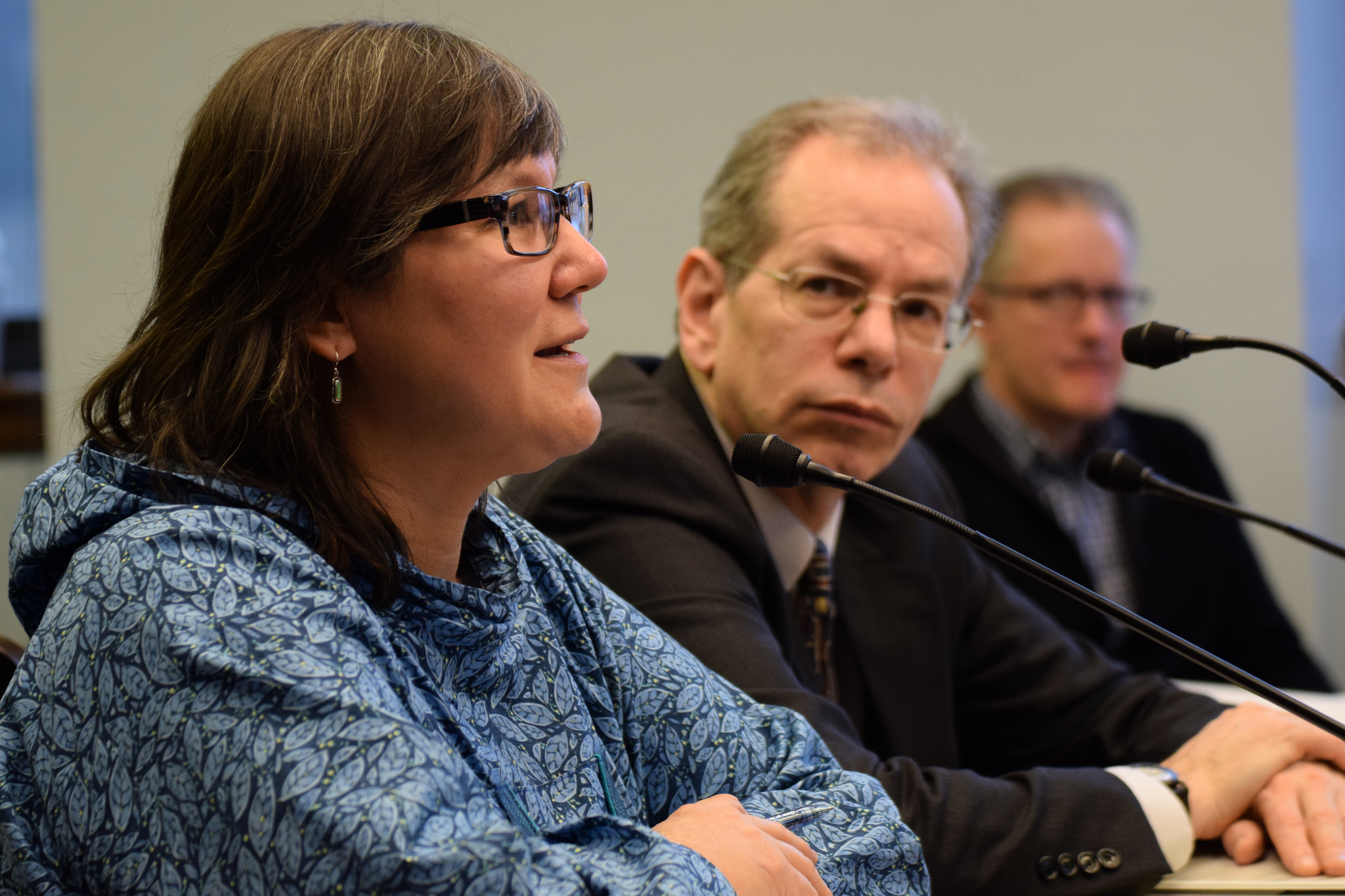
At a recent Senate Medicaid Reform Subcommittee hearing, Health Commissioner Valerie Davidson said it will be a challenge.

“This is hard stuff. If it was easy, Alaska would have done it long ago,” Davidson said. “And the great news is we have folks who have come together who are really interested in really changing the way that we deliver behavioral health services in our state, so that Alaskans can get the care that they need.”

In practice, it means more Alaskans will be screened for behavioral health issues in primary care settings, and a wider range of licensed counselors and therapists would be able to treat Medicaid recipients in a wider range of settings, like in a doctor’s office.

Davidson said current gaps in behavioral health care lead to other problems.

“We are seeing it in the number of children who experience child maltreatment,” she said. “And unfortunately, when we’re dealing with children, what we know is to the extent that that occurs, that can become a multigenerational issue. That if we don’t provide resources to family members who are in crisis, where we have places where they can actually go to receive help, we are never going to get ahead of this problem.”

A recent state-commissioned report recommended the state hire an organization that would increase the state’s capacity to provide behavioral health care, and manage a coordinated system.

While that organization would cost more than $5 million per year starting in 2018, the state projects that it would save a larger amount in future years.

Despite the state’s massive budget deficit, Anchorage Republican Sen. Cathy Giessel was on board.

“I appreciate the encouragement to invest in behavioral health and frankly I view it in the same way as investing in oil and gas credits for exploration. It pays off in the long run, though it costs a bit upfront,” Giessel said.

This coordinated approach is already practiced in some areas.

For example, Southcentral Foundation serves Alaska Natives with psychologists and social workers who treat patients in the same health centers as primary care providers.

The Alaska Mental Health Trust Authority board supports better integration of behavioral health care into the rest of the health care system.

Chief Executive Jeff Jessee said state leaders and providers will have to work together like a baseball team.

“The trustees believe this is the single biggest thing that the trust will encounter in our 20 years of history, this is an opportunity to truly transform our behavioral health and health care system,” Jessee said. “So, it’s the bottom of the ninth, we’re five runs down, we’re not bunting, and we’re not going to get one big swing either. We’re going to have to chunk away at this.”

While the groundwork for statewide behavioral health changes would happen over the next year under Gov. Bill Walker’s proposed budget, the bulk of the changes wouldn’t occur until 2018.

Memorial services for Rep. Gruenberg set for Sunday and Thursday

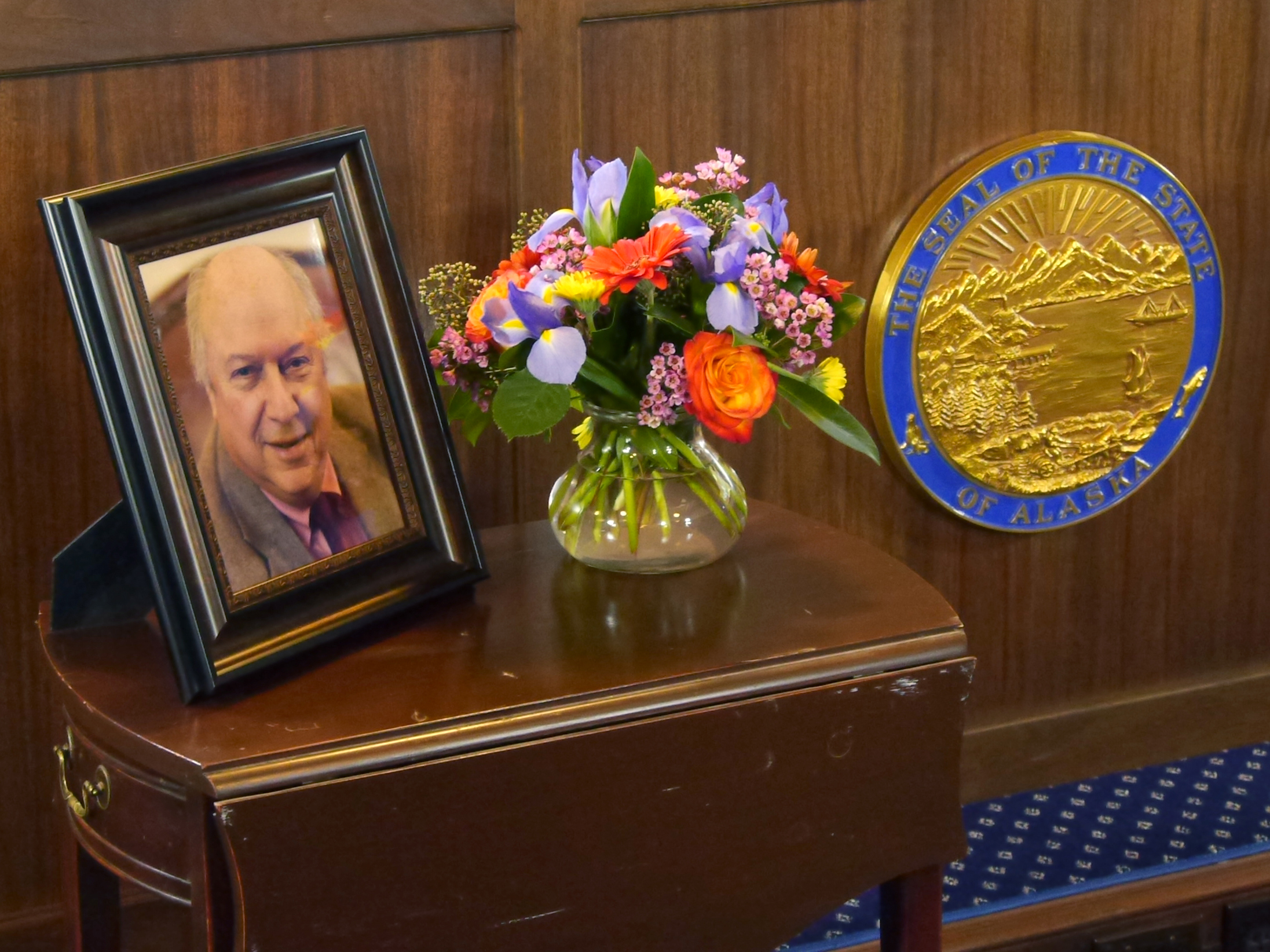
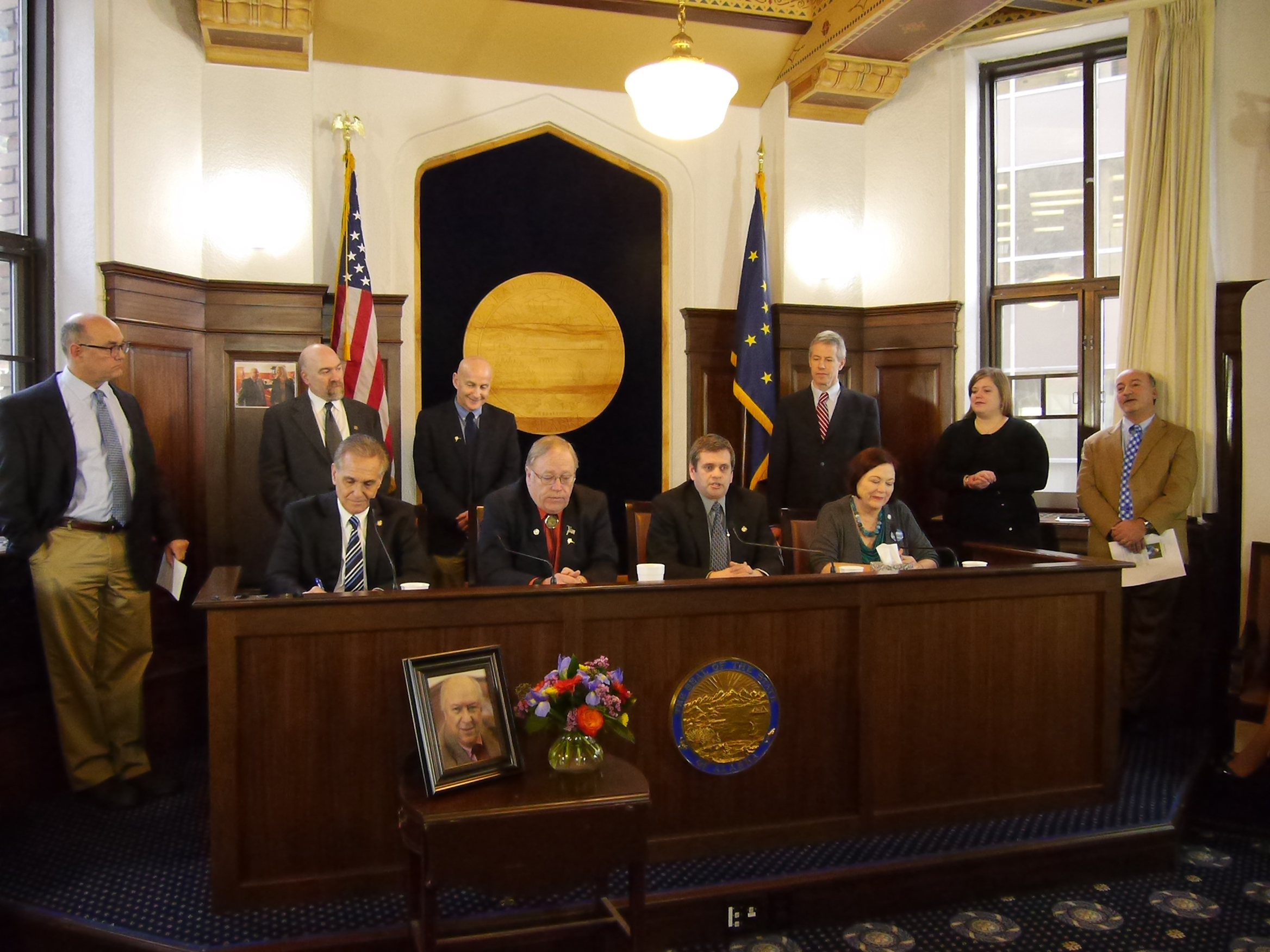
Photo of Rep. Max Gruenberg and state sealMemorial services are set in Juneau and Anchorage for longtime Alaska lawmaker Max Gruenberg.

Juneau services will be held at 3 p.m. this Sunday at Resurrection Lutheran Church on 10th Street downtown. In Anchorage, services will be held at 5:30 p.m. Thursday, Feb. 25, at Temple Beth Sholom on East Northern Lights Boulevard.

Gruenberg, a family lawyer by trade, died Sunday. He had served in the Alaska House of Representatives for more than 20 years representing the Anchorage neighborhoods of Russian Jack, College Gate, Nunaka Valley and previously Mountain View.

On Tuesday, his colleagues shared fond memories of him in the Capitol.

In lieu of flowers, the family requests donations be sent to charities for victims of domestic violence, animal abuse, children in need or Alaska Legal Services.

In lieu of flowers, the family requests donations be sent to charities for victims of domestic violence, animal abuse, children in need or Alaska Legal Services.
Legislative employee and Kayla Epstein, widow of Rep. Max Gruenberg
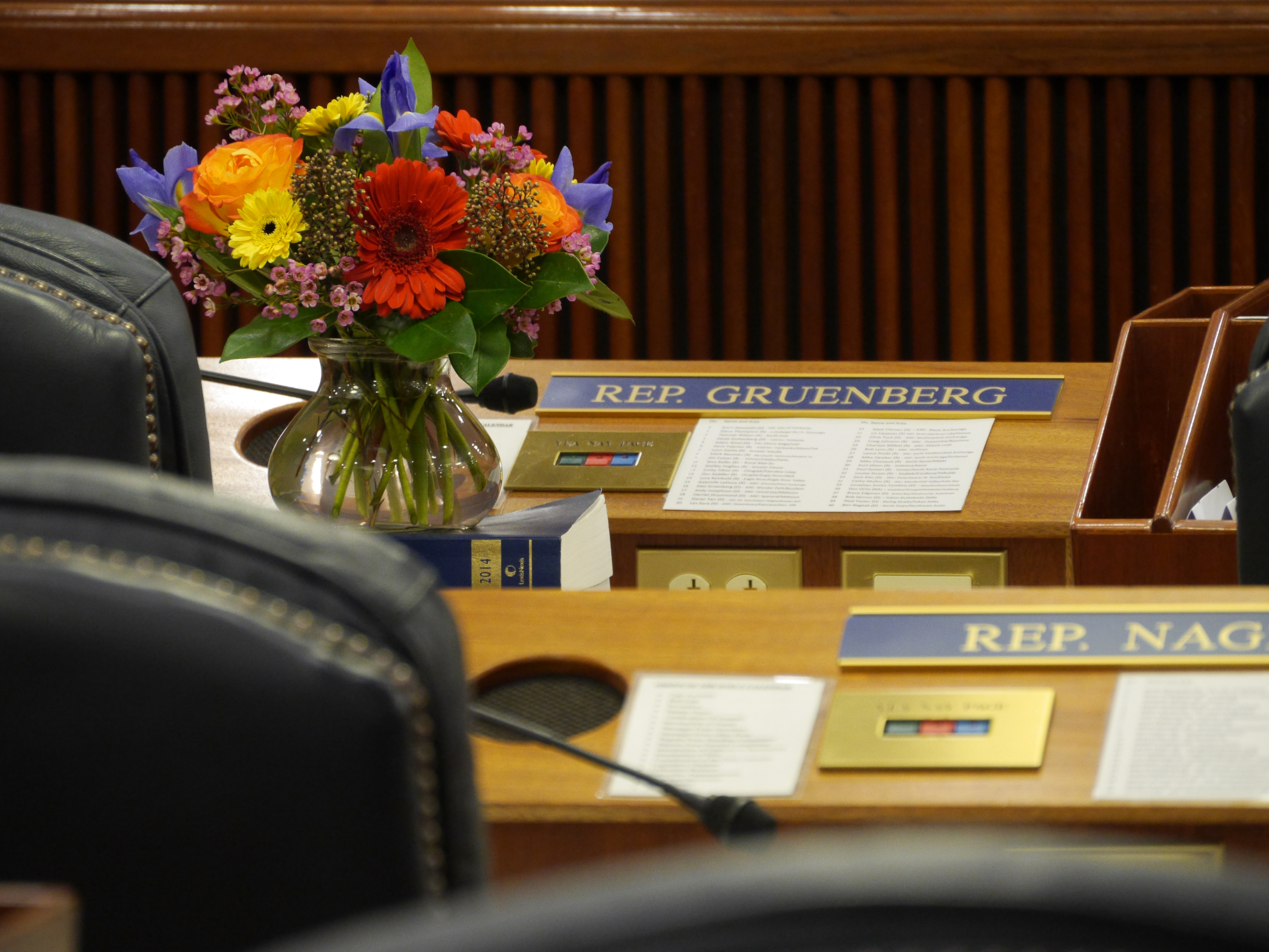
Flowers on Rep. Max Gruenberg’s desk
Lt. Gov. Byron Mallott at Max Gruenberg remembrance
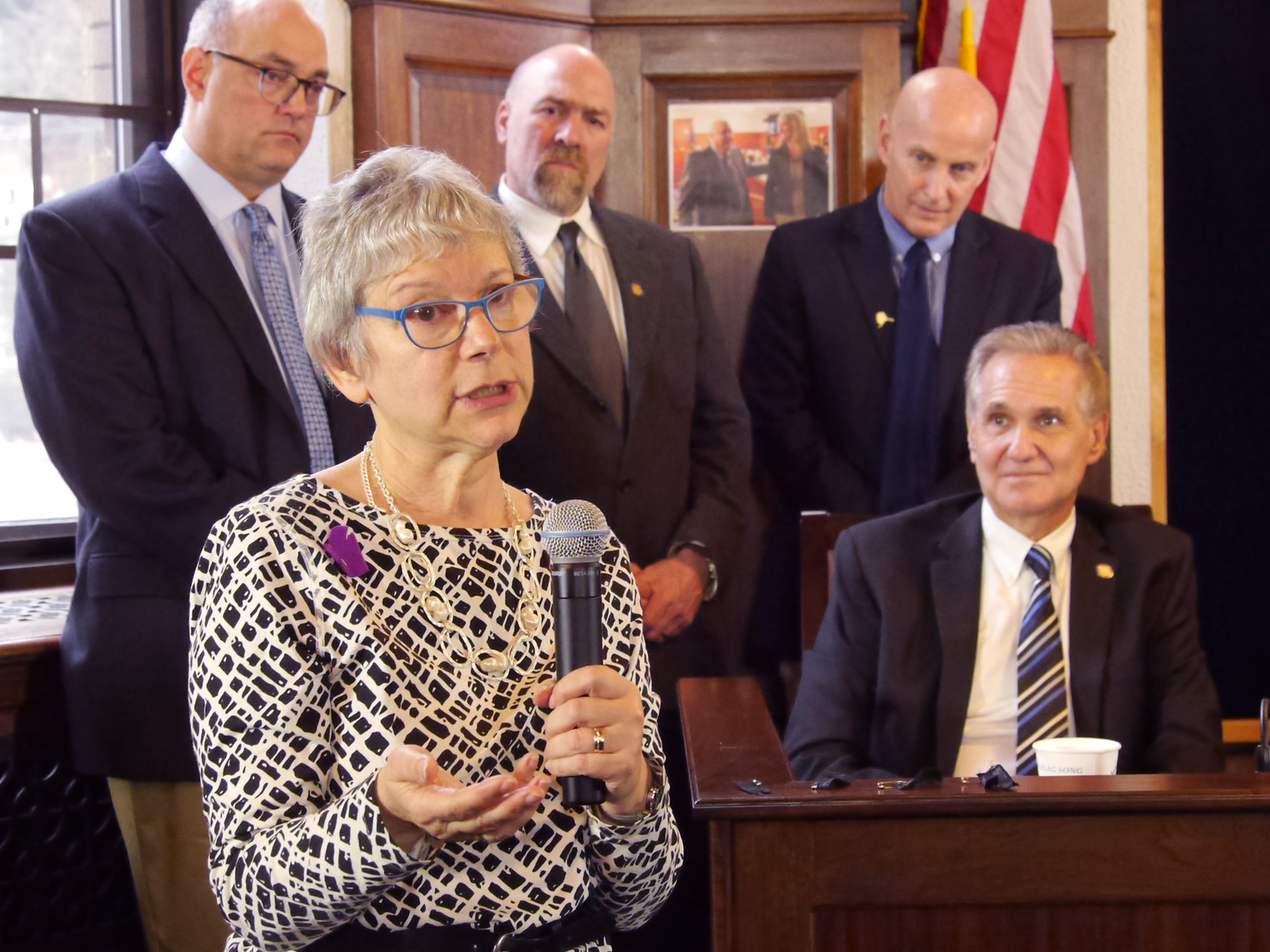
Left: A legislative employee and Kayla Epstein, widow of Rep. Max Gruenberg, console each other after a memorial for Rep. Max Gruenberg. Top right: Rep. Gruenberg’s desk in House Chambers on Monday. Bottom right: Lt. Gov. Byron Mallott shares a memory about Gruenberg as Gov. Bill Walker listens.
Kayla Epstein, widow of Rep. Max Gruenberg
Alaska legislators at Rep. Max Gruenberg remembrance
Capitol crowd Rep. Max Gruenberg memorial

The remembrance at the Capitol on Tuesday for Rep. Gruenberg was well attended by Capitol workers.

(All photos by Skip Gray/360 North)

State, partners mum on possible changes to massive gasline project

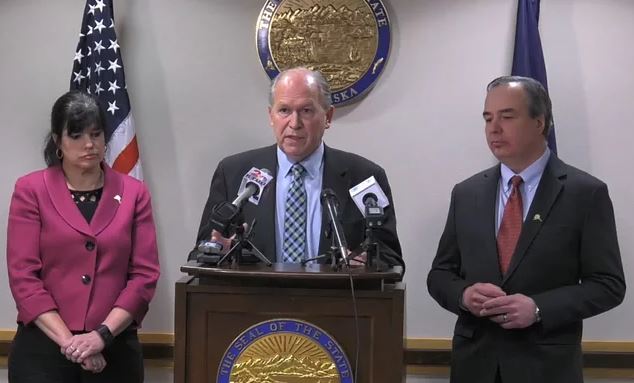
BP Alaska President Janet Weiss, Gov. Bill Walker and ConocoPhillips Alaska President Joe Marushack announced Wednesday that they're exploring options on the Alaska Liquefied Natural Gas Pipeline, but declined to give specifics. (Screenshot)
BP Alaska President Janet Weiss, Gov. Bill Walker and ConocoPhillips Alaska President Joe Marushack announced Wednesday that they’re exploring options on the Alaska Liquefied Natural Gas Pipeline, but declined to give specifics. (Screenshot)

Changes are coming to state plans for a liquefied natural gas pipeline, but the governor and the state’s three pipeline partners aren’t ready to say what those changes will be.

At a news conference Wednesday in Anchorage, executives with ExxonMobil, BP and ConocoPhillips joined Gov. Bill Walker to announce that they are “exploring options” to advance the pipeline.

Walker emphasized the importance of keeping the project on track.

“We know that most likely there needs to be some modifications in some way and so we sort of come back to the drawing board a bit on how to look at this project a bit differently,” Walker said.

The executives said they would complete preparations for front-end engineering and design work — also known as “pre-FEED” — on schedule by this fall.

But ConocoPhillips Alaska President Joe Marushack didn’t offer assurances beyond a commitment to explore options.

“What we’re trying to do is get through the pre-FEED process,” Marushack said. “Clearly the economic headwinds are pretty tough right now, but we’ve got to see what the project costs before we can make a statement if we should participate and go forward or not.”

Energy industry experts have said the project doesn’t make economic sense at today’s natural-gas prices.

The announcement put into doubt the state’s timeline for the project.

State Natural Resources Deputy Commissioner Marty Rutherford says everything is on the table ahead of another pipeline announcement next month.

“It’s sort of a nexus of problems that have happened — this economic situation on the value of oil and gas as well as slow negotiations — which has caused everybody to begin to discuss: ‘Well, as we continue forward on AKLNG as currently envisioned, are there other alternatives we should be looking at so we don’t have a delayed feed decision?’ ”

Walker earlier said he would seek a state constitutional amendment to lock in tax rates for the energy companies who are working with the state on the project.

The governor said Wednesday he isn’t ruling out the amendment, but the state may be able to provide cost certainty without an amendment.

The project has an estimated cost of $45 billion to $65 billion.

Speaker of the House Mike Chenault said he wished there was something more concrete from the announcement.

The Nikiski Republican added that he welcomes greater scrutiny of the cost of the project, which is the largest proposed infrastructure project in the world.

“I don’t know whether to take it as a sign of good or bad,” Chenault said. “I think we take it as a time that they’re still talking and, you know, in the economic times that we’re in, with the price of a barrel of oil, I think that it might do us well to step back and look at it and make sure that we haven’t missed something that may cost us in the future.”

Kenai Peninsula Borough oil and gas adviser Larry Persily said the options may include changing the percentage ownership each partner has in the pipeline.

Persily previously was the federal coordinator for natural gas projects in the state. He said if some of the partners decide to scale back their participation in the project, it will present a dilemma for the state.

“Right now, the state, I think, wants it more than the others, but when it comes down to it, the state is not in a position to take on more risk than the companies can afford,” Persily said. “We have enough of a financial hole in our budget.”

Persily said if the state wants to borrow money, it will have to show lenders it can pay the bills it already has. He said the announcement is a reminder that the state must be financially self-supporting before it can think of new options for the gas line.

Site notifications
Update notification options
Subscribe to notifications