Sen. Gary Stevens addresses a joint session of the Alaska Legislature during debate about confirmations of the governor’s appointees, April 17, 2014. (Photo by Skip Gray/Gavel Alaska)
The Legislative Council is seeking advice from an independent finance expert on what to do about the controversial lease on the Legislative Information Office in downtown Anchorage.
Council Chairman Sen. Gary Stevens, a Kodiak Republican, said Thursday the council would benefit from a fresh perspective.
The council has been weighing whether to break a 10-year lease with the building’s owner. The state also could opt to buy the building.
Council lawyer Serena Carlsen is providing Stevens with names of potential experts. Stevens expects the analysis to be completed within a month.
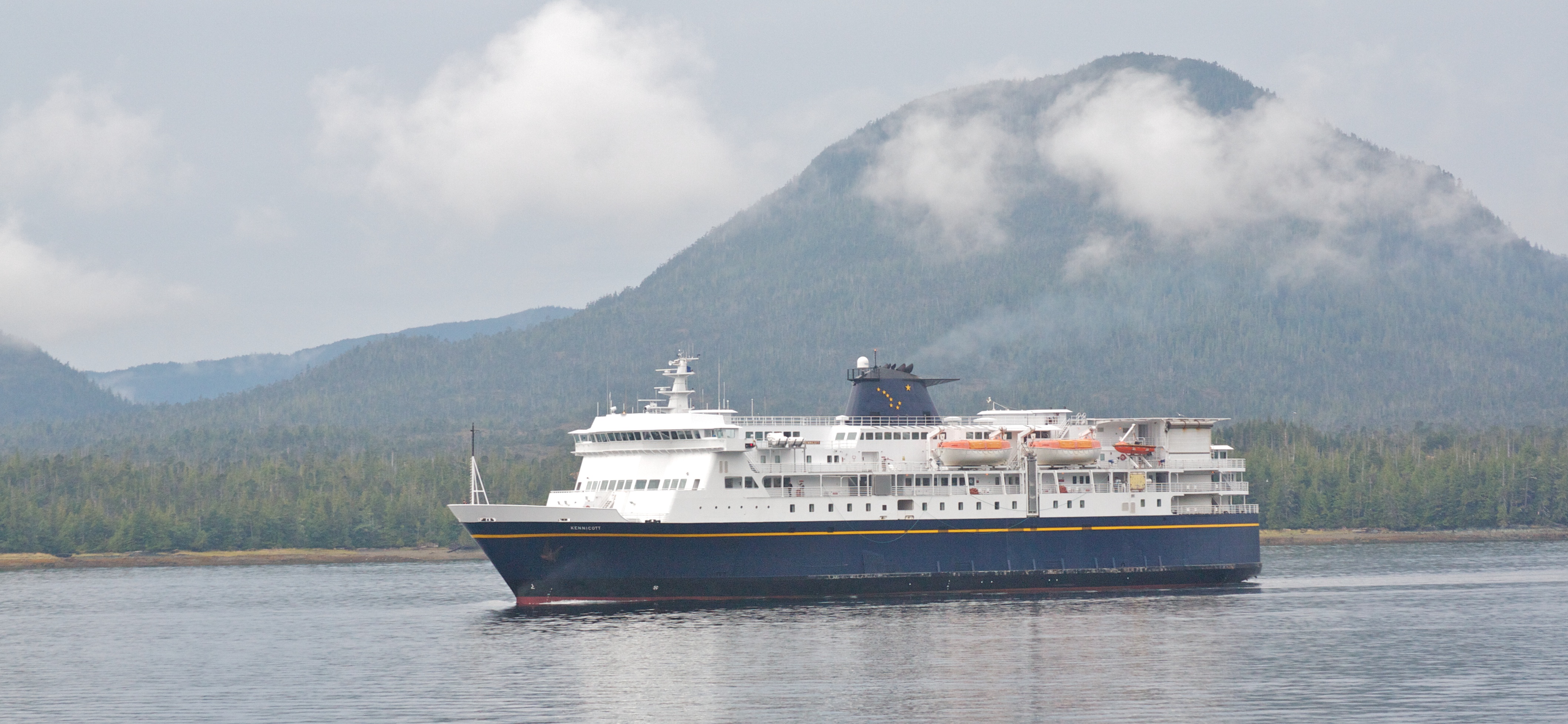
The Alaska Marine Highway System’s ferry Kennicott near Ketchikan in August 2010. (Creative Commons photo by Jay Galvin)
Many people think the Alaska Marine Highway System only serves port communities in the Southeast and Southwest parts of the state, plus Prince William Sound. It turns out the Railbelt benefits, too.
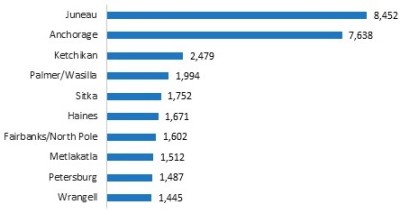
Ferry trips booked by community of residence. (Graphic courtesy McDowell Group)
The McDowell Group, a Juneau-based research business, was hired by the ferry system to produce an economic impact report.
It lists Anchorage and the Matanuska-Susitna Borough among the top hometowns for residents booking ferry travel. And Anchorage is tied for first as the prime destination for ferrying summer tourists.
“The marine highway system has this invisible role in the rest of the state that’s not as apparent,” said Heather Haugland, who wrote the report based on 2014 fiscal year information.
It shows the ferry system to be an essential part of Alaska’s economic landscape. The marine highway employs about 1,000 people directly, which leads to almost 700 other jobs in retail, tourism and other industries.
The report, released Feb. 4, said the system led to about $270 million a year of economic activity statewide. That’s more than double what the government spends on operations and maintenance. Direct revenues from ticket sales, freight and related activity remain far below the state’s costs.
Haugland said the economic benefits start with about $65 million in ferry workers’ pay.
“Those wages, in turn, get spent elsewhere in the state. And that creates indirect impacts. And then businesses, as well, that the marine highway system works with and makes purchases from, they in turn make additional purchases,” she said.
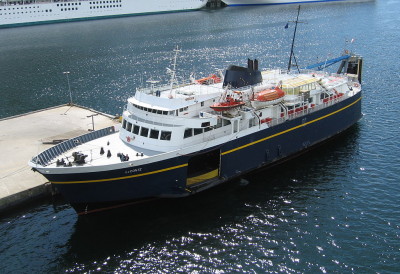
The Alaska Marine Highway ferry LeConte docks in Skagway, 2009. (Public domain photo by JWebber)
Of course, the marine highway’s biggest impacts are on smaller, isolated communities. Their residents depend on ferry travel for medical care, shopping and school trips.
“The marine highway system serves 33 communities. And only five of them are connected to the road system,” she said.
The report said the marine highway carried almost 320,000 passengers and more than 100,000 vehicles in the year studied. More than 4,000 container vans carried groceries and seafood, as well as other products.
Haugland said those are especially important in small communities with few other options.
“You can’t just replace the ferry system with air. Air travel (has) a lot of canceled flights. There is not as much capacity on air. It just plays such an essential role in many facets of life in these really small communities,” she said.
The schedule has been cut since the data was collected that was used in the report. More reductions are planned, due to the state’s budget crisis.
Haugland said economic and other impacts will drop proportionately as sailings and ships are cut.
Ferry system spokesman Jeremy Woodrow said the report is timely.
“There have been requests from the public and … the legislature as well to look at this economic impact and renew the study information,” he said.
Woodrow said the study has been sent to coastal legislators, as well as members of the House and Senate Transportation committees.
The Alaska Legislature held its second special session last year at the Anchorage LIO. (Photo by Zachariah Hughes/KSKA)
Owners of the contentious Legislative Information Office in downtown Anchorage have offered to sell the building for $37 million plus closing costs.
The developer said the sale would save the state $2,052,000 over the next nine years of its lease, and avoid possible lawsuits if legislators walk away from the agreement.
The offer is the latest salvo in a battle between lawmakers, developers and lawyers over the price legislators agreed to for the building in 2013 during a very different fiscal climate. The Jan. 29 proposal outlines savings to the state if it buys the building outright rather than piece-by-piece under the 10-year lease that lawmakers have debated abandoning.
The terms of the deal are laid out in a letter from Oct. 9, 2015, included in the materials made public Friday by the Legislative Council.
Based on figures from the Department of Revenue, the developer claims the sale would be cost-competitive against the alternatives.
“The DOR analysis clearly confirms that the Option to Purchase will provide the Legislature with more significant savings than any other scenario, including a move to the Atwood Building,” wrote developer Mark Pfeffer, one of the managing members of 716 West Fourth Avenue, LLC, the group that owns the building.
Legislative Affairs Agency Director Pam Varni refutes the basis of that claim in an accompanying memo.
“The data provided by 716 West Fourth Avenue, LLC to the Department of Revenue for their Proposal are misleading,” Varni wrote in a memo on Friday. According to Varni, by factoring in a continued debt load for leasing the Atwood space, the price is inflated. The numbers submitted to DOR are “unrealistic and erroneous,” she wrote, as the state will have paid off the Atwood building by March of 2017, although that is not the case for the parking garage that would be part of the potential Atwood lease.
In an emailed statement, Amy Slinker, a representative for 716, wrote that Varni’s memo “lacks third party analysis.”
The disagreement over exact numbers is hardly the final say over the future of the LIO building. The Legislative Council is meeting Thursday to discuss the proposal. Their recommendation will go to the full legislature, which must decide whether or not to appropriate money for the lease in the upcoming fiscal year.
The proposal also notes that the purchase option involves the dismissal of a lawsuit brought against 716 and the Legislative Affairs Agency by Alaska Building, Inc., the company run by Anchorage attorney Jim Gottstein. Reached for comment earlier in the week about what the terms of the dismissal are, Gottstein said only, “We’ll see,” and declined to elaborate.
For 40 years, someone from Bristol Bay has sat on the Alaska Board of Fisheries. For the first time next fall, that might not be the case.
Gov. Bill Walker announced five nominations to the state fisheries and game boards on Tuesday. On the list again for a fish board seat is scientist Robert Ruffner of Soldotna, who would replace Fritz Johnson, a commercial fisherman from Dillingham.
That was a surprise for many in Bristol Bay — including long-time drift fisherman Robin Samuelson, a former fish board member himself.
“This is a sad day for Bristol Bay,” Samuelson said shortly after the announcement was made. “Fisheries is everybody’s livelihood in Bristol Bay and I’m very disappointed in the governor’s action.”
Johnson, also a Bristol Bay drifter, wanted to serve a second term on the board. He was appointed to replace Vince Webster, of King Salmon, who replaced Dillingham’s Robert Heyano. As far back as 1975, when the board of fish and game was split into two, someone from Bristol Bay has sat on the board of fish. Dillingham’s Herman Schroeder was the first appointee from the region. Samuelson said he wasn’t expecting the governor to change that pattern.
“I could see him replacing Fritz, but it would seem that with having the biggest herring fishery in the state of Alaska, having the biggest salmon fishery in the world, that we’d be afforded a board of fish member,” Samuelson said.
A commercial fisherman and salmon in Bristol Bay, July 2, 2013. (Creative Commons photo by Chris Ford)
Norm Van Vactor, CEO of Bristol Bay Economic Development Association, said the news was a surprise to him as well. Although he’s been a supporter of the governor, he was frustrated by the lack of outreach to Bristol Bay stakeholders before the decision was made.
“And I think that the lack of process that the governor and the commissioner have not gone through is really sad,” he said. “… I think all of us were put in a position of not being able to rally and ask why.”
But Walker said he was ready for something different and didn’t make the decision lightly, knowing it was a big change for the bay.
“I just wanted a little different balance, not necessarily of user groups but a regional balance a little bit for a change,” Walker said. “I certainly wouldn’t look at this as a trend in anyway, but I think that there’s a lot of angst in the Cook Inlet, Peninsula region. … I looked at the individuals, both were obviously quite good. Fritz has been a good board member. And I look at Robert Ruffner, and … what I think he brings to the board, and I just felt I needed to have a little bit of a different, a little bit of a shift, and use Fritz in a different way.”
Although Johnson received a ticket for fishing three minutes after the fishing period closed this summer, Walker said that wasn’t a deciding factor in the decision not to reappoint him. Instead, Walker said he’s hoping Johnson will help with a new advisory group he’s forming to review the board process.
“I know he’d much rather be on the board, but I need somebody from the board to be part of this advisory group,” Walker said. “I want to look at some potential changes to the board process in some way, but I need to put together this advisory group to do that and so, like I said, I’ve asked Fritz to be part of that if he’s willing to.”
Walker said he met with Samuelson and Rep. Bryce Edgmon after the announcement was made.
Johnson’s replacement, Ruffner, is actually a second-time nominee. Last year, the state legislature voted him down after he was selected to replace former board chair Karl Johnstone, citing concerns that his appointment would change the balance. Johnstone was considered a sportfishing representative; Ruffner had a science background, and said he would put the resource first.
Walker later appointed Robert Mumford, a former Alaska wildlife trooper, to Johnstone’s seat after Ruffner wasn’t confirmed. Mumford served for most of the year, but announced in late January he planned to resign in March.
Walker has nominated Anchorage’s Al Cain, another former trooper, to replace him. The governor rounded out his fish board nominees with Israel Payton, a Wasilla resident who has worked as a hunting and fishing guide. He’ll replace Tom Kluberton, who said in December that he didn’t plan to serve another term.
The appointments change the balance on the seven-member board, which makes policy and allocation decisions for the state’s fisheries. Typically, there are three representatives of the sportfishing industry, one subsistence representative and three from commercial fisheries. The most recent round of nominations, if confirmed, will change the balance.
Samuelson said it isn’t just commercial fishing representation he’s worried about.
“Subsistence is the most important fishery in our state, especially in rural Alaska, and who’s gonna carry the torch on that board for us,” he said. “Not only our commercial fishery but our subsistence fishery.”
All of the governor’s nominations are subject to confirmation by the legislature, a process that’s been contentious in the past couple of years. Walker said he expects Ruffner to be confirmed this time around.
“I’ve received, I believe, assurances that it will go significantly differently. Otherwise I would not have put him back up as a nominee,” he said.
Specifically, Walker said individuals from the Kenai Peninsula told him they thought the vote would go differently this spring. But one Kenai Peninsula lawmaker, Republican Rep. Mike Chenault, said it remains to be seen how the confirmation process will go.
“It is contentious,” Chenault said. “I have never seen a board member just kinda sail through unscathed without somebody taking pot shots at ‘em. And you know, why some (people) even would want to be on this board? I have no idea.”
Chenault said the fish board appointees will likely face multiple confirmation hearings before the legislature meets in a joint session to consider the nominees. That hearing is typically occurs toward the end of the session.
In addition to the fish picks, the governor reappointed Nathan Turner for the state Board of Game, and appointed Guy Trimmingham for a first term.
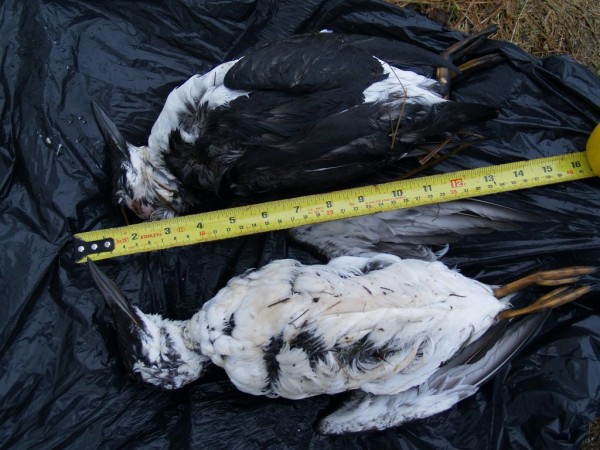
Dead murres on the beach in Haines on Jan. 12. (Photo courtesy Tim Ackerman)
The number of dead common murres showing up on Alaska’s beaches is growing, and the scale of the die-off is now on par with the grounding of the 1989 Exxon Valdez in Price William Sound when 22,000 birds were collected.
Heather Renner with U.S. Fish and Wildlife Service said it is already one of the largest die-offs in history and, unlike when the tanker went aground, not many people have gone out to remote beaches to survey for dead seabirds.
“The exactly same number is purely a coincidence,” said Renner. “Our number is changing every day as people call in more reports. But certainly there was a lot of effort put into searching beaches then. Now people are just calling in and telling us about them. And we haven’t gotten a chance to look at much of the remote coastline.”
Renner told the Alaska Marine Science Symposium that dead murres started showing up on beaches last summer, but since those numbers were spread out over a large area, they weren’t noticed until the thousands started showing up on beaches in January.
“It was 10 times what it normally is, but you still had to walk a long ways before you found a carcass,” said Renner. “Then suddenly since Christmas you can’t walk a beach without finding them everywhere. You see them along the Seward Highway here in Anchorage. They’re foraging in Cook Inlet, which they never do. But there’s dead murres on the ground everywhere, and it’s hard not to notice them.”
The reason for the dead birds is still a mystery, but Renner said both the huge area that they are being found in and the fact that it began last summer and has continued over a long time indicates it might be the result of a change in the food web caused by the unusual “Blob” of warm water pressed up against Alaska’s coast.
“I think it rules out short-term acute events like immediate poisoning events. I think it suggests something more related to the food web structure,” said Renner. “But there are a lot of hypotheses. That certainly these things all contribute to each other, so at a time when you have a big storm you have a large pulse of numbers because the birds are stressed and weakened already.”
Murres are found farther down the West Coast, in areas where the water is much warmer, but scientists think it was the abrupt change in water temperatures and conditions that may have changed the food web making it impossible for the birds to survive.
Researchers have now examined more than a hundred of the birds but have seen no sign of toxins in their stomach contents, but then again, Renner said, the birds were so starved that there was hardly anything in their stomachs to analyze.
The Regulatory Commission of Alaska described the electric utility scene in the Railbelt as “fragmented, balkanized and often contentious.”
But that may be changing.
Utilities from Homer to Fairbanks are in discussions to overhaul the way electricity is generated and transported across the region. The proposals would create a single operator to coordinate how power is delivered to customers throughout the Railbelt, and bring in an outside company to build and manage regional transmission lines. The goal is cheaper electricity and more renewable power.
“Maybe it’s a little bit about maturity and a little bit about a different way of doing business,” said Cory Borgeson, president of Golden Valley Electric Association in Fairbanks.
In the current way of doing business, six different utilities supply electricity to about half a million people between Homer and Fairbanks. In most parts of the country, a population that size would likely be served by just one utility.
Say people are using more power in Fairbanks. Ideally, the utility there would tap the next most efficient power plant in the whole system — maybe, at that moment, one in Anchorage.
That’s called economic dispatch — the ability to go to the cheapest power source available and route it to where the power’s needed most. It can save rate payers a chunk of money, but right now it’s not possible.
So utilities are exploring creating a single operator for the whole region. Chris Rose heads the Renewable Energy Alaska Project and would like that operator to represent a wide range of stakeholders, rather than being controlled entirely by the utilities themselves.
“We want a system operator that is impartial and independent,” he said. “I can’t emphasize that enough.”
The current system makes it hard for independent companies to access the grid, especially renewable power suppliers.
When Cook Inlet Region Inc. wanted to expand its Fire Island Wind project, Golden Valley Electric in Fairbanks was interested in buying.
But between Cook Inlet and Fairbanks are three other utilities. Each charged a fee.
“There was a willing buyer and a willing seller, but the transmission tariffs really killed the deal,” Rose said.
A single-system operator could create a one-stop shop for independent producers who want to access the grid.
Meanwhile, to make all this work, the RCA found that the system needs nearly a billion dollars in upgrades — money that no utility can raise alone. In the past, the funds might have come from the state, but that’s no longer likely. So utilities are also considering bringing in an outside transmission company to build and maintain lines.
The RCA, which oversees utilities, has ordered the companies to try to resolve the issues voluntarily. In an update to lawmakers on Thursday, Golden Valley’s Borgeson said it’s going well.