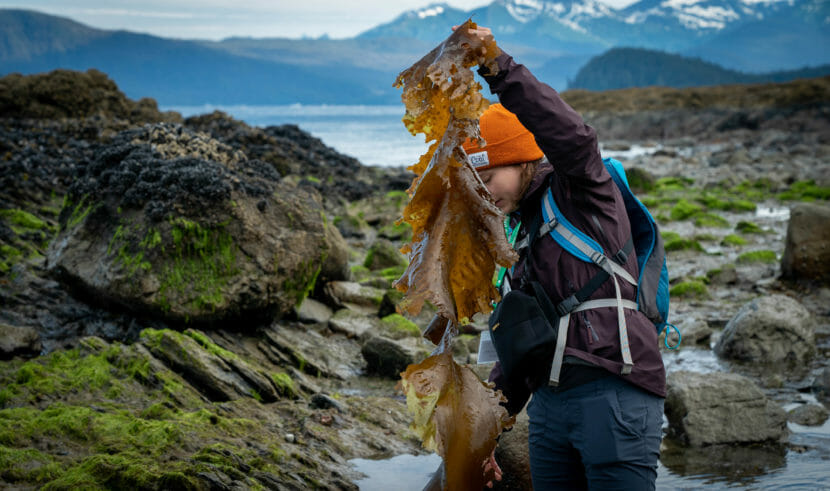
Audubon intern Mali Tamone discovers ribbon kelp at the beach near the Rainforest Trail on July 15, 2022 in Juneau. (Photo by Paige Sparks/KTOO)
The waters of Southeast Alaska are an ideal environment to grow species ranging from Pacific oysters to ribbon kelp. But growing them successfully requires in-depth knowledge of dozens of species — where they grow, when they grow, and under what conditions.
A new tool aims to make that easier.
The National Oceanic and Atmospheric Administration released a new guide earlier this month that chronicles more than 100 species of seaweed commonly found in Alaska.
“To grow it for the kelp industry, you need to know where you can find those spores, what time of year,” said Jordan Hollarsmith, a mariculture-focused research biologist with NOAA. “Or if you want to harvest it, to eat it, you need to know what you’re looking for, where you can find that species.”
The guide aims to advance the state’s budding mariculture industry at a time when global demand for kelp products is on the rise. Alaska mariculture is still tiny compared to other coastal states, like California, Oregon and Washington. But it is steadily gaining ground. All told, the state boasts more than 1,300 acres permitted for mariculture, according to a NOAA report from last year.
And more mariculture farms are coming. On average, Alaska received more than a dozen applications for new sites each year between 2019 and 2023. That’s more than double the average for the five years prior.
“A decade ago, I don’t know if there was a single farm,” Hollarsmith said. “And now we see multiple around Kodiak, some pretty small-scale ones in Kachemak Bay and in Prince William Sound, and then a few smaller, medium-sized ones and a large one as well in Southeast Alaska.”
Hollarsmith didn’t author the updated guide. But she says it will be a crucial tool as the industry develops across the state. Right now, the highest concentration of mariculture is in Southeast, with forty permitted farms, according to the 2024 report.
NOAA is also exploring where other farms might thrive. At one point that included the waters around Haines. But the agency later dropped Haines from the list because the area is near several state marine parks, which cannot overlap with farm lease applications, Alicia Bishop, a regional coordinator for NOAA Fisheries, said in an email.
Siting new farms is one of the key obstacles to growth. That’s because new sites have to meet several key criteria, including the right environmental conditions and limited overlap with other marine activities.
“You can’t set your farm where there’s already a fishery, where there’s military installations, a ferry route, those sorts of things,” Hollarsmith said.
Still, the industry is growing – and fast.
That’s largely due to a $49 million federal grant awarded in 2022 to a coalition of companies, agencies, tribes and researchers working to boost the industry. NOAA said at the time that the grant could help grow the industry to be worth nearly $2 billion within the next decade. A state task force, meanwhile, set a goal in 2016 to develop mariculture into a $100 million industry by 2040.
Driving the state’s interest in part is the industry’s potential to boost Alaska’s coastal economies. Hollarsmith thinks mariculture could offer more opportunities for people already working on Alaska’s waterfronts.
“We see a lot of people that participate in commercial fisheries also participating in the mariculture industry,” she said.
Hollarsmith says untapped opportunities for Alaskan oyster farms could also fuel growth. Kelp, meanwhile, is becoming an increasingly popular health food, and can also be used for other purposes. The industry is exploring how different species can be used as a strengthening ingredient in concrete, or in fertilizer to boost crop production.
While the new field guide doesn’t focus on the quickly growing industry, it does provide detailed information about dozens of seaweed species commonly found in Alaska. That was made possible in part by new genetic techniques, like DNA sequencing, that have allowed researchers to better classify seaweed and identify new species over the last decade.
“It’s really important that we’re all using the same name to describe a given species,” Hollarsmith said. “Especially in this time of kelp industry growth, when farmers are experimenting with new species and trying to understand what species are out there and what kind of benefits they might have.”
A Delta Air Lines flight touches down in Juneau. (Photo by Heather Bryant/KTOO)
Delta Air Lines has pulled its bookings for summer flights to both Ketchikan and Sitka, a seasonal service it had offered for nearly a decade. That leaves Alaska Airlines as the only major carrier in the two communities.
Scott Habberstad oversees community relations for the Alaska market of Alaska Airlines. During a Ketchikan Chamber of Commerce luncheon days after Delta’s Jan. 11 pull-out, Habberstad gave a presentation and took questions from the audience.
Habberstad said he was disappointed to see his competitor go.
“I love the fact that Delta was here, because competition makes you better, right? Really does,” he said.
But Habberstad was adamant that losing Delta would not affect the cost of flights in and out of Ketchikan.
“The fares will be the same as they were last year, as they were this year, and they’ll be the same next year,” Habberstad said. “We’re not here to gouge, we’re here to stay.”
Since 2015, Delta had been offering once-daily flights connecting both Ketchikan and Sitka to Seattle during the busy summer months. As the carrier has expanded its hub in Seattle, it has increasingly challenged Alaska Airlines’ dominance in its namesake state. That competition has meant lower prices for customers.
Scott McMurren, the long-time publisher of the Alaska Travelgram newsletter and travel columnist for the Anchorage Daily News, tracks the price of Alaska flights for a living. He said each time Delta has entered a city previously dominated by Alaska Airlines, prices have dropped.
And since Delta pulled its seasonal flights in Ketchikan, McMurren said Alaska Airlines’ prices already look to be substantially higher for the upcoming summer than they were last year.
“It’s important to just understand that when there is a monopoly in the market, prices drift up,” he said. “And this is not exclusive with Alaska Airlines, Delta does the same thing. All airlines do the same thing.”
But Habberstad insists Alaska Airlines does not intend to raise prices. In a phone call with KRBD, Habberstad said that the apparent increase could be due to sale pricing.
“It’s possible that there was a sale fare in the market, a special sale fare, for some reason when you were looking at it, and there may not be a sale fare today,” he said.
As for Delta, the Sitka and Ketchikan flights apparently just weren’t getting enough passengers to pencil out. In a statement sent to KRBD, a Delta representative said to better meet demand, those aircraft are being reallocated to Bozeman, Montana, “a market with strong year-round demand from Seattle.”
But the airline is continuing to expand in the state’s biggest cities. Delta has recently added a new route from Fairbanks to Salt Lake City and from Anchorage to Los Angeles.
In the last decade, there was just one commercial red king crab fishery in Southeast Alaska. But a proposal going before the Alaska Board of Fisheries could potentially change the tide for future openings.
The proposal, submitted by the Alaska Department of Fish and Game, could allow a smaller commercial fishery to open when stock levels are lower than required.
“It would create opportunity where there hasn’t been many opportunities in the past,” said Adam Messmer, regional shellfish biologist for Fish and Game.
In order to open the Southeast commercial red king crab fishery, state regulations require there to be a stock of at least 200,000 pounds regionally.
“The 200,000-pound threshold … isn’t a biological threshold,” Messmer said. “It was created by the processors many years ago, saying that they couldn’t make money on anything less than 200,000 pounds. That was back when red crab was three or four dollars a pound. And times have changed…”
Red king crab is a low-volume, high-value fishery. The crabs can bring in over $100 each.
But the state’s red king crab stock estimations for the region have repeatedly fallen short of 200,000 pounds.
Fish and Game’s proposal to the Board of Fish explains that there will not be a commercial red king crab opening in Southeast Alaska while crab stocks are below that minimum threshold.
The proposal looks to allow a small, conservatively managed commercial fishery by introducing an individual catch limit for commercial permit holders. This would divide up the catch between however many commercial permits are eligible to fish that year and allow for a commercial opening when the region’s estimated stock is less than 200,000 pounds. When that minimum threshold is met, a competitive commercial fishery would be held like usual.
This plan was developed over several years with collaboration between Fish and Game and permit holders. Craig Evans is the president of the Petersburg Vessel Owners Association, a key party in forming the proposal. At a Petersburg Borough Assembly meeting on Jan. 6, he said the plan has been a long time coming.
“A better part of a decade, we’ve been working on this issue to try to get more access to the red crab fishery,” he said.
Though the proposal could have allowed just a few more commercial openings in the last decade, Evans said the plan is still a start and a step forward.
“It’s something that we can work with and … hopefully improve as time goes on. But right now, it’s basically we don’t have a fishery, and under the current regime, we probably won’t be getting fisheries,” said Evans. “This will get us back on the water, and hopefully we can improve it … as the years come.”
But, not every proposal supports more commercial crabbing.
Territorial Sportsmen Inc. —a Juneau-based group— submitted a different proposal looking to completely prohibit commercial crabbing for red kings in the Juneau area and allocate the commercial harvest solely to personal use.
Right now in the Juneau area, more than 60% of the harvest goes to personal use, and 40% goes to commercial permit holders. However, if there is not enough crab for a commercial opening, that portion stays in the water.
The Juneau proposal states that demand for personal use in the area is growing; it aims to protect the red king crab stock around Juneau from the commercial fishery, pointing to reductions for personal use and years of closures that followed commercial openings.
The proposal would revoke the commercial allocation and direct 100% to personal use — harvesting 70% in summer and 30% in the fall and winter.
If the proposal goes through, it means red king crab in the Juneau area would be off-limits for all commercial pots.
“There’s a lot of unknowns there, if that one passes. It would eliminate commercial fishing for red crab in the Juneau area,” said Messmer.
He said other factors for managing the fishery will need to be reconsidered if the proposal gets passed by the board.
“We’re going to make the board aware that, you know, if this passes that … there’s other regulations that possibly might need to be changed,” Messmer said.
Although the proposal wants to stop commercial red king crabbing around Juneau, it says it does not aim to shut down the commercial fishery for the region — noting commercial harvest can still happen in the other areas if crab populations meet the threshold.
According to state surveys, Southeast’s red king crab stock is poor, and has been for years. Data from 2024 shows that a quarter of the region’s red king crab population resides in the Juneau area. It’s also the only area with above-average stock.
As it stands, Messmer said removing the Juneau area’s stock from the equation reduces the likelihood of meeting the threshold that’s currently required to open the commercial fishery in Southeast, which means it may be more difficult for a regional commercial opener to happen.
“We might have to modify the 200 pound threshold,” he said. “But that’s something that we’ll have to talk about at the board meeting.”
Messmer said officials would need to look back on how much of Juneau’s crab stock contributed to that threshold over the years if they consider changing it. But he said recalculations would be difficult to do because those population trends change.
Local Fish and Game advisory committees in Petersburg, Wrangell and Sitka support the department’s proposal to allow for a biologically-managed, small commercial fishery for red king crab.
The Juneau-Douglas advisory committee voted in support of the proposal to eliminate commercial red king crabbing in the Juneau area; Sitka took no action, and Petersburg and Wrangell opposed it.
The Board of Fisheries will meet in Ketchikan from Jan. 28–Feb. 9 to consider more than 100 different proposals for the region.
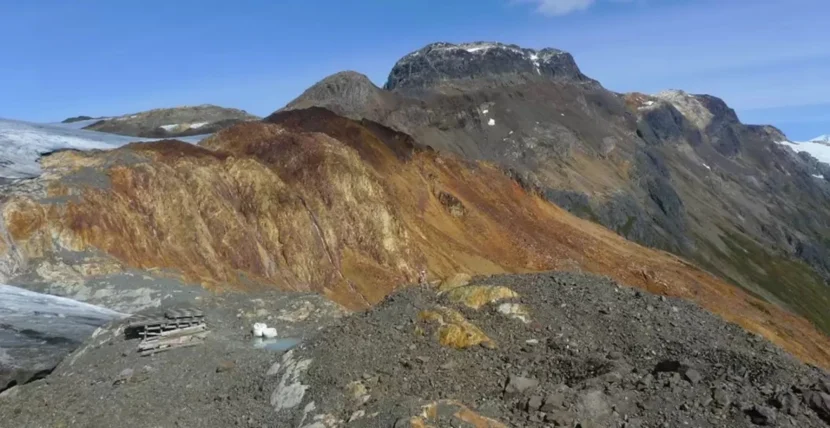
Oxidized rock colors a ridge above where one of Seabridge Gold’s KSM project’s open pit mines is being dug, from the KSM Project’s Prefeasibility Technical Report. (Seabridge Gold)
A major Canadian mining prospect upstream from Southeast Alaska is drawing legal challenges from both sides of the border, as tribal groups fear the project could pollute their ancestral waterways.
At the river’s mouth
The Southeast Alaska Indigenous Transboundary Commission, or SEITC, is worried about the region’s rivers. The commission represents 15 Tlingit, Haida, and Tsimshian nations that came together because they believe mining in British Columbia poses a threat to their spawning salmon and hooligan habitats, like the Unuk and Stikine Rivers.
The transboundary commission’s attention is currently on the Kerr-Sulphurets-Mitchell project, a proposed gold and copper mine at the foot of a glacier just across the Canadian border.
“KSM is on a whole other scale of mining, one of the world’s largest open pit mines, if it’s ever built,” said Guy Archibald, SEITC’s director. “Our tribes and communities are directly downstream. We rely on fish and the food security opportunities that the Unuk provides.”
The KSM Project is being developed by Seabridge Gold. According to the Canadian exploration company, the mine could generate nearly 1,500 jobs and over $30 billion in Canadian dollars for British Columbia and $60 billion Canadian for the nation over its projected lifespan of about 60 years.
Archibald weighs the stakes differently.
“Billions of tons of acid-generating waste rock just piled into valleys,” he said. “Valley fills in direct tributaries to the Unuk River. And so it’s almost inevitable that bad things are gonna happen.”
Mine tailings are the materials left over from the mining process, like acidic rock waste, undesirable metals, and the chemicals and discharge from processing the ore. All of this waste is stored in tailings facilities or dammed ponds until it can organically break down. According to the U.S. Environmental Protection Agency, many decommissioned mine tailing facilities are designated as Superfund sites.
Archibald cited the Mount Polley disaster, a 2014 failure at another mine in British Columbia that is widely referred to as one of the worst mining disasters in Canadian history. Canadian news outlet The Narwhal reported that KSM’s tailing ponds would be around 28 times the size of the one that failed at Mount Polley. SEITC estimated that KSM’s tailings ponds would require ongoing maintenance for at least 250 years, long after the mine shutters.
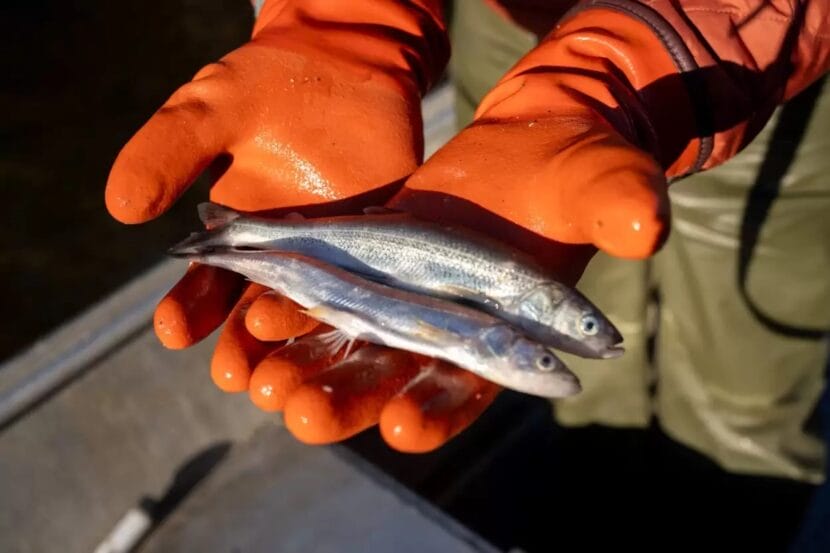
Tazia Wagner holds a pair of hooligan. (Jack Darrell/KRBD)
A voice in the process
In July, the British Columbia government issued a finding in the permitting process for the project known as a “Substantially Started Determination.” Under British Columbia’s law, environmental permits for development projects like mines come with an expiration date. According to the British Columbia Environmental Assessment Office, that’s partially because the environmental assessment process is constantly evolving – i.e. new science, new information, new regulations. Once a mine reaches a certain stage in development, though, the province can declare that it is far enough along and has met the environmental permitting requirements to move forward without its environmental “stamp of approval” lapsing.
Part of that environmental assessment process involves public comment and “a legal obligation to consult with Indigenous nations whose interests could be affected by the outcome of a substantially started determination.”
“And yet, the Alaska tribes are not really afforded any kind of voice in how this process works out. So we are trying every way possible to try to be sure that our communities are protected,” said Archibald, alleging that tribes in the transboundary commission weren’t afforded a meaningful seat at the table in that process.
In late November, the transboundary commission and SkeenaWild Conservation Trust filed a legal challenge against the British Columbia government. They’re represented by the Canadian law firm EcoJustice and are arguing that the mine was “rubber stamped” – challenging the premise of the province’s decision that the mine is “substantially started.”
The KSM mine received its environmental assessment a decade ago. EcoJustice attorney Rachel Gutman said that the process has changed since then and the province has a “deeper understanding of a rapidly changing climate” and “threats to salmon populations.”
“There are good reasons why the law has expiration dates for environmental assessments, including ensuring that mega projects like the KSM mine do not proceed based on outdated information,” Gutman said in a press release. “This is particularly important in this case due to the rapidly changing climate in Northern BC.”
The challenge also alleged that the province specifically considered whether the “substantially started determination” would help the mine in its timeline to secure outside funding when it issued the determination.
“We believe it is inappropriate for the (British Columbia Environmental Assessment Office), the agency tasked with assessing the environmental impacts of a project, to consider how their decision might support a company with project funding,” said Greg Knox, the executive director of SkeenaWild.
R. Brent Murphy is Seabridge’s Vice President of Environmental Affairs. In an email to KRBD, he wrote that Seabridge’s legal counsel are preparing to defend the validity of British Columbia’s determination. In his view, the Southeast Alaska tribal commission’s “ultimate goal is to halt all mining and exploration activities in the transboundary region.”
Murphy claimed that mining projects like the KSM aren’t responsible for declines in salmon and hooligan habitats. He chalked them up instead to “changes in ocean conditions, declines in quantity and quality of spawning habitat, and overfishing.”
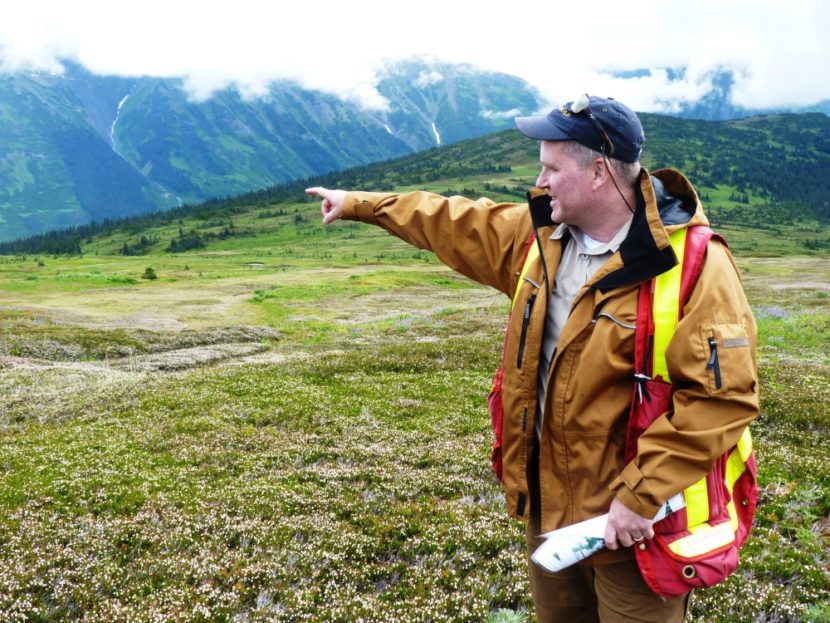
Seabridge Gold’s Brent Murphy points to a valley to be dammed to hold tailings from the KSM mine during a July tour. The project has won federal environmental approval. (Ed Schoenfeld/ CoastAlaska)
“There is also a misconception that Alaskans were not engaged during the (environmental assessment) process of the KSM Project,” Murphy said about the transboundary commission’s challenge that tribes weren’t properly consulted in the process. “On the contrary, the BC Environmental Assessment Office actively receives input and feedback from Alaskan regulators, tribal groups, and the Alaskan public for any mining project undergoing the EA process within the transboundary region.”
For Archibald and the transboundary commission, though, those requests for feedback amounted to an empty promise. He called British Columbia’s consultation process for Alaskans “everything short of being meaningful or consent-based at all.”
There is Canadian legal precedent for U.S.-based tribes to be afforded the same rights to consultation as First Nations protected under the Canadian constitution. That precedent is R. v. Desautel,a 2021 Canadian Supreme Court finding. An indigenous American citizen was tried in Canada’s courts for killing an elk in British Columbia without a hunting license. The defendant lived on a reservation in Washington and argued that he was exercising his Aboriginal right to hunt in the traditional territory of his ancestors.
As Archibald put it, the case forced the Canadian Supreme Court to ask a central question: “Do indigenous, non-resident people of Canada – people who live outside of Canada but have ties to traditional lands within Canada – have any rights to those lands? And the Supreme Court said yes.”
“Given the complex nature of an ecosystem, a productive ecosystem, like the Unuk watershed, and the complex nature of one of the world’s largest mines, what the outcome of that is going to be if it moves forward, is really anybody’s guess,” said Archibald.
In a September opinion piece in the Anchorage Daily News, Murphy struck back at the legal challenge and its supporters categorizing Canada’s decision as a “rubber stamp,” saying that Seabridge had already sunk roughly $1 billion in Canadian dollars into the project which constitutes substantial progress. He also challenged what he called “widespread misinformation” surrounding the mining industry.
Murphy said that the KSM project met British Columbia’s three main criteria for a “substantial start determination” – work had begun on the mine, the company had spent significant money on construction, and it had received “the support of our First Nations partners.”
The headwaters
The Tsetsaut Skii km Lax Ha Nation is an Indigenous First Nation in British Columbia that borders the KSM site.
In November, it filed its own legal challenge against British Columbia. Ryan Beaton, who provides legal counsel for the nation, said that the KSM project’s proposed tailings facility is on the nation’s land and the province didn’t properly consult with them either before “essentially greenlighting” the project.
“If we’re going to go ahead with this permitting, and this is going forward, where’s the consultation? Where are the funds to deal with the environmental damage from this?” Beaton asked.
Beaton described Tsetsaut Skii km Lax Ha as a small tribal nation “surrounded by larger, more powerful or more connected First Nations neighbors.”
Those larger First Nations surrounding the Tsetsaut Skii km Lax Ha’s traditional territory are the Tahltan and the Nisg̱a’a. And both nations publicly support the mine.
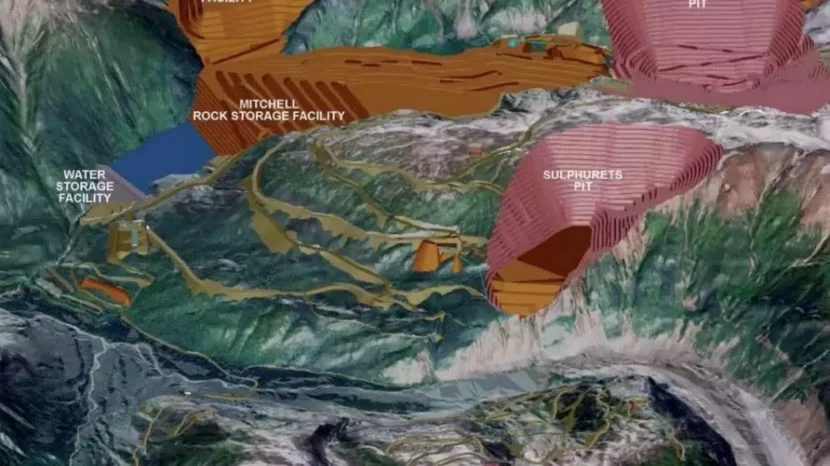
If the KSM project is built, Seabridge envisions three open-pit mines that will feed a processing facility and a tailings facility to store mine waste. Seabridge anticipates those mines could produce at least 47 million ounces of gold and 7 billion pounds of copper over their lifespan.
“The concern is a huge amount of toxic waste flowing out onto the territory, into the waterways, destroying the fishing for the nation, affecting wildlife,” he said, explaining the nation’s concerns if one of the dams at the tailing facility failed.
The KSM project’s mine site layout during the operation phase, from its environmental assessment certificate application. (Seabridge Gold)
For Beaton and the Tsetsaut Skii km Lax Ha, even if all goes according to Seabridge’s plan, some of the damage has already been done.
“Just the construction of the project on its own terms, if everything goes well, has had a huge impact on their hunting territories, their traditional ways of life, huge swaths of forest cut down, so there’s already been major impact,” Beaton said.
The KSM project has also caused particular friction between the Tsetsaut Skii km Lax Ha and their First Nations neighbors. That’s because Beaton said if the project moves ahead, gold and copper aren’t the only things that will be flowing out of it – so will huge sums of money to the Tahltan and the Nisg̱a’a.
The Tahltan and the Nisg̱a’a both signed agreements with Seabridge over the last decade. Publicly, Nisg̱a’a Nation President Eva Clayton has said that projects like Seabridge’s KSM stand to attract investors to First Nations territories in the Golden Triangle and “improve the quality of life of our Nisg̱a’a and Tahltan people.”
Recently, the two nations announced a partnership to “maximize joint opportunities on the Seabridge KSM Project.”
“On behalf of both the Nisg̱a’a Nation and the Tahltan Nation, I would like to acknowledge Seabridge for their support and encouragement,” Tahltan Nation Development Corporation Chair Carol Danielson wrote in a statement at the time, “and their willingness to actively engage and work with our Partnership on their KSM project, the world’s largest undeveloped gold project.”
Neither Tahltan nor Nisg̱a’a leadership responded to requests for comment.
Beaton compared the tailings facility dispute to hearing there was a big construction project happening in your neighborhood and then finding out “all the toilets for the project were going to be built in your backyard while the money flowed elsewhere.”
“When the (KSM project) is over, the Nisg̱a’a and Tahltan get to go home and the Skii km Lax Ha, this small First Nation, is stuck with a huge waste facility on its territory, and that is not the way Indigenous consultation should go,” said Beaton.
The Tsetsaut Skii km Lax Ha aren’t strangers to mining, though. The tribe has worked with other mining projects in the past and recently signed an agreement with a different company for a neighboring mine.
“Our nation is certainly not anti-industry,” said Beaton, adding that the nation does see the benefits mining could have on the province and their communities. “But it’s got to be done responsibly and in a way that respects both the nation’s rights but also the environmental concerns that they have.”
“'(It’s) the ‘Asserted’ territory of the Tsetsaut Skii km Lax Ha,” said Seabridges’ R. Brent Murphy about the First Nation’s claim that it owns the land for the tailing facility. “While they have sought recognition of their ‘exclusive’ rights to this area, it is currently not recognized by the government.”
The federal government of Canada marks the site of the proposed tailings facility as traditional Tahltan territory.
In its legal challenge, the Tsetsaut Skii km Lax Ha allege that this comes from a complex history of misinterpreted treaties and shaky ethnographic accounts that essentially, as Beaton puts it, “writes the Skii km Lax Ha out of their own history on their own territory.”
This assertion is backed by a 2021 report from British Columbia’s Attorney General, as well as a 2017 environmental assessment of a different mine, that supports the Tsetsaut Skii km Lax Ha’s exclusive rights to the area where the tailings facility will be located.
“We’re not asking them to take our word for it,” Beaton said. “We’re asking the province to act on their own assessment.”
Similar to the legal challenge EcoJustice filed on behalf of Alaska tribes across the border, the Tsetsaut Skii km Lax Ha’s legal complaint is lobbied against the provincial government. According to Beaton, that’s because the small First Nation is alleging that the province officially recognized their territory but because of their size and their lack of support for the KSM project, their constitutional right to consultation was minimized.
“The province is really picking and choosing who gets rights, and that is not appropriate. It’s really colonialism in action,” said Karen McCluskey, Beaton’s co-counsel representing the Tsetsaut Skii km Lax Ha.
For Seabridge, the could-be world’s largest gold mine passed its comprehensive seven-year environmental review process and according to Murphy, the company plans to invest millions of dollars annually into ongoing water quality reviews. For him, the province’s determination just reflects that Seabridge has done its part in making sure the project is safe and sustainable. He also continuously pointed to the support of their Indigenous partners – the Tahltan and Nisg̱a’a – and how they’ve allowed the project to move forward on their ancestral lands.
“The benefits are flowing to neighboring First Nations, to the government, and to industry. You know, the Tsetsaut Skii km Lax Ha nation has said they would like to have no dump on their land. That’s their position,” Beaton said.
The ball is currently in British Columbia’s court to determine how long officials will need to respond to these legal challenges on both sides of the border. Beaton estimated the whole process could take about a year.
For the KSM mine, Seabridge is hoping to solicit a partner for the venture, another mining company big enough to build and operate a mine this scale. After that, the company anticipates construction on the mine would take about five years.
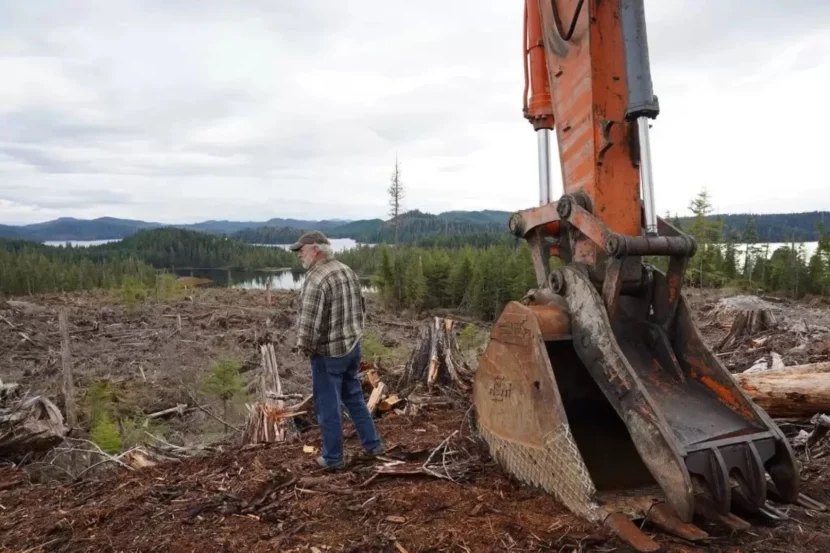
A Naukati Bay resident looks out over a clear cut northwest of his home on Prince of Wales Island in Alaska in September 2021. (Eric Stone/KRBD)
In the first two days of his new term, President Donald Trump signed more than 200 executive orders. One was aimed at accessing more natural resources in Alaska. It attempts to roll back protections on over 9 million acres of Tongass National Forest, potentially opening them up for logging.
Trump’s executive order is titled “Unleashing Alaska’s Extraordinary Resource Potential.” The order alleges that restrictions on mining, logging, oil drilling and other resource extraction on Alaska’s federally protected lands is “an assault on Alaska’s sovereignty and its ability to responsibly develop these resources for the benefit of the Nation.”
The Tongass is the world’s largest remaining temperate rainforest. The Trump administration is seeking to rescind the Roadless Rule, which prohibits road construction and timber harvest on over 58 million acres of national forests across the country.
The Jan. 20 executive order won’t have any immediate effect on the ground. Normally, an executive order like this would kick off a lengthy public process with the U.S. Forest Service and its parent agency, the U.S. Department of Agriculture.
The Juneau-based Southeast Alaska Conservation Council has been fighting to keep most of the Tongass roadless for decades. Council Director Maggie Rabb said it’s hard to predict what this administration will do next.
“This president has proven to be unusual sometimes, and so we’re not sure,” she said. “It is possible they could just try to remove it and skip the public process.”
The Tongass covers most of Southeast Alaska and is the largest national forest in the country. The conservation council was formed in 1970 specifically to combat wide-scale, industrial old growth logging in the forest.
During his first term, Trump took action to exempt Alaska from the Roadless Rule, only to be reinstated by the Biden administration. Rabb said the rule has been rolled back and rolled forward by various presidents pretty much since its inception – but not without a fight.
“If they do remove the Roadless Rule, it would start – it could start new litigation that we would join to put the Roadless Rule back in place, and then we would be suing against the Forest Service,” she said.
The conservation council has been involved in litigation around the Roadless Rule off and on, but as the presidential administrations change, so do their legal allies.
“The parties on our side change whether we’re with or against the federal government,” said Rabb.
During the Biden administration, the conservation council was suing the State of Alaska on behalf of the federal government to support its protections of the Tongass. That case is now on hold.
It’s possible the current administration could completely remove the Roadless Rule in short order and begin fielding proposals for new logging roads through the forest.
“How quickly that happens is very much a question, because logging has not proven to be that profitable for quite some time,” said Rabb. “Why would you push to further grow a logging industry that’s costing the taxpayers money and supports less than 1% of our regional economy?”
“These sales have consistently generated less revenue than the USFS spends to administer them, resulting in large net losses for U.S. taxpayers,” the report said, adding that taxpayers were subsidizing the region’s logging industry to the tune of $1.7 billion over the last 40 years.
Rabb said that the conservation council is not anti-logging. There is still active logging in the Tongass. For Rabb, the Roadless Rule has been an effective tool to protect old growth without actually ending logging.
“The push to roll back the Roadless Rule has very little to do with on-the-ground realities in Southeast Alaska or market demand, and it’s very much about external agendas that are disconnected from our region,” she said.
According to Rabb, the removal of the Roadless Rule has been a conservative talking point for years and was outlined in Project 2025, an infamous conservative policy roadmap for the Trump administration aimed at reshaping the federal government. Trump has at various times embraced the document and its architects and distanced himself from its ideological extremes.
“If you actually look at the language there, one of the reasons they articulate for getting rid of the Roadless Rule is that it ‘forces residents to rely heavily on a subsidized ferry system,’” Rabb said, referencing the Alaska Marine Highway System. “But I would love to have someone explain to us how removing the Roadless Rule would allow you to drive from Ketchikan to Sitka. It’s just preposterous. It has very little to do with our realities.”
President Donald Trump signs an executive order at the White House supporting natural resource development in Alaska on Monday, Jan. 21, 2025 in Washington. (C-Span screenshot)
Keith Landers has operated a small sawmill on Prince of Wales Island for the last 30 years. If you flown to Alaska in the last few years, you’ve probably passed beneath a wooden, mushroom-like sculpture in the N Concourse of Seattle-Tacoma Airport. Landers brags that his mill supplied the wood for that sculpture, as well as the cedar-planked ceiling above passengers’ heads.
He doesn’t think more logging in the Tongass is a bad thing.
“We need to be truthful about our forest,” Landers said. “This is a big forest. It grows over a billion board feet a year. No one’s going to clearcut the whole thing.”
Landers said he hasn’t had a winning bid for Tongass timber in two years because larger competitors outbid small mills for the limited inventory. Most of that wood, he said, doesn’t stay in Alaska.
“I’m really looking for an honest program, something that supports stuff besides outside influence,” Landers said. “Over the 30 years I’ve been here, nothing has been done. I have never felt like I have been supported by anybody.”
Landers said he’s glad for anything that would open more timber for his mill, but only if it prioritizes Alaskan operations and supplies locals first. As opposed to “more large corporations buying up the Tongass and shipping the lumber overseas.”
“I’ll be honest with you, under the first Trump administration, he rolled back the Roadless (Rule) and never did a darn thing,” Landers said. “We have to have a serious conversation about what we want to do with our forest and to create some jobs here because their word is worthless. It’s worthless. It’s not for local people.”
Landers hopes the new Trump administration can guarantee reasonably priced, sustainable Tongass lumber, without environmental groups like the Southeast Alaska Conservation Council taking them to court over each timber sale. But he’s not optimistic. For Landers, the rules changing every four years makes it hard to run his small business.
“We just can’t continue to have timber for four years and then under the next administration, have no timber at all. It just doesn’t work real well,” Landers said, adding that what the Tongass needs is a balanced timber program that both political parties can get on board with.
“That’s what I would tell Mr. Trump. I would say, ‘We got to have a forest plan that works and that’s guaranteed for people to invest,’” Landers said. He added that it’s a waste to spend millions of dollars on timber sales and logging infrastructure, “and then turn around and tear it down in four years. Don’t bother us.”
Landers recalled that when he first got into the logging business, there were “probably around 30 small mills” in Thorne Bay. Now, his mill is one of three. He said his children will inherit the mill when he retires but something has to change.
“This will continue to go on,” he said about the mill. “But I’m not putting my family through what I went through over the years. It’s been nothing but a dogfight with the environmental groups.”
Joel Jackson is the president of the Organized Village of Kake, an Alaska Native tribe located on Kupreanof Island in the heart of the Tongass. He’s been supporting the Roadless Rule since it was enacted, because he says the old growth trees it protects are essential for preserving their way of life.
“It took thousands of years to become what it is today,” he said. “The canopy of the old growth trees are spaced in such a way that it allows growth underneath the trees, and that’s where we collect our medicines and our berries and everything else that’s there.”
Jackson respects anyone trying to make a living – he worked in industrial logging himself during its heyday decades ago. But he’s also seen huge swaths of clearcut forest change the landscape.
“I’m not against anybody working, but, gosh, we got to be able to manage our resources better than what we’ve done in the past,” Jackson said.
“There is broad, sweeping support of keeping the Roadless Rule on the Tongass. And so I think our job is to bring those voices together again and show that we can have a healthy Southeast Alaska with the Roadless Rule here in place, and that it is an important tool that we don’t want to throw out,” said Rabb.
Trump hasn’t made his picks for who will lead the USDA or the Forest Service so he hasn’t formally staffed the agencies or roles that he’s giving direction to.
USDA spokesman Wade Muehlhof said in an email that they are in the process of reviewing Trump’s executive orders. Afterwards, he wrote, they’ll tell agencies how to implement them as soon as possible.
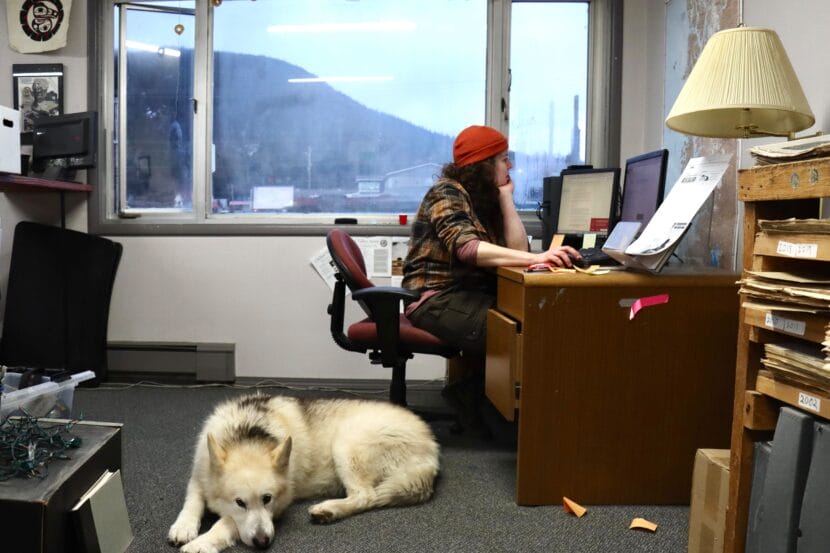
Chilkat Valley News owner Rashah McChesney sits in her office in Haines, along with her malamute, Klondike. (Photo by Avery Ellfeldt/KHNS)
Late one night in January, a reporter sat working on the floor of an orange building in Haines. The building is home to the small town’s police department, fire station and morgue – plus the borough assembly chambers, which are often packed with concerned citizens.
The journalist, Rashah McChesney, isn’t just a reporter. She also owns the local newspaper, the Chilkat Valley News. The weekly paper has a circulation of 1,200 during the summer and 1,000 in winter. About 2,500 people live in the Haines Borough.
McChesney was covering the local assembly meeting – and was one of the last people there. That meant she was standing by when a heated exchange broke out between two borough officials in the parking lot.
The next morning – McChesney’s deadline day – her malamute Klondike strutted around her office while she talked shop with a local reporter. The reporter asked how McChesney planned to describe the incident.
“Oh, I’m just going to say, ‘Shouted a string of obscenities at him in the parking lot,’” McChesney said. “Because print is boring.”
Be that as it may, print is what brought McChesney to Haines last April. She bought the paper after a decade in public radio, including several years at KTOO in Juneau.
McChesney made the move even as news organizations across Alaska and the U.S. increasingly struggle to stay afloat amid soaring costs, declining readership and the explosive rise of social media.
Just 15% of Americans say they’ve paid for local news in the last year, according to a recent survey by Pew Research Center. And of those who do get their news from daily newspapers, the vast majority access the content online.
The result: more than 3,200 print newspapers closed over the last two decades, according to a 2024 report by Northwestern University’s Local News Initiative.
One-hundred-and-thirty print newspapers shut down between October of 2023 and October of 2024 alone.
In Alaska, papers including the Anchorage Daily News, Juneau Empire, Peninsula Clarion and Homer News have scaled back printing, citing readers’ growing preference for reading the news online.
Which is why McChesney isn’t just focused on Haines. She also recently co-founded a nonprofit called The Alaska News Coalition — a group of publishers and journalists around the state working to help independent, local news organizations stay in business.
“By and large, there’s a lot of publishers who are experts at making papers, and who have struggled to modernize their organizations digitally,” McChesney said. “I feel like I am building a collaboration with a group of people who really want what they were doing successfully in print, to be successful in digital, and maybe don’t necessarily understand or have the capacity to do that.”
The effort got a big boost in October, when it received a $100,000 grant from Press Forward, a national news initiative funded by philanthropy organizations. The Alaska-based coalition pools resources and ideas and provides grants to newspapers to help them digitize their work and distribute news.
All of this might make McChesney, a 41-year-old millennial, seem like a bit of an anomaly. But she says she decided to go all-in on local news in Alaska for a simple reason.
“Communities want local news. That’s why we have public radio stations that work as well as they do,” she said. “I think there’s this sort of myth that a small-town paper is just sort of like a losing proposition. And I just — I don’t buy that.”
“Haines’s paper is doing fine. It’s not making a ton of money, I’m not making a ton of money. But this [community] has consistently financially supported its paper since it opened in 1966,” she added.
McChesney said it’s been exciting to work alongside publishers of other Alaskan papers, including the Wrangell Sentinel and the Ketchikan Daily News, to reduce the likelihood that any more communities will lose their newspapers.
It’s also difficult, given that McChesney runs a business and reports the news at the same time.
That work is made even more interesting by the place where it happens. Haines is known for being politically divided and highly engaged. McChesney thinks that can make reporting challenging. But she also thinks it’s indicative of something bigger.
“People don’t fight about stuff they don’t care about. The opposite of love is not hate. The opposite of love is indifference,” she said. “You can’t accuse this town of being indifferent.”
Owning a newspaper in small-town Alaska also means something else. At least in Haines, she can’t ever just be “Rashah.”
“I don’t get a lot of [taking]-my-newspaper-hat-off time. If I want to do that, I’d go out into the Porcupine District and run around with my dog,” she said. “But I think that’s sort of the pressure of being a small-town journalist in general.”
Close
Update notification options
Subscribe to notifications
Subscribe
Get notifications about news related to the topics you care about. You can unsubscribe anytime.