Southeast

Sitka’s top nutcracker collector hopes to crack open people’s childlike wonder

Jack Petersen poses with a portion of his nutcracker collection displayed at Wildflour Cafe and Bakery. (Ryan Cotter/KCAW)

As a well-known prop designer for community theater productions in Sitka, Jack Petersen is no stranger to construction. He holds up one of his proudest works, a wooden nutcracker adorned in a blue marching band uniform.

“As an artist, I do get very particular about…not just like the visual aesthetics, but also how things feel, how they sound and stuff, and I love how this one feels when it cracks a nut,” Petersen said. “For being the first Nutcracker that I kept myself, I am very proud of the construction.”

Reaching into a basket of walnuts, Petersen plucks one out and places it into the nutcracker’s mouth, preparing for a satisfying crack.

The first nutcracker Jack Petersen ever made stands proudly amongst other displayed nutcrackers in his collection. (Ryan Cotter/KCAW)

This nutcracker is the first of three that Petersen has made. They are part of his large nutcracker collection, which features over 130 nutcrackers. Since the beginning of the month, the majority of the nutcrackers in Petersen’s collection have been displayed at Wildflour Cafe and Bakery, where he serves as a year-round line cook. The nutcrackers are spread out across the restaurant in an array of sizes and materials, some made from various kinds of wood, and others from relatively unconventional materials like iron and brass. Their uniforms are adorned in details marking their country of origin, from Germany to Russia. Wreaths of fake pine boughs and Christmas lights wrap around the room, a playful reminder to patrons that the holiday season is upon us.

While many of them are displayed out in the open by Wildflour’s entrance, some of the nutcrackers have more cheeky hiding spots.

“I do like hiding the nutcrackers really high up on shelves, especially for kids who like to look around and stuff,” said Petersen. “I have nutcrackers hiding in the rafters in the bathroom by the salt shakers there. It is a wonderful little game of ‘I Spy’ for people who want to come in and look around.”

Petersen’s fascination with nutcrackers began when he was around three years old, when he saw a local production of the iconic ballet, you guessed it, The Nutcracker.

“It was just like something magical,” Petersen said. “I like the ideas of toys and dolls and things coming to life when we don’t see them and stuff.”

While many young audience members who attend the yearly production often walk away inspired to become ballerinas, the show took Petersen’s imagination in a different direction.

“This may seem silly, but I remember being a kid and wishing that I could crack a nut with a nutcracker and having daydreams of some whimsical Drosselmeyer figure of my own to [say] ‘Hello, young boy. Would you like to crack a nut?,’” said Petersen.

As his admiration for nutcrackers persisted over time, Petersen began the work of collecting them to fulfill his childhood dream.

“Eventually, when I became an adult with adult money, but none of the adult responsibility, I started looking online, reaching out, and started researching nutcrackers that could actually crack nuts, and one thing led to another, and we are now here,” he said.

A freshly cracked nut, with this nutcracker being one of three nutcrackers Jack Petersen made himself. (Ryan Cotter/KCAW)

When it comes to determining what nutcrackers to add to his collection, Petersen is drawn to those that have unique designs that resonate with his inner child.

“I really love finding the ones that are homemade, like they’re ones that individual people made, or smaller crafters, or some older oddities,” said Petersen. “I look for ones that look like they could have leapt off of the children’s books I used to read as a kid because I don’t know, there’s just something really magical about that.”

And it is that very magic that Petersen wishes to share with the community through displaying his collection at Wildflour.

“I love sharing my collection with people, and I specifically love being able to share nutcrackers that actually crack nuts, because it’s a very mundane thing, but it’s also not something that the average person gets to do in a lifetime,” he said. “And it’s a bit of holiday magic to be silly.”

Petersen’s nutcrackers will continue to be displayed up until Christmas, before being packed away once more as Wildflour begins renovations in January. In the meantime, Petersen hopes his collection can spread some Christmas cheer, and that he can maybe even help some folks crack a nut for the very first time, just like the nut-cracking mentor he dreamed of having as a child.

State to overhaul Southeast’s 20-year transportation plan

A small tent pitched on the deck of a ferry, with coastal mountains in the background.
The Alaska Marine Highway System’s mainliner, the Columbia, during its weekly sailing from Washington state to Skagway in early 2025. (Avery Ellfeldt/KHNS)

The state is in the early stages of crafting a new plan to guide decisions about Southeast Alaska transit for the next two decades.

The Alaska Department of Transportation and Public Facilities aims to draft a plan for Southeast by the end of summer 2026 and finalize it by this time next year. The document will cover all communities from Yakutat to Metlakatla.

Jill Melcher, DOT’s Southcoast planning chief, said the new version would mark the first complete overhaul in more than 20 years.

“The last adopted plan was in 2004 and an unofficial update was done in 2014 that captured changes over 10 years,” she said. “Our region has changed significantly since 2014, and it’s time for an update.”

Agency staff say that in the early stages, a handful of themes have already emerged. They range from ferry reliability to resiliency amid climate change.

Now the state is asking for public input, both via email and during town halls.

During two virtual open houses this week, residents raised a long list of specific projects and broader issues – many revolving around more reliable ferry service and the Cascade Point ferry terminal project.

Mike Jackson, in Kake, raised sporadic ferry service in his community. He said the state has said Kake rarely gets ferries, in part because the terminal can’t accommodate larger ships. He said there’s been talk about updating the terminal with new catwalks to change that.

“So that is one of the things we talked about doing here,” Jackson said. “But if there’s a way to better serve Kake somehow, we sure would appreciate it.”

Participants also talked about the need for float plane dock maintenance and more airport parking. One raised the need for restoring ferry service from Ketchikan to Prince Rupert, British Columbia – an idea the state is studying now.

Haines local Patty Brown asked about the state’s ongoing study of what it would cost to build a road on the west side of the Lynn Canal that would, at least in theory, better connect Haines and Skagway to Juneau. She wanted to know how that might be incorporated into the 20-year plan.

Southcoast Region Director Christopher Goins replied that the study would wrap up in January.

“Based on that, we’ll look at the data, work with this team and depending on what we see from leadership, include or not include that moving forward,” Goins said.

But it was a related project that kept coming up during the town hall: the Cascade Point ferry terminal. The state says building a new terminal north of Juneau would cut costs and ease travel between Haines, Skagway and the capital city.

The idea has drawn fire from residents in all three communities, who say the state should prioritize improving ferry service instead.

When Wendy Anderson of Skagway made that point in the town hall’s virtual chat, Goins responded that the agency does believe the terminal would reduce travel times. But he stressed that Cascade Point would not replace the Auke Bay terminal for most passengers.

“There will be mainline service that continues up once a week,” Goins said. “What is moving would be the trips to Haines and Skagway from Cascade Point.”

At least two other comments came in regarding Cascade Point. One dubbed the planned terminal a “shameful waste of taxpayer dollars” that would be “harmful” to the general public.

The other asked about the funding that has already been allocated to the project – and whether more will be set aside soon. Goins responded that the state currently has a design-build contract and is carrying out the required public comment and environmental processes.

“If we ultimately can’t make it through that process for various reasons, then the project would not go forward, and the second part of that contract would not be fulfilled. Plain and simple,” Goins said.

Agency staff and contractors thanked participants for their insight and encouraged the public to keep them coming. Comments can be submitted at SEATP@DOWL.com.

Haines writer nabs Rasmuson award for book about hope amid environmental collapse

Caroline Van Hemert, pictured above sailing in Canada's Northwest Territories as part of a larger trip with her family through the Northwest Passage. The journey will be featured in her upcoming book.
Caroline Van Hemert, pictured above sailing in Canada’s Northwest Territories as part of a larger trip with her family through the Northwest Passage. The journey will be featured in her upcoming book. (Patrick Farrell)

Three Haines artists were recently recognized by the Rasmuson Foundation, which announced its Individual Artist awardees earlier this month.

Shannon Kelly Donahue took home one of the $10,000 awards, which will help fund her work on a personal memoir that involves travel to Ireland. Andrea Nelson was another awardee. She’s building a collection of sculptural taxidermy to shed light on the northern fur trade.

Writer, biologist and part-time resident Caroline Van Hemert also took home an award. She recently finished sailing the Northwest Passage with her family, and the trip is among the adventures that will inform her new memoir, titled “Upwellings.” The book is about finding hope and joy in the natural world amid climate change and environmental collapse.

Van Hemert sat down with KHNS to talk about the $10,000 award and the project it will help fund.

This transcript has been edited for length and clarity.

Caroline Van Hemert: I’m working on a book project right now. So that’s what the Rasmuson specifically is helping to support. And it’s a combination of artist time, and I’ll be using some of my funds for some specific travel, hopefully doing a little bit more in Southeast Alaska, not too far from home. And then maybe make a trip up to the Arctic as well.

Avery Ellfeldt: You said the award is supporting specifically your new book. Could you tell us a little bit more about that? What’s it called? What’s the focus, and where are you at in that process right now?

CVH: It’s tentatively titled Upwellings, which actually comes from a moment when I was sitting at our cabin on Lynn Canal and looking out and watching a bunch of gulls beat up wind on a day probably very similar to what is happening now, with some fierce north winds, and trying to understand what they were doing and why they were doing it. And that led me into lots of other questions about the exceptions and extensions to the natural world that often get overlooked. And so the book is a memoir, but it’s kind of a collection of both home-based and travel-based pieces, really, each of them starting with a specific encounter with a wild species that then helps me contemplate bigger questions about climate change and also our relationship to the natural world.

AE: In the Rasmuson blurb about your award specifically, it says you’ll work on your memoir to confront the “collapse” you’ve observed by way of wildlife health research. Could you tell me a little bit more about that – what they might mean by collapse?

CVH: In terms of collapse, I’m referring to some of the ecological and environmental situations that have been unfolding. And I think it’s an alternative, again, to that, that narrative of gloom. We are so inundated with, you know, the story of the end of the world as we know it, which is not entirely untrue. But I think trying to draw on examples from the natural world of existing creativity and solutions and things that we don’t always think about when we look outside and see these massive changes.

AE: Has there been an example of collapse or change or shift that you’ve experienced and that’s made a large impact on you, or that you think has been particularly compelling or jarring to observe?

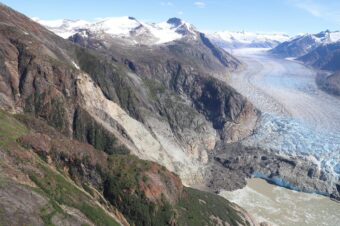
CVH: Where we live on Lynn Canal is very close to the Davidson Glacier. Anyone who spent any time in or around Haines knows that feature and knows how rapidly it’s changing. So it’s hard not to look at things like that and feel sort of the overwhelm of how rapidly our landscape is shifting.

Sometimes there’s a sense that you can almost run from the bad news by going to the places that we love. But I think this book has come about in part because there isn’t really a running from those experiences so much as trying to figure out, how do you grapple with them? And what are some of the ways that we can both acknowledge the state of change, but gather the joy and the wonder that I think ultimately motivates all of us to think differently, and maybe live differently, in a larger collective way.

Alaska studies building a ferry terminal at Hyder to connect to the road system

Hyder is marked in red, located about 70 miles up the Portland Canal.

The state of Alaska is considering opening up a new ferry terminal in Southeast Alaska, connecting Alaska’s ferries to the Lower 48 road system without going through Canada.

The idea comes as Alaska continues to struggle with the closure of the ferry terminal at Prince Rupert, British Columbia. Now, the state is conducting a $250,000 study to see if a terminal on Alaska’s side of the border would be a good replacement.

For decades, the Alaska Marine Highway System relied on a terminal at Prince Rupert as its southern road connection. The state has leased the terminal from Canada since 2013, but it’s been closed for most of the past six years. There are numerous complications, like infrastructure challenges and disagreements with Canada over border control responsibilities. The dock needs over $20 million in repairs, and Alaska’s aging fleet isn’t certified for international travel anymore.

Jim Clark spoke about it at a regional development meeting in Ketchikan last year. He’s the former chief of staff for Governor Frank Murkowski, who worked on the ferry system for decades.

“If we can put a man on the moon, we ought to be able to solve the problem between here and 90 miles away at Prince Rupert,” Clark said.

Prince Rupert’s closed terminal has been a hot topic in many southern Southeast meetings. Some, like Robert Venables of the Southeast Conference, say they’re not ready to give up on Prince Rupert.

“It’s going to take everyone to lean into this thing,” Venables said. “It is problematic at the highest levels of bureaucracies to try to get back to Prince Rupert. But we’re going to give it our best, best push, and we’re going to keep pushing until it happens.”

The Prince Rupert connection isn’t completely off the table. But Alaska would need a federal waiver to bypass a requirement that steel materials for repairs be American-made. The state has requested this waiver in recent years without success. Canadian officials have opposed the requirement because the terminal is on Canadian soil.

And so, the state’s Department of Transportation has considered Hyder, Alaska — about 90 miles from Ketchikan — as an alternative.

“Fortunately, we have a lot of data for this site,” said Kirk Miller, an engineer with the state’s Department of Transportation, last year. “We’ve done engineering up and down this whole Causeway, the island, I’ve been working on their harbor and all these projects there for years. So, we have data, but not quite enough.”

This October, a new feasibility study began and is expected to be completed in mid-2026. The study is looking at all the details, like where a dock would go, the water depths, dredging, and environmental concerns.

It’s estimated the new terminal would cost about $30 million. It’s located about the same distance to Seattle as Prince Rupert – about 1,000 road miles. Prince Rupert is much larger than Hyder and has more amenities, but Hyder would be under Alaska’s control.

“I just want to really voice my support for Hyder,” said Bob Horchover, speaking in July as a member of the Alaska Marine Highway Operations Board, which makes recommendations to the state.

“In Hyder, we own the land, and most of the work is already done,” he said. “It’s a very adaptable situation. So, for me, there isn’t even a discussion.”

The state approved a 20-year ferry plan this year, based, in part, on a survey of over 2,500 Alaskans. Many respondents said restoring a road connection in Southeast was a priority.

Local governments agree. The Ketchikan Gateway Borough passed a resolution supporting a Hyder terminal if Prince Rupert doesn’t work out. Nearby Metlakatla feels the same. Mayor Albert Smith said that the lack of a Prince Rupert connection has hurt his town’s economy.

“With fishing, the rail system is real close to Rupert, so we could use the ferry to transport fish, and then it’s connected right to the 48s,” Smith said. “It’s a more efficient way than other ways of shipping.”

At least one Alaska lawmaker is on board: Republican Representative Jeremy Bynum of Ketchikan.

“I’m going to be a fierce fighter here on the legislative side and make sure we can get the funding in place that we need,” he said.

Whether Alaska rebuilds the Prince Rupert connection or builds a new terminal at Hyder, officials say either option would take five to eight years to complete the necessary infrastructure work.

Congress approves reauthorization of Secure Rural Schools funding

Secure Rural Schools payments go to municipalities with large amounts of untaxed federal land — including those near the Tongass National Forest and the Chugach National Forest. (Sydney Dauphinais/KRBD)

Congress approved critical funding for rural schools Tuesday night with the Secure Rural Schools Reauthorization Act.

More than $12 million is set aside for Alaskan communities affected by the decline of the timber industry. That money goes to districts with large amounts of untaxed federal land, and is distributed in annual payments to rural boroughs and school districts — including those near the Tongass National Forest in Southeast and the Chugach near Prince William Sound.

“We had a big success,” said Rep. Jeremy Bynum (R-Ketchikan). “The legislature spoke with a unified voice that Secure Rural Schools needed to be reauthorized.”

Bynum sponsored a resolution earlier this year to renew and permanently reinstate the program. He said when the funding lapsed the past two years, those smaller rural communities felt the impact.

“We absolutely noticed that not having that funding available put an immediate pressure on, how do we backfill that funding?” he said.

In Ketchikan, the annual payments go to the borough and typically end up being between $1 million to $1.5 million. In smaller communities, like Wrangell, those payments end up being a big portion of their school budget.

The Secure Rural Schools Act initially passed in 2000 in response to the decline of the timber industry. But that funding lapsed at the end of the 2023 fiscal year. With overwhelming bipartisan support, the U.S. House of Representatives voted to reauthorize that program through September of 2026, including two years worth of back-pay.

Bynum says he knows this reauthorization isn’t a permanent fix, and that it will take work to find other ways to fill that gap and be less reliant on Secure Rural Schools funds.

“What I don’t want to have happen is I don’t want to end up in a situation where we let it lapse again, and then we’re really kind of scrambling to figure out how to effectively do the backfill for for our school funding,” he said.

Bynum says there has been discussion of filling that financial gap with longer-term logging contracts, but he doesn’t believe that will be close to enough. He says those logging contracts aren’t long enough to see forest industries revitalized.

The federal payment amounts are decided by how much money each community would have made in the height of the logging industry.

For rural municipalities that have counted on this funding for over 20 years, losing it has been a big financial blow.

In Ketchikan, Secure Rural Schools money goes directly into the Local Education Fund, a borough-managed account that funds schools and is primarily paid for with property taxes. There’s a $2 million floor for the Local Education Fund that, without a supermajority vote from the assembly, the borough’s required to stay above.

Charlanne Thomas, the finance director for the Ketchikan Gateway Borough, said that without the Secure Rural Schools money, the account went below the $2 million floor.

She says without those payments, they might have to pull from the borough’s general fund.

“So if we end up in a shortage in the Local Education Fund, it could result in property taxes being raised to make up the difference or supplementing it from the general fund, which could affect the sales tax needing to be increased,” Thomas said. “So it kind of has a domino effect. If one is shorted, it would definitely affect the other fund.”

The Secure Rural Schools Reauthorization Act now heads to the president’s desk. It is unclear when that will happen. Once it is signed into law, payments are expected to be distributed within 45 days.

Rare birds in Sitka spark excitement ahead of annual count

A Dickcissel spotted in Sitka in mid-November (Marc Kramer/Birding By Bus)

Two different birds rarely seen in Sitka and much of Alaska showed up in Southeast last month. As KCAW’s Katherine Rose reports, it was exciting news for birders leading into a big month for our feathered friends–the Audubon Society’s annual Christmas Bird Count.

In mid-November, the arrival of two rare birds in Sitka caught the attention of birders from around the state. Local naturalist Matt Goff said his son, a fellow naturalist, spotted them back-to-back.

“My son got ambitious about feeding birds this fall again, so [he’s] been putting out a lot of bird food, and he noticed a Harris’s sparrow in the yard, which is a bird that we’ve been looking for for a while,” Goff said.

The small brown sparrow breeds in the boreal forest of Northern Canada, but typically winters in the lower Midwest. Goff had never seen a Harris’s Sparrow in Sitka- the bird was last spotted here in the 1990s.

Just minutes later, his son spotted a second bird.

“About a half hour later, he’s like, ‘There’s another unusual bird in the in the yard,’” Goff recalls. “And he says, ‘I think I remember what it is. I can’t remember its name, but it’s like, it begins with a D, and it’s rare,’ and I said, ‘Is it a Dickcissel? And he said, ‘Yeah, that’s what it was.’”

The Dickcissel was even more unusual. Goff said the midwestern bird that winters in South America was last spotted in Juneau in 2004, and the Sitka sighting is the third on record for Alaska. Its arrival was so unexpected, it brought even more out-of-town visitors. Goff said after he posted about the sightings to the Alaska Rare Birds Facebook group, several birders from Anchorage flew down too…by plane, of course.

“There’s folks that keep track of a list, their Alaska State list, how many birds they’ve seen in the state. Some of these folks have well over 300 species. One of the people that came had over 400 species,” Goff said. “And it’s pretty difficult for them to get new birds these days, because they’ve seen most of them.”

View the group’s eBird checklist to see the birds they spotted on their Sitka visit

For some it wasn’t their first stop- one drove over five hours from Anchorage to Valdez the day before to see a Broad-winged hawk, the first spotted in Alaska.

“Some of us are mad travelers when it comes to birds,” Goff said. “Especially unusual birds.”

While the Dickcissel hasn’t been seen since late November, Goff said it’s possible the Harris’s Sparrow will stick around for the winter. If it does, it could be counted as part of the Audubon Society’s Christmas Bird Count. Victoria Vosburg is a retired Alaska Raptor Center veterinarian, and she said it’s the country’s longest running citizen science initiative.

“Way back in the beginning, people on Christmas Day used to get together and hunt. They called it a ‘side hunt,’ and it was a competition to see who could kill the most living things,” Vosburg said. “So it wasn’t just birds, it was killing everything. And then some people decided, ‘Let’s do something different. Let’s just count birds, instead of kill them.’”

For more than a century, the Christmas Bird Count has documented population declines and recoveries of all types of bird species, and the data collected during the count has influenced policy and conservation efforts. Sitkans began participating in the 1970s, and in just the past couple of decades, Vosburg said they’ve observed a lot.

“I started running the bird count about 20 years ago, and just since I started doing that, we’ve seen swans come back to town. We’ve seen Anna’s hummingbird start spending the winter,” Vosburg said. “We’ve seen Eurasian collared doves come to town, population explosions, disappear, and now we’re watching them on the rise again.”

Sitka’s Christmas Bird Count is December 20, and there are a number of ways to get involved. But if you’re looking to see a Dickcissel or a Harris’s Sparrow, it’ll be a lucky break. Only one of each was spotted. Goff said that’s often the case with lost birds.

“I think there’s some speculation that what might happen, in part, is their internal compass, so to speak, might be off 180 degrees or 90 degrees, or something like that, and they just go the wrong way because they orient differently,” Goff said. “Then they end up someplace that is not at all what their, sort of, biological systems are expecting.”

Goff said lost birds often look for the birds that are local and “in the know” to find food and sometimes they settle in for the winter. Sometimes not. But even if participants at the Christmas Bird Count don’t spot one of the rare birds, there are plenty of other bird species that are counting on being counted.

Site notifications
Update notification options
Subscribe to notifications