Southwest

Next generation takes over fishing in Ekuk

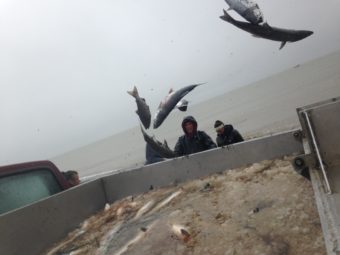
Ani White pulls the net out of the water with her truck as her siblings start to pick out the fish. (Photo by Matt Martin/KDLG)
Ani White pulls the net out of the water with her truck as her siblings start to pick out the fish.
(Photo by Matt Martin/KDLG)

During the summer, the population of Bristol Bay explodes with people from all over the world. They’re looking to play a part in the largest sockeye return in the world. Many of these strangers crew on drift boats or work at a cannery. But there is one beach in the Nushagak Bay that remains a home to local family operations.

Ani White sprinkles rosemary, among other spices, over two whole chickens. She’s preparing dinner for her fishing crew. They’re all taking a quick nap before it’s time to pick the nets again.

“We eat pretty good around here. I like to cook, definitely,” said Ani.

Along with the chicken, fresh green salad and corn on the cob (is) the menu. Ani prepares the meal in one of the half dozen cabins her family owns on Ekuk beach. About 20 other families have similar cabins all along the beach.

There are a few close friends that fish along with Ani but it’s mostly a family operation. Ani is in her midtwenties and lives in Anchorage now but says it’s like a family reunion each summer at the small fish camp.

“During the year, we’re all at different places going to school and so we usually only come together at Thanksgiving, Christmas and then of course, in the summertime for Ekuk and fishing,” said Ani.

An American flag dons a fish camp cabin on Ekuk beach. (Photo by Matt Martin/KDLG)

Ani is the oldest child and has kind of taken over as head of the camp. Her father, John Bouker, is a pilot in Dillingham. He’s been fishing since the 70s but now that his children are older, for the most part, he lets them do all the work.

“My wife and I keep none of the money. It’s all for these kid’s college and their endeavors,” explained Bouker.

He flew over from Dillingham earlier in the day to drop off some supplies and fix the fridge. He says fishing on Ekuk is unique for Bristol Bay. With satellite TV and nightly steam baths, he says the fishing here is like a vacation, not really work.

“Out here you throw your net out like you see out front, we’re not sitting out in a boat beating around out there,” said Bouker. “Look at those boats beating around out there. That look like any fun? No, I did that when I was a kid, that’s no fun. Those guys ain’t having no fun.”

Ani leaves the chicken in the oven to cook. The tide is on the way out and it’s time to pull the nets. Heavy wind and rains greet this fishing family as they leave their cabins to retrieve their nets from the bay.

While most fishing in Bristol Bay involves around pulling a net over the stern or bow of a boat … Things are done differently here on Ekuk, no boats needed on this beach. A highway of trucks and four-wheelers move up and down the beach. Unlike set net sites on other beaches in Bristol Bay, the fisherman in Ekuk use pickup trucks and a pulley system to drag their nets up out of the water.

“Nikki, help Johna when it’s down here,” said Ani, directing the work from her truck. “She needs help. Somebody, one person.”

Fish picked out of the net find their way to the ice slush in the back of the truck. The crew then delivers the catch to the cannery down the beach. (Photo by Matt Martin/KDLG)
Fish picked out of the net find their way to the ice slush in the back of the truck. The crew then delivers the catch to the cannery down the beach.
(Photo by Matt Martin/KDLG)

Once the net is attached to the winch on the front of the truck it begins to back up and the net slowly slides out of the water. The beds of the trucks have to all be modified to hold a slush of sea water and ice. Their catch goes into that icy brine, and they drive it up to the cannery about a mile down the beach.

Like a lot of fisherman, Ani thought the season was going to be a dud but the late push changed that. She says this time last year they had already packed up all their gear.

“Yeah, we thought we weren’t going to get any fish and here we’re on more fish then we got last season so pretty happy about that,” said Ani.

With fishing out of the way, it’s time to eat that chicken.

“Oh yeah!” exclaimed Ani’s other sister, Nia Bouker, at the sight of the chicken.

“We don’t know if we eat better or if it just tastes better because we work all day,” said Nia.

John Bouker believes having his children do this work is about more than just fish or money. He says the summer fishing work has taught his children discipline and how to plan for the future.

“People don’t think about looking into the future,” said Bouker. “No plan. No plan you might as well be a piece of drift wood drifting around out in the bay. You don’t have a clue we’re you’re going. You’re taken where the current and the wind are going to take you. So you got to have a plan for your children, you know.”

Ani White has a plan. She plans on being back at Ekuk beach each and every summer.

“As long as there is fish, as long as the cannery is open, as long as there is some to buy my fish, I am going to be down here,” said Ani. “So definitely a lifelong Ekuk resident.”

After dinner, the crew heads off to the steam baths before bed. The tide turns early in the morning and another day of fishing will begin.

Ekuk direct marketer cuts up a ‘butterfly fillet’

Friedman Family Fishery in Ekuk, south of Dillingham, may be the only processor in Alaska marketing butterfly salmon fillets. (Photo by Matt Martin/KDLG)

Small independent processors and direct marketing of sockeye is a growing trend among fisherman in Bristol Bay. One such business in Ekuk has a new take on the traditional frozen fillet. The Friedman Family Fishery is one of the few, if not the only, processor bringing a butterfly fillet to market.

Friedman has been fishing in Ekuk since 1989, twenty years ago he bought some property in the summer time fishing village and started a processing operation.

“It’s a really good thing I can realize full value of these fish by selling them to the public,” said Friedman.

Friedman started by taking only 100 pounds of fish back to his home in Baltimore in 1995 as an experiment and with that the Friedman Family Fishery was born. And Friedman says the business has taken off solely by word of mouth since then. This year he plans to send home 8500 pounds. Among the traditional salmon fillets, Friedman is packing up a more usually cut. He calls it the butterfly fillet.

To make a butterfly, take a regular fillet, make two diagonal cuts and then cut underneath those cuts so it comes off as one piece. Open up the flaps and you have a semi-round butterfly shaped chunk of meat.

“Which I think is a cool look when you put it on a plate next to some veggies or any other dish that you’re servicing,” said Devin Darrough, who cuts the butterfly fillet for Friedman. Darrough has been commercial fishing on Ekuk beach with his family since he was a child and introduced the butterfly cut to Avi. Darrough says he learned it from his father.

“Who he learned from his father Bob. And it is claimed that he come up with it but we think he got it from somebody else. But we give grandpa credit for the butterfly fillet,” explained Darrough.

These two master filleters met up when Darrough started dating Friedman’s daughter and now the family tradition of the butterfly cut has made into the list of produces Friedman will be selling to his east coast customers this year.

“I’ve never seen it on the market. I’ve only known about it because our family has done it and now Avi is selling it. So he’s the only one that I know of who actually sells it,” said Darrough.

Darrough says it’s his favorite was to eat salmon.

“I personally like to fry it up. I like to get it crispy. It cooks really (quickly) because it’s a thinner piece of meat,” said Darrough.

Friedman believes the butterfly will be popular with his clients. He says it’s an easy way to just have a single serving, something many of his customers are looking for.

Alaska Supreme Court upholds superior court ruling against ‘Save Our Salmon’ Initiative

Bristol Bay Watershed. (Map courtesy EPA)

In a ruling issued Friday, the Alaska Supreme Court upheld the overturning of the Save Our Salmon initiative.

Save Our Salmon was adopted by a narrow vote in the Lake and Peninsula Borough in 2011. It established a borough permitting process to develop a mine like Pebble. Its sponsors believed it would not only add a layer of protection against Pebble but perhaps preempt the mine developers investing further in the project since that permit would be all but impossible to obtain.

Save our Salmon was challenged in court by Pebble and the State of Alaska in separate lawsuits which were later joined. In March 2014, Superior Court Judge John Suddock ruled in their favor, striking down the initiative, saying it superseded the state’s natural resources permitting authority under the constitution.

The ballot sponsors, George Jacko and Jackie Hobson, who were backed financially by Bob Gilliam, appealed the ruling to the Supreme Court. On Friday, the court issued a 20-page opinion siding with Suddock that Save Our Salmon was not lawful and leaving it overturned.

Invasive doves reach King Salmon

Two Eurasian Collared Doves perching on a balcony and about to take flight. (Creative Commons photo by Horia Varlan)
Two Eurasian collared doves perching on a balcony and about to take flight. (Creative Commons photo by Horia Varlan)

An invasive species of dove was spotted in King Salmon Tuesday afternoon. It’s the farthest west the Eurasian collared dove has been found in the U.S.

Matthew McFarland was working outside of the inn he co-owns when he heard a whistling from the porch behind him.

“And I heard that noise, that distinctive noise that doves make. So I said ‘Oh, it’s just a dove!’ But then I thought to myself, ‘Well, we don’t have doves here,’” McFarland says.

McFarland thought he must be mistaken. But his cousin, who was working nearby, heard it too.

“He poked his head around the corner out and asked if we have doves here. I said, no, we don’t have doves here at all! And he said ‘Well, that was a dove!’ So we went around the house and it had flown up and landed on one of the power lines.”

McFarland quickly took a few photos. It was a gray dove, with a big black band across the back of its neck and a straight edge on the bottom of its tail.

He was pretty sure he knew what kind of dove this was – he’d seen them when he lived in Arizona – but he called Stuart Fety, a biological technician with Fish and Wildlife in King Salmon.

“It was in fact a Eurasian collared dove, surprisingly enough,” Fety says.

He says this particular species has a long history of moving in where it shouldn’t. It’s native to Europe and Asia, but first became established in the U.S. in 1982 after escaping a pet shop in Florida, Fety says.

“And they were first seen in Alaska in 2009 along the Denali Highway… and they’ve kinda rapidly expanded their range,” he says.

Until now, the furthest west the dove had been seen was in Homer, a few weeks ago.

So how can these doves thrive in habitats ranging from Florida to Alaska? Fety says they’re just really good at finding a niche wherever humans live.

“They’re well adapted to utilizing food put out by people in their feeders and just utilizing resources around urban or developed areas,” he says.

Fety says Fish and Wildlife isn’t too worried about the dove.  Unlike some invasive species, such as Chena Slough elodea or Adak Island rats, he says the Eurasian collared dove doesn’t really threaten native wildlife, and he was planning on leaving it alone.

As many Lower 48 hunters will attest, doves are quite a tasty prey. Whether this dove is a lone wanderer, or a forerunner for a whole new population, birdwatchers in Bristol Bay can keep an eye, an ear, and maybe a shotgun out for this unique visitor.

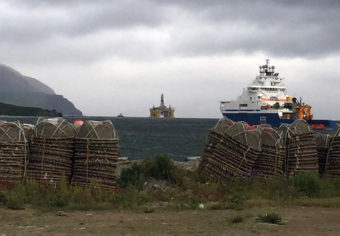
Shell rigs leave Dutch Harbor for Chukchi, to wait

MV Fennica. (Photo courtesy of Shell)

Shell is still moving its ships and equipment into the Arctic, even as one of its icebreakers prepares to head back south for repairs. The unexpected crack in the hull of the ship called the Fennica has added a measure of uncertainty to the start of the short Arctic drilling season.

This week both of Shell’s Arctic drill rigs, the Noble Discoverer and the Polar Pioneer, left Dutch Harbor to begin the thousand-mile trip to the Chukchi Sea. Shell Spokeswoman Megan Baldino says the plan, for now, is to get there and wait.

“The rigs, with their associated support vessels, will connect to several anchors that were recently staged over Shell’s Chukchi prospect,” she said.

Shell is waiting for the Bureau of Safety and Environmental Enforcement to decide on the last permits the company needs, the applications to drill. Now that the Fennica is out of the picture for an unknown period, the wait is a bit more fraught. The ship is one of Shell’s ice handlers. It also carries the capping stack, a key piece of response equipment if there’s a blowout. Baldino says federal regulators will decide how much work Shell can do in the absence of the icebreaker.

“It’s our view that drilling can proceed, so in other words we would begin a top hole,” she said, referring to a partial well that stops above the petroleum layer.” But of course we’re going to comply with our permits, and work within the framework of our permits.”

Ten environmental groups have written a joint letter to the Interior Department, saying Shell shouldn’t be allowed to conduct any exploration in the Chukchi without the Fennica.

“All of the plans that Shell submitted and the government approved are premised on the availability of two primary icebreakers to protect the fleet,” said Michael LeVine, Juneau-based Pacific senior counsel for Oceana. “The Fennica is one of them, and the government can’t grant approval to Shell to operate without both icebreakers in the Chukchi Sea.”

LeVine also says the accident that damaged the Fennica shows Shell is taking unnecessary risks. But as Shell describes it, the short trip on July 3 from Dutch Harbor to the location where the damage occurred does not sound inherently risky. The company says the Fennica was in charted waters with a marine pilot on board when the hull struck something that just wasn’t on the chart.

LeVine, though, claims the leased ship was traveling in shallower waters than it had to.

“The choice may have been made by a contractor or a pilot but ultimately those contractors are working for Shell, and it’s Shell that bears responsibility for making sure that all of its operations are safe and responsible,” he said.

The last time Shell drilled off Alaska’s shores, in 2012, one of its rigs ran aground, capping a series of other mishaps. LeVine notes that federal investigators faulted Shell then for failing to see and mitigate risk, and for not properly overseeing the actions of its contractors.

Greg Julian, press secretary for the Bureau of Safety and Environmental Enforcement, says it’s not clear yet when the agency will decide on the applications to drill or how the missing icebreaker affects the plan.

“We’re still evaluating what might be possible for Shell to do until the Fennica can return and at this point it’s not yet determined,” he said.

He said BSEE Alaska Region Director Mark Fesmire flew to Dutch Harbor last week to inspect the capping stack aboard the Fennica and found it is undamaged.

President Obama may visit rural Alaska this year, Dillingham on the shortlist

President Barack Obama. (Creative Commons photo by mikebrice)

A team from the White House will be in Dillingham this Thursday and Friday to check out the town ahead of a possible visit by President Obama later this year.

“We were contacted by some Washington staffers to tell us that it’s possible the president would make a trip to Alaska sometime in the late summer or fall, and that it’s also possible that he might visit some rural communities, and Dillingham had made the list of those communities,” says Alice Ruby, mayor of Dillingham. “So a pre-advance team would visit and look at different facilities and meetings and so on.”

Ruby says the team will visit various facilities, including the airport, the hospital, the school and the campus.

Ruby says she thinks Dillingham may be one of several Alaskan communities receiving such a visit this summer.

A White House representative said they have no official details to share at this time.

Site notifications
Update notification options
Subscribe to notifications