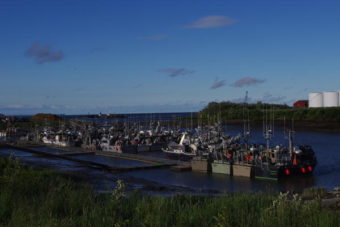
Russian Orthodox and Old Believer boats lined up in the Dillingham boat harbor. (Photo by Molly Dischner/KDLG)
Even in the midst of an opener, with fish running, many Russian Orthodox crews place faith over fish. The colorful boats with the distinct dark tinted windows of the orthodox fleet are easy to spot in the harbor. They are taking a rest day to celebrate a religious holiday to remember the lives and sacrifice of Saints Peter and Paul.
Dennis Hannon sports the traditionally untrimmed beard most Russian Orthodox men wear. He fishes on the F/V Cruiser. He says in the Orthodox tradition, Sundays and holy days shouldn’t be used to make money.
“There are a lot of people that could use the extra pounds or the extra money but at the same time it will all come back to you in the end if, I guess, you believe,” Hannon says.
Hannon is up from Oregon for the season. Interwoven with the religious reasons is the desire to keep the Orthodox culture strong. He says a lot of the culture is already lost; this is one way to hang on.
“Being in the states you are exposed to so much of a different lifestyle … slowly religion would be lost,” Hannon says.
Most of the Orthodox men fish for Icicle Seafoods. Angela Christensen is the office manager for Icicle in Dillingham. She says the company doesn’t treat the Russians any different then say, the Seventh Day Adventists when they take Saturdays off. She says it just takes a little extra planning.
“We just make sure our tenders are well fueled,” Christensen says. “We usually have an extra, or just have a service tender standing by for just the extra traffic for when they come in and leave.”
Hannon and the rest of the crew on the Cruiser may not fish on religious holidays, but they’ll be ready to get the nets out again at midnight.
Chinook salmon, otherwise known as a king. (Photo courtesy U.S. Fish and Wildlife Service)
The Nushagak River is becoming one of Alaska’s premier destinations for king salmon sport fishermen. The king return to the Nushagak is proving stronger this year than last, and Fish and Game says they’re on track to meet the escapement goal. Sport fishing guides say the angling has only been average.
Years of experience has taught Nanci Morris Lyon that sweet spot for catching kings is a water temperature right between 52 and 54 degrees.
But hot weather in Bristol Bay has put the water temperatures well into the 60s.
“Between that and the bright light that tends to make all fish head to the bottom it’s definitely had an effect, I feel it’s had an major effect on what we’ve seen as far as the king catch this year.”
Lyon is the managing partner of the Bear Trail Lodge in King Salmon.
Her clients pay big money to catch kings on the Nushagak, one of the best king producing river in the world. Fish and Game manages to put 95,000 kings in the Nushagak River, and is on track to meet that goal this year. But that hasn’t translated into anglers landing kings in regular numbers.
“You know, we’ve been catching a lot more of the smaller fish. And for the numbers that they are seeing in the return at the sonar counter, we’re not seeing that kind of numbers, in relative percentages to past years, in the boat. So we are definitely not catching what I would say is a normal catch for sport fisherman.”
Matt Norman, manager of King Salmon Lodge, has been seeing the few bites from kings as well. He says a recent corporate group fishing for kings was less than satisfied.
“Boy, it was a real bust. We have 22 guests and I think if we caught three kings out of 22 people it was a good day.”
Norman says after that trip the organizer of the group told him that they loved the lodge and the food was great.
“But if we want to stand and not catch fish, we can do that on the Kenai without the airfare to King Salmon.”
That’s why Norman says he’s starting to book more guests to fish for silvers later in the season.
“August, knock on wood, has been a really good month. The last part of July through August for silvers has been pretty steady out here.”
He’s alright rebooked that corporate group to come back next August to fish for silvers instead of kings.
But Nanci Morris Lyon isn’t giving up on the Nushagak king run.
“These things are all very cyclical. So I am rather reluctant to say that I feel like it’s a doomed fishery or that we are seeing the end of it.”
Lyon says the Nushagak is a long ways from becoming like the poor king run on the Kenai.
“But I think it is something that needs to be watched. I think we need to be very conscientious and watch and see what our numbers do on some of our years that have more norms for the temperatures and weather, rather than this year.”
Lyon describes herself as an eternal optimist, which she says is a requirement to be a successful fishing guide. Her lines are cast for next year.
Canned Alaska salmon. (Creative Commons photo courtesy of cookbookoman17)
In 2013, 38 percent of the salmon coming out of the bay was put into cans. But they aren’t flying off the shelves. Marketer Craig Caryl is working with the Alaska Seafood Marketing Institute to change that.
“I think that canned salmon needs to be positioned with blueberries, literally, as a superfood,” Caryl said.
He’s not the only one who wants to see resurgence in canned salmon.
“Brings tears to my eyes because it’s such a, it’s an old business but it’s such a staple business,” said Eric Weiss, who sells tin to canneries throughout Alaska, including some in Naknek. “And people need to eat more canned salmon.”
Weiss works for Crown Cork N Seal, which has worked on developing new, smaller cans that he thinks are more appealing to consumers.
“We’ve actually introduced a new smaller size to the industry,” Weiss said. “It’s about the size of, the height of a quarter pound can and then the diameter of a half-pound can.”
But Weiss says there are challenges in getting that new can sold – from inefficiencies for processors in filling smaller cans, to convincing stores to sell them.
Caryl is trying to increase demand. His target audience is millennial women, particularly pregnant women and new moms who might be interested in the health benefits of a can of fish, and also appreciate the sustainability of Alaska’s fisheries.
Caryl’s wife is an integral part of that effort.
“My wife has been developing these amazing salmon burgers, with like a caper lemon sauce that she mixes up. And the big test for us is will our six year old son eat it? My six-year-old is pretty picky and he really digs these salmon burgers.”
Caryl hopes that a website with 30 or so recipes tested by his wife will hit home with the mommy bloggers who can spur purchases and eventually help salmon capture a little of the tuna market.
“It’s changing people’s perception about them and driving the consumer into the shop and forcing the shop to say ‘hey, you know, we gotta move this off the bottom shelf and put this four feet high so people can see it.'”
Alutiiq Pride Shellfish Hatchery in Seward. (Photo courtesy of Wiley Evans/NOAA)
New research paints an unsettling picture of the future of shellfish in coastal Alaska. The effects of ocean acidification are worsening and could mean the end of hatcheries in the next 25 years if costly mitigation efforts aren’t put in place.
2040: that’s the date put forward by researchers in the ongoing study.
“It is dire,” says Wiley Evans, research associate at the NOAA Pacific Marine Environment Lab in Seattle and the University of Alaska Fairbanks Ocean Acidification Research Center.
He led the project, based at the Alutiiq Pride Hatchery on the Kenai Peninsula. Right now, the hatchery has only a 5-month window where ocean conditions are right for production.
“You know, I have young children and when I’m talking to the public about this, I typically will say that my kids are going to be graduating college when this optimal growth window potentially closes for the Alutiiq Pride Shellfish Hatchery,” says Evans.
“It was very, very alarming. Not knowing much about ocean chemistry, I know a lot more now than when we started, that’s for sure,” says Jeff Hetrick, owner of Alutiiq Pride, which is situated at the head of Resurrection Bay in Seward. “Right now we have blue and red king crab, roughly 6 million sea cucumbers, 2 million cockles, 7 million little neck clams, 100,000 butter clams, roughly 300,000 purple-hinge rock scallops, abalone as well, and we have oysters and geoducks, too.”
It’s currently the only full-time commercial shellfish hatchery in the state, with on-site personnel, which made it a logical choice for data collection.
“We had the opportunity last year to install a state-of-the-art system that could monitor the water chemistry of the seawater that they were pumping in to the hatchery on a continuous basis and it would report out to us in what we call real-time,” says Jeremy Mathis, a NOAA oceanographer who helped choose the site.
Ocean acidification is the name for certain changes in the ocean’s chemistry due to higher levels of carbon dioxide. When seawater absorbs CO2, there’s an increase in hydrogen ions, leading to more acidic water, and lower levels of carbonate ions.
Carbonate ions are crucial for organisms like clams and mussels to develop hard shells. And, without shells, they aren’t protected and can’t survive.
Mathis says Resurrection Bay is in a particularly vulnerable position because of certain environmental factors.
“It gets a lot of freshwater input from not only the streams and little freshwater runoffs that come through there but also quite a bit of meltwater from glaciers. And that unique water chemistry can actually exacerbate or worsen the ocean acidification effect,” says Mathis.
Cold water, which is quicker to absorb CO2, combined with the presence CO2-rich glacial melt put Alaska as a whole at particular risk. Evans says those factors are natural and it’s a delicate balance. But as for the levels we’re seeing here now-
“It’s not natural and it’s a large problem,” says Evans.
Humans and their carbon footprint have added serious amounts of CO2 to the atmosphere very quickly.
“And that little bit of additional carbon dioxide can just push the system past thresholds to where you can’t produce shellfish perhaps anymore without very serious mitigation strategies,” says Evans.
That’s what worries Hetrick when he thinks about the future and the 5-month production window at his hatchery that’s on track to close completely in 25 years.
“We don’t really know what the full costs are going to be. There’s going to be some. There’s going to be capital costs and there’s going to be some operational costs. It’s just going to be another thing we’re going to have to do to produce shellfish.”
Figuring out exactly what to do next is tricky but Mathis says Alaska has to put in the effort, immediately.
“Unfortunately, Alaska is the canary in the coal mine for ocean acidification. We’re seeing changes in water chemistry faster in Alaska than really any other place around the world. So, it’s our job now in the next few years to figure out what the magnitude and impact of those changes are going to be.”
And he says find a way to protect our fisheries before it’s too late.
The first of 60 reindeer arrived in Port Heiden last week. The Native village is working to re-establish traditional reindeer herding in the community. (Photo courtesy of Village of Port Heiden)
The first of 60 reindeer began arriving in Port Heiden last week after a several month delay.
Adrianne Christiansen is the business development director for the Native Village of Port Heiden which has been working to reinstate a long-dormant tradition of reindeer herding. She said the reindeer began arriving Friday via charter plane from Stebbins/St. Michael’s.
“And we are really excited to re-establish reindeer herding in Port Heiden,” says Christiansen.
It’s going to be a big community learning experience, says Christiansen. For the next three months, an experienced herder will stay in Port Heiden to teach everyone about the reindeer.
“We have a pen built for them, and we have a traditional reindeer herder down to train our young people to learn how to herd reindeer … so they’ll be in the pen until we all learn how to herd the reindeer.”
Christiansen says about 100 community members, including 30 school-age children, will be trained.
Once the herd is well-established in the area, the community plans to harvest some for food. Christiansen says that may be four or five years down the road.
The Minidoka internment camp was hastily erected in 1942 on a stark, sagebrush plain near Twin Falls, Idaho. (Photo by Tom Banse/Northwest News Network)
OLYMPUS DIGITAL CAMERA
A panorama view of the Minidoka War Relocation Authority center in 1942. This view taken from the top of the water tower at the east end of the Center, shows partially completed barracks. (Photo courtesy of U.S. Department of the Interior)
A view of the Minidoka internment camp's flimsy, tar-papered housing barracks. (Photo courtesy of U.S. Department of the Interior)
Baggage, belonging to incarcerees arriving from an assembly center at Puyallup, Washington, is sorted and trucked to barracks at the Minidoka internment camp in 1942. (Photo courtesy of U.S. Department of the Interior)
Living witnesses to the forced relocation of West Coast Japanese-Americans during World War Two are growing fewer every year. Many who were incarcerated are in their 80s and 90s now. Their descendants — and historians — want to preserve the memory and lessons from the unjust internment. Some take an annual pilgrimage to the Minidoka internment camp in southern Idaho to find out more.
We need to take a quick detour to the past before dwelling in the present. You know about the surprise attack on Pearl Harbor in 1941. Less well known is that in its wake, President Roosevelt signed an executive order to summarily round up Japanese immigrants and Japanese Americans living along the West Coast.
Minidoka was one of ten main camps built to confine civilians of Japanese ancestry during the war. It held people from coastal Oregon, Washington and Alaska, most of whom were U.S. citizens.
The former internment camp is now managed by the National Park Service. It’s also the destination for an annual pilgrimage.
“The potbellied stove was in the corner,” Sam Kito Jr. says. “Then we had a triple bunk on this side.”
Kito was five years old when his family was crammed into one room in a barrack block guarded by soldiers amidst the dusty sagebrush of southern Idaho.
“And then a double-bunk on this side,” Kito says.
At its peak, Minidoka internment camp held nearly 10,000 people. Kito, 77, hails from southeast Alaska. He says it was his daughter’s idea to join the organized pilgrimage to the site. Hope Kito, 32, is a nurse in Bellingham.
“It was something I always heard about growing up, but it is not something anyone ever talked about for a while,” Hope Kito says. “I don’t think the magnitude of it was ever expressed. So it was worth coming with him.”
“When you get new people or younger people involved, what happens is your mind starts thinking about what should have been better for your parents and your generations,” Sam Kito says. “Well, that’s great. But you can’t rewrite history. You live history the way the cards that were dealt to you and then make sure it doesn’t happen again.”
Mary Tanaka Abo, 75, was held at the camp when she was a child. In the midst of war hysteria, her family was “evacuated” – to use the parlance of the day – from Juneau, Alaska.
“Being here made me ashamed of being Japanese when I was young,” Abo says.
Abo came on the pilgrimage with her daughter and two grandchildren. This was the second trip back for the retired teacher, now living in Bremerton, Washington.
“Just being around people is always good,” Abo says.
Nearly two hundred pilgrims journeyed to the site on the final weekend in June. Co-organizer Bif Brigman says this was the eleventh edition of the Minidoka Pilgrimage. He says the idea from its genesis carries on today.
“We’re losing the Issei, the first generation, and Nisei, the second generation of Japanese-Americans. We’re afraid of losing those stories,” Brigman says. “That is one of the things that pushes us to do it annually, to keep doing it.”
Brigman says the number of first hand witnesses decrease with every passing year.
“We can see that those memories, those stories are slipping away,” Brigman says.
Minidoka National Historic Site Superintendent Judy Geniac also feels the urgency to capture more voices of witnesses before they go silent.
“It would be incredible for us to figure out a way to have young people interviewing, whether it is their great-grandfather or it is their next door neighbor,” Geniac says. “We know that people from the camp went all over the United States after they left the camp.”
Earlier this June, the National Park Service award more than $368,000 to the Seattle-based nonprofit Densho, which collects Japanese-American oral histories. The latest grant was directed at enhancing an online encyclopedia about this dark chapter in American history and to help Densho do outreach to connect the Japanese-American incarceration story to more contemporary examples of injustice.
Densho curates an online video repository featuring more than 800 interviews about the community’s life before, during and after World War II.
Meanwhile, the physical remains of the Minidoka camp – which nearly disappeared – are being resurrected. A guard tower, barracks, mess hall and fire station have been rebuilt or restored in recent years. Geniac says a visitor center is in the works as are plans to recreate the central baseball field.
Close
Update notification options
Subscribe to notifications
Subscribe
Get notifications about news related to the topics you care about. You can unsubscribe anytime.