Southwest

Governor meets with Kuskokwim tribes on ‘land into trust’

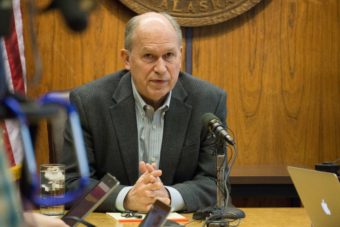
Gov. Bill Walker on April 18. 2015. (Photo by Jeremy Hsieh/KTOO)

Gov. Bill Walker was in Akiachak and Tuluksak Tuesday to discuss a lawsuit involving tribal lands into trust, according to officials in Akiachak. Walker’s office tried to keep a low profile on his first post-election visit to Southwest Alaska amid high interest in a case that could reshape jurisdiction on Alaska Native lands.

Walker arrived in Akiachak around 10 a.m. and spent a couple of hours meeting with tribal officials and community members before flying to Tuluksak.

Phillip Peter is chairman of the Akiakchak Indian Reorganization Act (IRA) council, which opposes any further delays.

“Akiachak already won the case. I said to them we’re not going to drop this issue, it’s already been approved by the court,” said Peter.

The Walker was traveling Wednesday on the North Slope where he was talking with other tribes about trust lands and was unavailable for comment. Spokeswoman Katie Marquette says Walker is reaching out to tribes like those in Southwest Alaska.

“… To talk to them about lands into trust issues, he has additional meetings across with other tribes in villages across the state to continue to talk about land into trust issues,” said Marquette.

The Department of the Interior announced new rules last year to allow Alaska tribes to put land into trust. Alaska Native leaders say the change, after years of litigation, brings them one step closer to self-determination.

Trust status for tribal land protects it from taxation and alienation – the taking or sale of land — and gives tribes greater jurisdiction. Under the new rules, tribes could put lands they own into trust, including land they’d purchased, received through an inheritance, or lands transferred to tribes by Native Corporations.

The state has fought the issue over the years. Walker inherited the 2013 lawsuit from the Parnell administration. Most recently, Walker asked earlier this year, for a six-month delay in the case. The state is not talking about its plans now, but Akiachak officials say Walker wants another six months.

Cori Mills, an assistant attorney general with the Department of Law, says the first six-month extension ended in July, the state then received a 30-day extension and now faces a deadline of Aug. 24.

“That’s the deadline in place now. Whether the state makes a different decision or wants to withdraw the appeal, that’s yet to be seen and will be determined by Aug. 24 in whatever is filed by that time,” said Mills.

The state can also ask for more time.

After the meeting, described as a first for the community, Akiachak’s Phillip Peter is hopeful that Walker seems willing to work with them.

“The governor is willing to work with the tribes about the land into trust issues. I was saying to the governor that we’re going to go forward and work with the state of Alaska on this land into trust issue,” said Peter.

Akiachak and Tuluksak were plaintiffs in earlier litigation to allow trust lands.

One year after environmental disaster, Wrangell residents protest BC mines

Tribal member Apryl Hutchinson arrives at Shakes Island at the end of the march. (Photo by Katarina Sostaric/KTSK)

A protest in Wrangell on Sunday marked the one-year anniversary of a mining disaster in Canada and sought to bring attention to mines being developed across the border from Southeast Alaska.

About 100 people marched through Wrangell behind a banner that read “Keep the Stikine Clean.”

Wrangell tribal member Apryl Hutchinson says she hopes the community effort will make a difference.

“We don’t want what happened at Mount Polley to happen on the Stikine,” Hutchinson says. “And we just want to make everyone aware–especially here in Wrangell at the mouth of the river–that we are here, and we’re not going to stand for it.”

Mike Hoyt helped organize the event with Salmon Beyond Borders and the Wrangell Cooperative Association, the local tribal government.

“A lot of the perception is that since it’s going on in Canada, we don’t have much of a voice down here,” Hoyt says. “And I think that’s what this is about, is trying to get people motivated and involved and showing them that we do have a voice in this.”

Last August, the Mount Polley Mine in central B.C. spilled millions of gallons of mine waste into a salmon-bearing watershed. The owner of Mount Polley, Imperial Metals, also owns the Red Chris Mine that opened this summer upriver from Wrangell. Red Chris has the same waste rock storage system that failed at Mount Polley.

Tlingit and Haida tribal members, other Wrangell residents, conservation organizations and representatives of First Nations in Canada marched to the Chief Shakes Tribal House to sing, dance and learn about B.C. mine issues. There was a strong call for unity between Native tribes of Alaska and First Nations of B.C. in efforts to prevent another mine disaster.

Jacinda Mack is from the First Nation in the vicinity of the Mount Polley spill. She told the crowd this was the first year the community didn’t have fish, and she’s very worried about potential long-term effects on the environment.

“My hope is that my people, the Secwepemc, from where the Mount Polley mining disaster happened, can work together with the different tribes of Alaska,” Mack says. “Because we have so much in common and so much to learn from each other and share with each other to protect our common interest of healthy, clean water.”

A protest in Wrangell on Sunday, August 2, 2015. (Photo by Katarina Sostaric/KSTK)

Mack says she wants to help protect Alaska from the same problems.

Oscar Dennis of the Tahltan Nation near the Red Chris Mine talked about his direct action campaigns to expel other resource extractors from that area over the past 10 years. He says the rally was a start, but getting the U.S. and Canada to invoke the Boundary Waters Treaty could take some extra pressure. The treaty is intended to settle disputes about bodies of water shared by the two countries.

“Letter writing is not going to get it done,” Dennis says. “And you can sit here for 10 years and watch it, and by the time everything’s over and destroyed, you wake up and that’s a little bit too late. You have to force your politicians to take action. That’s basically the only way. In my experience, after 10 years on the ground, it’s the only way we’ve ever gotten results.”

But Wrangell Tribal Administrator Aaron Angerman says it is important for everyone to get educated about what could happen.

“If Wrangell could wrap their heads around not having fish for a whole year, possibly longer, maybe it would really open their eyes to see what could happen with this mine up there on the Stikine,” Angerman says.

He plans to host more events like this in Wrangell, and he hopes more Southeast communities will follow suit.

‘Expedited partner therapy’ lowers YK gonorrhea cases

There’s been a big decrease in the number of gonorrhea cases in Southwest Alaska over the past five years, according to the Alaska Department of Health and Social Services. It comes after local doctors tried a new strategy, called expedited partner therapy.

When he moved to Bethel to take a job as an OBGYN at the Yukon-Kuskokwim Health Corporation in 2009, Dr. David Compton learned the region was having an outbreak of the sexually transmitted infection gonorrhea.

“I found out that not only did we have a very high baseline rate of sexually transmitted infections – gonorrhea and chlamydia – but we were seeing what we discovered to be was an epidemic of gonorrhea that the CDC was very concerned about and we were very concerned could develop into epidemics of other sexually transmitted diseases, like HIV,” Compton says.

Dr. David Compton with Nurse Caroline Compton who is also his wife. (Photo Courtesy of YKHC)

Until 2008, gonorrhea infection rates in Alaska were very low. In 2009 infections broke out across the state.

If left untreated, in women, the bacterial infection can result in pelvic inflammatory disease and serious pregnancy complications. It can lead to infertility in both women and men. Young people, 15-29, are more likely to be infected by gonorrhea because of their sexual behaviors. Alaska Natives are disproportionately affected.

The Centers for Disease Control and the state suggested something called expedited partner therapy; that’s where instead of tracking down partners of infected people and trying to get them to come in for treatment separately, the doctor prescribes or gives the medication to the patient to pass on to their partners.

It took six to nine months, Compton says, to convince everybody involved that it was a good idea. They had to switch from the recommended medication, which is a shot to a pill, Compton says, in order to make it easier to deliver the medication, but it worked.

Gonococcal_Infection_per_100000_Southwest_Statewide_chartbuilder
(Graphic by Ben Matheson/KYUK)

“What we found when we tried this was that the partners were treated up to three days faster and therefore they had sex with fewer people with the infection and we were able to decrease the rate of the gonorrhea,” Compton says.

They reduced new infection by 48 percent in the Southwest region of the state over the past five years.

They also reduced the duration of the test-to-treatment time for the STI from nearly a week to just two or three days. Now expedited partner therapy has become routine at YKHC in Bethel. It’s also available at village clinics and at the public health office.

That’s something Susan Jones, who works for the state HIV/STD program, says was critical to getting the outbreak under control. Now it’s becoming more available throughout Alaska, she says.

“It’s something that has extended across the state in various degrees. One of the things that have helped this along is that the physicians in the state changed their regulations that allowed them to do prescriptions for individuals exposed to STD’s. You don’t have to see the person, but you can write a prescription if they’ve been exposed to gonorrhea,” Jones says.

Jones says although the decrease in YK Delta Gonorrhea is hopeful, it’s recently come to light that some is being missed in the routine urine test, so it’s important to ask providers about additional testing, in some cases.

While gonorrhea is down in the region, Jones says the Southwest area, along with Northern Alaska, still have the highest rates of gonorrhea in the state and Alaska ranks number four in the nation for the STI.

Shell begins exploratory drilling in the Chukchi Sea

The Polar Pioneer drill rig arrives in Dutch Harbor. (Photo by Emily Schwing/KUCB)

Arctic drilling is under way.

Shell Oil confirmed Thursday that its Polar Pioneer rig sent a drill bit spinning into the floor of the Chukchi Sea about 5 p.m. Alaska time.

It came at the end of one of the most eventful days in the company’s eight-year effort to find oil in the Arctic Ocean.

More than 2,000 miles away, just a few minutes before the drill bit hit the sea floor, the company’s icebreaker Fennica managed to free itself from a blockade of protesters in Portland, Oregon.

Protesters had suspended themselves from a bridge across the Willamette River.

Others had taken to kayaks to block the exit of the Fennica.

Thursday morning, the Fennica approached the bridge, then turned around after a 15-minute standoff.

A federal judge in Anchorage slapped Greenpeace with a $2,500 fine for every hour its activists blocked the Fennica.

By late afternoon, local police and the U.S. Coast Guard had disbanded the protesters. The Fennica set sail past the bridge and headed for Alaska.

Greenpeace called delaying the icebreaker for 36 hours a victory.

Activists say climate change and the risk of an oil spill make drilling in the Arctic Ocean a dangerous mistake.

Shell has begun drilling a 40-foot-deep cellar for housing a blowout preventer.

It can only begin drilling into oil-bearing layers beneath the seafloor after the Fennica arrives at the drill site in the Chukchi Sea.

Interior Department officials say they expect to approve the deeper drilling quickly once the Fennica has returned to the Arctic.

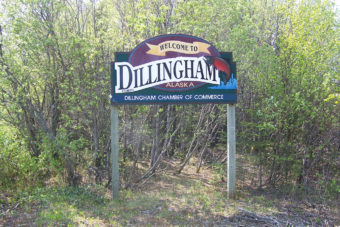
Sexual assault reported in Dillingham Jail

Dillingham police have charged a man with third degree sexual assault for an alleged incident inside a jail cell.

On Tuesday evening Dillingham police picked up 54-year-old John Wassily who was intoxicated and lying in the street by the Senior Center. They placed him under Title 47 protection, meaning Wassily was given a jail cell to sleep it off but was not under arrest.

His cell mate that night was another man under Title 47 protection, also sleeping off having too much to drink.

Within minutes of Wassily coming into the cell, the other inmate called for help saying he had been sexually assaulted. Police say they separated the men and reviewed the video surveillance footage the next day.

According to police, the footage showed Wassily groping the man, curling up next to him with his pants off and committing other acts considered sexual assault. The victim woke up and kicked Wassillie off of him before calling for help.

Wassily told police he only remembered waking up in cell 5, and that he’d had a “fifth” of vodka and two beers to drink the day before.

Police interviewed the victim who recalled the specifics of the incident, saying he felt violated and would testify in court.

Both men told police they didn’t know each other.

Wassily was booked on a third degree sexual assault charge and held on $10,000 bail pending arraignment.

Work on one of the state’s few capital projects begins in Naknek

The Bristol Bay Borough is working on one of the few projects in the state’s capital budget this year — an upgrade to the sewer system in Naknek.

A westward view of downtown Naknek in the summer. (Creative Commons photo by Todd Arlo)

The borough received almost $500,000 from the state for the project this fiscal year, which started in July. It was one of just four projects funded by the Department of Environmental Conservation’s grant program this year.

Kevin Schoneman is the borough’s wastewater and water supervisor.

“I’ve been told it should be in the neighborhood of $3.8 million dollars, and we were one of four projects funded in the state for this budget cycle,” Schoneman says.

The project includes a new lift station at Peter Pan. Sewage is raised and pumped through the system at lift stations.

Peter Pan is in the same area as several other canneries, and Schoneman says use of the wastewater system in the area has increased in recent years. During a two-and-a-half day period in early July, the lift turned on 160 times and operated for about 11 hours total.

The upgrade will allow for future expansions at processing facilities in the area.

“It will ensure that this area can grow for many, many, many years,” he says.

Schoneman says processors and residents shouldn’t notice the work while it’s underway.

“That’s been a challenge with the engineering is making sure we don’t interrupt anybody’s service during the time we’re constructing,” he says.

Engineering and planning for the upgrade has been underway for several years and is planned to be complete by the end of next summer.

Site notifications
Update notification options
Subscribe to notifications