Southwest

Mysterious whale deaths spike in the Gulf, prompts investigation

Handout map shows this summer's reported whale strandings. (Courtesy NOAA)
A NOAA map shows this summer’s reported whale strandings.

Federal scientists have launched a coordinated investigation to find the cause of this summer’s mysterious die-off of whales in the Gulf of Alaska, and they want the public’s help spotting and reporting stranded whales.

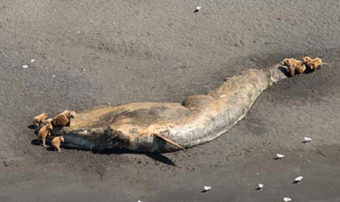
Thirty large dead whales have been observed floating or washed ashore in coastal Alaska since May. That’s over three times the average for Alaska waters.

National Oceanic and Atmospheric Administration’s declaration Thursday of the whale die-offs as an unusual mortality event allows federal, state and tribal biologists to develop a coordinated response and investigation plan, and allows more access to financial, technical and logistical resources. There have been three such events declared for unusual marine mammal or whale deaths in Alaska in the last 15 years. Over 60 have been declared nationwide.

Eleven fin whales, 14 humpbacks, one gray whale and four unidentified whales have been observed stranded along the Gulf of Alaska coastline from Seward down to just past Cold Bay. Nearly half of the stranded whales were spotted just in the Kodiak Island area. It’s unknown if the increased mortality is caused by disease or a biotoxin from recent algae blooms.

Aleria Jensen with the NOAA Fisheries Stranding Network says it’s important that fishermen, boaters and beachcombers report a dead or live distressed whale as soon as possible. Contact a local stranding coordinator, the Marine Mammal Stranding Network Hotline at 877-925-7773 or the U.S. Coast Guard through VHF channel 16.

“We caution the public not to approach any animals that are sighted, or touch or handle in any way, or intervene,” Jensen says. “Most important thing is to report. Also, keep pets away from any animals that are sighted to avoid the risk of any transmission of harmful agents.”

Bears feeding on a fin whale carcass in Larson Bay, Alaska, near Kodiak. (Photo courtesy of NOAA)
Bears feeding on a fin whale carcass in Larson Bay near Kodiak. (Photo courtesy NOAA)

Biologists have only been able to do a limited necropsy on one of the 30 whales so far. It may be a challenge, if not impossible, for biologists to access some of the stranding sites because of rugged geography. Bears or other predators feasting on a carcass may also make it unsafe, and high tides may carry beached carcasses away.

“One of the issues here is that a lot of these carcasses are seen floating and it might be someone who’s not very versed to determine whether a carcass is fresh or not,” says Kate Savage of NOAA Fisheries in Juneau. Savage says it’s important to sample the whale tissue, fat, eye liquid, bile, feces and urine as soon as possible.

“The condition of the carcass is paramount in taking samples,” Savage says. “And the fresher, the better. Once the tissue starts to degrade, the quality of the samples we can take and also the realm of samples we can take starts to decrease. From what I understand, the level of toxin that you would expect to find would also decrease as the carcass degrades.”

Savage and Jensen were part of a panel of American and Canadian scientists which fielded questions from the media Thursday about the investigation.

Paul Cottrell, Pacific marine mammal coordinator with the Canada Department of Fisheries and Oceans, says they’ve observed four humpbacks, a fin whale and a sperm whale that were stranded on the central and northern British Columbia coast. With the exception of the fin whale in May, all of the other strandings happened earlier this month.

“Most recently, we had a sperm whale off the west coast of Haida Gwaii, Graham Island, which is again like we see in Southeast Alaska. It’s a fairly isolated area,” Cottrell says. “It’s a carcass that was observed quite a while after it hit land because it was so isolated. So, it’s fairly decomposed.”

Results from two British Columbia whale necropsies are due back in a few weeks.

Teri Rowles, NOAA Fisheries lead marine mammal scientist and National Marine Mammal Stranding Network coordinator in Maryland, says the higher whale deaths appear limited to the far northeastern Pacific Ocean.

“In comparison to what is happening on west coast of the U.S., large whale strandings are not increased in the same time frame as they are increased locally in the western Gulf of Alaska,” Rowles says. “So, this is not a coast-wide event at this point.”

One leading theory is the whale deaths are due to biotoxins from algae blooms caused by this summer’s abnormally warm sea surface temperatures, but there’s no conclusive evidence yet. Some form of an infectious disease or a virus is also a possibility. But the panel said flatly that there is no evidence the whale mortality is due to recent military exercises in the Gulf of Alaska, and they referred reporters to contact a military spokesman on that issue.

Coming up with any answer as to the potential cause of death of the 30 whales may take months, if not years.

Pebble asks to subpoena former EPA official

The proposed Pebble Mine site looking northwest. (Photo by Jason Sear)

The Pebble Limited Partnership is asking for a former Environmental Protection Agency official to be subpoenaed as part of the lawsuit over the agency’s alleged violation of federal regulations.

In an Aug. 17 motion, lawyers for the Pebble Partnership asked a federal court to subpoena former EPA employee Phillip North.

According to court documents, North is believed to reside in Australia. In the motion, the partnership asserts that North worked with Federal Advisory Committees on use of the Clean Water Act to prevent the development of the mine.

The motion also says North collaborated with other entities on the Tribes’ eventual petition to the EPA.

The lawsuit, which was brought by the partnership, asserts that the EPA violated the Federal Advisory Committee Act, and the motion alleges that North was an important figure in that activity.

According to the motion, some records of North’s work at the EPA is no longer available, and he shut down his personal email on which some of the alleged communication is said to have occurred, so he needs to testify in person about his activities.

Essentially, the partnership says the EPA acted improperly in its communication and coordination with other entities on the EPA’s consideration of a Clean Water Act designation. The partnership wants to develop a mine there; the EPA’s proposed designation would prevent that by restricting the use of certain waters in the Bristol Bay watershed for disposing of dredged and fill material from the mine.

A decision on the proposed designation is on hold due to the lawsuit.

In an email, a spokeswoman for the Department of Justice, which is representing the EPA in the lawsuit, declined to comment on the motion. An EPA spokeswoman also told KDLG News that her agency wasn’t commenting on the filing, as its part of ongoing litigation.

The Pebble filing says that the organization discussed the motion with counsel for the defendant in the case, which is the EPA, and they didn’t oppose it.

A lawyer for the partnership also did not respond to a call from KDLG News.

The case is in front of U.S. District Court Judge H. Russel Holland, who denied the EPA’s motion to dismiss the case in June.


Archaeologists uncover new artifacts near Quinhagak

At a site near the Southwest Alaska village of Quinhagak archaeologists are racing against time to uncover Yup’ik artifacts before the effects of climate change cause them to erode into the sea. The old village continues to reveal artifacts that give a glimpse into the daily lives of Yup’ik people hundreds of years ago.

The crowning artifact found this season, says Rick Knecht, the lead archaeologist and a professor from the University of Aberdeen in Scotland, is a mask half human, half walrus, in nearly perfect condition. It’s wrapped in several layers of plastic as Knecht keeps the mask damp and cool in a refrigerator at base camp.

“It’s got amazingly lifelike contours with the cheek bones, and the nose, and the forehead and so-on. Beautifully carved out of wood, and as you can see it’s got two little conical tusks that represent that transformation into a walrus. And these are in fact made out of walrus ivory. It’s got a little beard here, and half of it are human hairs and then on the other half are sea mammal hairs, maybe walrus whiskers,” said Knecht.

Knecht says the mask could have been a used by a Shaman. He unearthed it, about five miles outside Quinhagak, on the edge of the Bering Sea, where archaeologists have spent the six field seasons scraping dirt from the remains of a 500-year-old Alaska Native sod house. Today’s discovery of a wooden bowl gives another clue about how Yup’ik people lived.

“On the bottom of the bentwood bowl is an ownership mark left by the person who carved that and these ownership marks were inherited between families. We have about six or seven ownership marks we see consistently throughout this site, which we believe was a very large sod house divided up into compartments which were domestic spaces for women and children,” said Knecht.

His team has found tens of thousands of household items, jewelry and weapons, among other things. The dig is composed of what’s left of an entire village at the site of the ancient community of Arolik.

The objects look much younger than the centuries they’ve endured. That’s because they’ve been encased in permafrost. Wood and leather items can survive for hundreds of years. The oldest objects date as far back as seven hundred years.

Unseasonably warm temperatures at the dig site– nearly 80 degrees- create another set of variables for the crew to deal with. Conditions that Knecht say are driving the crew to work as fast as possible before more washes away.

The Nunalleq excavation near Quinhagak is revealing artifacts that have survived hundreds of years in permafrost. The site is threatened now by coastal erosion. (Photo by Daysha Eaton / KYUK)

In the early 1600s, right around the time that Shakespeare was publishing plays and poems in England, Knecht says, these people were crafting art too: carving intricate ivory jewelry and weaving baskets. Then, in the middle of the 17th Century, says Knecht, their communal, sod house was attacked and burned.

Carlotta Hillerdal is a co-investigator with Knecht on the project. Back at the dig, she points to a burnt orange streak running along the dark soil of the dig’s dirt wall.

“This site was abandoned around 1640. So that’s where we have the kind of orange and black soil that you see in the wall over there that we dug. That’s the roof of the last phase of the structure that stood here that was burnt down and abandoned,” said Hillerdal.

The evidence at the site corresponds with local Yup’ik lore about the ‘bow and arrow wars,’ a time of fighting between tribes during an earlier climate change that strained resources.

Those are stories that Yup’ik elder Annie Cleveland knows. She says, when she was a girl, she remembers walking on the beach just outside of her village and finding old spears and human remains along the shore.

“When my grandmother and I used to walk down the beach to get some driftwood or pick berries we used to find spear-anek (spears) and maybe a human bone and skull and we used to put the bones back up there and dig a little bit and cover them,” said Cleveland.

That spot where she and her grandmother kept reburying things has turned into the dig called Nunalleq, meaning ‘old village.’ Cleveland says the project is bringing to life history for Yup’ik people in her village and giving them a sense of pride. The Native corporation in Quinhagak eventually wants to develop ecotourism around the site, but rapid erosion has made getting artifacts out the priority.

As they dig, researchers are finding that the village is larger than expected. With the new discoveries they’ve tacked on another season of fieldwork to unearth more history before it’s too late.

The archaeologists will ship the artifacts to Scotland for study and preservation before they return them to the region. Tribal leaders say they will eventually display them either in Bethel or Quinhagak.

From working to homeless and back again — a story of hope from the Brother Francis Shelter

Mike Hindman at the Brother Francis Shelter. (Photo by Anne Hillman/KSKA)

People don’t usually plan to experience homelessness; life just takes unexpected turns. But for some guests of the Brother Francis Shelter in Anchorage, like Michael Hindman, the experience leaves them with more hope than anything else. When KSKA’s Anne Hillman spent the night at the shelter late last month, he greeted her and other guests at the door.

“All right, anybody and everybody who wants inside, please line up on the right hand side,” 26-year-old Hindman says as he opens the self-locking door to the shelter. He greets a guest. “How you doing, sir?”

It was an unusually calm summer evening. Hindman was monitoring the entrance area to the shelter and checking for contraband like weapons or alcohol.

“Anything inside of your pockets I can see?” he asks a woman as she gazes a bit past him.

Burly and tall with a goofy smile, the name of an ex-girlfriend tattooed in delicate script on his arm, Hindman never saw himself in a place like Brother Francis. He was young, strong, making good money.

“In the back of my mind I thought, ‘Why are people homeless? And I’ve always had a job. Why don’t people work and why don’t people do this?’ Maybe I didn’t have compassion or sympathy at first,” he recalled.

But a few years ago, he made a mistake.

“This is the part of the story where I’ve got to tell the truth, OK? This is my big blip. I was in Dutch Harbor, Alaska, working as a longshoreman …”

Hindman got involved with drugs, was busted for buying narcotics for an undercover cop, pleaded guilty to a felony, and went to prison.

“I learned my lesson right off the bat. My first 30 minutes in jail I realized this is not for me and then besides that 30 minutes I had another 18 months to learn the same lesson thinking, ‘This is definitively not for me.’”

As part of the plea deal he gave the state everything he owned. He was released this spring with nothing but purple prison underwear, donated clothing, and a quarter in his pocket. After sleeping rough for a couple of nights, someone told Hindman about Brother Francis. He began volunteering as a door monitor in exchange for secure housing at the shelter and help finding a job. Hindman said it completely changed his perspective.

“I no longer pass judgment when I walk by somebody, its more what can I do to help? Because whether the person, maybe they are an alcoholic or maybe they do have a temper problem, or maybe they do have a flaw, but I think all of us do. What I worry about now is, is that person cold?”

Working at the door lets him see people’s lives turn around, he said. One day they’re tired and stressed and a few weeks later they have a job and are looking bright. That’s his story, too. He was recently hired as a cook on the North Slope.

But during his off weeks he’ll be back at the shelter, helping out, and saving money to rent a place of his own. Hindman sees beauty in the echo-filled concrete halls.

“I’ve seen people with nothing to their name but they give everything they can to the next guy who also has nothing,” he said, recalling people offering up their only jacket to protect others from the rain. “I know people that make $100,000 a year that probably wouldn’t let you borrow their jacket, you know?”

He says he stays positive and hopes it helps others stay that way, too.


Juveniles identified in Bethel preschool vandalism

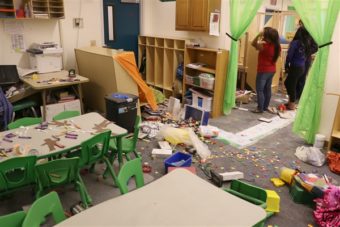
Damage could exceed $100,000. (Photo by Dean Swope/KYUK)

Bethel police have identified five juveniles, ages 10 and 13, suspected of vandalizing preschool classrooms and smashing windows in more than a dozen cars owned by the Lower Kuskokwim School District. Charges are being sent to the Department of Juvenile Justice.

Lt. Joe Corbett says this is not the first time police have dealt with vandalism in the school, which has high quality video cameras that were rolling.

“We [passed] the images around the police department, we put them in front of school administrators to try to get those kids identified,” said Corbett. “It normally doesn’t take us very long.”

The damage was discovered Sunday morning and closed the preschool this week. Corbett says the investigation is not entirely complete.

“The first confession isn’t always the entire truth. We need to work it from every angle and make sure that what we’re being told, the confessions we did obtain are accurate and consistent. We need to make sure there is no one else out there who could be escaping punishment on this if we’re to get all of the kids that were involved,” said Corbett.

The preliminary damage estimates exceed $50,000 for the vehicles and at least $50,000 to the preschool.

“This amount, this level of damage, is certainly out of the ordinary. But property damage from kids in this town has been a problem for a long time, and a lot of this is about parental supervision,” said Corbett.

Going forward, Corbett says, the police will be enforcing a zero tolerance policy on the city’s curfew rules.

“It’s never been enforced at that level. We’ve always left that up to officer discretion. But when a problem’s been identified, it needs to be addressed. We clearly see there is a problem here. It’s our tool to address it, but it’s not the only tool that the city and citizens have. If you have responsible parents involved in what their children are doing, that’s the best tool of them all. Then we don’t have to write tickets,” said Corbett.

Parents can be fined up to $250 for curfew violations.

Vandals cause $100k in damages to Bethel preschool

Damage could exceed $100,000. (Photo by Dean Swope/KYUK)

Vandals trashed preschool classrooms and smashed windows in 13 of the Lower Kuskokwim School District’s vehicles over the weekend.

LKSD Superintendent, Dan Walker, says it appears people threw rocks at cars parked near the district office. Inside the M-E preschool they made an absolute mess.

“All of the toilets were clogged, the water was left running. We had several smart boards that were torn off the wall. There are computers that were thrown off onto the floor and a few computers that were missing,” said Walker.

The preliminary estimates of the damage exceed $50,000 for the vehicles and at least $50,000 to the preschool. Bethel police are investigating. Walker is hopeful that the school’s camera system can develop leads in the case.

“Our technology folks are going thought video footage right now. I’d be surprised if we don’t have some footage. The question will be if we can identify people from the footage or get an idea of who we need to talk to,” said Walker.

After starting up the new school year last week, nearly fifty families with preschoolers are now waiting again for school to start. Walker says there is no firm timeline.

“Right now we’ve cancelled classes until further notice. Probably later this week we’ll have a better idea of whether we’ll be far enough along getting the building cleaned up so we can have classes next week,” said Walker.

Before cleanup goes too far, Walker says his team needs to know whether the air is hazardous from fire extinguishers that were emptied. He says the district can’t simply move preschoolers to another classroom because the facilities have to be licensed.

“We have limited time with them anyway, and we want to do everything we can to maximize the learning time, so we’ll do everything we can to get the facility back up and open,” said Walker.

And in the meantime, Walker says the district wants to look at adding additional lighting outside and cameras.

Site notifications
Update notification options
Subscribe to notifications