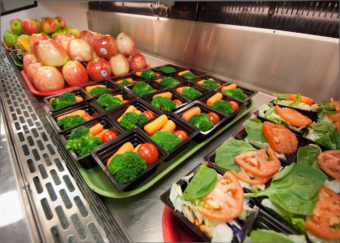
The National School Lunch Program is a federally assisted meal program administered by the United States Department of Agriculture, Food and Nutrition Service operating in public, nonprofit private schools and residential child care institutions. (Photo by Bob Nichols/USDA)
All students at Dillingham City Schools will be provided with free school breakfast and lunch this year. That comes as changes were made to the Community Eligibility Provision, a federal program run through the U.S. Department of Agriculture.
“If you have 40 percent poverty in your district, you now qualify for every child in the school to be able to get free lunch and free breakfast,” says Superintendent Danny Frazier.
That’s down from a prior threshold of 80 percent, which was just above Dillingham’s calculated poverty level.
But the majority of students have been eligible in the past for free lunches through other programs, like the federally-funded Title I-C Migrant Education Program.
“We’ve always been able to offer the free lunch to students that filled out the application with Migrant Ed, and Migrant Ed students automatically qualified also,” said Frazier. “So yes, we’ve had a significant amount of students that did receive free lunch, free breakfast, but now it’s 100 percent.”
High school students are allowed to and often do leave the school grounds and take lunch elsewhere. But the district has been tracking that more students are opting to eat school lunch than in years past.
Frazier credits staff with keeping more students in the cafeteria at lunchtime, where the meals are cheaper and often more nutritious.
The district had a grant last year to buy more Alaska Grown-labeled products, which included produce from local farms. That federal grant ended, but Frazier said he still intends to buy locally as it’s available.
Governor Walker visited five rural Alaska communities, including Akiachak. (Photo by Ben Matheson/KYUK)
Governor Bill Walker faces an August deadline for determining the future of the state’s appeal against a court case that could clear a path for Alaska tribes to put land into trust.
He’s facing pressure from tribes to drop the lawsuit. Trust status would reshape tribal sovereignty on certain lands. Walker said Monday that the purpose of his recent five-village trip was to listen and build relationships with tribes.
“I wasn’t trying to sell a deal or make a deal, or get anyone to do anything different. I just wanted to understand and hear from them about some of their issues in their village and tribal associations,” said Walker.
Walker inherited a 2013 lawsuit fighting an earlier decision about land into trust, from the Parnell administration. He’s delayed action for seven months. A brief is due on the 24th indicating the state’s plans. His tour last week brought him to five places: Akiachak, Tuluksak, Chalkyitsik in the interior, Barrow, and finally to Haines.
He brought boxes of vegetables and strawberries from Palmer-area farms to far corners of the state, as he spoke with plaintiffs who originally sued the federal government in 2006 for the ability to put lands in trust. Walker says a common thread was that tribes wanted to make sure the land is available for future generations.
“The theme I would take from across the state is they were looking at it more from a preservation standpoint. They’re trying to hold on to what they had, recognizing that they had a whole lot more previously,” said Walker.
Trust status, however, has major implications for jurisdiction and could give tribes wider control over laws and management of lands, while restricting the power of the state. It also has tax implications. Walker says land status is one of an array of issues related to tribal sovereignty that his administration is considering.
“We’re looking at some of those already, as far as for how we can transfer jurisdiction for certain matters over to tribes. I think I would look, our vision is much broader than land into trust,” said Walker.
His administration is also wrestling with how to implement tribal courts. Walker is not detailing his plans for the lawsuit yet. He says he and his legal team are still reviewing the case.
The Vatican officials are seeking to connect with people of Western Alaska through the masks. (Photo by Ben Matheson / KYUK)
A team from the Vatican was in Bethel last week trying to trace the origins of several traditional Yup’ik masks they received nearly a century ago. Museum experts are going through the Vatican’s vast collection and trying to find the people who can explain the art.
There is next to no documentation for the seven masks besides a note that says “from Holy Cross.” The Yukon village was the location of a Jesuit orphanage and mission.
Nicola Mapelli, curator for the Ethnographic Section of the Vatican museum and colleague Katherine Aigner held meetings in Bethel Tuesday at the Cultural Center. They say they contacted people in Holy Cross who believe the masks are from further south. That brought the team to the Lower Kuskokwim to attempt to track down the history of the masks.
The wooden masks are light in tone with orange and blue coloration. They depict animal forms like salmon and birds with expressive faces. The trail from Alaska to the Vatican begins in 1924 when Pope Pius XI wanted to hold an international exhibition of works from far reaches of the earth where his missionaries were based.
The Pope asked for objects from around the world to show the daily and spiritual lives of the people. The Vatican team emphasizes that the masks were gifts, but for the masks, they’re not sure of their origins. Regional experts thought the masks could be from the Goodnews Bay area although there was no formal Catholic mission there at the time.
When the Vatican team traveled to Goodnews Bay, Wednesday, they say one person identified a mask as the style from the area and a carver remembered his grandfather and father making similar masks.
However, there is still no definitive word on the masks’ provenience and they say their detective work will continue. They want to show photos and have conversations with people in the YK Delta and hope that they can learn the story of how the masks got to the Vatican.
The team brought images of the masks that were given to the Pope in 1924. (Photo by Ben Matheson / KYUK)
Of the 100,000 items sent to the Vatican last century, 60,000 were returned and 40,000 stayed to form the core of a collection. The items have not been on display for 40 years, as the museum closed due to preservation concerns.
They’re now reaching out across the world to connect with the communities and bring the items back into public view. They recently did a large exhibit of indigenous Australian art and are hoping to someday do an exhibit on the Americas.
Bethel’s John McIntyre, originally from Eek, is an accomplished mask carver and dancer and has had his work displayed at the Smithsonian. He met with the Vatican team and was eager to lay the groundwork for bringing the masks back to Alaska for an exhibit.
“We need to start looking at bringing back all these artifacts that have been brought out of the region. It’s very important for us to keep our culture and tradition alive. And with the artifacts, we can explain to the younger generation before that information is lost,” said McIntrye.
The team expressed interest in someday showing the masks in Southwest Alaska. The international logistics and funding challenges, however, make it a very slow process.
A team from the Vatican brought images of masks to Alaska as they attempt to trace the history of the masks. (Photo by Ben Matheson / KYUK)
Missionaries were among the first Europeans to live among the Yup’ik people, and not without a troubled history. There are stories of missionaries repressing traditional beliefs and the Yup’ik language.
The team says the objects now are an opportunity for the Vatican to reconnect in a positive way with the indigenous people of Alaska.
Next the representatives from the Vatican will travel to Barrow with more photos of objects from Northern Alaska, including ivory carvings.
Note: Vatican officials did not have permission to be quoted for this online story or to share their high-quality digital photo of the masks.
Each July and August, dozens of Bristol Bay residents take to the berry flats. Some are casual gatherers, picking handfuls here and there. Others set out to harvest enough salmonberries to rival the year’s salmon harvest.
Kim Williams, her sister-in-law Liz Johnson and aunt Judy Samuelson are the latter.
Around 9 a.m., the three women embark on their tenth day of salmonberry season. Williams says it’s been a good haul so far.
“How many bags you put away?” she asks the group. One says 37; another says 40.
They load plastic buckets and quart-sized Ziploc bags onto their four-wheelers. Williams leads the group onto the tundra, picking her way between swampy patches. She’s heading toward one of their closely guarded berry spots.
“We have spots that we regularly look at beause we’ve been [going] there for at least 30 years,” She says. “We have spots that we go back and check. Some years they’re there and some years they’re not.”
Last year was an off year with no salmonberries to be found. Williams says heavy wind and a late frost killed the delicate blossoms.
“These berries are really fragile,” she says. “They’re a white blossom – a lot of rain can knock the blossom off [or] the wind … a lot of things can happen so they don’t berry.”
This time around the conditions were right and the berries early. Williams says they started scouting for June 9, more than a week earlier than usual.
“We always know that when you hear the cranes out on the berry flat, berries are ready. And when the fireweed is blooming, berries are ready. That’s the sign to tell you to go look,” she says.
Judy Samuelson, Liz Johnson and Kim Williams take a mid-afternoon rest after leaving one patch of berries picked nearly clean. Credit Hannah Colton/KDLG
Today’s destination is a prime berry spot the ladies have visited before. We arrive to find the flats thick with the big, bright orange berries that Williams says they favor.
“We want them big. We leave the small ones,” she says. “We don’t like them white, we don’t like them with black dots, we we don’t like them hard so you have to clean ‘em … they have to be just right.”
Kim Williams with part of a day’s haul. Credit Hannah Colton/KDLG
These flawless berries could sell for $100 a gallon or more, but Williams says they won’t put them on the market.
“We never sell. I did sell one year, my old ones, when I had like 80-some bags,” she laughs. “We’re not hoarders!”
William’s says her berries will go straight into her father’s freezer. Her family will enjoy a year’s worth of akutaq, a dessert made with berries mixed into shortening and sugar.
“Usually for my family we take out two bags when we’re going to have a meal of salmonberry akutaq, and I take blackberries or blueberries and I add it and it stretches it,” she says. “Now auntie Judy, she likes just strictly salmonberry akutaq. But she’s a picking fiend!”
The three women pick the area for several hours, with a light breeze keeping the bugs off. Before leaving for new territory, they try to tally up their haul from this one spot…
“Forty-four!” she exclaims. “Eleven gallons! That’s really good! … That’s lots, no wonder our backs are hurting!”
By late afternoon, they’re running low on Ibuprofen and freezer space, making it about time to call it the end of a successful salmonberry season.
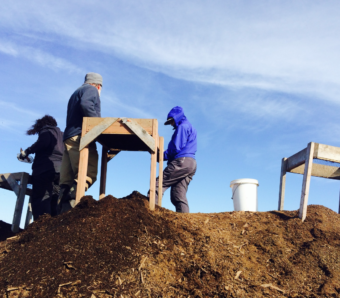
Around this time next year, Dillingham gardeners should have access to compost made from the waste of locally caught salmon. A grant-funded project is taking off at the local landfill in August, and it will need some good fish waste to get going.
“I’m calling it the Fish Waste Compost Project,” says Gabe Dunham, the Marine Advisory Program Agent in Bristol Bay. Dunham inherited the project and is nudging it past the planning phase this month.
Producing the compost will take a fair amount of fish waste this year, and the plan calls for a focus on making use of subsistence fish waste. Though it’s a little late in the season for most people’s fishing efforts, Dunham is hoping that the scraps from whatever salmon are caught, likely silvers, and ends up in a separate waste bin marked UAF Sea Grant that’ll be available by the second week in August.
The City has allowed the project to use a portion of a closed landfill cell, and final approval from the state is still pending.
Dunham says the composting technique has been proven at other projects. An electric fence should help deter bears and covering each compost row with top soil and fabric should cut down on the stench.
Since the project is grant funded for now, the compost will be free next year and probably up for sale after that.
A smokehouse and fishrack in Emmonak. (Photo courtesy of Alaska Department of Fish and Game)
Slow fall chum runs have kept subsistence fisherman from being too active on the Yukon River this past week, but as Chinook continue crossing the border, officials say their numbers are well above escapement goals.
“As far as I know, everybody’s smokehouse is empty, waiting for fall chum,” said Fred Huntington in Galena.
It was a sentiment echoed by many calling into the weekly teleconference for fishermen and managers along the Yukon last week. That wait has been going on for two weeks now—ever since fall chum officially started running around July 18, creating a midseason lull for many fishermen between summer and fall chum runs. Bonnie Borba, the fall chum research biologist for the Alaska Department of Fish and Game, said the first pulse of fall chum would be making its way upriver by the end of July and into the first week of August.
In all, the fall chum run on the Yukon is expected at between 700,000 to 800,000 fish. It’s a moderately-sized run that Fish and Game’s Jeff Estensen said may be slow, but they are on their way.
“[Fall chum] certainly will be getting there,” he told callers. “They’re making their way up. I did get a chance to talk to a fisherman in Holy Cross a couple of days ago; he mentioned there are definitely signs … so by all accounts it seems like we have a pulse of fish going upriver.”
The fall chum run should be enough for escapement, subsistence and commercial needs, Estensen said; already, commercial harvesters in the lower river have caught nearly 27,000 fall chum.
But Huntington pressed managers to loosen gear restrictions for mid and upper-river fisherman who are still trying to meet their subsistence needs. Right now, he said, he has to travel downriver to Koyukuk to catch the fish he needs.
“It would be helpful to us, because (of the) price of fuel here, and the lack of fish in our smokehouses, it would help quite a bit if we were able to just go out here with our 5 gallons of gas that we could possibly have [Districts] 4B and C open for drifting,” he asked. “Get our 10 fish or whatever we want to get, rather than going to Koyukuk and trying to get a hundred.”
While fall chum slowly move upriver, the Chinook continue moving into spawning grounds in Canada. As of last week, nearly 65,000 kings have now crossed the border. Stephanie Schmidt, the summer season manager for Fish and Game who oversaw the king salmon run, said beating the upper-limit escapement goal of 55,000 fish is a victory for everyone involved.
“This run is still well below average, well below what we used to see a couple of decades ago,” she began. “However, thanks to the tremendous conservation efforts on behalf of fishermen up and down the river, we’ve been able to achieve escapement goals on all of our Alaska drainage projects so far. And we’ve now achieved the upper end of the escapement at the border. And thanks for working to make sure these fish get on the spawning grounds so we can try and rebuild this run for the future.”
Close
Update notification options
Subscribe to notifications
Subscribe
Get notifications about news related to the topics you care about. You can unsubscribe anytime.