Western

Historic agreement gives Kuskokwim tribes say in fish management

Chair Mike Williams Sr. signs the MOU with USFWS Yukon Delta Refuge Manager Ray Borne. (Photo by Charles Enoch/KYUK)

The Kuskokwim River Inter-Tribal Fish Commission signed a historic memorandum of understanding, or MOU, with the U.S. Fish and Wildlife Service. The agreement is the first formalization of co-management between the Alaska tribes along the Kuskokwim River and the federal government.

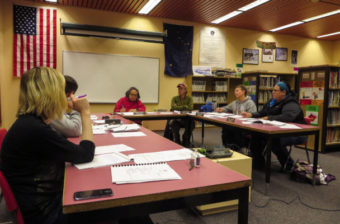
The full Kuskokwim River Intertribal Fish Commission, made up of representatives from village tribes all along the Kuskokwim, gathered at the Cultural Center in Bethel to take part in the Commission’s annual meeting, including the signing of the memorandum of understanding. Mike Williams Sr. of Akiak is the Chair of the commission.

“I’m really excited about the MOU, to work formally with the USFWS and the KRITFC, to make sure that our people have enough to eat and that we have enough escapement of our king salmon and salmon upriver,” Williams said.

Partners in the MOU include the U.S. Fish and Wildlife Service, the Alaska Department of Fish and Game, the Association of Village Council Presidents, and the Tanana Chiefs Conference.

The Commission was formed in May 2015 following an initiative presented by Deputy Secretary of the Department of Interior Mike Connor at the 2014 Alaska Federation of Natives Convention. Conner’s initiative calls for federal managers to integrate tribes into the management of Kuskokwim salmon fisheries in federal waters. The MOU is the first part of a two-part project called the “Partnership Project.”

The second part of the project is the creation of a detailed management framework. The Commission has brought forward a proposal to be discussed by the Commission, the Kuskokwim River Salmon Management Working Group, the Alaska State Office of Subsistence Management, and the U.S. Fish and Wildlife Service.

Since managers forecast a better king run this year, the management framework includes a proposal by the Intertribal Fish Commission for a subsistence harvest of 40 thousand king salmon, over 20 thousand more than last year.

According to the MOU the Yukon Delta Wildlife Refuge manager, based at the Refuge headquarters in Bethel, will consult with the Commission before making management decisions for the Kuskokwim salmon fishery in federally managed waters. Commission member Greg Roczicka said they will try to integrate state managers into the plan.

“And they have not developed the management plan yet, they have said they wanted to have a ‘blended management,’ and they came out with the idea that their blended management would say that they’ll limit it to federally qualified users and let the state manage all the openings and closings. The state does not have the options for calling what some might say is an allocation or to the harvest shares that we’re trying to get equitably, federal does.”

The commission expects to hear back from federal managers on the proposal by Wednesday this week.

Shaktoolik builds berm to stave off rising tides

Eugene Asicksik, on the berm he and others built between village and the waters of the Norton Sound.
Eugene Asicksik, on the berm he and others built between village and the waters of the Norton Sound: “At least we try and defend ourselves and maybe give us more time to beat the storm back a little.”
(Photo by Isaac Kestenbaum/Frontier of Change)

“Twenty years from now, this place would probably be under water,” says Rhoda Asicksik, who lives in the western Alaska coastal village of Shaktoolik. “That’s what really, really concerns me.”

Asicksik and most of Shaktoolik’s 350 residents want the federal and state governments to move the community away from the barrier spit on which it’s built – and which is in danger of being engulfed by the ocean or being swamped by waves driven by powerful storms.

“It’s so scary — too scary — to live here in Shaktoolik, because we have virtually no way of escape.” Asicksik said.

Her husband, Eugene Asicksik, Shaktoolik’s mayor, believes the best short-term solution is to improve infrastructure and build a mile-long berm the locals built on the seaward side of the village that he recently showed to a visitor.

Map of villages considering relocation
Shaktoolik, Newtok, Shishmaref and Kivalina are generally considered most at-risk of coastal erosion, flooding and other climate change-related damage. They’re among at least 12 Alaskan villages that are considering relocation or other strategies.
(Public Domain photo by NOAA)

“We’re standing on the berm now,” Eugene Asicksik told a documentarian during a visit to Shaktoolik and other Alaska Native villages earlier this year. “The berm goes all the way past the dump. At least we try and defend ourselves and maybe give us more time to beat the storm back a little.”

Shaktoolik is one of four coastal Alaskan villages considered most at-risk from such climate-change impacts as receding sea ice, rising sea levels and powerful storms. Newtok, Kivalina and Shishmaref all are working to relocate to safer locations. Shaktoolik has opted to stay where it is – at least, for now.

“Basically what we’re trying to stop now is becoming an island,” Eugene Asicksik said in a telephone interview last week.

Asicksik says he and other locals built the berm in 2014 after years of working with bureaucracies more accustomed to dealing with the aftermath, rather than the lead-up, to disaster. Like the one that’s eating away at the sandy spit on which Shaktoolik was built in 1967, after an earlier relocation.

“We’ve already lost 50, 60 feet, since we relocated here,” he said.

That, combined with the worst-case storm surge scenario, worries Joel Niemayer, federal co-chair of the Denali Commission, which President Obama tapped to coordinate a response to the threat.

“That just terrifies me,” Niemayer said. “It just terrifies me.”

Editor’s note: many thanks to independent producer Isaac Kestenbaum for sharing excerpts of his interviews with Eugene and Rhoda Asicksik, conducted as part of the Frontier of Change project.

Two former elected officials to serve as liaisons for rural broadband project

Denise Michels (center) at a Nome City Council Meeting in 2014. (Photo by Matthew F. Smith/KNOM)

As construction crews work to bring high-speed internet to Western Alaska, Quintillion has chosen six local liaisons to keep communities informed of their progress. In Nome, former mayor Denise Michels has got the job.

“I worked with Quintillion in my prior elected life, so I was very familiar with the project and very supportive of the project,” said Michels, who is currently Kawerak’s Transportation Director. “We had mutual interest in seeing this move forward.”

Northwest Arctic Borough Mayor Reggie Joule accompanied a delegation of Arctic indigenous leaders attending the U.N. Conference on Climate Change in Paris. (Photo courtesy of Northwest Arctic Borough)
Northwest Arctic Borough Mayor Reggie Joule.
(Photo courtesy of Northwest Arctic Borough)

Michels said she’s responsible for coordinating between Quintillion’s contractors, the City of Nome, and Nome Joint Utility System as the telecom company lays 15,000 feet of conduit pipe throughout town. The pipe will eventually hold the fiber optic cable that’s scheduled to deliver high-speed internet by early 2017.

This summer, Michels said she’ll also communicate with the public about where crews are working and how construction may affect traffic and lane closures.

In Kotzebue, outgoing Northwest Arctic Borough Mayor Reggie Joule will serve as Quintillion’s community liaison while Isaac Killigvuk will represent Point Hope.

Tribal council proposes Iñupiaq language and culture partnership with Nome Public Schools

King Island in June of 2014. (Photo by Carrie Ojanen Cockerham)

As this school year winds down, the Board of Education for Nome Public Schools is looking ahead to next year. At a recent meeting, the board heard a new proposal during public comments. Megan Alvanna-Stimpfle — the Vice Chief of the King Island Tribal Council — asked the school district to partner with the council and apply for a grant from the Alaska Native Education Program.

She said the funding would provide students with an afterschool activity focused on Iñupiaq culture and language. In the longer term, she said the council wants to work toward an even larger language program, like an immersion school within the district.

“We have this opportunity to save a language and time is of the essence for us to collectively act,” she said. “We’re ready to be partners because we can’t afford to not act.”

Superintendent Shawn Arnold said he’ll arrange a meeting between district officials and the King Island Tribal Council to discuss the partnership further.

The school board is scheduled to meet again on May 24. Their work session will focus on budget amendments for the fiscal year 2016.

Bethel alcohol sales spill over into nearby villages

In an Illinois railyard, train cars carrying beers such as Corona and Pacifico are at risk of spoiling their cargo if freezing temperatures take hold. Scott Olson/Getty Images
Bethel recently made alcohol sales legal after nearly 40 years of prohibition. Scott Olson/Getty Images

Kuskokwim villages say they’re feeling the effects of Bethel’s new liquor store. The shop opened last week in the Kuskokwim’s hub after decades of banned sales.

In Akiak, Tribal Police Officer Cynthia Ivan has been keeping a call log to compare how alcohol sales in Bethel have increased the amount of emergency calls in her village.

“Assault four domestic violence, I got four of those, suicide threats, public intoxication, and intoxicated children,” Ivan said.

Ivan has been keeping the log for weeks and says the number of calls she received this week has been “insane.”

She says keeping alcohol out has shifted from difficult to impossible. And bootlegging has spiked among people who didn’t do it before.

“And only because the liquor store was open, and it was right there in front of her. It was available. It’s cheap. She bought it; she brought it back to the village; and she sold it,” Ivan said about a woman she recently caught reselling large amounts of alcohol purchased Bethel.

In Napaskiak, a 20-minute boat ride downriver from Bethel, the people are also feeling the impacts of Bethel’s legal alcohol sales.

“It’s been a very rough week since the liquor store opened,” said Brenda Carmichael, Napaskiak Mayor, who says she’s seeing an unusually high amount of inebriated people in the street this week.

Napaskiak is a dry village, like most of the villages immediately surrounding Bethel. But Carmichael says now that Bethel has a liquor store, so does Napasiak.

Carmichael’s main concern is that her city’s small police force won’t be able to handle the crime caused by increased intoxication.

“I’d be surprised if they lasted any longer,” the Mayor said.

Pete Suskuk, Kwethluk Tribal Police Chief, shares this concern.

“We usually have jail guards, and right now we don’t have any jail guards because of budget cuts,” Suskuk said. He says that the department was managing before alcohol sales started but now it’s having trouble.

“Now the officer is going to have sit here all night long until someone is able to come in and relieve him or her and will have to stay in the building. We can’t leave the building, even though we got another call,” Suskuk said.

This means that if they get a domestic violence call or hear of gunshots being fired their lack of staff will leave it unanswered.

All of these officials say they’ve failed to prevent the booze coming into their communities. As for how to fix the problem, none of them has been able to come up with a plan to keep their dry towns from getting soaked.

Mount Edgecumbe students to present original research on beluga and narwhal bioacoustics

SeaTech students on a Skype call with Josh Jones of Scripps Institution of Oceanography. (Photo by Brielle Schaeffer/KCAW)

Despite graduation, school is not over for some science students at Mount Edgecumbe High School in Sitka. The class, known as SeaTech, is headed to the Scripps Institution of Oceanography in San Diego to present their original research on beluga and narwhal bioacoustics.

You’ve probably never heard a beluga whistle or a narwhal click. Not many people have. But Michael Mahoney’s students are experts on the bioacoustics of these mammals, after spending hours logging recordings of their sounds from the Chukchi Sea and Northwest Passage.

“We’re trying to figure out if they’re happy if they’re sad, like, if there’s more fish around, to see if their clicks and their buzzes represent what’s going on in the ocean around them,” said Natalia Smith, a 17-year-old junior from Elfin Cove.

The SeaTech class is not your regular science lab. The students are actually contributing to the research at Scripps Institution of Oceanography at the University of California, San Diego.

“You’ll have people who come to your classroom who say, ‘If you go to school for a really long time you can be a scientist like me, too,’” Mahoney said. “Scripps and the Whale Acoustics Lab says, ‘Why don’t you guys be scientists with us right now.’”

Using Skype, SeaTech students connect with the oceanographer John Hildebrand and Josh Jones, a graduate student in biological oceanography at Scripps, to talk about how researchers analyze the acoustic data to study the marine mammals.

Jones says the diversity of students at Mount Edgecumbe, many who are from the villages near his study area, benefits the project. The students from subsistence communities have cultural ties to whales, having grown up around them or depending on them for food.

“That perspective, that sort of cultural and personal perspective on the animals really lends a lot to their insights on what might be going on in these otherwise numerical analytical processes,” he said.

And, Jones says, working with the SeaTech class is good for productivity.

“In a certain respect we work harder down here in our lab because we are trying to keep up with the students who are up there making steady progress on this research,” he said.

The Whale Acoustics Lab collects the sounds underwater with a high-frequency acoustic recording package, which is basically a computer and hydrophone anchored to the sea floor. The system can record underwater sound continuously for a year at a time.

Mahoney says the students go through the tape with a computer program to identify any patterns in sounds made by the whales at different times of year. The work looks to see effects of climate change and human activity on these animals.

“We can know when ice formation happens, we hear ice sounds,” he said. “Or lots of other environmental sounds. We can hear anthropogenic sounds, sounds that humans make so we can hear ships that pass over or any of those types of things.”

Jones says the Scripps/Mount Edgecumbe partnership has been going on for about 10 years. He started the program as an undergrad interested in science outreach and with roots in Sitka, having worked at the Baranof Wilderness Lodge.

As the program grew, several of Mahoney’s former SeaTech students have presented at other symposiums and even had their work published in scientific journals. A couple even chose to attend UCSD and got jobs at the Whale Acoustics Lab when they started.

In San Diego, SeaTech students will present their findings from the research they’ve been conducting during class, which is kind of a big deal.

Natalia is looking forward to the trip.

“It’s really cool,” she said. “I never thought it would be this big. I thought it was just we go into his class and we learn how to use these programs. I never thought we would get to go down to San Diego and talk to all these important people in science and learn more about these animals.”

The students will also spend time on some Scripps Institution research vessels and when the hard science is over, they’ll study the habitat of mice, talking dogs, and flying elephants during a visit to Disneyland.

Site notifications
Update notification options
Subscribe to notifications