A News

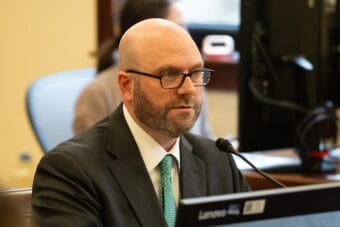
Bristol Bay fisherman and retired educator Bill Hill enters U.S. House race

(Bill Hill for Alaska campaign)

Alaska U.S. House Rep. Nick Begich III has a new challenger.

Bill Hill, a Bristol Bay fisherman and retired teacher and school administrator, filed to run for the congressional seat as an independent candidate.

He cites the late Alaska Congressman Don Young as an inspiration.

“That’s kind of who I hope to, in some respect, mold myself after,” he said. “What’s good for Alaskans first and, you know, we need to start putting distance between politicians that are just cozying up to billionaires and special interests. And we need people that are going to work for Alaskans.”

A day after launching, Hill’s campaign announced he’d raised $200,000.

Hill has retained the campaign consulting firm Ship Creek Group, the same agency that brought early success for Mary Peltola when she launched her bid for U.S. House in the 2022 special primary election.

If elected, Hill isn’t committing to joining either the Republican or the Democratic House caucuses.

“I think that decision needs to be done thoughtfully, and that needs to be done at the appropriate time with whatever the structure of Congress looks like at that time,” he said.

Public records show he made small donations last year, through the ActBlue platform, to Rep. Alexandria Ocasio-Cortez, D-N.Y., and Sen. Bernie Sanders, I-Vt., and larger ones to Democrat Les Gara for his campaign in 2022 for Alaska governor.

Hill is Athabaskan, raised on Lake Iliamna and now lives in Naknek. He worked as a teacher in Naknek and Juneau, an administrator in the Lake and Peninsula School District and as superintendent of the Bristol Bay district. He’s also lived in Fairbanks and worked in construction jobs and ran a small business.

Begich, a freshman Republican, has raised more than $2 million for his re-election campaign. Democrat Matt Schultz, a Presbyterian minister from Anchorage, is also campaigning for the seat. He hasn’t had to file a fundraising report yet.

Mary Peltola to make stop in Juneau for U.S. Senate campaign launch

U.S. Rep. Mary Peltola smiles for a photo at a meet and greet in Juneau on Saturday, Jan. 27, 2024. (Clarise Larson/KTOO)

Former Alaska Congresswoman Mary Peltola will be in Juneau Friday evening at the Crystal Saloon bar downtown to celebrate her campaign launch for U.S. Senate. 

Last week, she announced she’s running for U.S. Senate against Republican incumbent Senator Dan Sullivan. 

Peltola, a Democrat, served both a partial and full term in the U.S. House until the 2024 election, when she narrowly lost her seat to Republican Nick Begich. She became the first Alaska Native person elected to Congress when she won the 2022 special election.

Peltola has historically seen strong support from Juneau. During the 2024 election, Peltola outpaced Begich in every Juneau precinct – even in the precincts from the Juneau International Airport to Mendenhall Valley that went for Trump, according to the Alaska Division of Elections.

Her bid for the congressional seat, if successful, would give Democrats a shot at winning a majority in the Senate.

Her meet and greet will be at the Crystal Saloon on Front Street, Friday evening from 5 p.m. to 7 p.m.

New bill aims to bring stability to Alaska school districts’ budgeting process

school bus in front of building
A school bus waits outside the Alaska State Capitol after offloading a group of preschoolers, their parents, caregivers and advocates on Feb. 13, 2023. (Katie Anastas/KTOO)

Alaska’s state education funding formula is really complicated. It’s based on data, collected during the school year, that takes months to process. That can leave districts building budgets based on projections that might be inaccurate. Juneau Democratic Rep. Andi Story wants to address that through a bill that would change what data is used for funding calculations. 

Story, who served for years on Juneau’s school board, said there’s a level of uncertainty built into the way students are counted.

“When I was a school board member, when we were asking community members, parents to come and work on our budgets, we were always projecting cuts and not knowing what we were going to do,” she said.

Part of that uncertainty comes from not knowing exactly how many students are enrolled until later in the budgeting process. Right now, school districts count the number of students enrolled in October of their current school year. That count needs to be approved by the Department of Education and Early Development, and it determines how much state funding a school district will get for the following school year. 

Districts typically don’t receive the approved numbers until months later – in January. That lag means districts begin planning their budgets based on projections instead of actual data.

Story’s bill – House Bill 261 – would make several different changes to which student counts would be used when determining state funding for education.

Story said one of the main things her bill would do is to base student counts either on the previous school year or an average of the previous three years – numbers that would have already been processed by DEED and wouldn’t change throughout the budgeting process.

“I’ve been living in this roller coaster, and seeing how it does not build confidence in our public schools,” Story said. “And so we need to get on a more stable plan, a smart plan.”

This isn’t a new idea. Story is on the Legislature’s Task Force on Education Funding. She said this part of the bill came from a recommendation made by an education consulting agency more than 10 years ago. The idea came up again last November, during a task force meeting.

The bill also seeks to address budgeting for students with disabilities, keeping schools open

There are a couple of other pieces in this bill as well. One addresses how the state counts students that qualify for intensive services. Students with disabilities that require those services receive 13 times the amount of funding that’s typically allocated for a student. If the state determines there are fewer of those students than what the district counted, that can create serious shortfalls in its budget.

The new bill would offer four different options for how to count students who qualify for intensive services, to ensure districts receive the funding needed to support them.

Districts could count students in October or February of the current school year, in October of the previous school year, or take an average of the last three years. They could then use the number that would provide the largest amount of funding.

Story said this method would account for students who might move to other districts.

“Sometimes students move after the count date, they might move to another community, and all of a sudden that community is going to have to hire another staff person, but they’ve already budgeted,” she said. “So where do they pull that money? Because by law, we need to meet that student’s needs.”

Story’s bill also addresses how enrollment counts determine how many schools a district can have. She said small districts can sometimes fall below the threshold that allows for opening another school or keeping an existing school open if enrollment drops by just a couple students in a given year. She said taking an average would help stabilize numbers in situations where the difference of one student could have big financial consequences.

“Those big funding cliffs that really make— that really have communities on edge of, ‘Am I going to get a couple more or a couple less?’” she said.

Lon Garrison is the executive director of the Alaska Association of School Boards, a nonprofit organization that advocates for Alaska students. He said the bill would provide far more stability as school districts build out their budgets. But he said the issue of adequate education funding remains.

“That’s the piece that we have to be focused on,” Garrison said. “What are we going to do to ensure that we’re getting the student outcomes, and what resources do we need?”

It’s unclear if this bill will make its way through the Legislature. Story expects the House Education Committee, which she co-chairs, to take it up in a couple of weeks.

Alaska lawmakers fail to override Dunleavy’s veto of corporate income tax bill

Legislators watch during an vote seeking to override Gov. Mike Dunleavy's veto of a bill that would have expanded Alaska's corporate income taxes to capture more revenue from Outside businesses.
Legislators watch during an vote seeking to override Gov. Mike Dunleavy’s veto of a bill that would have expanded Alaska’s corporate income taxes to capture more revenue from Outside businesses. (Eric Stone | Alaska Public Media)

Alaska lawmakers failed Thursday to override Gov. Mike Dunleavy’s veto of a bill that backers said would have modernized Alaska’s corporate income tax system.

The override failed 35-25. It would have required a 45-vote majority to become law.

Senate Bill 113 would have expanded the state’s corporate income tax to capture revenue from so-called “highly digitized businesses” that sell to Alaskans over the internet but may not have a physical presence in the state. Some of the money raised by the tax change would have gone toward reading programs in public schools.

After the vote, House Speaker Bryce Edgmon, a Dillingham independent, said the debate over the bill illustrated how difficult it would be for lawmakers to agree on ways to raise new revenue as the state deals with a fiscal crunch.

“I’d also say it’s a preview of the debate that we’re going to undergo on a fiscal plan,” he said.

Some Republicans who voted against the override said they were concerned that the bill could increase costs for Alaskans, including Big Lake Republican Rep. Kevin McCabe.

“It’s disingenuous to think that we are not going to pay for this tax one way or the other,” he said.

Supporters of the bill rejected McCabe’s characterization, saying that the bill would simply give Alaska a share of similar taxes companies already pay in other states.

Sen. Bill Wielechowski, an Anchorage Democrat who championed the bill last year, said the idea that the bill would raise consumer costs was “wildly inaccurate.”

“In fact, there’s been research on this,” he said. “The National Bureau of Economic Research did a working paper titled Corporate Taxes and Retail Prices, and found null — zero — effects on prices for firms subject to a single sales factor.”

Gov. Mike Dunleavy said Wednesday that he planned to introduce a temporary sales tax as part of a larger fiscal plan. Wielechowski said the corporate income tax change was a better option.

“How dare we go to Alaskans and say, ‘We want to tax you. We want to take your dividend,’ before we’re going to tax collect revenue from tech billionaires,” he said. “Really? Is that where we’re going with this?”

Some lawmakers who voted against overriding the bill said they supported the law in concept, including Fairbanks Republican Rep. Will Stapp, who voted for the bill when it passed in May.

But he said the complexity of the tax change— and the fact that the bill would take effect immediately if the veto was overridden — gave him pause.

“(If) you vote to override this bill, Mr. Speaker, you’re going to create a new type of corporate tax structure for people that there’s no regulatory guidance on how to pay,” Stapp said. “I would argue we probably shouldn’t do that.”

Wielechowski said he was confident the state would have been able to put out regulations before taxes would be due in 2027.

Even so, Stapp said he planned to introduce a new version of the bill this session addressing that and several more technical objections he raised on the floor.

“There are a lot of questions with the bill that we should probably know the answer to,” he said.

WATCH: Gov. Dunleavy delivers 2026 State of the State address

Gov. Mike Dunleavy is set to deliver the annual State of the State address to the Alaska Legislature in Juneau Thursday at 7 p.m.

Starting at 6:30 p.m., KTOO Managing Editor Lisa Phu will host a discussion with Alaska Legislative Digest Publisher Tim Bradner, KNBA News Producer Rhonda McBride, and Alaska Public Media State Government Reporter Eric Stone to provide some context for the speech.

Watch live Gavel Alaska coverage of the discussion and Dunleavy’s speech on KTOO 360TV or listen to your local public radio station.

Newscast – Thursday, Jan. 22, 2026

In this newscast:

  • 19-year-old Kake resident Jade Williams was killed at a party in 2017. On Wednesday, more than eight years later, the main suspect in the case was sentenced for causing her death,
  • The City and Borough of Juneau is seeking feedback about how the community wants the Assembly to prioritize city funds as it faces a recurring multi-million-dollar budget deficit beginning July 1st,
  • Young commercial fishermen from all over the state gathered in Juneau this week to absorb industry knowledge of previous generations,
  • The federal government is reviewing the business program that benefits Alaska Native corporations and tribes
Site notifications
Update notification options
Subscribe to notifications