A News

Juneau teens call on state lawmakers to halt Alaska LNG project

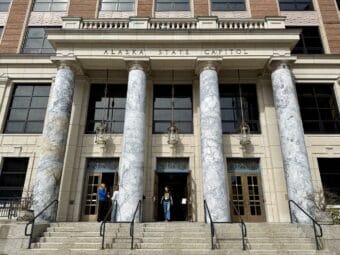
Members of the Alaska Youth for Environmental Action hold signs at the steps of the Alaska State Capitol in downtown Juneau on Saturday, Jan. 24, 2026. (Photo by Clarise Larson/KTOO)

Juneau teens and residents are calling on the Alaska Legislature and Gov. Mike Dunleavy to call off the state’s longtime push for a natural gas pipeline in Alaska. 

On Saturday, more than 40 people gathered at the steps of the Alaska State Capitol in downtown Juneau to protest the long-sought Alaska LNG project. The protest was led by Alaska Youth for Environmental Action, a youth-led environmental advocacy group with chapters across the state. 

Paige Kirsch is a senior at Juneau-Douglas High School: Yadaa.at Kalé and a member of the group’s Juneau chapter.

“I think it’s really important to be cognizant of the future of Alaska, especially because I do want to live here when I grow up, and I don’t want to live somewhere that’s purely for economic profit,” she said. “I just don’t think it’s really that fiscally responsible to keep investing in non-renewable resources.”

Alaska officials have been pushing for the proposed pipeline for decades and the state has already poured more than half a billion dollars into the project. If it’s built, the project would move natural gas from the North Slope to Southcentral for export overseas. A portion of the gas would be reserved for in-state use. The project has already been federally permitted. Last year, the Texas-based Glenfarne Group assumed majority ownership of the project from the state. 

Members of the Alaska Youth for Environmental Action write messages in chalk in front of the Alaska State Capitol in downtown Juneau on Saturday, Jan. 24, 2026. (Photo by Clarise Larson/KTOO)

Since then, it has announced a handful of nonbinding gas purchase and supply agreements. Last week, the company announced several more agreements it says moves the project’s first phase into an early development stage.

Proponents for the project say it would tap into an underdeveloped natural resource and provide energy security to a region facing shortfalls. But others remain skeptical about whether the project will actually be built, citing high costs and competing global energy projects.

At the protest on Saturday, multiple teens took to a microphone to share some of the negative impacts they believe the pipeline would bring, including bisecting land, disrupting habitat and emitting carbon dioxide. Atagan Hood, a junior at JDHS, says Alaska’s dollars would be better spent on renewable energy to mitigate human-caused climate change. 

“We are told that the 800-mile Alaska liquid natural gas pipeline is a bridge to a cleaner future, but you cannot build a bridge to a stable climate out of fossil fuel infrastructure,” he said. 

Last year, an Anchorage Superior Court Judge dismissed a youth-led lawsuit challenging the pipeline.  

There was one counter-protester at the event on Saturday. Kevin Nye, a retired engineer, stood on his own holding a sign that read “Build the Pipeline.” He said he wanted to represent those in Alaska who support the economic benefits the pipeline would bring to the state. 

Kevin Nye, a retired engineer, stands with a sign outside the Alaska State Capitol on Saturday, Jan. 24, 2025. (Photo by Clarise Larson/KTOO)

Glenfarne told reporters last week it expects to begin laying pipe later this year. But project skeptics say that the timeline is unrealistic. The company also initially said it planned to make a development decision by the end of 2025. That decision is now expected to come in February at the earliest.

State education board OKs UAA program aimed at tackling school psychologist shortage

A group of students in the distance gather after exiting a yellow school bus.
Students exit a school bus outside of Juneau-Douglas High School: Yada.aat Kalé on Aug. 15, 2025 (Photo by Jamie Diep/KTOO)

The State Board of Education and Early Development unanimously approved a school psychology master’s program at the University of Alaska Anchorage aimed to address the state’s shortage of school psychologists. The approval took place during the board’s special virtual meeting on Thursday.

This comes after the board voted it down last October after some members brought up concerns about social justice mentioned in a sample syllabus.

Several people testified at the meeting in support of approving the program, including Palmer resident Rebecca Emerson. Her son Winston is a second grader with Down syndrome, and she said school psychologists are instrumental to make sure he gets the services he needs.

“I ask you to look past the ideological debate and see the faces of the students like Winston who rely on these services. Please approve this program so that more Alaskan students can have the support they need to succeed in the classroom,” Emerson said. 

Board member Kathryn McCollum originally brought up concerns about social justice in the program. After receiving clarification about how the program works, McCollum said she appreciates the efforts to create a homegrown program.

“I’m not thrilled that we have all these contractors from outside of our state. So I would much prefer to see people from Alaska serving Alaskans so I appreciate your efforts here,” McCollum said.

Board member Barbara Tyndall, who previously opposed the program, voted in favor this time around. She still had concerns about the focus on mental health.

“As I’m going through the health and safety stuff, it’s mental health, mental health, mental health,” Tyndall said. “And I don’t think we should just only be looking for mental health, because there are people out there just looking for problems.”

People have a few ways to become licensed school psychologists in Alaska. One main way is to graduate from a program accredited by the National Association of School Psychologists. Another is to go through a program approved by the state’s education board.

UAA’s program is on its way to getting NASP accreditation. The earliest it could achieve that is 2029, one year after the program’s first cohort graduates. Now, with the state board’s approval,  those students could become licensed and hired to work shortly after graduating.

Candlelit vigil lights downtown Juneau following Alex Pretti shooting in Minneapolis

Residents gather for a candlelit vigil at Overstreet Park on Monday, Jan. 26, 2026. (Photo by Clarise Larson/KTOO)

More than 200 Juneau residents gathered downtown at Overstreet Park Sunday evening for a candlelight vigil. They were there to honor a man who was fatally shot by a U.S. Border Patrol officer in Minneapolis, Minnesota, during protests against ongoing U.S. Immigration and Customs Enforcement operations. 

“There’s a lot of grief, there’s a lot of anger — and there’s also a lot of hope,” said Claire Richardson, a volunteer with ReSisters, a local group of women who work for social justice and equality. 

The crowd gathered just a few hours after the pop-up event was posted on social media by several advocacy groups in Juneau. 

Multiple local and state leaders spoke to the crowd as snow fell Sunday night, including Juneau Assembly member Maureen Hall. She says immigrants are the bedrock of the community. 

“Let us keep praying, let us keep speaking out, and let us keep standing in solidarity with those in the community that are too afraid to show up at something like this tonight,” she said. 

Juneau’s vigil on Sunday night joins a wave of vigils and protests in Minneapolis and across the U.S. that erupted over the weekend following the death of another person killed by federal officers during immigration enforcement protests. 

The man killed was identified as 37-year-old Alex Pretti, an intensive care nurse. His death marked the second person killed in Minneapolis during encounters with immigration officials amid a crackdown in the city. Just weeks prior, an ICE officer shot and killed 37-year-old Renee Good in her vehicle while the agency was conducting an operation in the city. 

The deaths have ignited fierce debates, with Minnesota and Congressional leaders pressing the Trump Administration over the facts and legality of actions by ICE officers as immigration enforcement ramps up across the country. 

In Anchorage and Fairbanks, residents gathered in similar protests this weekend, according to social media posts. U.S. Sen. Lisa Murkowski, along with other congressional Republicans, has called for an investigation into Pretti’s shooting. 

Wetlands are warming as fast as the atmosphere. That’s bad news for salmon.

Researchers used air and water temperature from sites around the Copper River Delta to gauge climate impacts on wetlands.
Researchers used air and water temperature from sites around the Copper River Delta to gauge climate impacts on wetlands. (Amaryllis Adey)

Before juvenile salmon make their way to the sea, they grow and feed in freshwater, including wetlands, for anywhere between a few months and several years.

But new research finds that as air temperatures rise with climate change, the water that flows through coastal Alaska’s ponds and marshes is warming rapidly, too. That could spell trouble for Pacific salmon, which can’t grow – or live – in waters above certain temperatures.

“I’ve never really hoped so much that I might be wrong,” said Amaryllis Adey, a researcher at Virginia Tech.

Adey is a co-author of the report, which was published in December in the journal Nature. The researchers compared nine years of water and air temperature data from 20 ponds near Yakutat and Cordova. They found that the water was keeping pace with increases in air temperatures.

That’s notable because it marks a departure from what’s happening with other freshwater ecosystems as temperatures rise, Adey said.

Past research shows that rivers and streams are warming more slowly than the air due to a range of factors, including that they move quickly and benefit from glacial runoff. Wetlands, meanwhile, are typically shallow, still, and more spread out across the landscape – leaving them more exposed to the air.

“It was really stark,” she said. If “one degree of air temperature results in one-degree increases in water temperature, that could be really concerning in the future.”

Report co-author Amaryllis Adey and a fellow researcher download temperature data in the field.
Report co-author Amaryllis Adey and a fellow researcher download temperature data in the field. (Elliot Deins)

The researchers’ next step was using the historical data to model what might happen in the decades to come.

The researchers looked at two possible scenarios. One was a future in which humans continue producing greenhouse gases at the current rate. Adey called that the “business as usual scenario” and said it resulted in a “drastic increase” in water temperatures.

“It was like up to 22 degrees Celsius by the end of the century,” Adey said.

That’s about 71 degrees Fahrenheit, which is really warm – and dangerous – for these wetland ecosystems. Coho salmon, for instance, stop growing at around 68 F. And death becomes likely once temperatures surpass about 73 F.

Adey says it’s certainly possible that salmon would adapt. But if they can’t shift the timing of their migrations or habitat use, she said, “they won’t be able to continue to grow and survive in these systems that are very economically and culturally dependent on them.”

The second scenario was less grim. If humans continue emitting at current rates for another decade and then begin reducing carbon emissions, water temperatures would still rise. But they would be less likely to reach dangerous levels.

The study looked specifically at two areas – the Yakutat Forelands and the Copper River Delta. But the results have far-reaching implications, including in Southeast Alaska.

“We’d expect that there’s going to be kind of similar responses across that coastal region,” she said.

Other organisms, including algae and bottom-dwelling invertebrates, are also temperature sensitive, the study said. That means warmer water could be felt by the entire food chain, ranging from different fish species to migratory birds.

The Pentagon is reviewing a program that helps Alaska Native corporations get federal contracts

Secretary of Defense Pete Hegseth on April 9, 2025.
Secretary of Defense Pete Hegseth on April 9, 2025. (Senior Airman Madelyn Keech/U.S. Air Force Senior Airman Madelyn Keech | Department of Defense)

The federal government is reviewing a business program that brings contracting opportunities to Alaska Native corporations and tribes.

U.S. Secretary of Defense Pete Hegseth said in a video posted on X Jan. 16 that his department will review the 8(a) Business Development Program. The program falls under the federal Small Business Administration and supports businesses owned by socially disadvantaged individuals or tribal entities, including Alaska Native corporations.

Hegseth said in the video that the program promotes diversity, equity, and inclusion framework and race-based contracting.

“We are taking a sledgehammer to the oldest DEI program in the federal government,” Hegseth said. “Our goal is to spend your money to build our defense industrial base with businesses, large and small, that share our mission.”

Quinton Carroll, the executive director of the Native American Contractors Association, originally from Utqiaġvik, said that Native participation in the program is not a diversity, equity and inclusion initiative.

“It is grounded in the unique political and legal status of tribal nations under U.S. law and fulfills longstanding federal trust and treaty obligations to tribes, Alaska Native Corporations and Native Hawaiian Organizations,” Carroll said.

Tribal participation in the program

Alaska Native Corporations rely heavily on federal contracts, which they often secure through the 8(a) program.

In 2021, corporations received more than $11 billion from federal contracts, which were their primary source of revenue, according to data from the Federal Reserve Bank of Minneapolis. More than a half of that revenue came through the 8(a) program, and the majority of those contracts were with the Department of Defense, according to that research.

Christopher Slottee, an attorney who ‎works with Alaska Native villages, regional corporations and tribal governments, said that makes the Pentagon’s review of the program “a significant concern” for tribes and corporations.

“They often rely on those contracts to generate the revenue that lets them provide the benefits to their shareholders and tribal members,” he said.

Slottee said that tribal entities are subject to the same standards, reviews and compliance requirements as everyone else, but they do have a few advantages in the program.

Slottee said tribal entities, unlike individuals, don’t have to prove their social disadvantage. They can also have multiple companies in the program, while individuals can only have one. Plus, tribal entities have significantly higher limits for certain awards, he said.

Slottee said a government agency also might want to contract with an Alaska Native organization because they often have more experience than some of the traditional small businesses. And there are treaty obligations to fulfill, he added.

“There is a general, government-wide encouragement for agencies to contract with entities owned by tribes and ANCs, as part of the government’s responsibility to Alaska Natives and Native Americans,” he said.

The DoD review of the program 

Hegseth ordered a line-by-line review of 8(a) contracts that are over $20 million in value. He said in a memorandum to the Pentagon leadership that the department would get rid of contracts that don’t make the country’s military more lethal.

“We have no room in our budget for wasteful DEI contracts that don’t help us win wars,” he said in the social media video.

Carroll, with the Native American Contractors Association, said that Native federal contractors have been partners of the Department of Defense, working to strengthen readiness and the military industrial base.

Hegseth also said the department would make sure that the businesses with contracts were actually doing the work. He claimed that small businesses often receive a contract, take a fee and then pass the job on to a larger firm that’s not eligible for the program.

In June, the Small Business Administration ordered an audit of the 8(a) program following a fraud investigation. The Treasury Department has also been looking into potential misuse of the program.

Carroll said Native contractors support the elimination of fraud and waste within the program.

“It is critical that oversight efforts preserve a program that has proven its value — strengthening national security, reinforcing the defense industrial base, and supporting economic growth in Native and surrounding communities,” Carroll said.

Other threats to the program

The 8(a) program has faced recent scrutiny from other directions as well.

President Trump signed an executive order in April directing the rewriting of federal contracting regulations. Slottee, the attorney, said the revision has been completed, but it’s not clear yet how the changes will affect tribal entities.

He said that there is more focus now on the use of larger contracts, which can be harder for smaller corporations and tribes to access.

“It’s going to take a little bit for folks to actually see the kind of on-the-ground downstream impact, but we definitely anticipate seeing that in the course of 2026,” Slottee said.

Earlier this month, the Small Business Administration issued an announcement that, among other things, described a massive reduction in how many applications were approved for the program.

“The Trump SBA accepted just 65 new 8(a) firms into the program last year – compared to over 2,100 who were accepted during the Biden Administration,” it said.

Slottee said that the many Native-owned businesses felt that reduction.

“There is a concern that ANCs and tribes will have to start looking for alternatives,” he said. “If the SBA is not going to be approving new 8(a) applications, even though they should be under the rule established by Congress, that’s going to be a downstream impact on ANCs and tribes.”

Crum deviated from state law and policy when investing Alaska’s savings, review finds

Adam Crum speaks to reporters on Oct. 4, 2022 at the Alaska Scientific Crime Detection Lab in Anchorage while serving as health commissioner.
Adam Crum speaks to reporters on Oct. 4, 2022 at the Alaska Scientific Crime Detection Lab in Anchorage while serving as health commissioner. (Wesley Early | Alaska Public Media)

Former Alaska Revenue Commissioner Adam Crum deviated from state policy and failed to perform the necessary due diligence before committing millions in state savings to a private equity fund, according to an outside review ordered by Gov. Mike Dunleavy after Crum’s decision came to light last summer.

In its report, the D.C.-based law firm WilmerHale said its investigation had raised “significant concerns” about whether Crum met his fiduciary duties under state law. Investigators also found Crum engaged outside lawyers to represent the state in the investment without obtaining the approval of the attorney general “in apparent contravention” of state law, according to the report.

“Mr. Crum’s process for selecting the DigitalBridge fund and the two other private funds in which he intended to invest did not involve rigorous due diligence, and Mr. Crum did not follow Department of Revenue protocols designed to assist him in meeting his fiduciary duties in connection with the investment,” the report states.

The state ultimately invested some $50 million from its primary rainy-day fund, the Constitutional Budget Reserve, with the private equity firm DigitalBridge. The investigation found that Crum intended to invest $75 million with the firm.

The investment came to light shortly after Crum left office to run for governor. The state ultimately sold the investment to an Israeli insurance company and lost roughly $859,000, according to a letter sent to the state House and Senate’s finance committees. A portion of the $50 million sent to DigitalBridge that was not invested yielded $325,000 in interest, offsetting a portion the loss, according to the letter.

“Clearly, this was an unsuitable investment for the (Constitutional Budget Reserve). No question about it,” said Sitka Republican Sen. Bert Stedman. “The ex-commissioner broke his fiduciary duty to execute it.”

Shortly after the legislative session began in Juneau this month, Stedman introduced a bill that would bar the state from doing business with DigitalBridge.

The report, which cost the state an additional $350,000, found no evidence of criminal wrongdoing or self-dealing. And it said Crum had the authority as revenue commissioner to commit money to the private equity fund. But that’s only if he had done the requisite due diligence, and the report says there’s reason to believe he didn’t.

In a phone interview, Crum said he tried his best to keep everything above board. The private equity investment was an effort to simultaneously boost the returns of the savings account and spur investment in Alaska, and he kept in touch with the Department of Law and the governor’s office about the investment, he said.

“I actually had multiple communications with (the Department of) Law, even with Treasury staff, trying to actually figure out what — I would send emails and ask the questions that say, have we met all of the legal duties in order to actually fulfill this?” Crum said.

But according to the investigation, he chose not to inform the governor’s budget office, the legislative auditor, or members of the Legislature as state policy requires. He wrote on a checklist outlining the policy for so-called “non-routine investments” — created after a state investment misadventure in 2015 — that “Treasury must not abdicate its statutory authority.”

Crum also failed to inquire with the Department of Law whether the investment met his fiduciary obligations under state law, according to the investigation.

Crum casts the issues the investigation raises as “procedural.” Details, he said, were not his mandate as revenue commissioner.

“It’s not about being technically proficient on all that stuff. It’s knowing the overall concepts,” he said. “Making sure that you actually are the expert on the actual delivery of that thing — no, that is not the case. That’s why you have staff. Otherwise, why do you have staff?”

The report included four recommendations aimed at avoiding similar issues in the future. As it was released, Gov. Mike Dunleavy issued an administrative order implementing many of the recommendations by placing additional checks on the revenue commissioner’s authority to invest in unconventional assets.

In the order, Dunleavy said the changes were intended to “enhance the transparency of investment decisions.”

Site notifications
Update notification options
Subscribe to notifications