Filipinos in Alaska

Sitka middle schooler breaks down language, cultural barriers for immigrant students

At 12, Jasmine Molina has found a way to help newly arriving Filipino students transition to middle school. “She is a self-initiated ambassador,” says her teacher, Janelle Farvour. (Emily Kwong/KCAW photo)

Imagine you arrive in a world where it rains all year round, and daylight swings from 17 hours in summertime to a paltry six in winter. And you’re only seven years old. That’s the situation Jasmine Molina found herself when she first got to Sitka, over 5,000 miles from her native city of Manila in the Philippines.

Sitka’s Filipino population has grown substantially in the past five years, but there remains no formal system to help new students transition to school. That is, until Jasmine came to town.

“Hello – ang pangalan ko ay Jasmine Molina.”

There’s something about Jasmine that makes you want to talk to her.

“It’s a pretty big school compared to the Philippines,” she said, walking down the hallway.

Maybe it’s her big brown eyes or her silky black hair, which she quickly tucks behind her ear while dialing her locker combination.

But it’s probably her smile, which turns her face into a huge pair of parentheses.

“I just like want to go up to them and be like, “Hey, do you want to be my friend?” And they’ll be like, “Yeah.” And I’ll be like, “Cool,”’ Jasmine said. “Everyone says I’m weird. But weird is awesome. I think weird is awesome.”

Oh, and she’s got killer self-confidence. Again, not your typical middle schooler.

Janelle Farvor was Jasmine’s language arts teacher last year.

“She’s funny, sensitive and she’s generous,” Janelle said.

Janelle remembers the very first time she saw Jasmine. At the grocery store, with a bunch of other Filipino kids, talking.

“I thought, ‘What is this little girl doing?’   She’s talking so fast, and I just kinda observed a little bit and then I saw her pointing out things and showing things, and I thought, ‘Oh my gosh, this little girl is explaining how this store works,’” Janelle said.

Janelle saw her again a few years later. She’d grown a bit taller, but was doing the same thing.

Filipinos make up 9 percent of the Sitka School District, yet there is no Tagalog-speaking staff member or formal support group to help new students. In her own way, Jasmine has taken up that cause. (Emily Kwong/KCAW photo)

“I thought, I wonder if she’s an ambassador,” Janelle said. “These kids all look very new. They’re just wide-eyed and mouth agape, wondering what this is about, what this can is of. And there was Jasmine, explaining it all.”

And last year, when Janelle met her 6th grade class, Jasmine was in it – all grown-up. Jasmine’s dad is a fisherman and came to Sitka five years ago. Jasmine and her mom followed, a month later.

“I was really shy,” Jasmine said. “I didn’t really know anything about Sitka until my cousin showed me around the next day. There was a lot of tall people.”

And not only that, but it was several degrees colder than in Manila, where Jasmine grew up.

“I only had one jacket and it was really cold and there was a lot of snow on the ground,” Jasmine said.

As she got used to the cold, one thing that made a big difference to Jasmine was meeting other kids her age.

“On the first day I went to second grade they’re like, ‘Hey what’s your name?’ I’m like my name is Jasmine. I came from the Philippines.’ They’re like, ‘Cool.’ I wanted to do the same thing and make people comfortable where they are,” she said.

And it’s something Jasmine has been doing ever since: from greeting new families and showing their kids the ropes, to how to open a locker and getting around the building. It’s more than middle school survival tactics; Jasmine is helping her classmates succeed in a Western school.
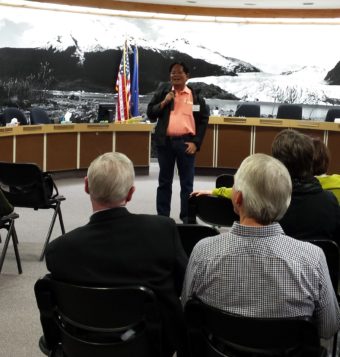
“And for her to do it on her own volition, and to just see a need and to step up to fill a need, I think that says a lot about her character,” Janelle said.

At Blatchley Middle School, there are 29 Filipino students and in the whole district, 121, making up 9% of the Sitka student body. At the bottom, the school district doesn’t have a designated Tagalog speaker or support group to help students orient themselves. But for now, Jasmine fills that gap.

“I’ve had her – even I’ve brought her down to help me scold,” Janelle said. “They need to not be so chatty or whatever, I have her talk to them in Tagalog to hear a lecture in the mother tongue. There’s nothing like it.”

Now, it’s hard to imagine Jasmine yelling at anyone. And if you asked her if she’s an ambassador or a leader, she’d probably say no. She’s just being a friend. Antonete Partido remembers meeting Jasmine in dance class.

“When I first got here, she talked to me instead of just ignoring me,” she said.

The two girls chatted in both English and Tagalog. Antonete lives with her grandmother, who adopted her. She hasn’t seen her parents for five years and describes her family as broken apart.

“I don’t really get to call them because I have school. My grandma has work. So we don’t really have time to call them,” Antonete said. “I don’t think other people know that my parents aren’t here because I don’t show my feelings to them.”

But Jasmine knows. And when we finish the interview, Jasmine takes Antonete aside and says, “You’re my one.” She says it again, “Don’t forget. You’re my one.” And with that, Jasmine turns on her heels and heads out the door to go to her next class.


Kalibo, Philippines is Juneau’s new sister city

Kalibo Mayor William Lachica (Photo by Kayla Desroches/KTOO)

Juneau gained its fifth sister city this weekend. Representatives from Kalibo in the Aklan Province of the Philippines signed documents Saturday afternoon to formalize the agreement. Juneau and Kalibo are both vibrant tourism centers and regional capital cities. They hope to mutually benefit each other socially and economically as sister cities.

About 3,000 Filipinos live in Juneau and roughly 800 of them are from Aklan. Vicky Roldan is one of them. She’s been in Juneau for 21 years and says family is the reason so many Kalibo residents move here.

“There’s a big number of them here because of intermarriages and all that and they keep bringing family over here.”

Alex Carrillo  was born and raised in Juneau and says the Filipino population has always been a tight-knit community.

“Just growing up in the Filipino Hall around even people who weren’t our relatives. We were so close back then because that’s all we had was one another. The Filipino Hall is a really big part of my life.”

He says Juneau’s bond with Kalibo is more than just a sign of good will toward the Philippines.

“Filipinos are a big part of Juneau, I think. And it just shows that the city of Juneau really appreciates us.”

While in Juneau, the Kalibo delegation did some sightseeing including visits to the Mendenhall Glacier and the Shrine of St. Therese. They also visited local businesses, like the Alaskan Brewing Co.

Many expressed hope that the sister city connection will encourage an exchange of goods, services and information. Dr. Makarius Dela Cruz is Kalibo’s municipal health officer. He says Aklan needs support to provide better health care to its residents.

“Your government could help my government to provide medicines, equipments and also promote nutrition in our town.”

Typhoon Haiyan hit the Philippines last November and damaged buildings in Aklan. Juneau’s Filipino Community Inc., or FilCom, reached out to those affected across the Philippines. Larry Snyder is on the Juneau Sister Cities Committee.

“The FilCom had a fundraising event for relief money to assist Filipinos. And then the state of course donated two cargo planes full of Alaska sea products, salmon, canned salmon.”

Seafood is important to both Southeast Alaska and Aklan. Jenny Gomez Strickler is the Philippines’ honorary consul to Alaska. She wrote to Alaska Airlines to explore the possibility of a direct flight to Manila that could increase the amount of fish exported. She says there are products that people in the Philippines could use that would otherwise go to waste in the United States.

“In Alaska, our fishermen grind up the salmon heads and throw it back in the ocean. I joke that that would be a taboo to Filipinos. Filipinos love making fish-head soup. They call it sinigang.”

John Pugh is the chancellor of the University of Alaska Southeast. He says there could be a trade in education.

“Having the sister city relationship will enable us to work towards maybe some educational exchanges through agreement with Aklan University – for students, for faculty exchanges – and we think that would be a real benefit.”

If the sister city relationship is successful, members of both communities hope it will also spark more tourism.

Twilight Cafe wins top award for attractive storefront

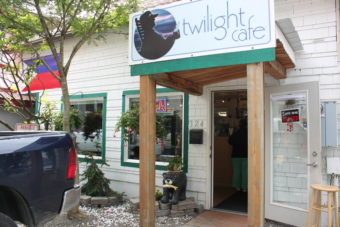
Juneau’s first storefront award has gone to Twilight Café on Willoughby Avenue. The Filipino-owned business won $500 for improving its entrance.
The Juneau Economic Development Council held the first Storefront Star competition this spring to encourage downtown business owners to invest in appearance.

Twilight Café co-owner Catherine Hill-Cristobal says she spent less than $1,000 on changes. She removed two parking barriers that blocked the front entrance, painted the window trim and other parts of the building, hung potted plants, added some landscaping and placed a small bear statue near the entrance.

“I just saw it in Fred Meyer and said, ‘Oh, that’s really nice.’ Because I was thinking more like a water buffalo because it’s more Filipino, but I can’t find it,” Hill-Cristobal says.

JEDC consultant Margo Waring was one of the judges for the contest. She says Twilight Café’s storefront is now more inviting.

“There’s been a significant change in the appearance of the building, its welcome-ness and also its accessibility to pedestrians. So they’ve really put in an enormous amount of work,” Waring says.

The Storefront Star Awards is part of JEDC’s ongoing downtown revitalization effort. Waring says a beautiful downtown will help Juneau remain the capital city.

Executive director Brian Holst says investing in a storefront means investing in the community.

“I think we all know that downtown Juneau is vital to our economy. It’s also a fun place to be and the more attention that we pay to how it looks, the better it will serve the whole community,” Holst says.

Bruce Abel won an award for the exterior redesign of the old Salvation Army building that now houses the Heritage Coffee Roasting Co. offices and plant. Goldstein Development Co. also won for improving the corner of Front and Seward. Annie Kaill’s owner Colleen Goldrich received a $100 prize for People’s Choice award.

JEDC is currently working on a project called Winter Windows encouraging seasonal businesses to think about storefronts even when they’re closed.

Juneau’s Filipino Community raises $21,000 for typhoon relief

Juneau’s Filipino community will contribute more than $21,000 to the relief effort for victims of Typhoon Haiyan in the Philippines. That’s the amount raised during Saturday’s fundraising dinner.

The dinner was scheduled to start at 5 pm but by 4:45, there was already a line of people waiting outside the Filipino Community Hall in downtown Juneau.

By 5:15, the building was packed. “It’s pretty busy,” says Mayden Cristobal, who was selling tickets. “We are swamped. There’s a lot of people and we have a lot of donations.”

Tickets cost $15 per plate. “Some were paying $50 and some were giving out $100 bill for a $15 plate dinner,” says Dante Reyes, president of Filipino Community, Incorporated.

Shortly after Typhoon Haiyan struck the Philippines November 8th, the non-profit decided to cancel its annual free Thanksgiving Day meal and, instead, hold a fundraising dinner and auction.

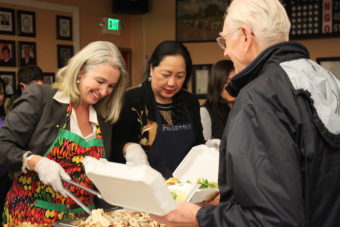
State legislators and past and present assembly members stood with members of Filipino Community, Inc to help serve food to about 515 people. The evening brought in more than $21,000. Reyes says some of the gifts were very personal, like Gabriel Kelley’s donation. Reyes says Kelley was raising money for his own trip to France and decided to give half of it to the fundraiser.

“I opened the envelope and I was very, very surprised with the amount. It was a $1,000 check,” describes Reyes. “I am not an emotional person but at the time I am holding back something. Somebody – not a Filipino, not related to a Filipino – instead of having that for himself, he shared it to those who need that big amount of money in the Philippines.”

A portion of the total money raised will go to Juneau’s sister city in the Philippines, Kalibo, which is in Aklan province. “Aklan, too, was damaged by Typhoon Haiyan,” explains Reyes. “It is also on the path of Typhoon Haiyan going out of the Philippines. And it also has devastated not only homes and properties but also some human lives.”

Josielind Ferrer is on the Filipino Community, Inc. board of directors. Ferrar is from the Visayas region, one of the areas hardest hit by Haiyan. Almost every Filipino at the fundraiser was affected in some way by the typhoon.

“We are doing okay,” says Ferrer. “As far as mental, emotional, we are hanging in there. We’re all strong, keeping everybody strong for each other, but with the help of the community – the whole Juneau community – this is definitely giving us more of a boost.”

She says she was overwhelmed by how many people were at the dinner, especially since it was such a last minute event, “but it looks like, just like the Filipino community, Filipinos managed to put it all together and hang in there and like they say, rise up Philippines, and we will do that.”

Reyes says funds will go to a few different organizations, including an international foundation based in the US and Philippines, Catholic Relief Services, and Red Cross.


Juneau’s Filipino community plans relief efforts for Typhoon Haiyan victims

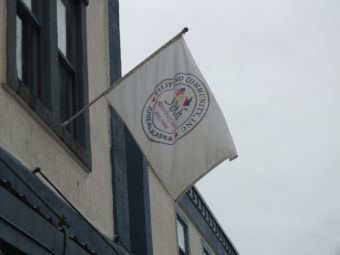
Filipino Community Inc flag
Juneau’s Filipino Community Inc. celebrated its 50th anniversary in 2006. Photo by Casey Kelly/KTOO.

Juneau’s Filipino community is pulling together to help the victims of Super Typhoon Haiyan, which hit the country early Friday morning.

Thousands are feared dead and injured from the storm, one of the most powerful ever recorded. According to news reports, at least 300 people are confirmed dead on Samar Island in the central Philippines. Another 10,000 people are believed to have died in Tacloban city on Leyte Island, near Samar.

The storm knocked out power and communications to much of the central Philippines. Dante Reyes is president of Juneau’s nonprofit Filipino Community Inc. He’s from Aklan province, where close to 10,000 homes were destroyed.

“We’re still waiting for some reports coming in from our relatives and from some of our friends what happened to them, or are they okay, or fine or something like that,” Reyes says. “So, it’s really hard.”

Filipino Community Inc. held a membership meeting on Saturday, where Reyes says they decided to cancel the organization’s free Thanksgiving Day meal. Instead, the group will donate the $3,000 dollars budgeted for the event to relief efforts. In addition, there will be a fundraising dinner on Saturday November 23rd at the Filipino Community Hall downtown on Franklin Street.

“We will be having the traditional American and Filipino dishes,” he says. “So we will have turkey for sure. We will have a Filipino kind of beef steak – we call it Bistek. So we’re planning to have a community-wide fundraiser for the event. And hopefully we can raise money to help the victims of the typhoon.”

He says the meal will cost $15 per single adult, or $25 for a couple, and $5 for children. More details will be available as the event gets closer.

Reyes says anyone who wants to offer to help can contact him on his cell phone at 321-6235.

CBJ Assembly endorses Sister City relationship with Philippine city Kalibo

Kalibo Airport
Kalibo Airport. Photo courtesy oasis li/Flickr Creative Commons.

The Juneau Assembly has endorsed a Sister City relationship with the Municipality of Kalibo in the Philippines.

Kalibo is the capital of the Philippine province of Aklan.

After retiring from the U.S. Coast Guard four years ago, Mendenhall Valley resident Larry Snyder says he and his wife, who is Filipino, began living half the year in Kalibo. Snyder says establishing a Sister City relationship could help forge economic ties, especially for Alaska seafood.

“This might be a wonderful opportunity for Southeast Alaska, Juneau in particular, to reach out with some of our products, and some of our knowledge on seafood,” Snyder said. “And I know that Kalibo would be receptive to such ideas.”

Filipino Community, Inc. President Dante Reyes hails from near Kalibo. He also spoke in support of the Assembly’s resolution.

“On behalf of the more than 800 Aklanans in the municipality of Juneau, out of the 3,000 Filipinos, we are in support of the CBJ proclamation,” Reyes said.

Now that the Assembly has adopted the resolution, Juneau’s Sister Cities Committee can proceed with the steps necessary to formalize the Sister City relationship.

Juneau’s other Sister Cities include, Whitehorse, Yukon in Canada, Chia Yi City in Taiwan, Vladivostok in Russia, and Mishan City in China.

Site notifications
Update notification options
Subscribe to notifications