Filipinos in Alaska

Consulate’s visit to Juneau delivers services for hundreds of Filipino Alaskans

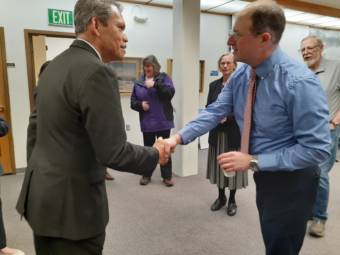
Consul General of the Philippines Neil Frank Ferrer shakes hands with Alaska State Sen. Jesse Kiehl at Juneau’s Assembly Chambers during a meeting between the Philippine Consulate and local and regional representatives. (Photo by Pablo Arauz Peña/KTOO)

Several hundred Filipino Alaskans from around Southeast gathered at Centennial Hall in Juneau this week to get much-needed services from the Philippine Consulate. 

After two years and a pandemic-related delay, the consulate’s mission from San Francisco meant some Filipinos in Alaska could finally visit their families back home.
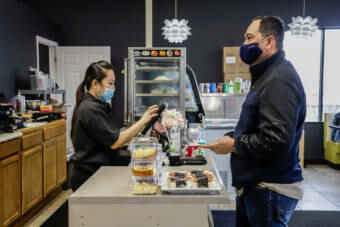
A line formed behind a table in the lobby of Centennial Hall, where Filipino Alaskans waited to get services to renew visas, passports and apply for dual citizenship. Masked volunteers took the temperatures of each person before they entered the main hall.

The Philippine Consulate’s regional office is based in San Francisco and serves most western states, from Colorado to Alaska. Typically, Filipinos who need services have to travel there to get them — but a visit like this saves them a lot of time and money.

Nora Carrillo is a volunteer and also applied for her dual citizenship in the Philippines with the consulate.

“It is nice for them to come over here and do dual citizenship instead of us going to San Francisco because it takes a lot of time,” she said. “Plus, it’s expensive. So we’re really thankful for them to come up here.”

Rebecca Carrillo is the Honorary Consul to the Philippines in Juneau. She says the consulate’s visit had been originally scheduled for last year, but the COVID-19 pandemic halted those plans. As a result, there was a backlog of people in need of consulate services. 

“For us here in Alaska, many Filipinos, Filipino-Americans, who would otherwise just be able to fly to San Francisco to receive services in person were unable to do so, thereby increasing the surge in the volume of calls at the Philippine Consulate,” she said.

Carrillo also says that travel restrictions to the Philippines meant that Filipinos in Alaska couldn’t visit their families back home. 

“There was a period when foreigners were not allowed to be issued visas to travel to the Philippines under certain type conditions, which includes if they are a parent of a Filipino child with disabilities, whether they’re serving on a humanitarian mission or their business,” she said.

Edric Carillo is president of the Juneau-based Filipino Community Incorporated. He says several hundred people from around Southeast Alaska were in need of the consulate’s services.

He says the consulate’s visit means that the Filipino community in Juneau is recognized alongside bigger communities in the country.

“That a small community of, you know, 30,000 plus people can, you know, rally together enough to get that level of recognition really, you know, is a testament to the community here and, and other communities in Alaska,” he said.

Consulate General Neil Frank Ferrer led the mission and says he’s happy with the turnout.

“The consulate, prior to the pandemic, has been making Alaska a priority for the outreach services. But now that the pandemic is more or less under control, I intend to come to Juneau and to Alaska every year,” he said.

The Philippine Consulate was in Juneau July 8-9 and in Fairbanks July 11-12. The consulate will be in Anchorage on August 26.

Juneau restaurant highlights women chefs of color

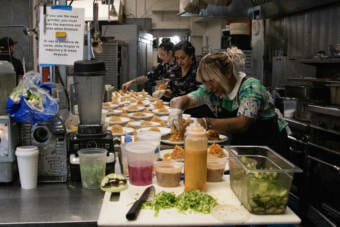
Rachel Barril works in the kitchen of Juneau Italian restaurant In Bocca Al Lupo for their event "Dinner with Friends: Womxn of Power edition" on June 26. (Photo by Lyndsey Brollini/KTOO)
Rachel Barril works in the kitchen of Juneau Italian restaurant In Bocca Al Lupo for the event “Dinner with Friends: Womxn of Power edition” on June 26. (Photo by Lyndsey Brollini/KTOO)

Juneau Italian restaurant In Bocca Al Lupo staff wanted a dinner party. But they also wanted to highlight women chefs of color.

So, they hosted Dinner with Friends: Womxn of Power Edition.

When doors to the downtown Juneau restaurant opened, a long line of well-dressed people streamed in. It was clearly a fancy night out for the 40 people who packed into In Bocca Al Lupo’s dining room for the sold-out event. And they were excited. Between the conversation and kitchen noise, the room was loud.

Everyone was checked in at the front door by staff to make sure they were vaccinated — a requirement to attend.

Back in the kitchen, music played loudly through the speakers while chefs prepared their dishes of the night. They were chopping vegetables, drizzling sauces over samosas, adding vegetable toppings to pancit.

Two chefs are Filipino: Aims Villanueva-Alf and Rachel Barril, and two are Mexican: Claudette Zepeda and Amara Enciso.

Claudette Zepeda works in the kitchen of Juneau Italian restaurant In Bocca Al Lupo for the event “Dinner with Friends: Womxn of Power edition” on June 26. (Photo by Lyndsey Brollini/KTOO)

Each chef made a dish that represented their culture. They also made some surprising twists to the dishes they grew up with.

And that noisy dining room? It got real quiet as people enjoyed the fusions.

Villanueva-Alf chose pancit as her dish because it represents how people made it through the pandemic.

“Pancit is about longevity,” Villanueva-Alf said. “And so, I just wanted to say that when the girls and I were here prepping everything, hearing all of you guys, and like the bustling and talking … We missed that.”

Villanueva-Alf, Barril and Enciso are all local chefs in Juneau. Zepeda is from San Diego.

Beau Schooler, co-owner of In Bocca Al Lupo, became friends with Zepeda through Instagram last year.  When Schooler and Alicia Maryott started talking about bringing Zepeda up for the dinner, Maryott had the idea of centering women chefs of color in Juneau.

“White men, in particular, get a lot of support, you know, from big money and corporations and just like, being elevated by accolades that, I feel like, have been centering white men for a long time,” Maryott said.

So the evening was just as much about pushing back against race and gender barriers as it was about having a dinner party. It also gave the women involved some space to experiment in the kitchen.

“There are other ways to just uplift and center and celebrate people of color, but women of color in particular in this situation, without, you know, having to shout from the rooftops that they have Michelin stars or James Beard nominations or whatever,” Maryott said.

Diners wait for the first course of a six-course meal being served at In Bocca Al Lupo's event "Dinner with Friends: Womxn of Power edition" in Juneau, Alaska. (Photo by Lyndsey Brollini/KTOO)
Diners wait for the first course of a six-course meal being served at In Bocca Al Lupo’s event “Dinner with Friends: Womxn of Power edition” in Juneau. (Photo by Lyndsey Brollini/KTOO)

Rachel Barril said that 10 years ago when she first started out, she thought the industry was more male-dominated, but that it is starting to change.

“The kitchen atmosphere has moved away from that, the very strict kind of like military-style, brigade style, old school French kind of hierarchy,” Barril said.

Barril works at In Bocca Al Lupo. She is a head chef at the restaurant, but she prefers going by cook. She said they don’t like using hierarchical terms in their kitchen.

Part of that change in kitchen dynamics, Barril thinks, is because a new generation of people are now owning restaurants and running kitchens. She also thought this change helped to make kitchens more inclusive.

“Haven’t really felt any, experienced any, like, I was at a disadvantage because I was female. Especially considering I dress very different for a female,” Barril said. “I never really felt that. And so, if anything, Juneau’s pretty accepting I think.”

The dish Barril prepared for the dinner was mushroom kare kare, a Filipino peanut stew. She added her own twist, and local ingredients, to the dish. She used a peanut miso she made for the base, wild mushrooms and beach greens collected locally.

“But it was, it was nice getting to do some creative stuff again. It was a relatively easy night. The food turned out pretty well. It seemed like the diners enjoyed the food,” Barril said.

And Barril really enjoyed working with the other chefs, who are all people she is friends with and admires.

Anchorage’s small international eateries, used to takeout, found a growing market during pandemic

Staff and family at Jeepney Filipino Hawaiian Fusion Food pose for a quick photo between to-go orders on a weekday afternoon in April. (Jeff Chen/Alaska Public Media)

It’s been a hard year for many restaurants in Alaska, but low prices and customers’ expanding palates have helped Anchorage’s small, family-owned eateries fare better than others during the pandemic.

Three-quarters of the new restaurants that opened in Anchorage in 2020 serve cuisines from countries across the globe, including the Philippines, the Caribbean, Greece and India, according to the city’s food permit records. Anchorage Daily News restaurant critic Mara Severin said it makes sense that smaller, family-owned eateries have done better than established fine-dining restaurants. Many have adapted quickly to social media marketing and online ordering for takeout.

She’s watched the expansion over a number of years.

“It used to be ‘Have you tried this new Indian restaurant?’ Now it’s ‘What’s your favorite Indian restaurant in town?’” she said.

And there’s the food itself. Many businesses did lots of takeout before the pandemic and their customers were already used to purchasing food that way. Businesses with large dining rooms that did less takeout had to help customers see their food as takeout food. In some cases that can be a challenge.

“I don’t particularly want to eat a filet mignon out of a cardboard box,” said Severin

Jeff Bumagat-Hidalgo, co-owner-manager at Jeepney Filipino Hawaiian Fusion Food, prepares an order of butter garlic shrimp on a weekday afternoon in April. (Jeff Chen/Alaska Public Media)

Severin said many of the restaurants that really excelled during the pandemic found creative ways to reach their customers. That often meant harnessing social media, using ordering apps, and encouraging outdoor dining or even tailgating.

Hawaiian-Filipino fusion restaurant Jeepney, located in South Anchorage, is in the middle of an expansion. A decade ago, owner Donna Manalo and her husband decided to open the restaurant on little more than a love of the food of her youth.

Now she has two food trucks, owns a store in a strip mall across from the Dimond Center, just opened a new storefront on JBER, and has plans to take over the former location of Arctic Roadrunner.

“We have big plans for it,” Manalo said.

Their restaurant has evolved since her husband suggested the idea of opening a restaurant 10 years ago.

“He had no experience of cooking or nothing, but he saw the lack of Filipino food in Alaska. And I was like, ‘Okay, sure, let’s do it,’” she said.

Through the pandemic, their customer base has grown, thanks to a quick pivot to online ordering. There is a broader demand for some of the food they serve — like dinuguan, a pork blood stew or lumpia, deep-fried Filipino-style egg rolls.

“I’m gonna say about 95% of our customers are not Polynesian or Filipino,” said Manalo.

Manalo has been adapting her menu over the past years, astutely catering to local tastebuds, such as her take on adobo burritos.

“Burrito is not a thing in the Philippines, but it is in America. So when they tasted that, we were like ‘Okay, this works, now let’s kind of try to introduce other dishes that we love from home and maybe they’ll like it too,’” she said.

Mona takes an order from a customer at Jeepney Filipino Hawaiian Fusion Food on a weekday afternoon in April. (Jeff Chen/Alaska Public Media)

They also just introduced poke nachos, and have low-carb Keto options on their menu. Their entrees are also affordable, with most around $15.

Manalo said her biggest challenge right now is finding enough employees to staff the new restaurants.

Asian Alaskans grapple with anti-Asian racism, feeling unsafe after Atlanta shootings

Leslie Ishii is the artistic director at Perseverance Theatre Artistic Director in Juneau, Alaska. (Photo by Rashah McChesney/KTOO)

Last week, a string of murders targeting spas in the Atlanta area left eight people dead, including six Asian women. The tragedy amplified the conversation around anti-Asian hate, racism and violence in the United States, heightened in the last year by COVID-19 misinformation and stereotyping.

Reports of hate crimes targeting Asian Americans have increased dramatically over the last year. Stop AAPI Hate, which tracks anti-Asian harassment and violence, reported 3,800 incidents in the U.S. since the start of the pandemic through last month.

But the shootings in Atlanta were an inflection point for many Asian Americans already struggling to feel safe within their communities over fears of gender and race-based violence.

“This wasn’t the first time for me. Throughout my entire life, I’ve experienced this,” said Leslie Ishii, a theater artist and a fourth-generation Japanese American woman based in Juneau. Ishii said anti-Asian stereotypes, particularly of Asian women, have made her feel like an outsider her whole life.

“I’ve had people walk up to me and touch my hair and say, ‘Oh, your hair is so smooth and black,’” she said. “We’re not seen as fully human in that moment, we’re seen as something very exotic.”

COVID brought another layer of stereotyping. Last week at a grocery store, a shopper accosted her, blaming her for the spread of the coronavirus. The same thing happened a year ago in Minneapolis.

“I was walking down the street to go to the theater, and someone yelled across the street and just kept yelling at me: ‘It’s the Chinese flu. It’s your fault.’”

Now, Ishii said, she thinks twice about what time of day she shops, keeps an eye out for store exits and tries not to be alone in a grocery aisle.

In the wake of last week’s killings, Ishii, who serves as artistic director for Perseverance Theater, has been holding spaces to grieve with her theater community and drafting statements calling on theater and film industries to stop perpetuating stereotypes.

She said she hasn’t gotten a lot of sleep.

“I grieve off and on. I think of artists that I know who have been accosted or abused,” she said. “I think about, of course, the victims and the families.”

Chris Stuive is a counseling professor in Kenai. She is a Korean American adoptee, raised by white parents in Michigan.

In the years she’s lived in Alaska, Stuive said it’s sometimes difficult to parse out what’s racism and what isn’t. Sometimes it’s overt, such as a kid at daycare calling her son a “g—” — a derogatory term for Asian people that may have originated during the Korean War.

But there are also subtle things, like being stared at in the grocery store during the pandemic. Last week, a man started barking at her at the gas station. Processing all of it, wondering if she’s being singled out for her race, is exhausting, she said.

“It takes a lot of emotional energy,” she said. “You’re kind of left with this emotional residue that you have to sit with and wonder. And then you feel guilty, like, ‘Am I overreacting?’ … and then you beat yourself up for giving negative thoughts space. It takes attention away from other things that I’d rather be doing, or that would make the world a better place.”

Having grown up in a white family, Stuive grappled a lot with her identity. Internally, she said, she feels white — but every once in a while she’s reminded that’s not how she’s perceived.

“It really hurt my heart to think just based on what I look like, I could be accosted,” Stuive said. “I know that based on what I look like, I’ve been dismissed [or] paid less money than I should be. But the idea that I could just lose my life walking down the street, in the United States, that’s pretty unreal, right? But it’s happening.”

Stuive said the last few years have made her more alert and cautious, knowing she or her family might be a target. And having witnessed racism in Alaska — and seeing people ignore it — she doesn’t think Alaska is immune to the rising tide of hate crimes in the Lower 48, she said.

“In the past, I would have thought, ‘Oh no, this is just like an isolated event.’ But there’s just been so many things that are just straight-up hateful. It’s really hard to dismiss them all,” Stuive said.

Tom Li (left) and a person who didn’t want to be identified hold signs saying “Hate is a virus” and “Stop Asian hate” at the corner of Dimond Boulevard and Old Seward Highway Saturday, in response to increased anti-Asian racism and violence. (Jeff Chen/Alaska Public Media)

That diminished feeling of safety is something many Asian Alaskans are grappling with. Tom Li is a software engineer who moved to Alaska from Fuzhou, China 10 years ago to attend college and be with his father.

Li fell in love with the state and its people. An Anchorage resident, he calls himself Alaskan first, then American. But on more than one occasion, Li said he’s endured racist threats and harassment, even found himself cornered by white men larger than him, hurling insults or trying to pick fights.

“‘You look ugly.’ ‘Go back to your country,’” Li recalled some saying.

Every time something like that happens, Li said he feels upset for a few weeks. After one particularly confrontational incident — two men stopped Li and his then-girlfriend to harass them on the sidewalk — Li decided to start carrying a gun. And he doesn’t go to bars alone because it doesn’t feel safe.

“I don’t want to get into fights, I don’t want to risk my life when there is so much good things out there,” he said.

Last Saturday, Li and a friend waved signs denouncing the Atlanta shootings on an Anchorage street corner. A lot of people honked or gave thumbs up, one yelled “All lives matter,” and some just ignored them, he said.

Li said Asian communities don’t always feel visible beyond restaurants in Anchorage, and he wanted to bring awareness to the fact that anti-Asian hate exists up here, too.

“One of the women who died in Atlanta, she had two boys,” he said, referencing Hyun Jung Grant, a single mother who worked at one of the targeted spas. “My mom raised two boys. I almost see my mom in the pictures.”

Racist rhetoric around the coronavirus, which originated in Wuhan, China, may have amplified anti-Asian hate in the last year, but Asian Americans and scholars contend that it’s not new. E.J. David grew up in the Philippines, moved to Utqiaġvik as a teenager and now studies the psychological effects of historical oppression at the University of Alaska, Anchorage.

“The Filipino and Chinese cannery workers in the early 1900s — they were segregated, and the separation was not equal,” he said. In addition to poorer living and working conditions, Asian cannery workers were paid less than their white counterparts.

In a study a few years ago, David and his colleagues found more than half of Asian Alaskans experience harassment, violence and other forms of racism in their daily lives. Nationally, Stop AAPI Hate found Asian women report hate incidents more than twice as often as Asian men.

David said that trend of gendered racism is also familiar in Alaska, with the high number of missing and murdered Indigenous women and girls and the high rates of violence against Native women.

Asian Americans and Pacific Islanders make up the third-largest demographic group in Alaska, after white and Alaska Native people. But like Li, David thinks they’re not always visible.

In Anchorage, he said “we tout our diversity a lot, but we don’t harness it, we don’t let it influence our leadership, we don’t let it influence the direction of where our city should go.”

Processing the Atlanta shootings over the last week, David — who has experienced his own share of profiling and race-based harassment — said he felt saddened and enraged, but not surprised.

“I’ve seen it coming, not just because of the past year. I’ve seen it coming because of my entire life. And because I study history, I’ve seen this coming because of 200 years of history,” he said.

David said there’s a throughline between centuries of discrimination and stereotyping and the violence seen last week.

“What they do is they paint people as less than whole. It distorts what people really are, which is a full, complex human being. And once you start distorting your regard for people, once you see them as less human, then you’re more likely to commit violence against them.”


Filipino American History Month

Friday, October 16, 2020.

In honor of Filipino American History Month, we’ll spend the hour in in conversation with moderator Edric Carrillo and representatives from the Filipino community and Filipino Community Inc. They’ll discuss their history, personal stories, experiences of life in Juneau, and more.

Part 1: Conversation with Edric Carillo, Rebecca Carillo, and Sabrina Javier

Part 2: Conversation with Edric Carillo, Rebecca Carillo, and Sabrina Javier

Part 3: Conversation with Edric Carillo, Rebecca Carillo, and Sabrina Javier

That’s Friday, live at 3:00 p.m. on KTOO Juneau 104.3, online at KTOO.org, and repeated at 4:00 p.m. on KRNN 102.7.

Community Connection: Miriam Wagoner

Community Connection is a segment on KTOO’s Juneau Afternoon where listeners share personal stories, reflections, poetry or music about life in these strange times.

Miriam Wagoner is author of national award-winning, “A Poem Book From My Kaasei Nook To The World.” She was born in the Philippines but has lived in Juneau for about two decades.

“During this pandemic, I would like to contribute to Juneau Afternoon’s Community Connection and share the poem, “One Word, One World.” I worked hard collecting and researching the foreign words written in this also award-winning piece. Hope you enjoy and please take care” – Miriam Wagoner


Click here for instructions on how to submit your own Community Connection piece.

Site notifications
Update notification options
Subscribe to notifications