Filipinos in Alaska

Alaska House bill would start process to rename highway named after convicted war criminal

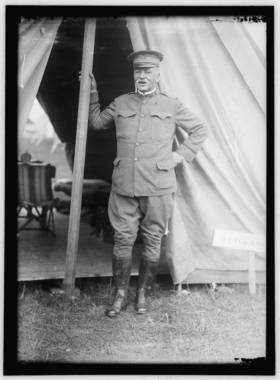
Edwin F. Glenn in 1916. (Photo from Harris & Ewing via the U.S. Library of Congress)

The Glenn Highway, which connects Anchorage to Glennallen, is named after Edwin Glenn, who oversaw U.S. Army expeditions in Alaska in 1898 and ’99. Glenn was convicted of committing war crimes in the Philippines the year after he left Alaska.

A bill working its way through the state Legislature would start the process of renaming the highway. But one House member is calling House Bill 352 a case of cancel culture.

Glenn was a career army officer. In the late 1800s he oversaw two expeditions in Alaska. Then he went to the Philippines, which at the time belonged to the United States — a trophy from the Spanish-American War. The Filipinos were fighting for their independence.

Anchorage historian David Reamer said that Glenn ordered soldiers to waterboard a Filipino man.

“When we say that he was a torturer, we say this because he admitted this,” Reamer said. “He admitted to doing these things. He admitted to ordering it. He admitted to overseeing it. He was there at times of torture. ”

Waterboarding simulates drowning and can cause lasting physical and psychological damage.

Soldiers who witnessed what happened talked about it after returning home, leading newspapers to report it. That led President Theodore Roosevelt and his secretary of war, Elihu Root, to order an investigation.

When Glenn was court-martialed, he admitted to what he did but denied it was torture. He was found guilty, paid a fine and was suspended from his command for one month.

Now Alaska lawmakers are considering a bill that would provide a process for renaming the Glenn Highway. It would require the state to consult with tribes, Alaska Native organizations and communities in the area to gather input on the new name.

Big Lake Republican Rep. Kevin McCabe opposed the bill at a March 1 House Transportation Committee meeting.

“This is cancel culture. I want that on the record,” McCabe said. “This is canceling somebody who when he did waterboard did not think it was torture. You make it sound like we’re pulling fingernails and that sort of thing. Waterboarding is accepted even today.”

That hasn’t been true, ever since former President Barack Obama prohibited government agencies from using waterboarding.

McCabe said Alaskans don’t know what Glenn did because they didn’t witness it.

“If I look at this bill, if you want to know the truth, this is a bill right here to besmirch the name of a guy that’s long dead,” he said. “Who cares? The guy is long gone. That’s all this bill does is besmirch his name.”

Joshua Albeza Branstetter is a member of AKAPIDA, the Alaskan Asian, Pacific Islander, Desi American association. He said changing the Glenn Highway’s name would recognize the role Filipino Americans have played in the state for 100 years.
“But for this highway to be named after someone who was, for lack of a better term, canceled by the U.S. military and by Teddy Roosevelt, who approved the findings in his case for his war crimes in a war that cost the lives of over 200,000 Filipinos,” he said. “That history has in turn been canceled from our school books.”

Lisa Wade is a member of the Chickaloon Native Village. The highway was informally named after the village, which it runs through, before being named for Glenn.

“This bill represents much more than a simple name change,” she said. “To me, it does not represent cancel culture. It represents an opportunity. It represents an opportunity to show respect and maybe even some reconciliation for past harms that were perpetrated against Alaska Native peoples during the time this highway was created, and even the harms to the other Filipino people as well.”

She said that area tribes generally don’t name things after people, but use the names of geographic features. She said that at the time the highway was built, her tribe suffered greatly.

“And history is not one-dimensional,” she said. “However, that history has long been told from one dimension and has resulted in the invisibility of the beautiful and unique Indigenous peoples at the glamorization of people like Edwin Glenn.”

State officials estimate renaming the highway would cost $2 million, to change the road signs and other things. But since the bill itself wouldn’t rename the road but just set up a process to do it, it wouldn’t cost the state anything if the Legislature passed it. That means the bill doesn’t have any cost listed on what’s known as a fiscal note.

For Anchorage Republican Rep. Tom McKay, that part doesn’t make sense.

“It said there’s a zero fiscal note, but we did rename it, there would be a fiscal note, because we’d have to pay for all the road signs to be changed, the maps would have to be changed.”

Anchorage Democratic Rep. Zack Fields introduced the bill.

“These tribal members have been in this corridor certainly a lot longer than I have and maybe we should seek their guidance about whether the Chickaloon Highway or the Katie John Highway or some other name might be the most appropriate,” Fields said.

The transportation committee hasn’t scheduled a vote on the bill yet.

New to Alaska, Filipino teachers find their rhythm in Aniak

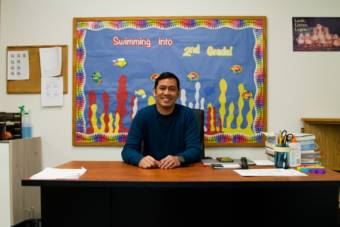
“It’s kind of a very shallow reason, but because of the snow. We don’t have snow there!” says Jay Mojello, of why he wanted to come to Alaska. Mojello is one of the many new teachers at the Kuspuk School District who are from the Philippines. (Photo by Olivia Ebertz/KYUK)

This school year, over half of the Kuspuk School District’s entire teaching staff is from the Philippines. And nearly all of them are new to the U.S.

Rovan Agad teaches math and coaches junior varsity basketball at the Aniak high school. He’s happy to be here, finally connecting with his students in person. He arrived from the Philippines in October 2021.

Rovan Agad teaches complex numbers to his students at the Aniak High School. (Photo by Olivia Ebertz/KYUK)

Agad was supposed to have started at the school a couple of months earlier, but a minor injury delayed his trip. He had to wait for a cut on his finger to heal before he could give his fingerprints to get a visa. So for the first two months of classes, Agad taught over Zoom from 1 a.m. to 7 a.m. Philippine time.

“It was hard to establish the connection, especially when you’re on screen,” Agad said.

But now that Agad’s here in person, the students are attentive, and even more so when Agad uses American slang.

“So that’s why I-squared is equal to negative one. Gucci?” Agad asked his class during a lesson.

“Gucci,” the class agreed.

Agad applied for teaching jobs in Alaska because he had been let go by his former school when it shut down during the pandemic. Agad isn’t the only teacher from the Philippines in Aniak this year. There are four, and they’re all roommates.

The Lower Kuskokwim School District also hired teachers from the Philippines this school year, though a smaller share of its new teachers are Filipino. Out of 82 new teachers the school district hired this year, 10 are from the Philippines.

At the Kuspuk School District, 19 of the 21 new teachers are from the Philippines, and 20 out of 39 of the district’s total teachers are from the Philippines.

Both school districts used the Alaska Teacher Placement Agency to hire teachers last year. A spokesperson for the agency said that it does not advertise in the Philippines, but accepts applications from all over the world. The spokesperson said that she saw an increase in the number of Filipino applicants compared to the year prior.

Kuspuk School District Superintendent James Anderson said that he didn’t necessarily look for applicants from the Philippines. Anderson said that he simply hired the best and most experienced teachers. It just so happened that nearly all of them were from the southern Philippines and speak a Bisayan language as their native language.

The Filipino teachers in Aniak all mentioned one reason to come to Alaska.

“It’s kind of a very shallow reason, but because of the snow. We don’t have snow there!” Jay Mojello said.

Mojello is a second-grade teacher. He said, like the other teachers, had a more serious reason for coming to the U.S. — the salary, which the Aniak teachers say is about 10 times higher than in the Philippines. Mojello needed to pay off his debt and send money back to his family.

Kaycee Limod had to leave her husband and 2-year-old at home in the Philippines. (Photo by Olivia Ebertz/KYUK)

So did Kaycee Limod, a sixth-grade teacher. But for her, it was an extra difficult decision to come to the U.S. She had to leave her husband and young baby at home.

“He’s already two. I just, I just miss him,” Limod said. “I asked him, if you can, please give me this opportunity. Be with our son, and then I’ll get you.”

Limod said that either she’ll join her family back in the Philippines or she’ll bring them to Alaska. She said she’s enjoying learning a new culture and gaining professional experience. That experience, Limod and the other teachers said, has come with growing pains.

“Every time I give them instruction, they don’t listen to me. And the first week, first, second week there I was here, I was really crying. Every time I go home, I always cry because I feel like I’m not an effective teacher,” Limod said.

But she said now, about halfway through the school year, she and the students have found a good rhythm. 

There’s a good rhythm at home too. The four Filipino teachers share a four-bedroom, one-bathroom apartment across town. They said that it helps them save on costs.

The teachers haven’t decided yet whether they’ll stay in Aniak for another school year. They say that overall they like Aniak, but they dislike the nearly hour-long walk to school on cold, dark winter mornings, and the lack of emergency medical care available in the community.

But if they leave, they said they would miss their students and the camaraderie.

Rovan Agad has been blending Filipino and Alaskan flavors in the kitchen. (Photo by Olivia Ebertz/KYUK)

On Fridays, the four colleagues hang out and watch movies. 

Each day, the men cook and the women do the dishes. Mojello makes breakfast and Agad makes dinner. He’s been blending Alaskan and Filipino flavors in the kitchen. They say that the community has been generous with gifting them subsistence foods.

“We had moose adobo. We got moose tapa. We also had salmon,” Agad said.

The teachers have until Mar. 4 to let the school know if they’ll be returning for the 2022-2023 school year.

Juneau’s solution to the national health worker shortage? Hire locals and pay to train them.

Marchan Putong, who works at Bartlett Regional Hospital, recently finished her coursework and passed her CNA exam. The hospital is training new staff from the community to address the shortage of health care workers. (Claire Stremple/KTOO)

Alaska, like the rest of the nation, has a shortage of health care workers. In Juneau, care facilities have found a local solution to that problem: they are paying people to get certified as nursing assistants.

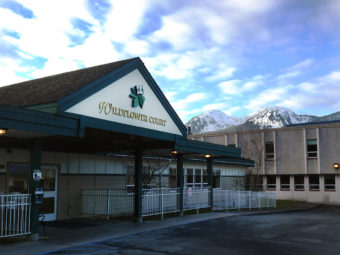
Wildflower Court, a nursing home in Juneau, closed an entire wing of its facility in early October because it didn’t have enough staff to operate it. Kirk Elmore, the nursing home’s administrator, says he would need to hire 11 certified nursing assistants, or CNAs, to open it back up.

But because of a national health worker shortage, he can’t find them.

So Elmore teamed up with Bartlett Regional Hospital, where they’re training new staff from the community — and he’s paying people to get certified.

“We’re providing them an hourly wage, as they’re taking the class we pay for the class. And we also pay for their licensing, with a commitment for them to come and work for us after they finished the coursework,” he said.

He says it’s an up-front investment for Wildflower Court, but it’s worth it. He gets to give staff that may already be employed with him a leg up to a better job. He says the investment stays in the community, which is a contrast to paying higher wages and fees for temporary traveling nurses.

Bartlett Regional Hospital’s staff development director, Jennifer Twito, says the hospital has also been fighting an uphill battle to keep nurses and CNAs. It’s why they started to train their own.

“It’s hard to recruit people into Juneau sometimes,” she said.

But just 18 hours after she posted the training offer, she says she had more local applicants than she could handle.

Twito says emergency regulations related to the pandemic make the program possible. Alaska usually has some of the most stringent requirements in the country for aspiring CNAs, but it has cut requirements in half during the public health emergency.
That expires at the end of the year. Twito says she’s not yet sure if the program will continue after that, but the hospital has made the most of the window. Her staff has trained a dozen locals in the first two cohorts. She’s got seven people signed up for another session this month.

“We’re creating career pathways for so many people in Juneau who maybe wouldn’t have an opportunity to get into the, you know, maybe they can’t get into the UAS program, because it’s always full. Maybe they don’t have the means to travel outside of Juneau to go to another program,” Twito said.

One of those people is Marchan Putong, who is now on a shift on Bartlett Regional Hospital’s third floor. Putong recently finished coursework and passed her CNA exam.

“I waited for so long, and this is it. I grabbed the opportunity,” she said.

Putong was a midwife in the Philippines until she moved to Juneau 11 years ago. She tried to take CNA training at the University of Alaska Southeast but didn’t pass the English exam. She found out about the opportunity at Bartlett because she was already working there, in housekeeping.

“For me, I start from the very low position, and then I go to CNA training program. And I get the job and it’s very easy because I already know the the building and other facilities, and they know me already,” she said.

The program has been a step up for several Bartlett employees. So far, only one Wildflower Court employee has gone through the training. But there are four more signed up this month. It’s not enough to reopen the closed wing, but it’s a step in the right direction.

First annual Filipino American Festival promotes community health, connections in Ketchikan

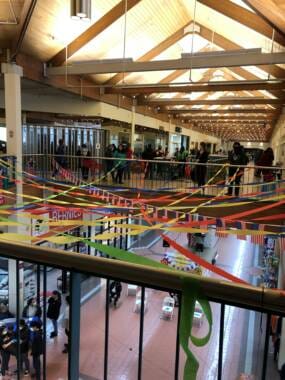
Ketchikan’s Plaza Mall was filled with chatter and music last Saturday as the first annual Filipino American Festival was in full swing. The event fell only two days before the anniversary of the first recorded arrival of Filipinos to the West Coast over four centuries ago.

October marks Filipino American History Month. One of the organizers of the first Filipino American Festival, Alma Parker, says it’s a time to celebrate the contributions of Filipinos throughout history within the United States — a history particularly that is rich in Southeast Alaska.

“Well, the Alaskeros were what’s what they call the Filipino cannery workers that could immigrate here due to the U.S. colonization. There was more freedom to come to the United States because they were considered U.S. nationals,” Parker said. “So there was an influx of workers to work in Southeast Alaska. I do know that. Ketchikan was the home to the first Filipino community club in the whole state of Alaska.”

The Filipino Community Club has records going back as early as 1938 at its original location on Stedman Street. Parker says she has fond memories of a later  Community Club, open during her childhood.

She recalls it serving as a space where Filipinos from the community could come together, practice dances, celebrate, and voice concerns with the local government. Today, the center is gone — the site is now a gravel lot next to Ketchikan’s American Legion post.

Nearly 10% of Ketchikan’s population has Filipino heritage — one of the highest concentrations in the state. Parker says she hopes the festival can help Filipinos connect with each other and build community by celebrating their heritage. The main event of the festival included a traditional stick dance, performed by the high school dance team.

Parker, with her new position at the Ketchikan Wellness Coalition, has started a project called “Sama Sama Tayo,” which she says, translates to “gather together.” It’s funded by a $300,000 health equity grant from the Robert Wood Johnson Foundation.

The aim is to improve the health of Ketchikan’s Filipino community. While it might not seem like a cultural heritage festival is immediately related to health care, Parker says it’s about building community — which she says helps Filipinos connect with the health care resources they need.

“As the health equity program coordinator, my goal is to improve access to health care and health care outcomes for Filipinos in the community and eventually to the underserved. So by having an event like this, it allows the opportunity to maybe, you know, connect with people and then to ask questions to say, you know, what are some of your challenges and obstacles,” Parker said.

In the Philippines, the months September through December are known as the “ber months” — when Filipinos celebrate Christmas. One of the most classic festivities is the parol, traditionally a lantern made out of bamboo. Parker has teamed up with the Ketchikan Area Arts and Humanities Council to share this custom with the community. A parol-making class will be held the second weekend of November where adults are welcome to come and learn more and participate in the Filipino tradition.

How Juneau restaurant Black Moon Koven offered a path of healing

Aims Villanueva-Alf works in her restaurant Black Moon Koven on August 5, 2021 in Juneau, Alaska. (Lyndsey Brollini/KTOO)

Juneau restaurant Black Moon Koven opened up this spring very elusively and mostly through word of mouth. Its dark, moody ambiance has drawn a cult following.

Walking in, there is a lot to take in. There are large murals painted in the shop featuring eyes, skulls and mushrooms — art by local artist Jollene Chup. Other art and decorations in the restaurant include spiderweb macramé, skeletons, tentacles, coffins and an espresso machine with a Ouija board on it. 

Aims Villanueva-Alf, the owner of the restaurant, said that the art is a reflection of her personality. And everything in the restaurant, from the art to the plants, comes from her friends and local businesses.

Mural painted by Jollene Chup inside of Juneau restaurant Black Moon Koven. (Lyndsey Brollini/KTOO)

After taking in all the art, you can see a food and drink menu with a lot of different items, like fried rice, soup, salad, bahn mi, coffee and bubble tea. On the side there is a selection of croissants and spam musubi that change from day to day.

“So I wanted it to be a space where you walk in and there was just so much,” Villanueva-Alf said. “There’s so much to look at that every time you come back, you’re like, ‘Oh I didn’t notice that’ or ‘I didn’t notice that.’ But an experience to just order food in itself.”

Villanueva-Alf said she gets weird reactions from people about the restaurant all the time. Some customers walk in very confused.

“They’ll come in there and they’ll kind of look at us and be like — like they don’t belong there and then they leave,” Villanueva-Alf said. “But then they end up coming back because they see somebody that had like a sandwich or a salad or some soup.”

Croissants on display in Juneau restaurant Black Moon Koven. (Lyndsey Brollini/KTOO)

The food at Black Moon Koven is made from scratch as much as possible. She also uses local ingredients, like chicken of the woods mushrooms and fiddlehead ferns, when they are in season. Other items on the menu, like ube scones, are influenced by her parents and her Filipino background. 

The key, for her, is making nutritional food that tastes good and makes your body feel good too.

“I want to be able to provide a positive habit for somebody, or at least change their narrative on food and what it means to be healthy,” she said.

Villanueva-Alf does not want people to associate food with dieting or restricting. She hates those words. Instead, she is aiming for intentional eating and sustainability in the food she makes. In the future, she is hoping to provide this through food subscriptions, but those are currently still in the works. 

In addition to offering healthy and tasty food, she wants the space to feel safe for people.

“But I always think back on how everyone has, like, a favorite spot that they just like to chill,” she said. “And when I was thinking about my time in Portland, there was always that spot that just felt safe, even though I was away from home.” 

The name of her restaurant came from that coffee shop. One day, Villanueva-Alf came in after a hard day. Another regular, a tarot card artist, said, “Oh no, Black Moon is having a rough day.”

When Villanueva-Alf asked what that meant, the artist told her that she would find out in time. She didn’t think anything of it in the moment. It was just a nickname someone called her once. But in March of 2020, the meaning of Black Moon changed completely. To her, it became a time when creativity and intentions are intensified. 

The catalyst for that change was Villanueva-Alf’s old restaurant GonZo. It was this wildly popular, Auke Bay restaurant that she owned for nearly seven years. Like Black Moon Koven, it had an uncommon menu and a cult following. 

When GonZo closed suddenly last year, a lot of people wondered why. On social media, they speculated that it was because of the pandemic. She told everyone that was not the main reason at all, but she was also not ready to talk about it yet

Now, she is. 

“I feel like this would be freeing for me to be like, ‘Yeah, at the end of 2019, a horrific assault happened in the space of GonZo. And it was physically and psychologically hard for me to be in a space where trauma was dwelling,’” she said. 

A few months after she was attacked, the pandemic happened and pushed Villanueva-Alf into shutting down GonZo. At the time, it was a temporary closure.

But one night, while she was running downtown, she saw the empty space that would become Black Moon Koven. 

The outside of Juneau restaurant Black Moon Koven. (Lyndsey Brollini/KTOO)

It was a full moon, so later that night she was planning to burn some old journals.

“So I was doing like a burning ritual and I was going through all my journals and the one from 2013 popped up and it said ‘Black Moon rising,’” she said. 

At that moment, she knew something had to change. She decided to keep GonZo closed for good.

It’s a big risk to open a restaurant during the pandemic, but her gut told her to just do it.

“I feel like Black Moon was my way of healing through my trauma and continually is a place where it could be, and seems super dark to people, but it actually brought a lot of life and light into my own darkness,” she said.

When Black Moon Koven opened in April 2021, she had a Mary Oliver quote posted in the window. To Villanueva-Alf, it is the crux of her Black Moon Koven philosophy.  

It reads: “Are you breathing just a little and calling it a life?”

Filipino teachers fill staffing gaps in Lower Kuskokwim schools

Amparo Faraon (left), Imari Gracetan (center), and Socrates Embesan (right) are new LKSD teachers from the Philippines. Photo taken at LKSD’s district office in Bethel on Sept. 7, 2021. (Greg Kim/KYUK)

A national teacher shortage, compounded by the COVID-19 pandemic, left the Lower Kuskokwim School District scrambling. With only a few months before the start of this school year, the district had dozens of teaching positions to fill. The district looked out of the country for solutions.

Over the past few weeks, new teachers for the Lower Kuskokwim School District have been arriving in Bethel exhausted after 36 hours of flying in from the Philippines.

Socrates Embesan is one of those Filipino teachers. He’ll be teaching math and science in Chefornak. In the Philippines, Embesan had been a college math professor in the landlocked province of Tarlac.

“It is quite a remote place because we are situated in the highland. No neighbors, no big numbers around. It’s just like this,” Embesan said.

In Tarlac, Embesan shared a home with his parents, his sisters, his brother, and several nieces and nephews. He said that his family keeps growing.

“And my salary is not increasing that much. So when I got this opportunity, I think right away, ‘This is a chance for the life that we have at the moment, the life of my family,’” Embesan said. “That’s the heart of the Filipino people. We are very close to our family.”

Embesan showed a picture on his phone of his 9-year-old nephew, who he has adopted as his own.

“That’s him. So he’s a big boy now and I entrust him to my sisters,” Embesan said.

Embesan said that in return, he will send his sisters a portion of his salary. The three teachers I talked with said that they were making four to five times more with LKSD than what they made in the Philippines. The average income in the Philippines is around $4,000 per year, according to the World Bank.

Out of 82 new teachers LKSD hired this year, 10 are from the Philippines. This is the first time that LKSD has recruited and hired teachers from outside the U.S. LKSD Human Resources Director Andrea Engbretsen said that the district has historically had trouble hiring enough teachers. But in recent years, she said that there has been a severe shortage of math and science teachers nationwide.

“It is really at a crisis point,” Engbretsen said. “Everywhere we go, I mean, just not even applicants. We can’t even find them.”

And then, she said, a pandemic made a bad recruiting environment even worse for potential hires.

“Many, many said, ‘I need to stay closer to home for family reasons,’ or just a fear of COVID, not wanting to leave their home areas,” Engbretsen said. “Which put us at another challenge of ‘Okay, now, how are we going to fill these positions?’”

That’s when Engbretsen heard about another rural Alaska school district, the Bering Strait School District, that filled its staffing shortage with teachers from the Philippines. She got on the phone right away.

“But the process is fairly lengthy,” Engbretsen said.

She said that there are embassy interviews and visa applications, and lots of paperwork, which is why the first teachers from the Philippines arrived in Bethel in September, after LKSD’s school year had already begun.

When they arrived, they were greeted by several Filipinos already living in town, including Glenda Swope, an LKSD preschool teacher in Bethel who immigrated from the Philippines in 2004. She said that she wanted to provide the new teachers a sense of familiarity. She knows the feeling of arriving in a foreign place.

“It’s like going in a ship and you don’t know who is the captain or, like, you don’t know where you go,” Swope said.

Swope said that at least 20 Filipinos live in Bethel. She said that some work as teachers like her, some are at the Bethel Youth Facility, but the largest number are nurses. She said that many Filipinos came for jobs. Others, like her, came to the U.S. after marrying an American. Swope said that moving from the Philippines to Western Alaska is not as drastic a change as it may appear.

“All of them, they said, ‘I feel like I’m home.’ Yeah, like, me too. Like, I feel like I’m home because we grew up in a simple life in a simple way. And we grew up with close knit families,” Swope said.

There are other similarities between the Filipino immigrants’ old and new home. Several teachers said that they brought dried fish in their suitcases, although not salmon or halibut. English is the second official language in the Philippines. And Embesan, the new teacher, said that a big aspect of Filipino culture is respect for one’s elders.

“And the way we show our respect to our elders is by just holding their hands and then putting their hands on our forehead. So we call that mano,’” Embesan said while demonstrating the gesture.

The Filipino teachers say that they will be exchanging cultures with the communities they’ll be in. New teacher Amparo Faraon said that she is excited to be able to share her cooking with her students.

“I let them taste sinigang and adobo, pancit!” Faraon said.

The new Filipino teachers are planning to stay at least three years on J1 visas, but first they’ll need to survive their first winter. After coming from a country with an annual average temperature of 80 degrees Fahrenheit, Embesan said that he’s excited to feel the cool breeze.

Site notifications
Update notification options
Subscribe to notifications