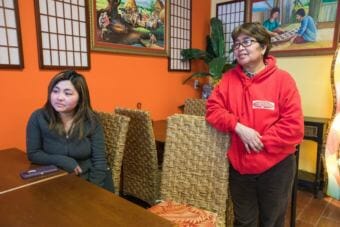
Betalyn Delacruz, owner of the Stop N’ Shop Asian Market, and her mom, Marietta Morota, speak about the impact of volcano Mayon’s eruption on their family that live near the mountain in the Philippines, on Wednesday. (Photo by Loren Holmes/Anchorage Daily News)
Delacruz and Morota’s relatives in the Albay province and just a few miles from Mayon had to go to an evacuation center last week, stirring memories and concern.
“It’s very hard being in an evacuation center,” said Morota, who works as a cashier at the store. Years ago, she said, “a lot of people got sick.”
Alaska has close ties to the Philippines, with more than half Asian Alaskans tracking their background there, compared with less than 20 percent in the U.S. as a whole, according to the state labor department.
Mount Mayon’s eruption had displaced more than 75,000 residents by Thursday, according to Reuters.
In Anchorage, many Filipinos are monitoring the situation however they can.
On Facebook, Delacruz frequently checks in with family.
At one point on Wednesday, a cousin Facetimed her a view of Mayon.
“We’re kind of worried about their situation because it’s very close to the volcano,” she said, “but seeing them, you know … we can see them on Facebook, you know, it eases our worries.”
Nearby in the Stop N’ Shop, among the shelves of canned almond jelly, lychee in syrup and prawn crackers, customer Beni Acton held up her phone to show a Facebook photo of Mayon one recent night, alit with red-orange lava trailing down the sides.
She’s from Ligao, also in the Albay province where Mayon is located and not far from the volcano itself. She talks to her friends and family who still live there every day on Facebook, Skype or just on the phone.
“Right now, my family is experiencing a lot of ash falls. It’s a lot,” she said. “Pretty much cleaning all the time because it’s not good for the kids. … Zero visibility.”
Morota said she’s most concerned about her evacuated family members back in the Philippines having access to food and clean water since they’re so far from the city.
“It’s hard. No food for the first day, no water,” she said, recalling that time in 1984.
Delacruz and Morota stayed at the same high school evacuation center nearly 35 years ago as where their relatives are taking shelter now.
Back then, Morota said, they stayed in the center for seven months. She recalled each room filled with several families and sleeping on the floor.
Maggie Balean, co-owner of the Indigo Tea Lounge in Anchorage, was also near Mayon during its 1984 eruption.
She grew up in Guam but also lived in the Philippines for a few years. Her father is Filipino and she has a niece and nephew in Santo Domingo close to the volcano.
They’ll typically send her a daily Facebook update of what the eruption looks like.
One recent night, she said, they told her it was tough to fall asleep because they were worried about lava coming.
“Of course you worry about it, you know, but there’s nothing we can do except wait and see,” Balean said.
Some in Anchorage say the natural disasters of the Philippines are so common they’ve simply become a fact of life.
“It’s a natural thing to us,” said Teresita Corral, who is also from the Albay province but now lives in Anchorage, where she owns an assisted living home. She said she isn’t very worried about Mayon.
“I know the people now are educated about the eruption of the volcano. It’s not the type of volcano that you don’t know it’s going to erupt,” she said.
Talking to friends and family every day, she’s heard communities are running out of masks to help people deal with the ash in the air, and as a result some kids are getting sick.
“We are used to having all these calamities, for example typhoons, floods and so on. It’s just, like, a normal thing,” said Cora Navio, in Anchorage. “We’re kind of immune. Which is bad but it’s a fact of life. We are just so resilient.”
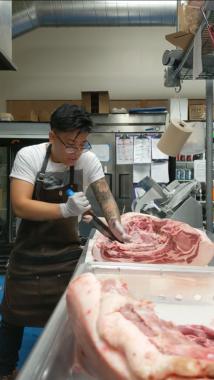
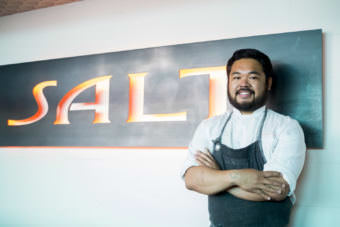
Chef Lionel Uddipa stands inside the downtown restaurant Salt in Juneau on Aug. 10, 2017. His winning dish of Bristol Bay king crab with risotto took first place at the Great American Seafood Cook-Off in New Orleans. (Photo by Annie Bartholomew/KTOO)
This month Juneau chefs Lionel Uddipa and Jacob Pickard represented Alaska at the Great American Seafood Cook-Off in New Orleans.
In a hotel room in New Orleans ahead of a national seafood cook-off, a pair of Juneau chefs were sweating.
“The rice wasn’t cooking as well as we wanted it to, our stock didn’t taste how we wanted it to,” Uddipa said. “Going into it, we’re, not gonna lie, pretty nervous.”
The rice is a key ingredient in one of Uddipa’s contest risotto. He calls it a lifestyle dish, a comfort food combining aspects from both sous chef Jacob Pickard’s Italian heritage, and his own Filipino roots.
“We eat rice 3 times a day, and we just didn’t want to just scoop rice onto a plate,” Uddipa said. “We wanted to give it some character.”
Juneau chef Lionel Uddipa’s winning dish at the Great American Seafood Cook-Off: Alaska king crab from Bristol Bay skewered with blueberry branches from Eaglecrest and a risotto made from black cod fish sauce presented Aug. 5, 2017. (Photo courtesy of the Alaska Seafood Marketing Institute)
Together the chefs went through a dozen variations before settling on a plate that represented the seasonality of Alaska’s fisheries: alder smoked Bristol Bay king crab, skewered with a blueberry branches from Eaglecrest, and the risotto garnished with sea asparagus foraged with their toddlers.
In their hotel room the chefs stayed up until 2:30 in the morning workshopping their dishes — tweaking the vanilla ratio, counting out salmon roe — and practicing their presentation.
In front of television cameras and a live audience the following day, they had only 60 minutes to prepare seven plates.
Timing was key as they skewered the crab thighs, smoked the alder wood and made final counts of sea asparagus and salmon roe.
At first, his rice didn’t cook fast enough.
“Five minutes felt like 30 seconds,” recalls Uddipa, knowing if risotto sits out too long, it gets mushy.
Chef Lionel Uddipa and Chopped Jr competitor Denali Schijvens stand outside of Salt on Aug. 10, 2017. Schijvens and Uddipa have been cooking together since Denali was 8. (Photo by Annie Bartholomew/KTOO)
Back in Juneau outside the restaurant Salt, Uddipa runs into another Juneau-famous chef: 10-year-old Denali Schijvens, who cooked his way to the White House and competed on Food Network’s Chopped Junior.
“I don’t think it really got to his head,” recalls the young cook. “I saw his face when he won (Uddipa laughs) it was happy, but it wasn’t — I’m-the-best-no-one’s-better-than-me face.”
The pair have been cooking together since Denali was 8, he considers Uddipa his mentor.
Like Denali, Uddipa grew up around food, helping out his aunt who owned Valley Restaurant. His cousins and siblings would play in the apartment building upstairs.
He says when the restaurant got busy, “We would just get a phone call from, like, my mom or my aunt and they’d be like, ‘We need help, we need you to come here and polish silverware, wash some dishes,’ and we were always stoked to do it.”
His advice for aspiring chefs like Denali?
“Be humble, and just be willing to learn, always try to improve from yesterday,” Uddipa said.
Uddipa said he still polishes silverware, helping out wherever he’s needed at Salt.
His teamwork with Pickard and creative spirit continues in Salt’s hot and humid kitchen.
Sous chef Jacob Pickard prepares the night’s scallop special Aug. 9, 2017, in Salt’s kitchen in Juneau. Pickard and head chef Lionel Uddipa won the 2017 Great American Seafood Cook-off in New Orleans for a risotto that included a black cod fish sauce created by Pickard. (Photo by Annie Bartholomew/KTOO)
Bacon lardon sizzles as Pickard slices grapefruit. It’s for tonight’s scallop special.
“It’s going to be a salad made out of shaved Brussel sprouts and zucchini with a grapefruit vinaigrette and champagne with whipped mascarpone and honey,” he said.
They’ve only been cooking together for eight months.
Long before the contest, Pickard started making their winning risotto’s signature ingredient, a black cod fish sauce stored in a downstairs prep kitchen.
“You need to make sure everyone’s at least 100 yards away,” Uddipa said. “And that you use a very large wooden spoon that you’re OK throwing away.”
He recommends plugging your nose.
But in very modest dabs in risotto, Pickard said the fish sauce adds another level of salty, oceany umami.
The winning dish will be on Salt’s menu of specials soon.
Gerry Carrillo Sr. sits in his barber’s chair at at his barbershop. He’s owned Gerry’s Barbershop for nearly 30 years. (Photo by Lakeidra Chavis/KTOO)
Gerry’s Barbershop has been around for nearly three decades in Juneau.
Owner Gerry Carrillo Sr., who emigrated from the Philippines in the mid-1970s when he was 16, started the shop after he was laid off from a state job in the 1980s. Now, he runs the shop with his daughter, Eva, and his son, Gerry Jr.
They say that after awhile even the clients become family.
Gerry’s Barbershop occupies a little nook next to a pizzeria in Juneau’s Mendenhall Valley suburb.
On a recent afternoon, the inside of the shop is loud — the music is up, conversations are going and the clippers are buzzing.
Here, it’s walk-ins only. A traditional cut, like a fade, is $18.
Eva is the oldest child. Covered in tattoos with long, black hair dominated by lime-green streaks, she’s full of laughter.
She has always loved doing hair and has worked alongside her dad for almost 10 years.
The trends with cuts come and go, she says.
“I did a lot of regular haircuts, and then the fauxhawk came back,” she says. “And now I still do a lot of mohawks, I think it’s ’cause I look like this so they always come to me, but a lot of people have been getting, like, old-fashioned haircuts like the traditional comb-backs and the pompadours.”
Lots of kids have bookended their school careers with haircuts at the shop, from their first day of class to graduation.
Kyle White is one of them.
Eva Carrillo cuts Kyle White’s hair at Gerry’s Barbershop. Kyle has been going to the shop since he was a kid. (Photo by Lakeidra Chavis/KTOO)
As he sits in Eva’s chair, White recalls visiting the shop as a kid: Gerry Sr. would tuck a Tootsie Roll behind his ear. If the young Kyle sat still for the cut, then he got the candy.
When White got older, he wanted a different hair style.
“I remember one time, I was like, ‘Hey Gerry, I think I’m going to do something different,’ and he was like, ‘No, you’re going to get the Kyle cut,'” he says. “And so I was like, ‘OK.’”
Eva lets out a loud laugh.
“Typical,” she says with a smile.
“‘No, no, no, you don’t want that.’ Like that?,” she asks, imitating her dad’s voice.
“Yeah, exactly,” White says, “‘You’ll get the Kyle cut.’ And then I just now started to get the fauxhawk.”
Combing his hair up to cut the ends, Eva tells White the style looks good on him.
White has checked out other shops in town, but always comes back to Gerry’s.
“Sometimes when they’re closed, I go somewhere, and they always don’t get it right,” he says. “But you come here for so long, they know what I want.”
Gerry Jr.’s chair is in the middle of the shop.
“I like to say that I beautify people,” he says.
Gerry Carrillo Jr. cuts David Mende’s hair. Gerry is the newest family member to work at Gerry’s Barbershop. (Photo by Lakeidra Chavis/KTOO)
His friends used to joke that he’d end up working for his dad — he didn’t believe them. Now, Gerry Jr. is in his third year working with his dad.
“I consider this like a family barbershop: grandpa will come and get a haircut, dad, grandson, sometimes great-grandson,” he said. “It’s hard. I guess working in a barbershop I feel like I don’t know how much time has passed by until someone comes in and I can see their hair.”
Gerry Sr. says haircuts will always be in demand.“(At the time) the economy was low, and I figured (that) hair is growing, it’s always got a job for me to do,” he said.
Cutting hair is a tradition in his family, he says.
“We got the blood of the barber,” he says. “My uncle was here first, long, long time ago, 1908 and he started a barbering business and he was very well-known in this town. … And I decided to go to school as a barber and (as) it happened I had a good touch.”
The Carrillos say they become a part of their customers’ family, even if in a small way.
The trio has given people their first haircuts, and sometimes their last.
A couple of years ago, a customer asked Eva to cut his hair before cancer took it away.
“He came back a year later, looking better than he did when I cut his hair off, he had so much hair, I was like, ‘Is that you?”… He’s doing really well,” she said.
Over the span of two hours, an old high school friend stops by, as well as a long-time customer who owns a pet grooming service in town and a new regular.
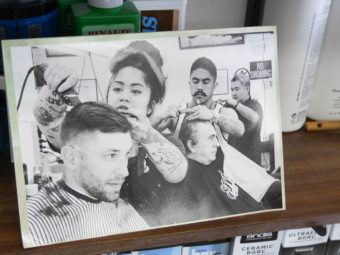
A photo of the Carrillo family sits on a shelf inside Gerry’s Barbershop. From left to right: Eva, Gerry Jr., and Gerry Sr. (Photo by Lakeidra Chavis/KTOO)
The barbers cut hair to celebrate the good moments and honor the bad.
Near Gerry Sr.’s chair toward the back of the shop, a black-and-white photo sits on a small bookshelf that stores supplies. In it, daughter, son and father are cutting hair. Gerry Jr. is sporting a handlebar mustache and has a large tattoo on his forearm. Written in cursive, it’s the family name, “Carrillos.”
But the trio make it clear that in their shop, family can be anybody — not just the people cutting your hair.
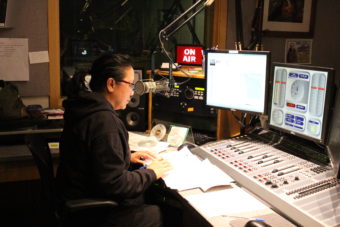
Genny Del Rosario balances work, life and being a KRNN volunteer DJ. She’s also the president of the League of Women Voters. (Photo by Elizabeth Jenkins/KTOO)
October is Filipino American History Month. In Alaska, that’s more than 26,000 people. One Juneau DJ is finding ways to connect others with their culture on the airwaves.
In the two years that Genny Del Rosario has been hosting her show “Good Evening My Friends,” she’s only been absent once. And that was because her car wouldn’t start.
In the summer, she closes her Filipino food shack early to make it here in time. The winter months, she said, are the hardest. It’s dark, the roads are slick with ice and it’s cold.
“But I have to be here, you know. It doesn’t matter. It’s like I have my alarm for this show, 9 o’clock. Even if I’m lying down. I say 30 minutes before, I come over now,” she said. “Sometimes I’m rushing in the car, ‘Ah, I gotta go!'”
During the breaks, she reads in Tagalog. The root language of the the Philippines has multiple dialects. Del Rosario can speak five.
“My father’s dialect which is Ilocano. Then I can speak Cebuano from Cebu. And then I can speak Chavacano which is from my birth city Zamboanga,” Del Rosario said.
She reads public service announcements, Filipino recipes, newsletters, even birthdays. In the summer, she fills the gaps with stories from cruise visitors. Usually, other Filipinos who work on the ships.
She started the show because she felt like her community wasn’t being represented.
“It’s a shame that we’re the second largest minority and we don’t have a show to showcase our tradition.”
Some of the music Del Rosario plays is from her youth.
“Anthony Castelo is one singer when I was in college, we used to scream like the Beatles when he goes to a certain town where we are. … He’s so handsome,” she said. “It’s like Justin Bieber or Joe Jonas. Anthony Costello was like that before.”
https://www.youtube.com/watch?v=n8xkMqhxBe4
When she visits her family in the Philippines, she brings CDs back. In Juneau, she said it’s impossible to find the music. iTunes and Spotify don’t have a great selection.
And like the food, she said the songs from home can trigger memories. Good Evening My Friends is for people who immigrated to the states. But also for their kids who might not have grown up speaking Tagalog.
“I hope that they listen, the teenagers. Because it’s good to know your mother’s or father’s language. I missed it out with my children. I just wished before that I could have taught them to speak Tagalog,” she said. “They told me every time they go home to the Philippines, they say, ‘Mom, why didn’t you teach us to speak Tagalog? Even give us a dictionary?’ I thought they weren’t interested but they were.”
Del Rosario came to the U.S. on a Rotary International scholarship. And traveled around the country as an ambassador for the Philippines in the 80s.
She went back, determined to return to the United States.
“It was like my eyes was open. And I was already 29 so I was ready to do adventure, adventure in the United States. My mom said, ‘Aren’t you scared?’ ‘No, ma. I’m 29 years old. What’s going to go wrong?’”
She met her now-ex husband, settled in Vegas. She was able to stay in the country with a green card and thought she’d remain there forever. Then the marriage split up and she needed a fresh start.
“I came to Juneau with just two suitcases. It was difficult for me for the first six months,” she said. “I was like a homeless person living from one friend’s to another friend’s house. I should have gone back to Vegas but I wouldn’t want to. I said I’m here, I will start.”
Eventually, she opened a daycare. That led to the funds to open Manila Bay Cafe with her sibling.
“We bought that store and it’s been there for six years. I used the store’s income to send my children to college.”
Del Rosario is visiting the Philippines in December. And she said it’s not easy to find a sub for the show. So far, her attempts to recruit someone who speaks Tagalog have failed. But that doesn’t mean she’s giving up.
When she does return home, she’ll collect more music for Good Evening My Friends and mourn with family. Recently, a sister passed away.
“Even though when my sister died three weeks ago. I don’t feel like coming but I said the show must go on. And you know, my sister would be proud. My family would be proud.”
KRNN is KTOO’s sister station. You can listen to Good Evening My Friends on Tuesday nights at 9.
The state Department of Labor and Workforce Development’s ‘Employees’ Frequently Asked Questions” pamphlet in Tagalog.
Not all employees in Alaska speak English proficiently, but the State Department of Labor and Workforce Development wants to make sure that all of them understand their rights. The department recently released several translations of its employee “frequently asked questions” pamphlet in different languages, including Yup’ik, Korean, Spanish and Tagalog. According to the 2010 census, 2.6 percent of Juneau’s population speaks Tagalog at home; for Spanish it’s 2.4 percent.
Kodiak also has a significant Filipino population. In 2010, Asians were the largest racial minority in the Kodiak Borough at almost 20 percent of the population, with Filipinos making up around 17 percent.
The statewide supervising investigator for the Wage and Hour Administration, Joe Dunham, says the 23 questions in the pamphlet are an overview of basic wage and hour laws for overtime and minimum-wage eligible employees.
“What is minimum wage? What about overtime? Who gets overtime? Who does not get overtime? Can I be paid salary? What about my final paycheck?” says Dunham. “Can they make deductions from my wages without my permission? So, it’s just simple everyday wage and hour questions that most of us come into contact with those questions at any particular job.”
While wage theft and labor abuse can occur, Dunham says some workers’ ignorance about United States labor laws could also be a matter of cultural difference.
“What turns out to be common in their culture turns out to be a violation in ours and very often, neither the employer nor the employee even knows about it,” says Dunham. “These questions are just something where employer-employee can look at this and say ‘Wow, I never knew that, maybe I should call up the Department of Labor and sit down and talk about it.’”
In the case that an employee feels they are being taken advantage of, they can report the issue to DOL investigators.
Close
Update notification options
Subscribe to notifications
Subscribe
Get notifications about news related to the topics you care about. You can unsubscribe anytime.