Filipinos in Alaska

Gold Medal basketball tournament returns to Juneau after pandemic hiatus

U.S. Rep. Mary Peltola put up the ceremonial jump ball for Kake’s Rich Austin (15) and Hoonah’s Albert Hinchman (22) during their Masters Bracket game in the Juneau Lions Club 74th Annual Gold Medal Basketball Tournament, Sunday, March 19, at the Juneau-Douglas High School: Yadaa.at Kalé gymnasium. (Klas Stolpe/For the Juneau Empire)

The Gold Medal Basketball Tournament was a familiar favorite for Southeast Alaska athletes for decades, until the COVID-19 pandemic hit the pause button. Last week, players took to the court at Juneau-Douglas High School: Yadaa.at Kalé for the first time in four years. 

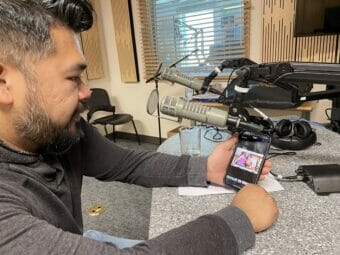
Reporter Klas Stolpe covered part of the tournament for the Juneau Empire. He spoke with KTOO’s Chloe Pleznac about some of the highlights and history of this beloved event.
This interview has been edited for length and clarity.

Chloe Pleznac: Thank you so much for joining me today to talk about the Gold Medal basketball tournament last week. I wanted to start off just by asking how many teams participated in the tournament and where were they from?

Klas Stolpe: Well, they have four brackets and there’s a B bracket, a C bracket, Masters bracket and women’s bracket. And so you have eight teams in the B bracket, eight teams in the C bracket and six teams apiece in the Masters and women’s bracket. And they come from all over Southeast. You got Angoon, Haines, Hoonah, Hydaburg, Juneau, Kake, Metlakatla and Yakutat and Hydaburg. Usually don’t get a Juneau team in, usually if someone drops out at the last minute. And in this instance, I think Wrangell backed out of their entries, just couldn’t find enough players. 

Chloe Pleznac: So how did it go over the week who came out on top?

Klas Stolpe: Well, in the B bracket, which is kind of the more elite players. The entry from Juneau won this this bracket, then they defeated perennial power Hydaburg, and it was awesome, awesome tournament games in the beat all year long, all tournament long, I should say. And Juneau won 86 to 62 in the championship game. The C bracket which is 32 years and older, again, the FilCom Juneau team defeated Klukwanw 79 to 49. And the Masters bracket which is 42 years and older, Hoonah defeated the Juneau team 64 to 43. And in the women’s bracket, Prince of Wales defeated Yakutat 79 to 38. And of course, there’s interesting stories in every bracket, which makes the tournament a lot of fun if you’re a media person. 

Cassie Williams is congratulated by her mother Ann after winning the Women’s Bracket championship and Most Valuable Player honors, Saturday, March 25, during the Gold Medal Basketball Tournament at Juneau-Douglas High School: Yadaa.at Kalé. (Klas Stolpe/For the Juneau Empire)

Chloe Pleznac: Well, that’s awesome. Was there any cultural significance that you noticed while covering this event?

Klas Stolpe: It’s funny because in Southeast Alaska, culturally, basketball has always and probably will always be just huge. I myself, you know, grew up in Petersburg, Alaska, before the internet age and before cell phones, and I still have lifelong friends that I’ve met across Southeast through basketball. Its course is really big in rural Alaska and the small communities and larger ones. They always share common courts when they play. Originally this tournament started in 1947. A Boy Scout executive for Southeast Alaska, his name was Dell Hanks, he had traveled all around Southeast on his missions, and he noticed how big basketball was. And he was talking to the Juneau Lions Club and they got this idea to start this tournament. So that said, it slowly gathered, it steamrolled over the years into this major tournament. And while it originally started with community pride, and gathering and seeing opponents and old friends again and again, and establishing and strengthening relationships. You usually at these tournaments, will have a couple of special activities during the week there. You know, there’ll be a Native dance group, a local cheerleading group. There’s usually a welcoming blanket dance where the names of every tribe are pronounced out and people in the stands will come down and of course, we always have frybread that’s passed out and the lobby is filled with vendors and the stands with fans and, of course, there’s some thick skinned referees. So yeah, it becomes a huge fun event.

Chloe Pleznac: Was there anything that surprised you covering this?

Klas Stolpe: Cassie Williams, she was the MVP of the women’s bracket. And she remembered when I interviewed her, she remembered traveling to the tournament as a kid and watching her mom and play and win a women’s championship. And now it’s 20 years later, and two of her mom’s teammates were on this year’s team. And her mom was in the stands watching Cassie win a championship so that was cool. Wow. And and then, in Juneau, do you notice FilCom a guy named Alex Heumann dreamed of winning a gold medal championship with his youth and high school teammate Larry Cooper. Plus he was playing for a family member who had passed and so they won a championship together. And Metlakatla’s Willie Hayward, who is just an icon in Southeast basketball, he was playing with his son. And Hydaburg’s Matt Carle – who was another icon and now he’s, he’s moved to Juneau – he was playing with his son Jaren on the Hydaburg team. You get all these little. I mean, it’s just families gathering, and very good competition. Hydaburg, Vinnie Edenshaw, I mean, he’s the smallest player on the court. But he was the tournaments, leading scorer. And there’s a great game well, Hydaburg defeated Angoon in a double elimination game was double overtime. And Hydaburg trailed by two points with .03 seconds remaining in the game, and the aforementioned Edenshaw on the line. So everyone thinks he’s going to tie this game up. But he misses the first free throw, so he had to miss the second, and the ball bounced back out and was tipped in the air by his teammate, George Peratrovich. And it tied the game and ascended into the second overtime and Hydaburg advanced. So that was pretty cool.

Chloe Pleznac: Wow, that is pretty cool. Thank you for telling that story. And thank you so much for taking the time to speak with me. I really appreciate it.

Meet Genevieve Mina, Alaska’s second Filipino legislator

Rep. Genevieve Mina is sworn-in as the second Filipino legislator since Thelma Buchholdt in almost 50 years. (Photo courtesy of Genevieve Mina)

In 1974, former Rep. Thelma Buchholdt, D-Anchorage, made history as the first Filipino to be elected to the Alaska Legislature. Now, almost 50 years later, Rep. Genevieve Mina, D-Anchorage, is making history as Alaska’s second.

Mina took office in January. She represents House District 19 in Anchorage, which covers the Airport Heights, Mountain View and Russian Jack neighborhoods. 

Like Buchholdt, who represented Spenard for 8 years, Mina has a strong connection to the Anchorage community. It’s where she was raised by her mother, an Ilonggo nurse, and her father, an Ilocano grape farmer and Alaskero who fell in love with the state.  

“There are so many people that I grew up with, that I went to school with, who have family in these neighborhoods who I would come over to hang out and watch TV, or have sleepovers, or do Dungeons and Dragons, or have tea parties,” she said.

Despite being elected at 26, Mina never thought she’d go into politics. She says she was shy and quiet as a kid, but she wanted to break out of her shell. At East High School, she began volunteering with school groups and realized her love for serving her community. 

While studying at the University of Alaska Anchorage, she was introduced to the debate team by a friend. It was a welcome break from her biology degree that quickly transformed into a passion that redirected her future plans. Then, the same friend who introduced her to the debate team asked Mina to help out on her first political campaign. 

“And I just got hooked from there,” Mina said.

Mina joined the Alaska Young Democrats and College Democrats, and was elected to be a delegate to the 2016 Democratic National Convention. She’s worked on numerous campaigns, interned in state and municipal political offices, and with policy firms in Alaska and Washington D.C. Her involvement in community groups expanded her interests in health care, public transit, economic empowerment and women’s rights. 

“The more I realized how much I love doing this type of work of talking with people, building relationships, making policies into reality and leading groups, the more I felt that it was a natural fit for me to eventually run one day, whenever the timing was right,” Mina said. 

Inheriting a passion for health care 

Mina grew up in a health care family, where she watched her loved ones care for others as a career.

Her mother, a nurse from Iloilo City in the Visayas region, was the first in her family to go to college. 

“My mom is a nurse. She’s the first nurse on her side of the family,” she said. “My brother became a nurse, my sister-in-law’s a nurse, my aunt is a caretaker. All of my immediate family works in the healthcare industry.”

Rep. Genevieve Mina stands next to her mother, Evelyn Mina, as she sits in her daughter’s seat on the Alaska Legislature’s House floor. (Photo courtesy of Genevieve Mina)

For almost 20 years, her family ran assisted living homes. The business, called the Genevieve Assisted Living Home, is named after her. 

“I grew up around more old people than people my own age,” Mina joked. 

When she was young, her father passed away by suicide. And after that, her mother lost Medicaid approval for their family business. When trying to appeal her case with the state, Mina said her mother felt she experienced barriers and discrimination. Eventually, her mother connected with other Filipino-American assisted living home administrators experiencing similar challenges from the state.

When she was still a preteen, Mina found herself supporting a burgeoning group of health care administrators in an attempt to sue the State of Alaska for shutting down Filipino-owned care homes without due process. She helped her mother document her handwritten recollection of interactions with the state, and she even designed the logo for the group.  

The group lost the case, but the experience shaped Mina’s love for health care policy. 

“It was really gratifying and fulfilling to be able to help someone understand what is going on, when they’re trying to deal with a very difficult system,” she said. “Health policy is truly an avenue where you are trying to work through the system to literally save lives, and I think that’s a beautiful thing.”

Learning who came before

In 2017, Mina interned with former Rep. Ivy Spohnholz at the Alaska Legislature.

“I was in the Capitol for the first time, being an intern. And I was just like, you know what, I wonder if there’s ever been a Filipino elected to the Alaska State Legislature?” she reflected. “And I looked it up, and I learned about Thelma Buchholdt.”

Before getting into politics, Buchholdt dedicated tireless hours to communities in Alaska. She was involved in Anchorage’s NAACP chapter, the Filipino Community of Anchorage and worked alongside rural Alaska communities to increase their access to health, education and social services.

She worked for years as a school teacher and first ran for the Anchorage school board in the 1960s. While she lost that first election by a small margin, she was elected to the Alaska House of Representatives in 1974 as one of the first Filipino-American women to be elected as a legislator in the U.S. 

Buchholdt spent her eight years in office passionately representing the concerns of her working class district in Anchorage. She served as vice-chair of the Finance Committee and chair of the Health & Social Services Committee, and her accomplishments include establishing the Alaska Commission on the Status of Women and the Asian Alaskan Cultural Center in Anchorage.

Even after leaving office, Buchholdt continued her mission for civil rights. She founded the Alaska chapter of the Filipino American National Historical Society, compiled a historical book about Filipinos in Alaska, and served 30 years on the Alaska State Advisory Committee for the Commission on Civil Rights. 

“I think that my mother was very aware of the lack of representation of Filipinos in the United States,” Buchholdt’s daughter, Titania Buchholdt, said. “And she took it very seriously as the amount of change she had the ability to create in her role.”

“I could see myself doing this work, because I saw Thelma doing it,” Mina said. “Learning about her history, learning about the work that she did, and the other parallels that I love, like that she was an ad hoc young Democrat.”

Reclaiming her Filipino identity

Buchholdt was born in Luzon, in the Philippines. She didn’t come to the U.S. until the 1950s for college.

Mina, on the other hand, was born in the U.S. in Alaska. But, growing up with family members that were all born in the Philippines, she says that when she was young she didn’t feel she was truly Filipino.

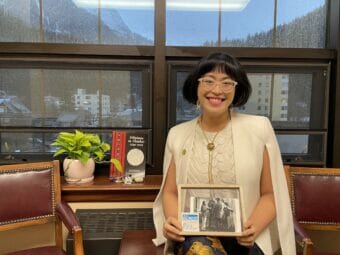
Rep. Genevieve Mina poses in her new office with a photo of former Rep. Thelma Buchholdt in January 2023. The photo was gifted to her by Christine Marasigan, a former legislative staffer who has mentored Mina around being a Filipina in politics. (Photo by Tasha Elizarde/KTOO)

“Between people who emigrated in their adult life with folks who were born here, it’s a huge cultural difference,” she said. “A big challenge that I have personally had is my family constantly speaking in a language that I don’t fully comprehend. That’s a very alienating feeling to have on a daily basis, where you don’t fully know what’s going on in your own home.”

Mina is now proud of her Filipino identity. It took an intentional effort exploring ways she could connect with her family – through food, learning her family’s language, attending Filipino community events and organizations and teaching herself that her differences didn’t make herself any less Filipino. 

Still, she emphasizes that her feelings of isolation aren’t abnormal in Filipino households, or in any home. As a public servant, she hopes to see other Filipinos feel included and take pride in who they are. She believes that talking through feelings of alienation, isolation, and depression is crucial to not only finding pride in our identities, but to supporting our mental health.

“Mental health is a huge issue in the Filipino community. I’ve been very open about how my dad died by suicide when I was very young,” she said. “There are ways to take pride in who you are. I own who I am, as someone who kind of knows Tagalog but not really, who didn’t grow up involved in the Filipino community, who wasn’t raised Catholic, but I’m just as Filipino as other folks from my community.”

Mina is known for putting together outfits that share the facets of her identity. On the day she was sworn in as a lawmaker, Mina wore a barong, a traditional Filipino blouse, gifted by her mom and jewelry made by T’boli artisans in the Philippines.

In her office in the Capitol, she has a framed photo of Thelma Buchholdt speaking to a group of taller male legislators. The photo was gifted to her by Christine Marasigan, a former legislative staffer and one of many accomplished Filipinos she credits with her journey into politics.

Mentors like Marasigan are why Mina introduced her first piece of legislation, HB23, which would establish October as Filipino American History Month in state statute. The bill will have its first committee hearing next week.

She hopes the bill will help the public recognize the complexities within the Filipino community while also challenging Alaskans to better understand the community’s history. 

“We have this assumption that Filipino-Americans work only in canneries, only in hospitality, only in health care. And when you think about these different Filipino groups, Ilocanos, Ilonggos, Tagalogs, Kapampangan, there’s a lot of complexity within our cultures,” she said. “And so I want to go deeper in that conversation and challenge the public. To learn more about who we are, why we came here, and why we take so much pride in being who we are.”

She hopes to see more Filipinos, and anyone else from an underrepresented community who doesn’t feel heard by the government, feel like they can be civically engaged.

“I just hope that I am able to live up to the work of (Buchholdt) and many other people who have come before me, to inspire others to to get involved and do the same after me,” she said.

Rep. Mina will be speaking at the Filipino Community Inc.’s installation of board officers ceremony and dinner on Saturday, Feb. 25 at 5 p.m. at Filipino Community Hall. The event is open to the public. 

Feb. 22, 2023: Halo-Halo Chef’s Talk; 2023 Jobs Outlook; Songwriter’s Circle

Rachel Barril works in the kitchen of Juneau Italian restaurant In Bocca Al Lupo for their event "Dinner with Friends: Womxn of Power edition" on June 26. (Photo by Lyndsey Brollini/KTOO)
Rachel Barril works in the kitchen of Juneau Italian restaurant In Bocca Al Lupo for their event “Dinner with Friends: Womxn of Power edition” on June 26, 2021.
(Photo by Lyndsey Brollini/KTOO)

On this month’s Halo-Halo Chef’s Talk segment, KTOO Community Reporting Fellow Tasha Elizarde sits down one-on-one with Rachel Carrillo Barril, Head Chef at In Bocca Al Lupo, to discover her Filipino roots and how she made her way to being one of the top chefs in Juneau. Also, information on the upcoming Filipino Community Legislative Reception / Installation of Officers Event.

Also, on today’s program…

KTOO’s Sheli Delaney hosts today’s program. You can catch Juneau Afternoon, Wednesday through Friday, live at 3:00 p.m. on KTOO Juneau 104.3 and KAUK 91.7 Juneau Auke Bay. A rebroadcast airs at 7:00 p.m. You can also tune in online at ktoo.org/listen.

Guests:

  • Rachel Carillo Burill, Head Chef at In Bocca Al Lupo
  • Tasha Elizarde, KTOO Community Reporting Fellow
  • Karinne Wiebold, Economist
  • Dara Rilatos, Musician

Subscribe to the podcast:

Juneau Afternoon is a production of the KTOO Arts and Culture Team.
Bostin Christopher produced today’s show with help from Erin Tripp.

Ketchikan podcast puts the spotlight on Filipino culture and voices

Archie Inoncillo, the host of the Halo-Halo Mix-Mix podcast, talks with students Ellhyn Alva, front, and Czarina Cabillo, back, during a recording session at Pilothouse Coffee on Jan. 15. (Raegan Miller/KRBD)

A Ketchikan podcaster is breaking down all things Filipino culture. Halo-Halo Mix-Mix started up last summer and launched a revival this year. KRBD’s Raegan Miller stopped by a recent recording session to learn more.

Halo-halo — a Filipino crushed ice dessert — is a refreshing, cool treat on a warm day. And that’s what Archie Inoncillo wants his podcast, Halo-Halo Mix-Mix, to be like for Filipino listeners.

“I love halo-halo, and it’s one of my favorite desserts,” Inoncillo said during a recent recording session at Pilothouse Coffee. “But here is the debate. Is it an edible dessert? Or is it a drink? What do you think?”

The question was his playful opener to an upcoming episode that tackles a wide variety of topics — ranging from language barriers and education to superstitions and Filipino representation in pop culture.

Inoncillo had two guests, Czarina Cabillo and Ellyn Alva, members of the high school’s Fil-Am Club. The two students both moved to the United States from the Philippines — Cabillo when she was 14, and Alva when she was 10.

So, is halo-halo a drink or dessert?

“Oh, good question,” Alva said.

“I would say edible, because of the ice cream, there’s a lot of stuff in there,” Cabillo chimed in.

Halo-halo was just one of the topics they took up with Inoncillo. The trio chatted with their host about topics big and small — including what it feels like to find community in Ketchikan as a Filipino person.

For Alva, Ketchikan High School’s Fil-Am Club was a gateway to the Filipino community. Before joining, she didn’t hang out with many of the other Filipino students.

So that was the start that I started hanging out with Filipinos — it was really scary to speak Tagalog, too,” she said.

Through the course of the podcast, the trio unpacks shared experiences. That includes a frank discussion of the different pressures they all feel when it comes to speaking Tagalog, the national language of the Philippines.

Cabillo shared she still gets nervous speaking English, her second language.

“I talk with adults, and it’s fine,” she explained. “But if I talk to the people my age, they just, I don’t understand the slang and stuff. And they would say like, ‘Oh, that’s wrong. Did you mean this? And I’m like, sorry. I’m sorry. I’m Asian.’”

And it goes both ways. Host Inoncillo was born in Ketchikan to Filipino parents and said he struggles with Tagalog. He said he practices plenty, but he  still braces himself for jokes about his language skills.

“It doesn’t feel like a joke,” he said. “It feels like I’m not being authentic enough as a Filipino because I don’t know that. I can’t speak the language.”

The podcast episode — which is still in production — will also touch on conversations about Filipino traditions.

Cabillo mentioned someone jumping with coins in their pockets when the clock strikes midnight on New Year’s Eve.

“I think they have to jump five times so they could get taller for that next year,” she said. “It never worked.”

“I think I stopped jumping after a while,” Inoncillo joked.

They also talked about the darker side of Filipino superstition — like stories of monsters that prey on pregnant women and other vampire-like creatures.

“My favorite one is the Manananggal,” Cabillo said.

“Oh man, where it’s like — I had dreams,” Inoncillo responded.

“It’s an Aswang, but his lower body is separated and he flies away,” Cabillo said about the monster.

The conversation touched on the growing number of Filipino people represented in mainstream TV and movies.

“It’s like there’s a whole lot more Filipino stuff in the media now though,” Inoncillo said. “Like in the mainstream media.”

“It’s so cool,” Cabillo responded. “I think it’s because there’s a lot of people here and Jo Koy (actor) has been doing a great job promoting Filipino culture.”

Reflecting, Cabillo said the Filipino community in Ketchikan is one that tries to make you feel like you’re in the Philippines. But she wants the community to stretch out in Ketchikan, and invite more people in.

“Why wouldn’t we do it in a bigger place so everybody could feel it?” she said.

The Halo-Halo Mix-Mix podcast is a project of the Ketchikan Wellness Coalition’s Strengthening Cultural Unity task force.

In Ketchikan, there’s a CPR class for Filipino residents of the town’s biggest apartment buildings

Ketchikan’s Tongass Towers apartment building. A CPR class aims to certify the Filipino residents who live in the town’s two biggest apartment buildings (Photo by Raegan Miller/KTOO).

An upcoming CPR class in Ketchikan will certify Filipino residents. The Ketchikan Wellness Coalition class aims to ensure residents can help their neighbors or family members in an emergency. That’s a skill even more necessary in two of Ketchikan’s biggest apartment buildings, where it’s difficult or impossible to access a defibrillator.

Alma Parker leads the coalition’s Strengthening Cultural Unity task force. She said this class specifically targets Filipino residents who speak multiple languages. If a bilingual person is CPR-certified, Parker said they can help others who don’t speak English while waiting for first responders in an emergency.

“Having bilingual (people) in different dialects (become certified) would also be ideal, because Tagalog is the national language, but there are so many different dialects of those who are from the Philippines,” Parker said. “So that would be in the perfect world.”

In particular, the coalition wants to see more CPR-certified Filipino people in Ketchikan’s biggest apartment buildings, Tongass Towers and Marine View Condominiums. A majority of the residents in both buildings are of Asian descent, according to 2020 Census data, and together, they’re home to about 30% of Ketchikan’s Asian-American community.

“Those are highly dense populations of Filipinos (who) live there,” Parker said. “And we felt it was necessary to ensure that there was a CPR trained resident in the building.”

Neither of the two buildings has an automated external defibrillator, or AED — a device that allows people with just a bit of training to shock someone’s heart back into rhythm — according to Ketchikan Fire Department officials, nor are they required to. But they can make it dramatically more likely that someone survives after their heart stops. For every minute that someone goes without a defibrillator, their chances of survival go down about 10%, according to the Red Cross.

Ketchikan Fire Department Chief Rick Hines said CPR is the best way to keep someone alive until there’s an AED available.

“And it’s in the hopes of keeping blood circulating, keeping the heart oxygenated and irritated enough that it will stay in that rhythm until an AED can get there, or a defibrillator can get there and try to shock them,” Hines explained.

Hines noted that when someone becomes CPR certified, it’s more likely than not that they’ll have to use that skill one day. And he said, most times, it’s a family member who needs help.

“We talk about having a plan for the fires or fire escape plans, or what we’re going to do if this happens, but I think also it’s worth mentioning, what happens if you’re with your parent, and they start showing signs and symptoms of a stroke, or signs and symptoms of a heart attack?” Hines said. “What’s your plan? How do you anticipate acting?”

Hines said every second counts. Typically, he would expect first responders to make it to one of the buildings from the downtown station in roughly six minutes. But that doesn’t count the time it takes to get the crew and equipment to the right floor.

“One of the things to factor in is elevator availability: how long it takes to call the elevator, how many stops the elevator makes going up to the floors,” he said. “And that certainly can make the time to make it to the top floor of that building longer than the time it takes to actually respond to that building.”

That’s one of the reasons the Wellness Coalition is working to certify more residents. And Parker said a similar CPR class last month yielded promising results.

“Our first CPR class was held at the Plaza that we recruited and solicited people to come and join the class that were of Filipino descent who specifically spoke Tagalog,” she explained. “So we could have some bilingual, CPR fully trained first aid and CPR community members in our lovely town of Ketchikan.”

At that class, eight Filipino residents became CPR-certified. Four of those people also spoke Tagalog. Some were kids, and Parker noted she’d like to see more young people in future classes.

She said trying to place AEDs in the building is something her organization would consider, but the devices also need upkeep and maintenance. So in the meantime, the coalition is pushing hard to get the lifesaving knowledge of CPR into the hands of as many people as possible.

Jan. 25, 2023: Three of Juneau’s best chefs and how their Filipino identity shapes the way they cook; Juneau Symphony’s “Transformations”; Comet C/2022 E3 (ZTF) visibility in the coming days

KTOO’s Tasha Elizarde interviews Rachel Carrillo Barril, Head Chef at In Bocca Al Lupo, Aims Villanueva, Owner of Black Moon Koven, and Abby LaForce Barnett, Co-Owner at Zerelda’s Bistro (Bostin Christopher/KTOO)

KTOO’s Community Reporting Fellow Tasha Elizarde sits down with three of Juneau’s most well-known chefs, Rachel Carrillo Barril (In Bocca Al Lupo), Aims Villanueva (Black Moon Koven), and Abby Barnett (Zerelda’s Bistro), to chat about how their Filipino identities shape the way they cook. The discussion includes a critique of the phrase ‘fusion food,’ a blending of Alaska ingredients with Filipino techniques, and the wars Filipinos wage through their adobo recipes.

Also:

Guests:

  • Rachel Carrillo Barril, Head Chef at In Bocca Al Lupo
  • Aims Villanueva, Owner of Black Moon Koven
  • Abby LaForce Barnett, Co-Owner at Zerelda’s Bistro
  • Charlotte Truit, Executive Director, Juneau Symphony
  • Christopher Koch, Music Director, Juneau Symphony
  • Steve Kocsis, Marie Drake Planetarium
  • Shellie Hanson, Planet/Bird Walk “Fly High”

KTOO’s Sheli Delaney hosts today’s program. You can catch Juneau Afternoon, Wednesday through Friday, live at 3:00 p.m. on KTOO Juneau 104.3 and KAUK 91.7 Juneau Auke Bay. A rebroadcast airs at 7:00 p.m. You can also tune in online at ktoo.org/listen.

Subscribe to the podcast:

Juneau Afternoon is a production of the KTOO Arts and Culture Team.
Bostin Christopher produced today’s show with help from Erin Tripp.

Site notifications
Update notification options
Subscribe to notifications