Community

Juneau chef crowned King of Seafood at Great American Seafood Cook-Off

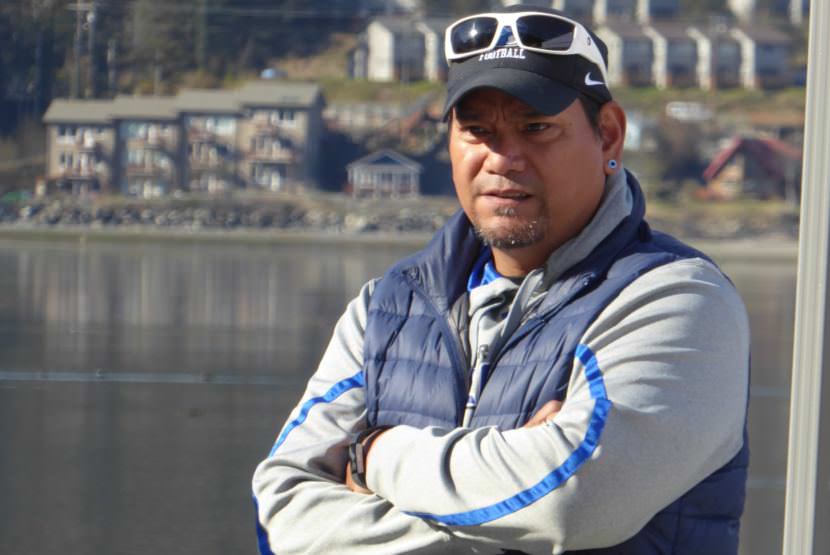
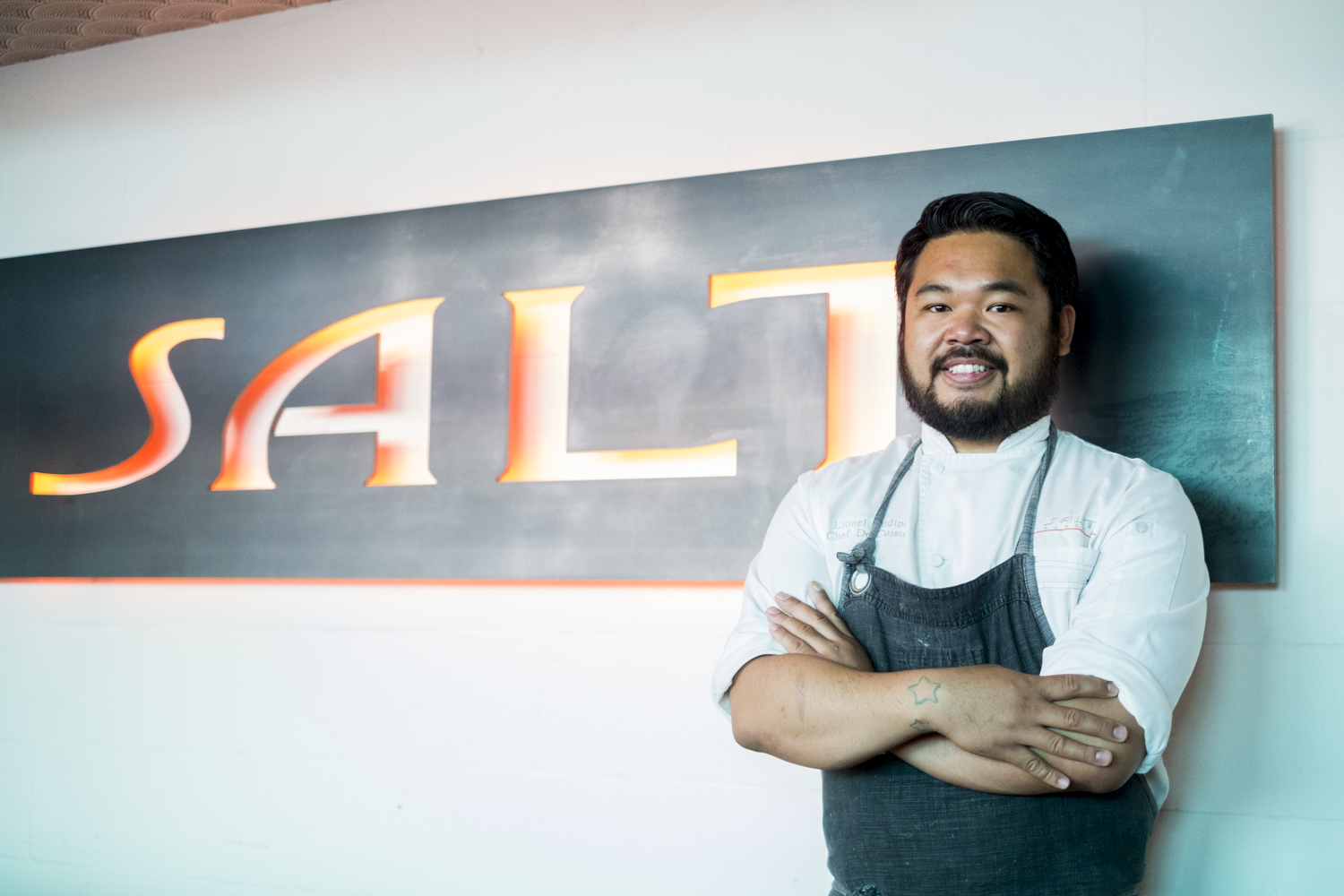
Chef Lionel Uddipa stands inside the downtown restaurant Salt in Juneau on August 10, 2017. His winning dish of Bristol Bay king crab with risotto took first place at the Great American Seafood Cook-Off  in New Orleans. (Photo by Annie Bartholomew/KTOO)
Chef Lionel Uddipa stands inside the downtown restaurant Salt in Juneau on Aug. 10, 2017. His winning dish of Bristol Bay king crab with risotto took first place at the Great American Seafood Cook-Off  in New Orleans. (Photo by Annie Bartholomew/KTOO)

This month Juneau chefs Lionel Uddipa and Jacob Pickard represented Alaska at the Great American Seafood Cook-Off in New Orleans.

In a hotel room in New Orleans ahead of a national seafood cook-off, a pair of Juneau chefs were sweating.

“The rice wasn’t cooking as well as we wanted it to, our stock didn’t taste how we wanted it to,” Uddipa said. “Going into it, we’re, not gonna lie, pretty nervous.”

The rice is a key ingredient in one of Uddipa’s contest risotto. He calls it a lifestyle dish, a comfort food combining aspects from both sous chef Jacob Pickard’s Italian heritage, and his own Filipino roots.

“We eat rice 3 times a day, and we just didn’t want to just scoop rice onto a plate,” Uddipa said. “We wanted to give it some character.”

Juneau chef Lionel Uddipa's winning dish at the Great American Seafood Cook-Off: Alaska King Crab from Bristol Bay skewered with blueberry branches from Eaglecrest and a risotto made from black cod fish sauce. (Photo Courtesy of the Alaska Seafood Marketing Institute)
Juneau chef Lionel Uddipa’s winning dish at the Great American Seafood Cook-Off: Alaska king crab from Bristol Bay skewered with blueberry branches from Eaglecrest and a risotto made from black cod fish sauce presented Aug. 5, 2017. (Photo courtesy of the Alaska Seafood Marketing Institute)

Together the chefs went through a dozen variations before settling on a plate that represented the seasonality of Alaska’s fisheries: alder smoked Bristol Bay king crab, skewered with a blueberry branches from Eaglecrest, and the risotto garnished with sea asparagus foraged with their toddlers.

In their hotel room the chefs stayed up until 2:30 in the morning workshopping their dishes — tweaking the vanilla ratio, counting out salmon roe — and practicing their presentation.

In front of television cameras and a live audience the following day, they had only 60 minutes to prepare seven plates.

Timing was key as they skewered the crab thighs, smoked the alder wood and made final counts of sea asparagus and salmon roe.

At first, his rice didn’t cook fast enough.

“Five minutes felt like 30 seconds,” recalls Uddipa, knowing if risotto sits out too long, it gets mushy.
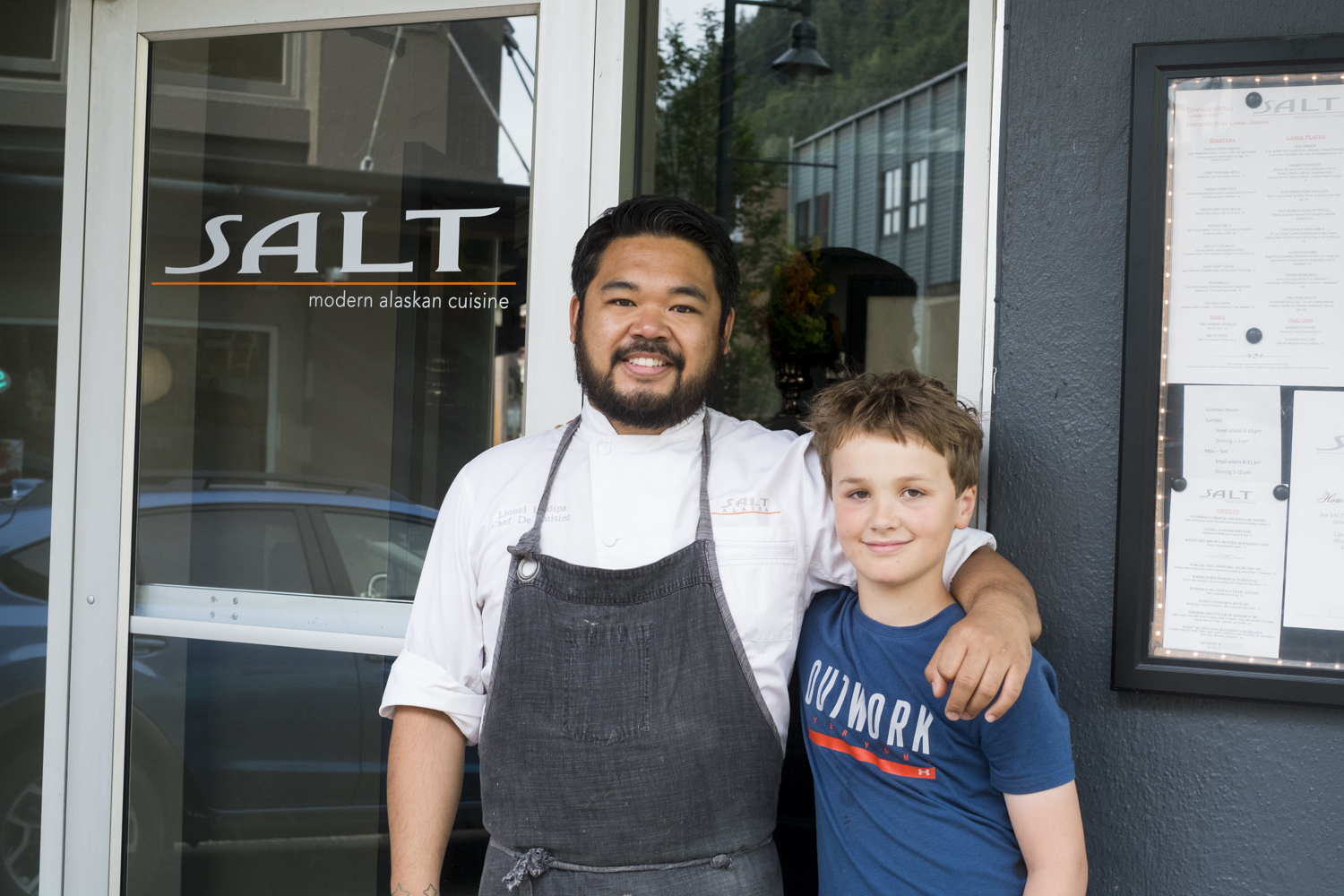
Chef Lionel Uddipa and Chopped Jr competitor Denali Schijvens stand outside of Salt on Aug. 10, 2017. Schijvens and Uddipa have been cooking together since Denali was 8. (Photo by Annie Bartholomew/KTOO)

Back in Juneau outside the restaurant Salt, Uddipa runs into another Juneau-famous chef: 10-year-old Denali Schijvens, who cooked his way to the White House and competed on Food Network’s Chopped Junior.

“I don’t think it really got to his head,” recalls the young cook. “I saw his face when he won (Uddipa laughs) it was happy, but it wasn’t — I’m-the-best-no-one’s-better-than-me face.”

The pair have been cooking together since Denali was 8, he considers Uddipa his mentor.

Like Denali, Uddipa grew up around food, helping out his aunt who owned Valley Restaurant. His cousins and siblings would play in the apartment building upstairs.

He says when the restaurant got busy, “We would just get a phone call from, like, my mom or my aunt and they’d be like, ‘We need help, we need you to come here and polish silverware, wash some dishes,’ and we were always stoked to do it.”

His advice for aspiring chefs like Denali?

“Be humble, and just be willing to learn, always try to improve from yesterday,” Uddipa said.

Uddipa said he still polishes silverware, helping out wherever he’s needed at Salt.

His teamwork with Pickard and creative spirit continues in Salt’s hot and humid kitchen.

Sous chef Jacob Pickard prepares the night's scallop special in Salt's kitchen in Juneau on Aug. 9, 2017. Pickard and head chef Lionel Uddipa won the 2017 Great American Seafood Cook-off in New Orleans for a risotto that included a black cod fish sauce created by Pickard. (Photo by Annie Bartholomew/KTOO)
Sous chef Jacob Pickard prepares the night’s scallop special Aug. 9, 2017, in Salt’s kitchen in Juneau. Pickard and head chef Lionel Uddipa won the 2017 Great American Seafood Cook-off in New Orleans for a risotto that included a black cod fish sauce created by Pickard. (Photo by Annie Bartholomew/KTOO)

Bacon lardon sizzles as Pickard slices grapefruit. It’s for tonight’s scallop special.

“It’s going to be a salad made out of shaved Brussel sprouts and zucchini with a grapefruit vinaigrette and champagne with whipped mascarpone and honey,” he said.

They’ve only been cooking together for eight months.

Long before the contest, Pickard started making their winning risotto’s signature ingredient, a black cod fish sauce stored in a downstairs prep kitchen.

“You need to make sure everyone’s at least 100 yards away,” Uddipa said. “And that you use a very large wooden spoon that you’re OK throwing away.”

He recommends plugging your nose.

But in very modest dabs in risotto, Pickard said the fish sauce adds another level of salty, oceany umami.

The winning dish will be on Salt’s menu of specials soon.

The Alaska Seafood Market Institute sponsored the chefs’ trip to the New Orleans and provided coaching support.

Juneau chef Beau Schooler won the same national competition in 2015.
100-plus Sitkans attend candlelight vigil for Charlottesville

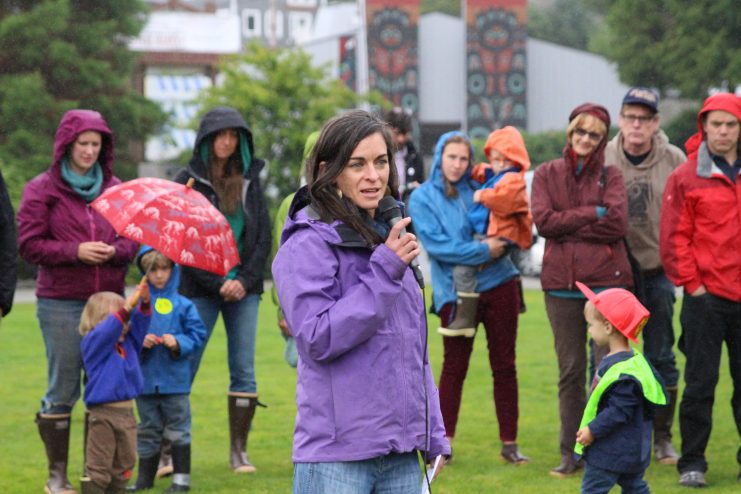
Raised in Charlottesville, Elizabeth Herendeen talked about how the violent clash beween “Unite the Right” marchers and counter-protestors has affected her hometown. (Photo by Emily Kwong/KCAW)

President Donald Trump said the white nationalists who marched in Charlottesville, Virginia, weren’t solely to blame for the violence there.

As he did this weekend, Trump suggested the left-wing counter-demonstrators also were culpable.

“You had a group on one side that was bad and you had a group on the other side that was also very violent,” Trump said.

Trump also defended the protestors. He said some weren’t neo-Nazis – they just didn’t want to see a Confederate general’s statue come down, a position he sounded sympathetic to.

“This week it’s Robert E. Lee,” Trump said. “I notice that Stonewall Jackson’s coming down. I wonder: Is it George Washington next week, and is it Thomas Jefferson the week after?”

Meanwhile, the events in Charlottesville continued to ripple across the country, with protests to condemn racism and to mourn for the counter-protester who was killed Saturday.

About 50 people gathered over the weekend in Homer, and some 300 came out Sunday in downtown Anchorage.

On Monday, dozens of people joined a candlelight vigil in Sitka.

A little girl watched her mother light a candle at Sitka’s peace vigil, which drew over 100 people around a large totem pole in the center of town.

Some brought tea lights cupped in seashells, others housed candles wrapped in aluminum foil.

The candles are for creating “a safe space for community, in solidarity with Charlottesville and beyond,” organizer Hannah Guggenheim said, describing the event on Facebook.

Holding a microphone, Guggenheim began the vigil with a quote from anti-Apartheid revolutionary Nelson Mandela.

“’No one is born hating another person because of the color of his skin or his background or religion. People must learn to hate and if they learn to hate, they can be taught to love,’” Guggenheim said. “That’s why I’m here. That’s why we’re all here, today.”

Many attended to talk about the nature of hate in 2017 America and how to move in a direction of love in Sitka.

For a town where the majority of the population is white, the gathering was fairly diverse and candid about Sitka’s own history of colonial occupation on Tlingit land.

Over 100 people gathered at a vigil in Sitka for the counterprotestor who lost her life in Charlottesville (Photo by Emily Kwong/KCAW)

Lakota Harden brought sage to burn.

Dale Williams recalled how in 1965 someone mounted a burning cross on the Sheldon Jackson Campus, in response to a local Civil Rights march.

Dionne Brady-Howard hoped the events in Charlottesville would spur further dialogue on not only what happened this weekend, but just how deeply racism in America runs.

“If nothing else, it’s brought to light how much hatred there still is and things like institutional racism and generational trauma across our nation,” Brady-Howard said.

Martina Kurzer, who grew up in Germany, said video footage of the street fighting in Virginia brought flashbacks to stories her grandparents told her, “stories of street fights between Communists and Nazis in the year 1925.”

For Elizabeth Herendeen, who moved to Sitka three months ago, this is all new.

She grew up in Charlottesville and attended the University of Virginia, where the “Unite the Right” rally converged.

“Just talking to my mom this morning, people are afraid to go out and live their lives and just to run errands or go to work,” Herendeen said.

Alt-right leaders have vowed to return to her hometown.

Over 100 people gathered at a vigil in Sitka for the counterprotestor who lost her life in Charlottesville. (Photo by Emily Kwong/KCAW)

In April, the Charlottesville City Council voted to remove a statue of the Confederate General Robert E. Lee.

Opponents sued and a district court judge postponed the decision for six months.

The case is still in court, making the city a battleground for white supremacists to push for its protection.

In June, the City Council renamed Lee Park — where the statue is erected — Emancipation Park.

David Kanosh shared how the possibility of racially motivated violence was a reality for him in 2003. He was beaten in a bathroom in Sitka’s ANB Harbor.

“I was beaten and left for dead by some people who carved a swastika in my chest. Do I have fear of going out that door? Of course. I always have that fear in my heart now. But I always face that fear with love because I always feel the people of Sitka that came out when I was in the hospital,” Kanosh said. “Will this dialogue continue? It must always continue.”

Sometimes that dialogue takes shape with music.

Joining hands again, the vigil closed with the an anthem from the Civil Rights era — the gospel song, “We Shall Overcome.”

Alaska Public Media’s Liz Ruskin contributed to this story. 

Clark’s Point drawing families back to the village by reopening its school

Clark's Point kids practice a traditional dance at summer culture camp. On August 21, they will be students at the village school. (Photo by Avery Lill/KDLG)
Clark’s Point kids practice a traditional dance at summer culture camp. On August 21, they will be students at the village school. (Photo by Avery Lill/KDLG)

When a school closes in rural Alaska, families who stay face tough choices.

They can send their children away to school in another village or city, or they can home school their kids.

Clark’s Point fought for a third option, to reopen their school. The school, which closed in 2012, will be back in session next week.

Clark’s Point is one of two schools in the Southwest Region School District that was closed because it did not meet the 10-student minimum enrollment set by the state.

Portage Creek is the other. The school at Portage Creek has been closed since 2005. That village now largely is a summer fishing community with an official year-round population of two.

Clark’s Point saw its population decline as well after its school closed.

“It was kind of sad. A lot of kids left, a lot of families left,” said Clark’s Point resident George Ramondos.

This year, however, the village saw a brief window of opportunity.

The village council heard from residents that they wanted to see the school reopened.

As the council explored the option, enough families committed to bringing their children back to Clark’s Point to meet the minimum enrollment.

“I’d hear that people wanted back, but they would say, ‘There aren’t jobs; there isn’t a school; if there was housing,’” said village administrator Danielle Aikins. “Suddenly, these things are opening up, and apparently they really meant what they said — ‘If these things existed, this is the place in the world we’d want to be.’”

Thirteen students are registered for this school year.

Aikins said it is unlikely the village could have met the minimum enrollment if the process had been put off another year.

At least two families, a significant number in a village of 63 people, told the council that they would move if no school opened in the fall.

“We assumed that if we didn’t get the school this year that our village couldn’t sustain itself. That is the impact of not having a school,” Aikins said. “You don’t get new people wanting to move in because there’s not a school for their children, and you have people having to leave.”

With the headcount in place, the village initiated a conversation with Southwest Region School District. They needed to hire staff and find a new building.

Using the old school building was not an option because it needs to be renovated to meet current building code.

Clark's Point School's modular building arrived in two pieces. (Photo by Avery Lill/KDLG)
Clark’s Point School’s modular building arrived in two pieces. (Photo by Avery Lill/KDLG)

“It’s the heart of the community,” said Steve Noonkesser, the associate superintendent of the Southwest Region School District. “When they came to us and said they came to us and told us they had students and that it was possible to reopen based on the numbers, I think it was more a question of how fast we can do this and how to put the pieces together.”

After a year of working with the school district and other area agencies, the school is set to open Aug. 21.

Clark’s Point received a block grant from the Bristol Bay Economic Development Corporation for a modular school building. It was delivered to the village in two pieces.

The goal is to have it assembled and utilities connected in time for the first day of school.

Classes will be held initially in the village council building if construction is delayed.

The teacher and principal, Shannon Harvilla, arrived from Florida in July.

The residents’ enthusiasm and effort were obvious to him even as they communicated with him before his arrival about plans for the school year.

Shannon Harvilla is the new principal and teacher at Clark's Point School. (Photo by Avery Lill/KDLG)
Shannon Harvilla is the new principal and teacher at Clark’s Point School. (Photo by Avery Lill/KDLG)

“The kids are excited. The parents are excited. They’ve missed the school tremendously, and it’s just a giant accomplishment to see the hard work of the village come together,” Harvilla said. “They say it takes a village to raise a kid. It took the village to raise a school and bring it back.”

Members of the community describe the school’s reopening as a dream come true.

One said that she and her grandson were packing to leave the village so that he could start school elsewhere when word came that the Clark’s Point School would reopen.

Josephine Ingram’s children were living in Anchorage, but she moved them to Clark’s Point last week.

“I’m glad for my kids to be able to come experience picking the berries and looking forward to the moose hunt coming up and the skiff rides, all of that. They’re going to be learning about their culture also,” Ingram said.

She would have kept her kids in school in Anchorage had Clark’s Point School not opened.

In speaking with Clark’s Point residents, it becomes clear that the school is more than an institution of learning; it is a lifeline for a small community.

It has given families with children more incentive to stay, and jobs at the school doubled the number of regular, full-time positions available in the village.

Clark’s Point has cleared many hurdles to reopen their school, and they are certain to face more as the school year kicks off.

Parents and community members describe many reasons why they want to stay in Clark’s Point and raise their children there – subsistence opportunities, quiet atmosphere and close proximity to family.

“This is home,” said longtime resident Diane Tennyson.

A $60,000 travel bill is normal for high school football in Juneau

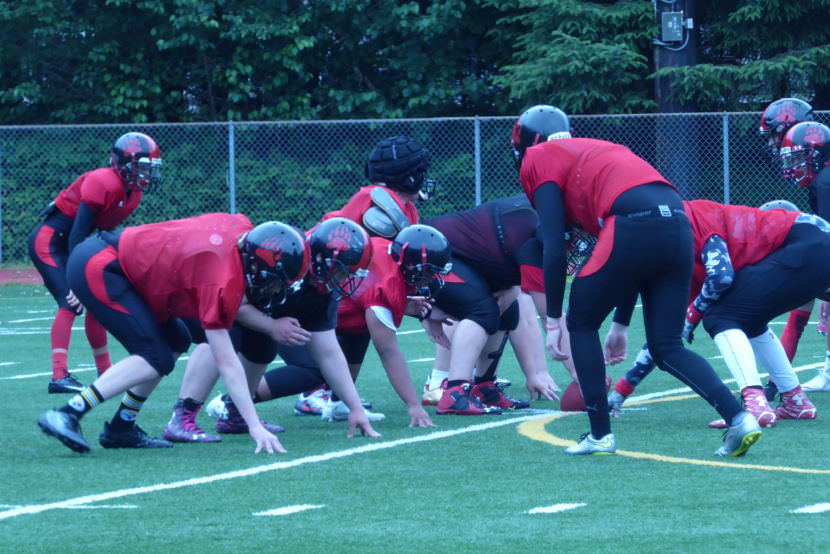
The Crimson Bears offense and defense face off at a summer practice.
The Crimson Bears practice at Adair-Kennedy Memorial Park on July 28. (Photo by Quinton Chandler/KTOO)

A Thunder Mountain High School parent might feel an especially powerful rush when their kid catches the game winning pass because that touchdown was expensive.

Juneau’s high school football teams have to pay thousands of dollars to travel long distances for their games. After the Juneau School District stopped paying for high school football travel, both teams racked up hundreds of thousands of dollars in debt just to play.

Last season, the Falcons paid a total of $66,000 to travel out of town and to bring other teams into Juneau.

That’s why Randy Quinto, the Falcon’s head coach, said the players gave up a day of freedom to work at Juneau’s annual Maritime Festival.

“Basically anything we earn will end up going back to the district,” Quinto said.

A Falcons football player helps carry a pavilion at the Juneau Maritime Festival.
A Falcons football player helps carry a pavilion at the Juneau Maritime Festival. (Photo by Quinton Chandler/KTOO)

The team does a lot of chores, and with help from their boosters, they run fundraisers each summer to pay for their next season.

Last season was actually cheap. The Falcons cut costs by ending their junior varsity program and playing more games close to home. Most of the Falcons’ opponents are in the Interior and Southcentral Alaska.

According to Thunder Mountain staff, their most expensive travel two years ago cost $140,000. Between 2014 and 2016, the team and their boosters raised more than $100,000.

Thunder Mountain Coach Randy Quinto at the Juneau Maritime Festival on Saturday, May 6, 2017.
Thunder Mountain Coach Randy Quinto at the Juneau Maritime Festival on Saturday, May 6, 2017. (Photo by Quinton Chandler/KTOO)

“These last two years we’ve been very fortunate and have gone to the playoffs and that just adds another expense,” Quinto said. “That’s plane tickets for 35 kids, plus coaches and then you’ve got vans and whatnot. With success I guess comes a price as well.”

Once, Juneau’s football teams didn’t have to pay for their travel. Thunder Mountain’s Activities Director Jake Jacoby said a few years ago, the district gradually started cutting the travel budget for high school activities. Then the money stopped.

Kristin Bartlett with the district said the school board made the cuts because costs kept rising but state funding stayed the same.

Now, the district pays for travel and then the teams have to pay it back. Jacoby said the Falcons owe $100,000 but that’s not counting all of this summer’s fundraising.

The JDHS Crimson Bears have fewer players than the Falcons. Their travel budget can cost up to $60,000. Last season was cheaper because the team didn’t make the playoffs.

Lance Fenumiai and Navy Nauer during track practice on May 18, 2017.
Crimson Bears football players Lance Fenumiai, right, and Navy Nauer pose for a photo during track practice on May 18, 2017. (Photo by Quinton Chandler/KTOO)

“(We’ve) got to fundraise about $2,000 in ads and raffle tickets,” Lance Fenumiai said. “That’s also to travel and the other half is to bring teams to come play here.”

Fenumiai siad that’s $2,000 per player. He is a 16-year-old junior on the Bears’ team. He plays running back and linebacker.

Fenumiai said fundraising is hard but worth it.

“We really want to play games and get like, scouted so we do what we can,” he said. “We go do ads and stuff (for) businesses and a lot of them are nice and they want to support us so, it makes it easier and selling raffle tickets, the community pitches in a lot and helps.”

Fenumiai’s coach, Kevin Hamrick, was hired in 2013. He said he inherited a huge debt.

“When I started, it was a negative $105,000. Recently, I believe it’s down to like $5,500,” Hamrick estimated.

Each season Hamrick said individual donors, boosters and local businesses have helped his team raise all of the money for their travel and pay about $25,000 toward their outstanding debt. He expects to be debt free after this season.

“Ninety percent of the businesses in town support both schools and they just keep giving and keep giving for every sport you can think of, every activity you can think of,” Hamrick said.

He chuckles and said the parents and coaches end up doing maybe half of the work.

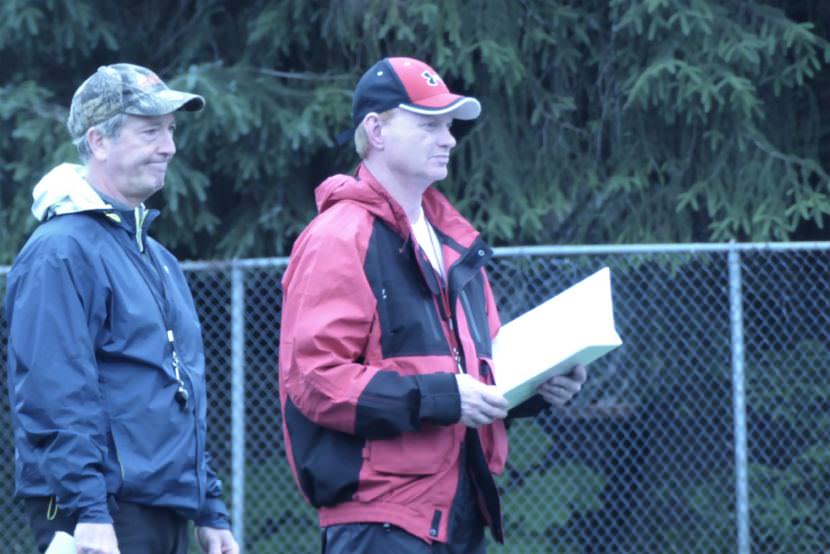
Kevin Hamrick, right, oversees the Crimson Bears practice on July 28, 2017 at Adair Kennedy field.
Kevin Hamrick, right, oversees the Crimson Bears’ practice at Adair-Kennedy Memorial Park on July 28, 2017 . (Photo by Quinton Chandler/KTOO)

The high travel costs convinced the Falcons and Bears to play two of their last eight season games against each other here in Juneau. They also played two games against nearby Ketchikan.

But, Hamrick said they still come up short.

“We haven’t changed our uniform in a long time,” he said. “I’m getting ready to throw out some shoulder pads because they’ve been around for too long.”

He said their helmets are old, too. They often pay to get old helmets fixed up and ready for reuse.

“We’re within the rule book but we only get three or five brand new helmets a season and right now I am short three large helmets,” he said.

Hamrick said he’ll try to borrow some from the Falcons.

Quinto said his equipment budget is tight too.

Both coaches plan to make do and keep giving their kids an opportunity to play.

Village of Newtok finds rebirth at Mertarvik

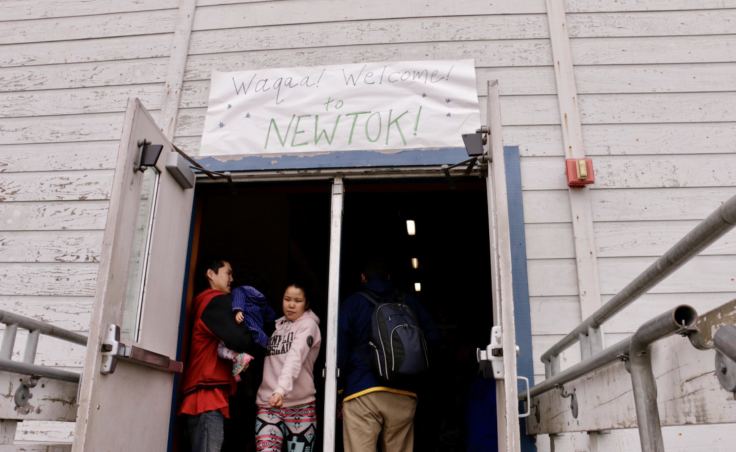
Over the last month and a half, a decade-long project to move the Yukon-Kuskokwim Delta village of Newtok is finally beginning to take shape.

The new village site held a ribbon in Mertarvik, which means “a place for water.”

The new community is safely above the rising water, which threatens the village of Newtok.

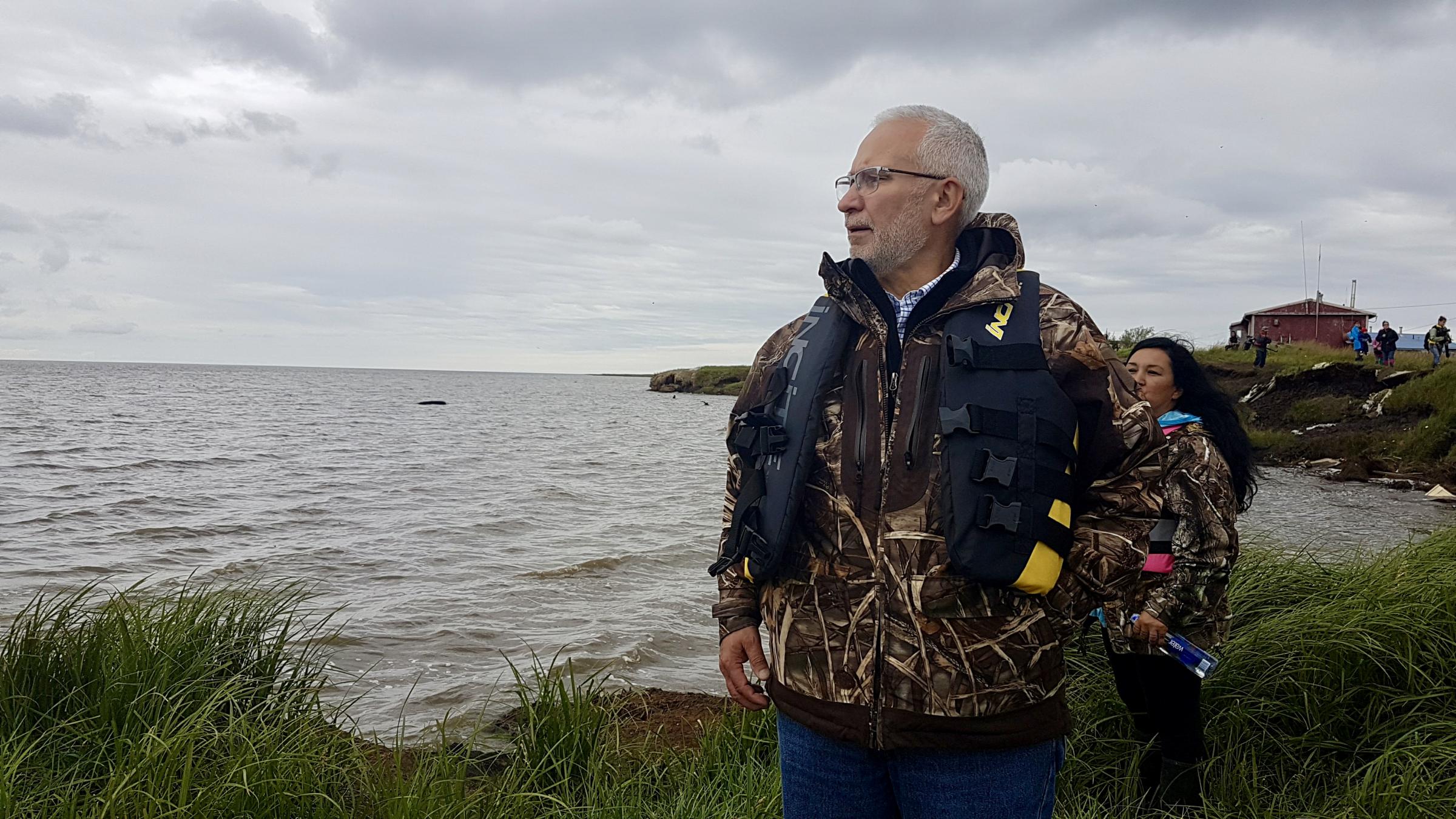
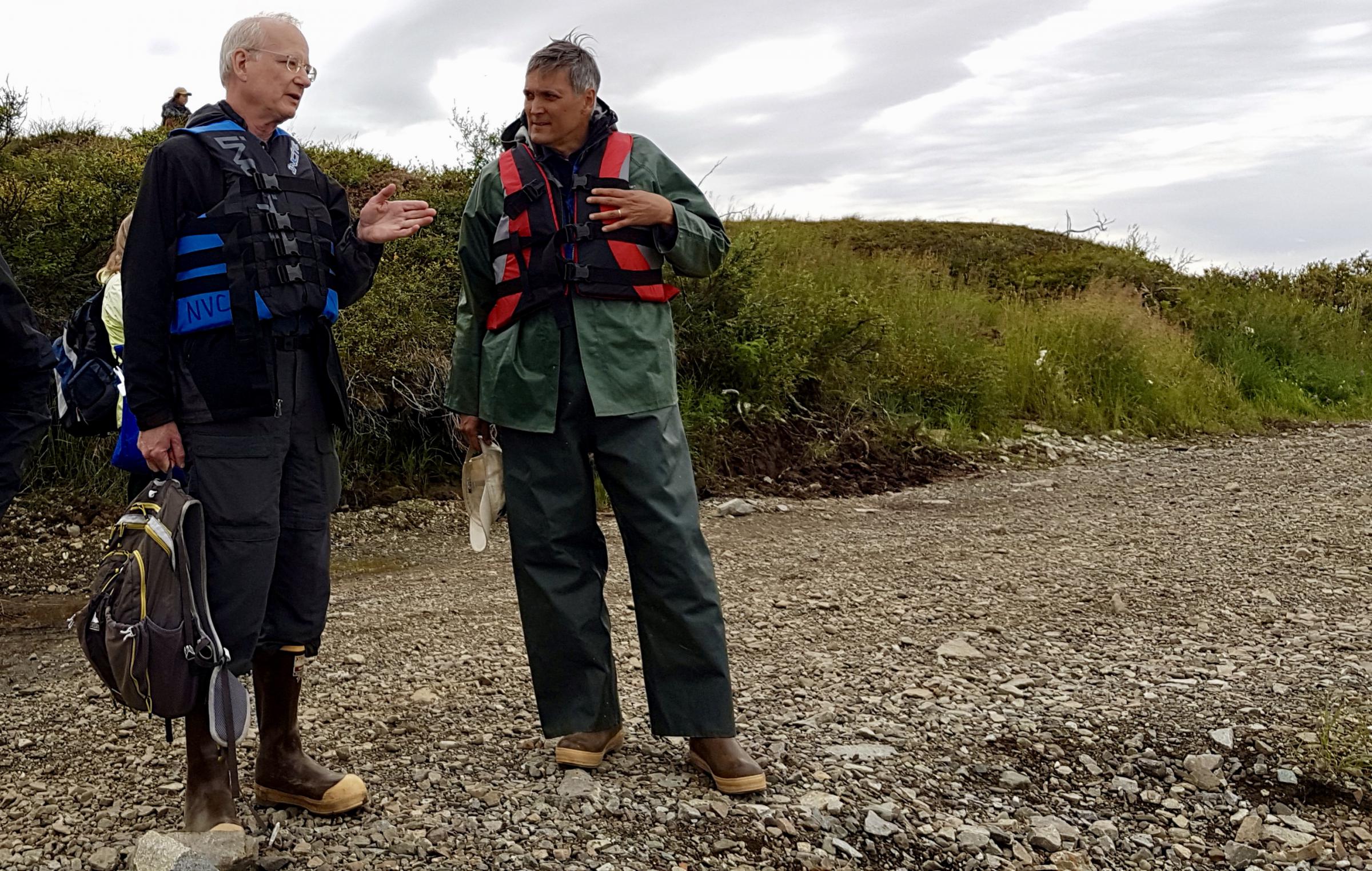
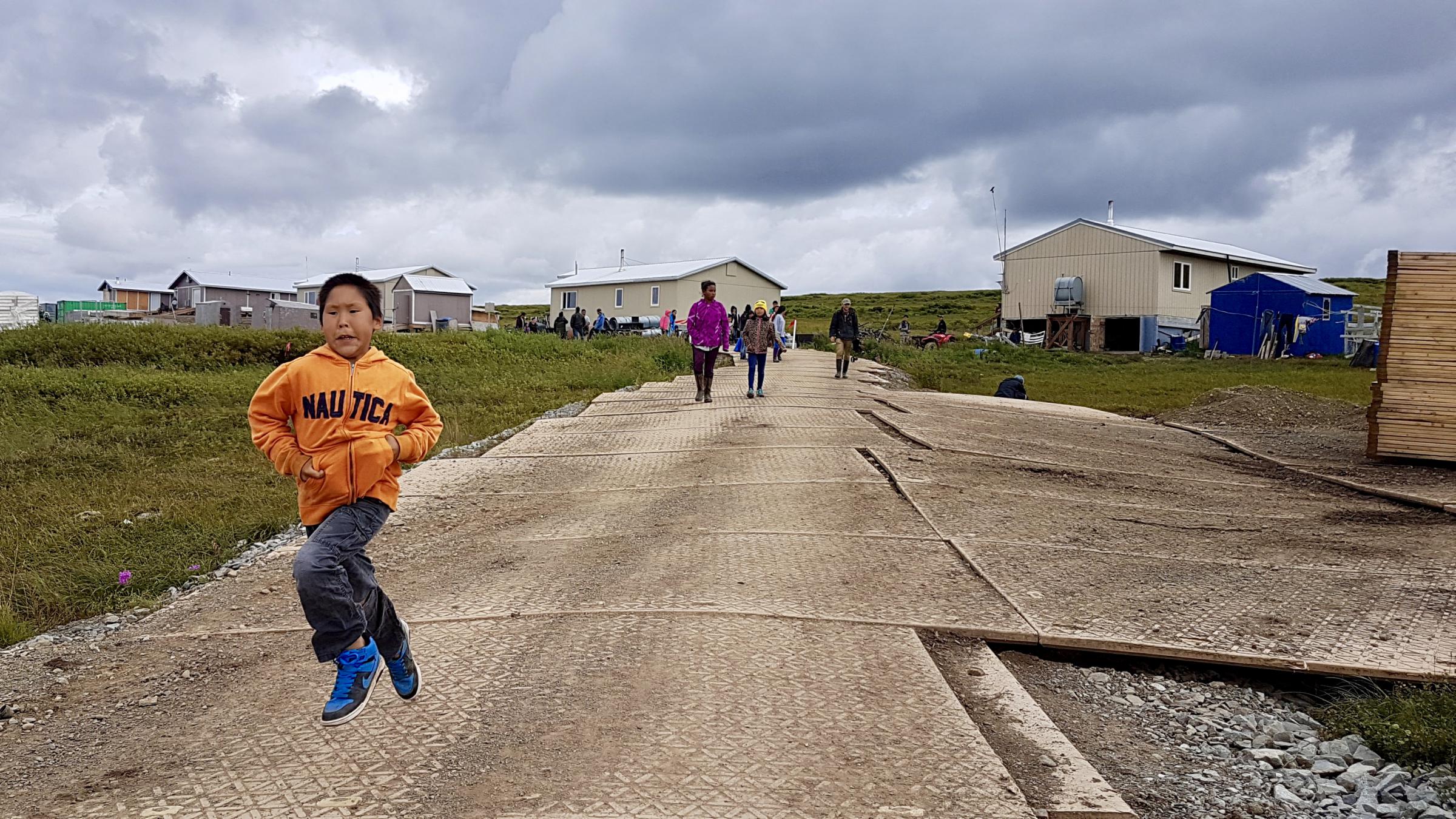
A small group of Newtok residents gathered high up on the bluffs at the new site of the village in Mertarvik.

“It’s a safe land; it’s high … it’s beautiful,” said Albertina Charles, a lifelong Newtok resident who mentioned that she was thrilled to be there.

Located a 10 to 15 minute walk uphill from the newly extended boat harbor, five to six homes – three of which are currently occupied – a steam house, and foundational pilings for four new homes line the main avenue.

Construction here has focused on water infrastructure.

Recent additions to life in Mertarvik include on-site hot and cold running water from water tanks fed by two drilled wells, a bathroom with four showers and four toilets, three washers and three dryers, a boiler, and a 125 kilowatt generator — equivalent to the power that is currently in Newtok.

Still under construction is the Mertarvik Evacuation Center, which the community hopes to start using next year.

The two-room building is being built large enough to house 250 people, if need be. A little ways further up the hillside is the dining hall that Troy Welch from HC Contractors helped build.

“It’s gonna be a viable community, very viable. It’s gonna be the community center, the kitchen area,” Welch said. “I think it’s gonna be the heart of the community.”

Planners still are working to secure the rest of the funding for the building and much of the planned housing.

Though there is much more to be done, there has been progress.

It’s been six years since state Department of Environmental Conservation Commissioner Larry Hartig was here.

He has been working on relocating Newtok for a decade.

“It was really great to see the rock pit open and see the progress on the road, because I can remember when we just wished we had a rock pit,” Hartig said. “There has been good progress.”

Hartig said that the commission’s ability to connect state and federal agencies has been crucial.

He also pointed out that the two wells that have been drilled will be able to use gravity to deliver the water, which will save on operating costs.

The biggest uncertainty threatening continued progress at Mertarvik is what kind of federal funding will be available.

In a boat headed back to the old village site, Bureau of Indian Affairs Acting Director Lynn Polacca said that Newtok is only one of many villages at risk from climate change.

The BIA is able to help fund roads, but does not have as much money available for housing, he said.

“Anything tied to transportation, that’s what we fund at the BIA,” Polacca said. “We’ve got limited funding for housing, but you know, we try to help out where we can.”

Charles is ready to be among the first to move to Mertarvik.

“I want to pioneer here in fall time. My daughter is scared for my grandchild,” Charles said. “She wanted me to take her with me so she can be safe here, but I want to be safe staying here ‘cause last year the water raised more than usual.”

With grey skies coming in, Charles remembers those fall storms, the high water levels that come with the rains, and the devastation that has come to a sinking land.

Toksook Bay fire destroyes family’s belongings, kills 5-year-old

A child is dead and a family’s belongings destroyed Saturday after a house fire in Toksook Bay.

Six people lived in the home. All but one, Kendrick Julius, 5, were able to make it out of the building after the fire started sometime before midnight.

City Administrator Paul Chimiugak provided the child’s identity; Kendrick was his nephew.

The cause of the fire is still undetermined.

Chimiugak said that there was a rush to respond to the blaze, with people stretching hoses to get water to it.

The flames were doused before any other structures were affected, but the house and everything inside were lost.

The community is collecting clothing for the family and asking people to ship donations. Grant Aviation, Ryan Air, and Ravn Alaska are all shipping the donations to Toksook Bay for free.

This is the village’s second house fire this month. No one was injured in the earlier blaze.

Donations can be shipped to:

Bob Julius and Family, Toksook Bay, Alaska 99637

  • Bob Julius: Pants size 30/30 or men’s size small sweatpants, shirt medium, coat medium, shoe size 8.5.
  • Cecelia Julius: Sweat pants preferred size medium, shirt large or extra large, coat large, shoe size 7.
  • Jennianne Theresa Julius: Pants size 3 or 4, shirt size medium, coat size medium, shoe size 7.5.
  • Natasha and Kayden: Clothing for 2-year-olds.
Site notifications
Update notification options
Subscribe to notifications