Community

Juneau police clear downtown homeless camp

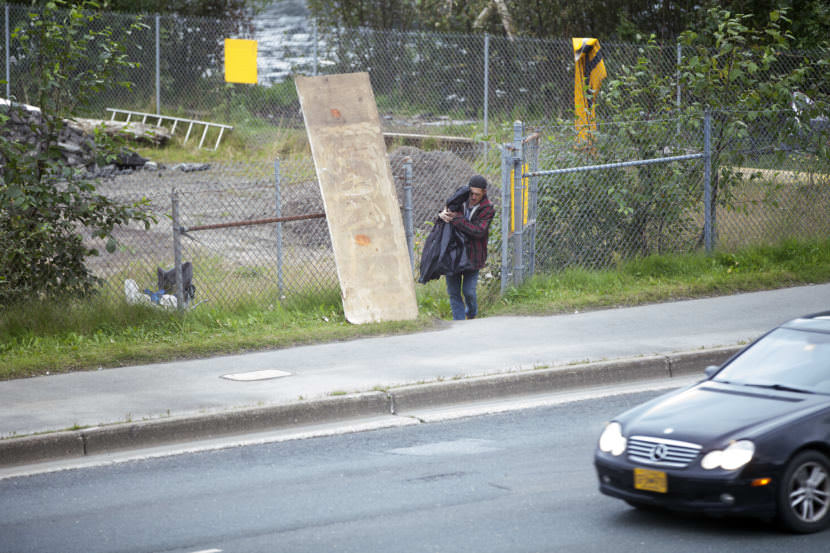
A man hauls belongings from a homeless encampment off Egan Drive on Wednesday in Juneau. The property is owned by the Alaska Mental Health Trust. (Photo by Rashah McChesney/Alaska’s Energy Desk)

Authorities cleared a downtown homeless encampment without incident this week. This comes as the City and Borough of Juneau looks to develop its strategy for tackling its homeless crisis.

Tents began sprouting up this summer on the former subport property off Egan Drive that’s owned by the Alaska Mental Health Trust. The Trust Land Office posted a trespassing notice two weeks ago and Tuesday was the deadline to vacate.

Police reported clearing the remaining people from the homeless encampment without incident.

“I think it went very smoothly,” said Wyn Menefee, acting executive director of the Trust Land Office. “We were very pleased to see that we had cooperation from all the campers that had been on the property. Most of them had already moved off and as of about 10 a.m. we had just two remaining camp groups that were in the process of packing and by noon they were off the property.”

His office last month closed on the sale of an adjacent parcel for $1.3 million to Juneau Hydropower. The energy startup has plans for a district heating and cooling plant.

Social care agencies were also on the ground during Tuesday’s sweep by police. The nonprofit Polaris House donated a van and driver to help people move their belongings, A case worker from the Juneau Alliance for Mental Health, Inc. also assisted.

This comes as a city task force is working to craft a strategy to tackle the community’s homelessness crisis – Juneau’s homeless population is the third largest in the state.

Some ideas are short-term: a sanctioned winter campground and a warming station for when temperatures drop below freezing.

Polaris House’s Executive Director Bruce Van Dusen said campgrounds, whether sanctioned or not, are not a long-term solution.

“Providing camping space for persons that are homeless is not a way to end homelessness,” Van Dusen said. “If we continue to provide supports and services that allow people to stay homeless then we’re going to continue to have a homeless problem.”

Nonetheless, City Housing Officer Scott Ciambor said several city-owned sites are still under consideration by the city’s task force.

“They didn’t necessarily settle on the idea that they liked the idea of a winter campground anyway but they just wanted to talk about it some more,” Ciambor said.

Additionally, the task force is looking at similar models to Juneau Housing First, a 32-unit apartment complex, slated to open next week. That will house some of the community’s most vulnerable homeless residents.

Initiatives like these, ones that help provide a roof over one’s head, are finding favor on the task force, he said.

“What they were more enthusiastic about was getting more details on the Juneau Coalition on Housing and Homelessness proposals,” Ciambor said, “so I’m getting some additional details on each of those.”

Those proposals include rental assistance for people unable to keep up with payments. Another model is scattered site housing which would be city-subsidized rentals scattered throughout the community. All of these proposals would cost money. The scattered site housing program could cost about $12,000 per unit, per year.

The city has also applied to the board of the Alaska Mental Health Trust Authority to fund a full-time coordinator for homeless services for the next three years. That request is being considered at the authority’s board meeting this week.

As for the displaced, a few have ended up at the Glory Hole downtown shelter and soup kitchen, though none wanted to comment.

Editor’s note: Scott Ciambor’s spouse is a CoastAlaska employee.

KTOO’s building sits on land leased from the Alaska Mental Health Trust Authority. KTOO has also applied for and received occasional grants for special reporting projects from the authority.

Juneau progressives protest Trump killing DACA immigration policy

A motorist passes a yard sign in the Flats neighborhood of downtown Juneau that celebrates diversity on Tuesday, Sept. 5, 2017.
A motorist passes a yard sign that celebrates diversity in the Flats neighborhood of downtown Juneau on Tuesday, Sept. 5, 2017. Homeowner Terry Tavel, who sometimes works for KTOO, said her grandparents on both sides of her family were immigrants from Lithuania. (Photo by Jeremy Hsieh/KTOO)

You may see an immigration-themed rally in Marine Park this evening.

Local progressive activists are protesting President Donald Trump’s decision to end the Obama-era immigration policy known was DACA, or Deferred Action on Childhood Arrivals.

The Alaska wing of Our Revolution, an advocacy group borne out of Bernie Sanders’ Democratic presidential run, is organizing the 5:30 p.m. rally at Marine Park.

“They say justice is what love looks like in public,” said volunteer Malena Marvin. “This time of year, Marine Park is a place a there’s a lot of people are around, and it’s a good place to sort of make a statement and share love with fellow community members in a way that is visible and can be seen by a broad swath of the community.”

The DACA policy let certain immigrants who came to the country illegally as youths apply for protection from deportation and work permits.

U.S. Attorney General Jeff Sessions called DACA “unilateral executive amnesty.”

Marvin said that doesn’t reflect Alaskans’ views.

“We just want to show that the immigrant youth who are in the DACA program and live in Alaska have support, have broad support in our communities,” she said. “We value immigrants and we value the contributions that these people are marking to our state’s economy, and our state’s culture. We want to be really clear that Trump’s position does not represent the prevalent views of people in Juneau and around the state.”

Marvin said she expects the event to be low-key without organized opposition.

Syringe exchange struggles to keep up with demand

Discarded needles at the Four A’s syringe exchange in Anchorage. (Photo by Zachariah Hughes/Alaska Public Media)

The state’s main syringe exchange can’t keep up with demand for clean needles among injection drug users.

The Alaska AIDS Assistance Association, or Four A’s, collects used syringes in its Anchorage office and gives out new supplies, primarily to people using heroin and other opioids.

The idea is to reduce the spread of disease and direct people abusing drugs toward recovery options.

Development Director Petra Davis said starting next week, they’re scaling back hours.

“It has become unrealistic to expect that Four A’s can sustain this alone,” Davis said. “We need other health agencies, we need other addiction agencies, we need other social service agencies to take on another syringe exchange. Realistically, Anchorage needs a lot.”

On a busy day, 150 clients will get needles from the small office on the edge of Spenard.

Between this fiscal year and last the number of individuals coming in went up 37 percent, driven in part by new users, Davis said.

“In FY17 alone we saw over 1,500 individuals who expressed that it was their first time using the exchange,” she said.

The demand for the syringe exchange has overwhelmed the organization’s other services.

Four A’s was set up to help people living with HIV/AIDS. But the increase in drug users coming to the needle exchange has made some existing clients uncomfortable.

“What made us open our eyes to that something needed to change in the syringe exchange was our HIV-care clients, some of them no longer felt comfortable coming into the office,” she said. “We are first and foremost set up to care for those clients that are living with HIV.”

Four A’s is cutting the syringe exchanges hours from 40 to 17 per week, mostly in the afternoons.

Davis said that will allow staff more time and capacity for other services related to HIV/AIDS assistance and prevention.

The program’s reduced hours go into effect Tuesday.

There is no other program filling the gap in Anchorage.

The only other similar programs on the road system are in Homer and Fairbanks, both of which are much smaller.

Four A’s runs an exchange in Juneau.

Building a future after prison through vocational education

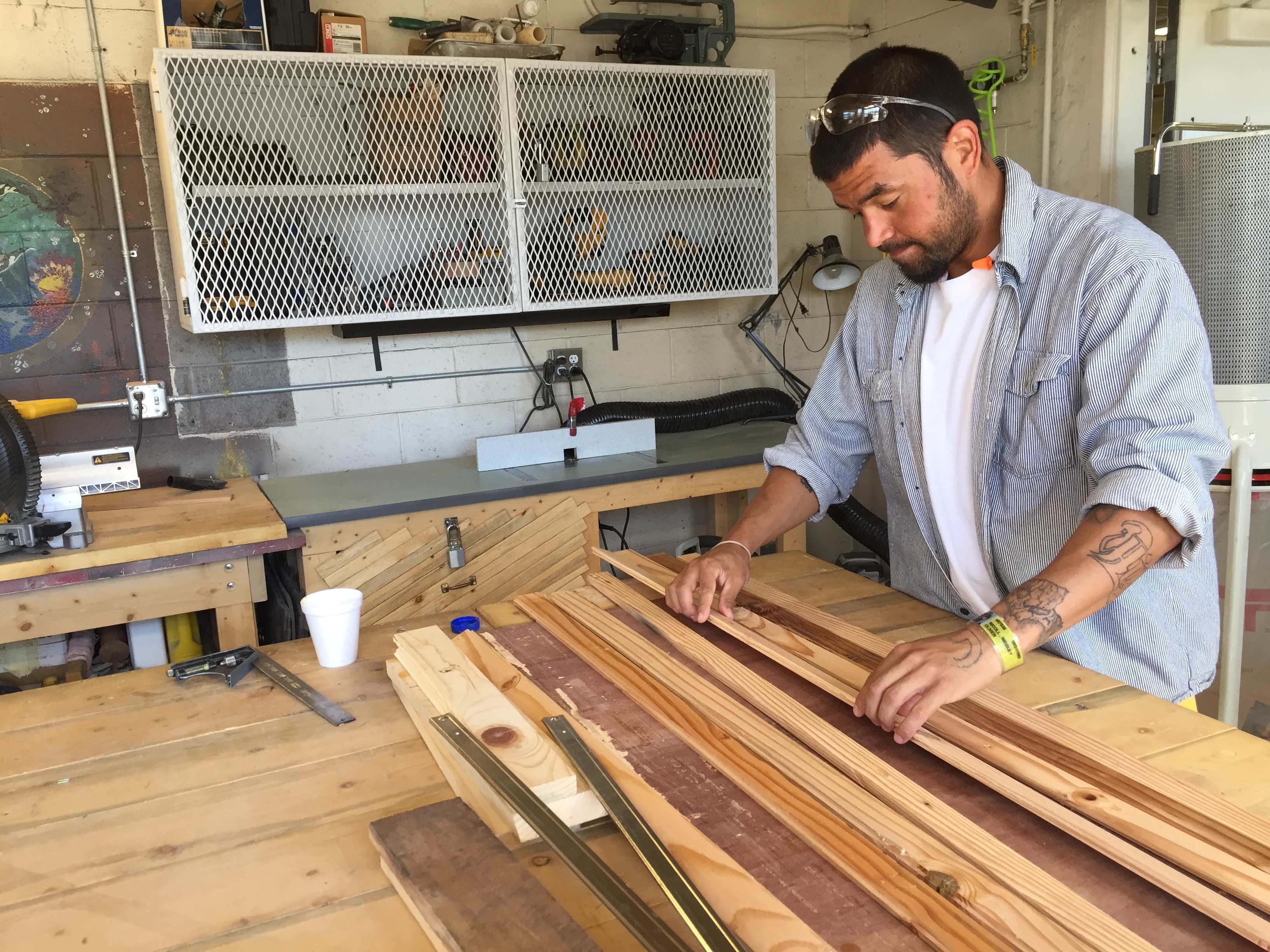
Wesley Nicoll builds a planter as part of the vocational education program at Wildwood Correctional Center in July 2017. (Photo by Anne Hillman/Alaska Public Media)

In Alaska, two-thirds of people who leave prison end up going back within three years.

Former inmates who can find decent jobs within a year of release are half as likely to re-offend, according to an Alaska Department of Labor report.

So how does the Department of Corrections want to cut recidivism? By teaching the trades.

“What we’re gonna do is take less than a 1/16th of an inch off the lip of this,” Wesley Nicoll explained as he picked up a thin slat of wood he was using to build a planter box.

He and another worker slide it into a loud table saw, the change barely perceptible.

Nicoll worked in construction before but has never done such highly precise carpentry.

It was just one of the many skills he was trying to learn as he neared the end of his sentence at Wildwood Correctional Center in Kenai.

Nicoll said it’s an important supplement to the substance abuse treatment he’s received while incarcerated.

“To be able to come here and do the hands on woodwork, welding, to keep my hands busy — I feel ready to go on the out. To be productive when I get out,” he said. It’s a huge change from his last release three years ago. “Before I was just getting released and being relatively aimless.”

Nicoll has been in and out of prison for about 12 years, mostly for drug-related crimes. He developed an addiction to opioids after a couple of severe injuries.

In the past, he was released without feeling like he developed any skills or support systems in prison.

“The last time I got out, looking for work and getting turned away multiple times, it got extremely frustrating,” he said. “After so long, I just kind of gave up and went back to what I knew,” using and selling drugs.

Which is what Department of Corrections staff, like vocational instructor Tim Ward, are trying to prevent.

Two years ago, Wildwood didn’t offer much to help prepare people for release.

Ward walked through the vocational education center, which is still in a state of expansion.

“This building used to be a storage area. It was just full of racks with pallets of junk,” he said, laughing at the memory.

Now it has a new classroom, a small area for carpentry, and extensive metalworking tools.

Ward has his students build practical items that can be used, like sheds and barbeque grills. They even built the booths they learn to weld in.

Participants can earn national certifications, too.

“The whole hope is they can get out of prison, get a job, and not come back. And this is the tool for that,” he said.

Wildwood Superintendent Shannon McCloud said the vocational education program is just an example of ways corrections institutions across Alaska are trying to be more than just punitive warehouses for people.

There’s a push for more programs in every state prison that help inmates develop the skills they need to re-enter society and stay there.

“The whole idea of incarceration has changed,” said McCloud, who has worked in corrections for more than 27 years. “I think people realize that these people are going to get out of jail. So, what can we do to put out a better product than what we received? So let’s work with them. Let’s get them out. Let’s try to help them not come back. I mean, that’s our motto.”

She said the idea behind the vocational education classes was to give people viable skills to seek jobs, but the program is accomplishing a lot more.

The inmates are “different when they’re over there. I mean, they’re like men. They’re not like these punk kids, ‘cause they know that’s what they’re supposed to be over there. Grow up. Get a skill. Move on,” she said.

And moving on is exactly what Nicholl is doing.

When we meet again – one month after I interviewed him in prison – it’s at a bustling coffee shop in south Anchorage.

He released from Wildwood a week earlier.

Through his family, he’s already received some job offers based on the certifications he earned at Wildwood, but he wants to find a job on his own.

The certifications help, he said.

“It makes me a lot more confident while I’m job searching, that’s for sure.”

He also has a full ride to college starting in January thanks to the help of his Native corporations.

Nicholl said it’s the first time in six years he’s released from prison prepared and sober – and he actually wants to stay that way.

“I spontaneously smile. I spontaneously catch myself laughing because it’s hard to believe it’s real sometimes,” he said, grinning.

He took a sip of his coffee, prepared to look for a job and move on with his life. He said he’s scared but ready.

Sealaska Heritage to celebrate Chilkat robe’s homecoming  

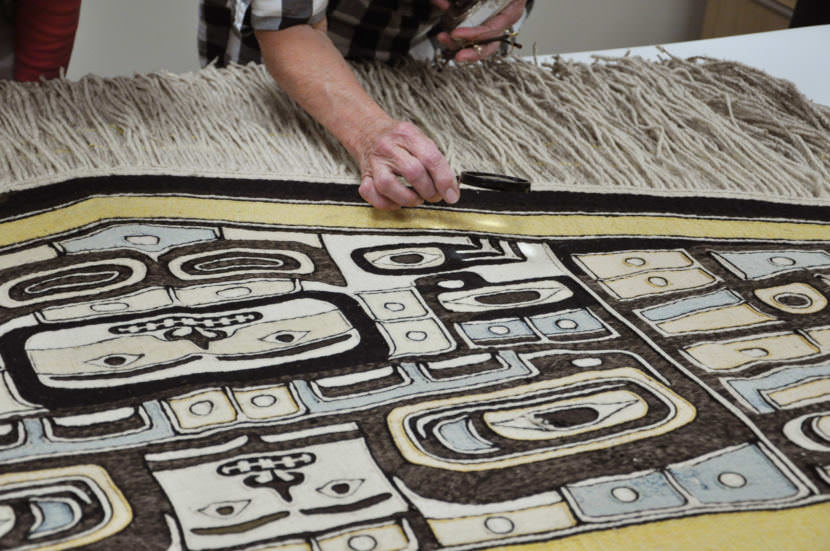
A 100-year-old Chilkat robe will be the guest of honor at a homecoming ceremony Saturday, August 26, 2017, in the Walter Soboleff Building. (photo by Davina Cole/Used with permission from Sealaska Heritage Institute)
This 100-year-old Chilkat robe will be honored at a homecoming ceremony on Saturday in the Walter Soboleff Building. (Photo by Davina Cole/Sealaska Heritage Institute)

A 100-year-old Chilkat robe has come home to Southeast Alaska. A Seattle couple originally purchased the robe in 1995. Upon realizing its significance, they began reaching out to experts about its origins.

Alaska Native weavers, historians and area residents are eager to see the return of the sacred clan object.

Chuck Smythe directs the culture and history department at Sealaska Heritage Institute. He said bringing home sacred objects like the robe is extremely valuable.

“Particularly items like a naaxein, a Chilkat robe, because they were rare and they were made by only very wealthy families, clans, and designate usually clan history usually related to a place where a crest was acquired,” Smythe said. “Just very important, sometimes they’re associated with a personal name that’s passed down and all that is kind of encapsulated in the design on the robe.”

Smythe said Chilkat weavers will study the robe to learn how it was put together.

“Weavers can see things in them like the robe that’s coming tomorrow. Delores Churchill and another weaver looked at it and they could tell that there had been an apprentice weaver assisting the master weaver who made it. They just said it was really a spectacular piece. The round circles in the middle were extremely well made and they saw the features of it were really beautiful.”

The robe is considered to be at.óowu, or a sacred clan object or treasure.

Sealaska Heritage is celebrating the robes return in a homecoming celebration that begins at 1:30 p.m. Saturday at the Walter Soboleff Building in the Shuká Hít clan house. Sealaska Heritage also plans to stream video of the celebration on Facebook Live.

Gold claims expand as Herbert Glacier retreats

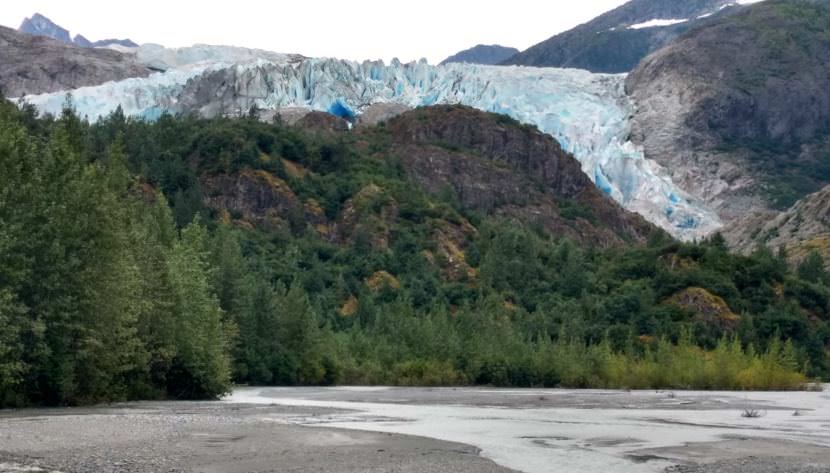
The Herbert Glacier viewed from the banks of the eponymous river on August 12, 2017. (Photo by Jacob Resneck/KTOO)

A retreating glacier is exposing virgin territory about 20 miles north of Juneau.

Mining claims around the Herbert Glacier has a Canadian prospecting company excited and environmentalists concerned.

Along the river bank, a bluish hue shines off the Herbert Glacier dominating the horizon. It’s near this wide spot in the Herbert River where mining claims begin.

Two decades ago this area was covered in ice.

“It’s easier and cheaper I think to drill when you’re not sitting on top of a moving glacier, a calving glacier,” said Guy Archibald, staff scientist for Southeast Alaska Conservation Council, a self-styled mine watchdog.

“What it’s doing is that the glacial retreat is exposing fresh rock that hasn’t been seen by anybody and some of that rock contains mineralization that could be economical to dig up and mine.”

The U.S. Forest Service oversees drilling permits here. Aerial photos from past years confirm the glacier’s retreat.

“The glacier’s receded since the late 1990s on the order of about a quarter-mile or so,” Minerals Program Manager Matthew Reece said.

That’s created opportunity and interest in the past decade and this summer the Forest Service renewed permits for a new round of drilling.

“It’s simply an exploration project,” Reece said. “Anything that would go further would require a significant amount of planning and environmental assessment.”

The drilling firm is Grande Portage Resources of Vancouver, B.C. It touts its Herbert Gold Project as “one of Alaska’s more promising prospects” in what it describes as an “underexplored” area rich in gold-quartz veins.

“We’ve been historically active in the area, drilling an exploration target north of Juneau called the Herbert Gold Project,” CEO Ian Klassen said.

The company’s reported drilling tests yielding about 60 grams of gold per metric ton at a depth of about 8 meters, which has sparked renewed interest.

“In the past we’ve only gone down about 600 feet,” Klassen said. “This year we’ll go a little bit deeper, down to almost testing 2,000 feet as well as testing the eastern extensions of three of the most prolific veins that we’ve tested to date.”

Developing a mine would require state and federal permits and would also be subject to local review. But Juneau’s local elected officials are considering eliminating that process.

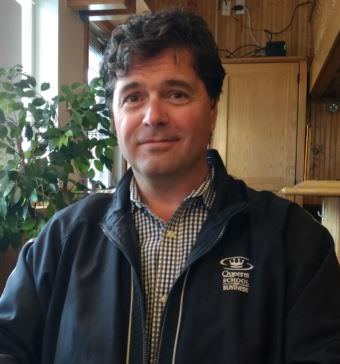
Ian Klassen, CEO of Grande Portage Resources Ltd. during a July 14, 2017, visit to Juneau. (Photo by Jacob Resneck/KTOO)

Environmentalists are troubled.

“Changing the mining ordinance will affect the city’s ability to analyze and ask for additional protections on any potential Herbert Glacier mine,” Archibald said.

But with the state’s fiscal crisis threatening public sector jobs, pro-mining boosters argue that Juneau needs to get back to its roots as a mining town.

“Juneau has a reputation as an anti-mining town,” Jim Clark, former chief of staff for Gov. Frank Murkowski, said in May. He and a group of well-connected businessmen convinced a majority on the Juneau Assembly that the city’s mining law should be re-examined. “Part of fixing this ordinance is to repair that image statewide so that we appear to be open for business.”

Juneau’s mayor has since appointed a task force to take a hard look at the local mining ordinance; its recommendations are expected in November.

Meanwhile, Grande Portage has a crew of nine in Juneau. Its drillers rotate shifts as work continues 24/7.

“We expect that this drill season will lead to future drill seasons and as we add significantly through the assay lab results we’ll end up redoing our resource calculation,” Klassen said. “The larger a deposit we get, the more interest you’d get from the investment community and from your peers.”

The Canadian CEO’s optimism isn’t matched by environmentalists.

“I can’t predict what this mine is going to look like,” Archibald said. “But the trick is the mining company, because of everything unique about this area and the complexity, they can’t predict what impacts are gonna be 200 years from now or even 50 years from now.”

Core samples will indicate whether further exploration is economical. But the political and environmental considerations of restarting gold mining around the Herbert Glacier is another question entirely.

Site notifications
Update notification options
Subscribe to notifications