Community

Goldbelt Heritage may inherit city-owned Aak’w Kwáan site

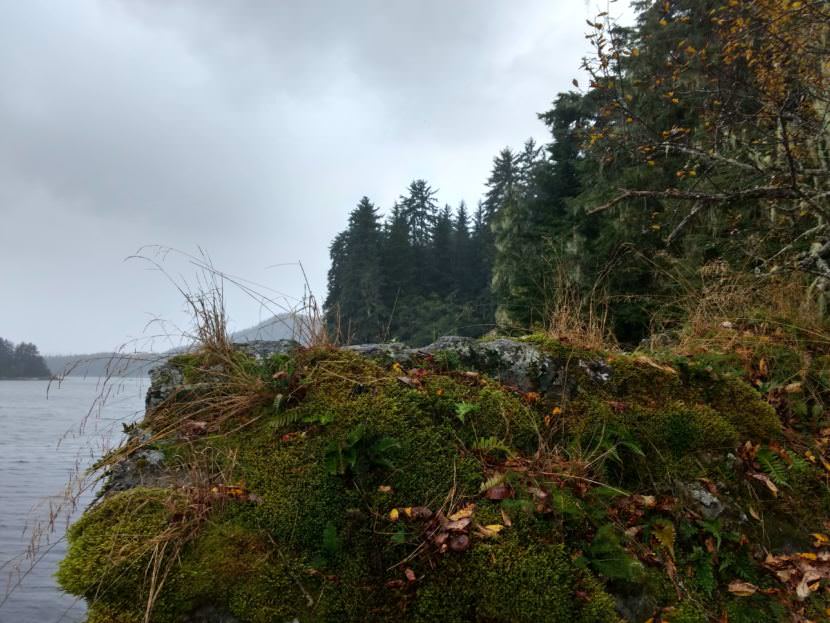
A rocky outcropping at the end of Indian Point on Oct. 3. This area is one of the oldest known village sites of the Aak’w Kwáan in the region and listed on the National Register of Historic Places. (Photo by Jacob Resneck/KTOO)

Indian Point, a former Tlingit village site on Auke Bay, may be ceded to a nonprofit dedicated to Aak’w Kwáan heritage.

The land was controversially acquired by the federal government before ending up in municipal hands in the 1960s.

At the southern-most point of Auke Cape, a rocky outcropping offers sweeping views of Indian Cove and Indian Island. Auke Cape is commonly known as Indian Point. These names give away this area’s history.

“This is a south-facing, waterfront lot with beautiful views of Auke Bay,” said Greg Chaney, lands manager for the City and Borough of Juneau. “Which is the exactly the reason that the Native people selected it for their village site so many centuries ago.”

The cape’s southern tip has been city-owned since the 1960s. It picked up a third tract in a three-way swap in the 1990s and now holds most of the cape and is looking to return it to the descendants of its original inhabitants.

“It’s very much like finding a wallet that somebody has – you pick it up on the street and you think, ‘Oh, this belongs to somebody.’ And so then, you know, I think most people would agree the proper thing to do is to return it to the rightful owners.”

A former Juneau Assemblyman wrote to the Assembly last month recommending that the city give Indian Point to the Goldbelt Heritage Foundation.

Randy Wanamaker penned that letter. The 73-year-old recalls spending time there as a boy with his grandfather who was born on Auke Bay.

“We used to put branches in the water for the herring eggs and dip nets in the water and get the herring out,” Wanamaker said by telephone from Seattle where he now lives. “That was a practice that was going on for thousands of years, but it got wiped out by the commercial fisheries.”

Goldbelt Heritage shouldn’t be confused with its sister organization Goldbelt Inc., a for-profit Native corporation. The nonprofit’s mission is cultural stewardship.

“They do a lot of things that honor and respect the culture and history of the original inhabitants,” Wanamaker said.

The story of how Indian Point became government land is typical of what happened to many Native villages across Alaska.

By the 1920s, much of the Native population around Auke Bay had moved to Juneau and Douglas to work in the mines, though they would periodically return to Auke Bay to hunt, fish and gather food.

“They were practicing a lifestyle that was in balance with nature. But the Forest Service in Southeast Alaska always said it was not used and it had been abandoned and that would be their justification when they acquired it for the federal government,” Wanamaker said. “The federal government did not consult with the Alaska Native people when they dispossessed them of their land. They just took it away.

As recently as 2002 in the Forest Service’s official history in Alaska asserts that Auke Bay villages were abandoned.
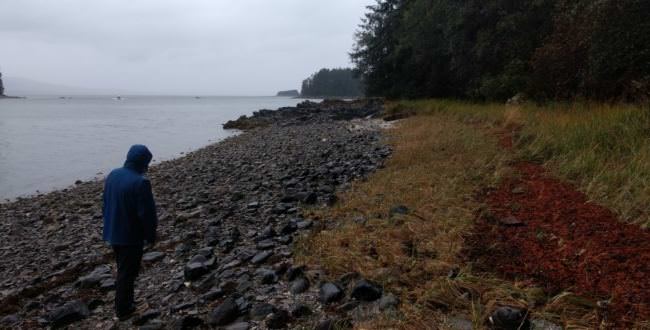
City and Borough of Juneau Lands Manager Greg Chaney walks along the shoreline off Indian Point on Oct. 3. About 52 acres of city-owned land may be transferred to the Goldbelt Heritage Foundation. (Photo by Jacob Resneck/KTOO)

Anthropologist Tom Thornton, investigated the cultural value of Indian Point on behalf of the federal government in the 1990s, said it wasn’t so simple.

“There was sort of a larger campaign to move Native people off of the Tongass forest land, and burning cabins and things like that. And the Forest Service always denied that until they stopped denying it and then apologized for it,” Thornton said in an interview from the University of Oxford where he’s a professor.

His research helped get Indian Point listed last year on the National Register of Historic Places.

The Forest Service first acknowledged in 2008 that it had wrongly removed fish camps and smokehouses, vital for the subsistence lifestyle, in the early 20th century.

Tongass National Forest spokesman Paul Robbins Jr. said in a statement that the Forest Service acknowledges that the destruction wasn’t limited to fish camps.

As we continue our dialog with the Aak’w Kwáan and various other tribes in this region, the Forest Service is going to remain open to all new information as historians continue to delve into the storied past of Southeast Alaska.”

The 52 acres on Indian Point is perhaps the most valuable — in real estate terms — that the city owns.

“That’s why we have to be very careful about transferring it to an organization that’s going to look out for the cultural interests of the Aak’w Kwáan and not just look at it as a multi-million dollar asset,” Chaney said. “In our current generation, we have the opportunity to right a wrong that was done generations ago. This was the old village site, this was a sacred site, and we could return it to the Aak’w people in our time.”

Indian Point was almost cut up in the 1960s for a housing subdivision. Opposition by the Alaska Native Brotherhood and others put a stop to that.

A half-century later, the possible fate of Indian Point again lies with the Juneau Assembly.

The lands committee is slated to consider the transfer later at its Oct. 23 meeting.
Hikers barred from trail at the end of North Douglas Highway

New signs at a popular beach access that begins where North Douglas Highway ends declare “no trespassing.” But a trail group said it hopes to negotiate public access with the landowner.

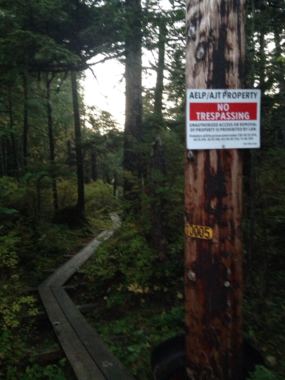
No trespassing signs mark a popular trail at the end of North Douglas Highway on Sept. 28, 2017. The signs were recently re-posted at the request of landowner Goldbelt, Inc.
No trespassing signs mark a popular trail at the end of North Douglas Highway on Sept. 28. The signs were recently re-posted at the request of landowner Goldbelt, Inc. (Photo courtesy Tressa Millam)

The land at the end of the road is owned by Goldbelt, Inc. The Native corporation owns much of the shoreline along the western end of Douglas Island.

A trail runs through an easement Goldbelt granted to Alaska Electric Light & Power Co. in 2002. It provides access to a substation that transmits power to the Hecla Greens Creek Mine.

“Some folks do think it’s a public trail and don’t realize it’s private property,” said AEL&P spokeswoman Debbie Driscoll. “And we were informed that the signs that we had previously put up had fallen off or were no longer there. And so, Goldbelt had requested that we re-post signs, which is what we’ve recently done.”

Trail Mix, Inc., a Juneau group that develops trails and advocates for public access, said it’s a popular way for people to access the beach.

“It’s got a beautiful view so people have been using it since it was put in, even though it is on private property and it was not intended as a recreation trail,” said Erik Boraas, Trail Mix’s executive director. “According to AEL&P and Goldbelt, it’s never been open to the public. But like a lot of trails in Juneau, people are not familiar with who the land manager is and what the status is and are like, ‘Oh, there’s a trail, so I’m going to walk on it.'”

He said he’s approached the Native corporation about helping develop the trail for public access. After visiting the area this week, he agreed that there are problems.

“There was litter out there,” Boraas said. “There was trees that had just been hacked away at, green trees that people I assume were cutting for firewood, that are not good firewood. And yeah, just not treated with respect.”

Barring any agreement, the trail is on private property and remains closed to the public. Goldbelt said only its shareholders with a Goldbelt ID card are allowed access without prior permission.

Artists of All Nations fosters communal creative space

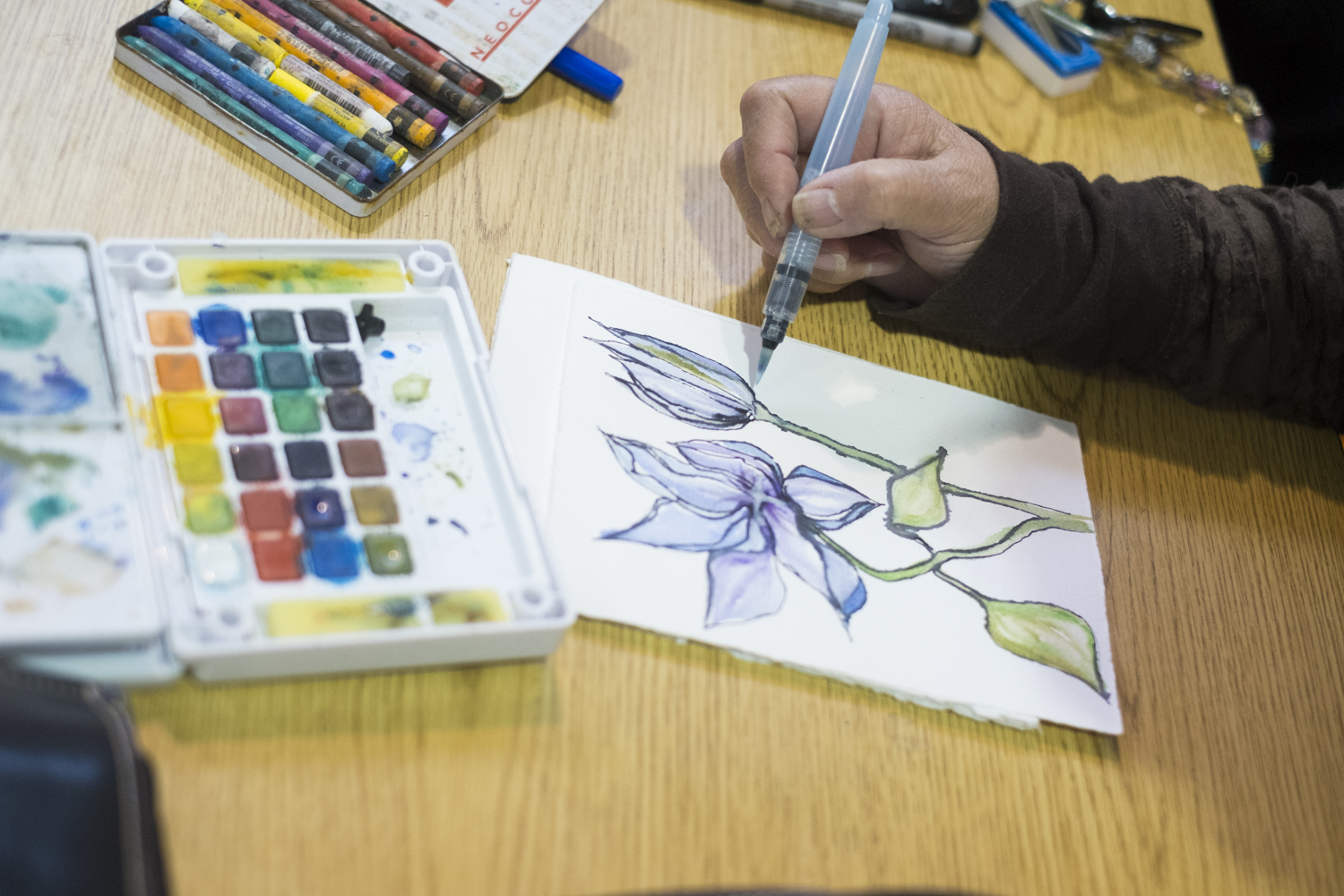
Pua Maunu uses watercolors and pen and ink to paint at Artists of All Nations, a communal art space at the JACC on Sunday, Sep. 24, 2017. (Photo by Annie Bartholomew/KTOO)
Juneau painter and 2017 Juneau Arts and Humanities Council Juried Art Show Winner Pua Maunu uses watercolors and pen and ink to paint at Artists of All Nations, a communal art space at the JACC on Sunday, Sep. 24, 2017. (Photo by Annie Bartholomew/KTOO)

More than 30 artists, children and crafters got together this past weekend for an open studio gathering at the Juneau Arts and Culture Center. 

It was the second monthly Artists of All Nations event put together by the Juneau Arts and Humanities Council.

The Artists of All Nations events are a result of the JAHC’s Diversity and Inclusion Task Force, which responded to Alaska Native artists’ desire to create art as a collective experience.

“Most of the Native artists that I know, including myself, work in community,” says program facilitator and JAHC and KTOO board member Debra O’Gara. “We’re trying to set up just a community space where people can come in, work on their projects, but also view what other people are doing and get ideas and inspiration for not just for your project, that you’re working on, but also give inspiration and ideas to somebody else.”

Open to all artists and mediums, activity included both Raven’s Tail and Chilkat weaving, beadwork, carving, needle point, painting, coloring and mixed media.

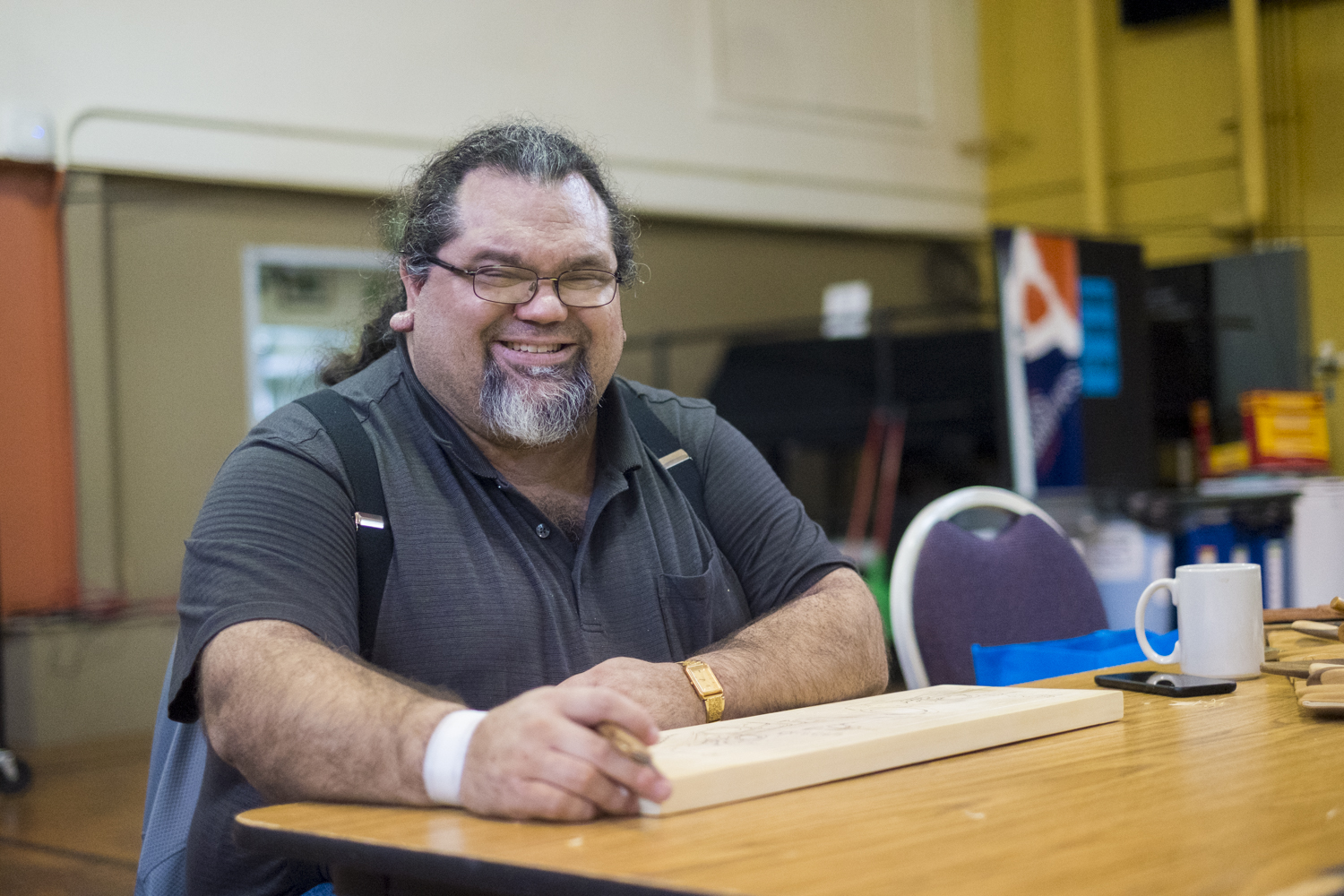
Juneau artist and UAS professor Abel Ryan works on a carving at Artist of All Nations, a open studio and community art space happening once-a-month at the JACC. (Photo by Annie Bartholomew/KTOO)
Juneau artist and University of Alaska Southeast professor Abel Ryan works on a carving at Artist of All Nations, a open studio and community art space happening once-a-month at the JACC. (Photo by Annie Bartholomew/KTOO)

Juneau artist and University of Alaska Southeast professor Abel Ryan worked on a bas relief carved plaque, which is part of a commission with two rings that feature a of formline whale design.

Ryan said the art form is at least 1,000 years old, “It’s a lot of fun to learn how to do and it’s easy to get lost when composing the designs.”

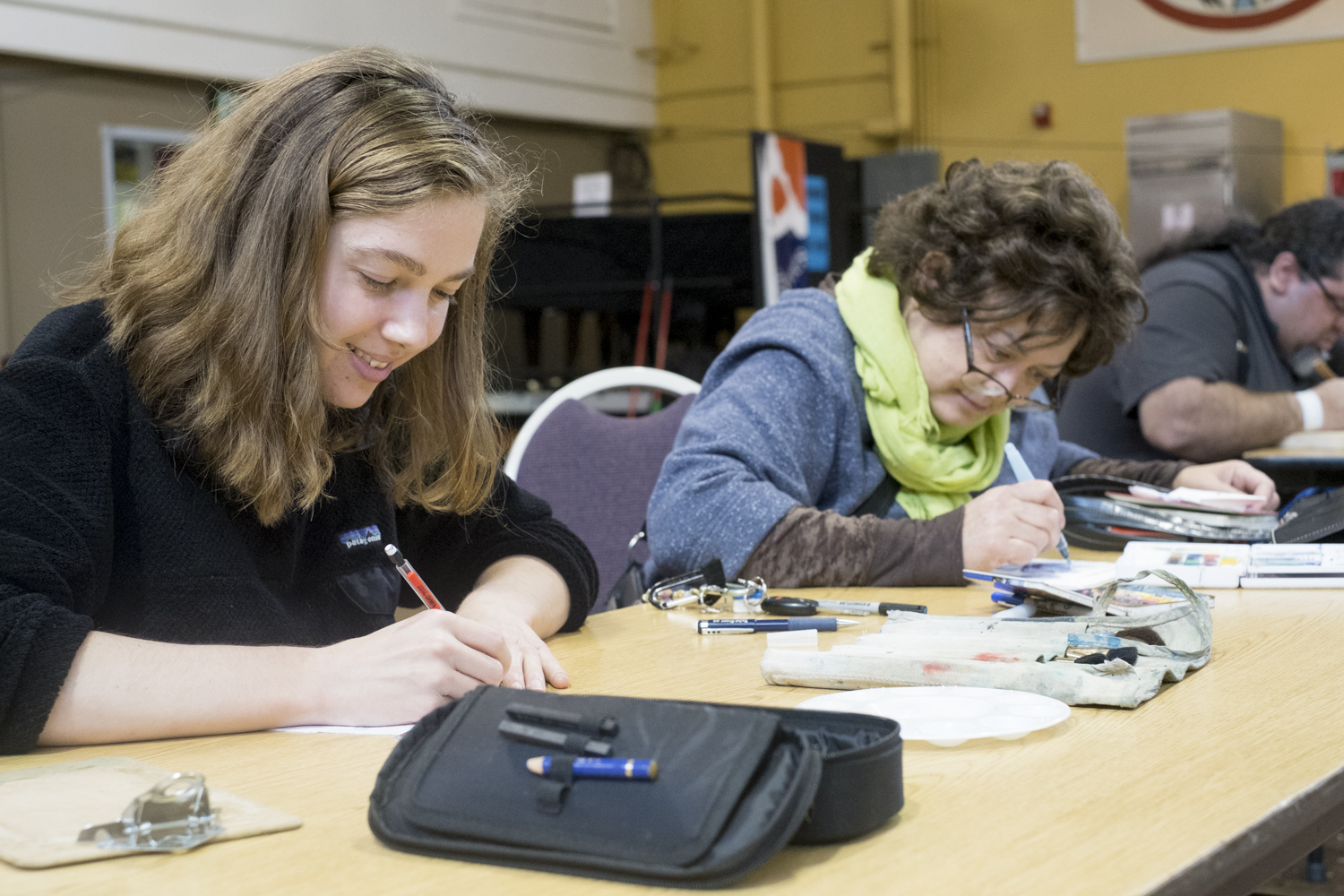
More than 20 artists gathered at the JACC for Artists of All Nations, a monthly creative space open to all artists and mediums. Juneau artist Pua Maunu of the Plein Rain Painters works on projects on Sep. 24, 2017. (Photo by Annie Bartholomew/KTOO)
More than 20 artists gathered at the JACC for Artists of All Nations, a monthly creative space open to all artists and mediums. Juneau artists Crystal Cudworth and Pua Maunu of the Plein Rain Painters works on projects Sep. 24, 2017. (Photo by Annie Bartholomew/KTOO)

Juneau painter and 2017 JAHC juried art show “Best In Show” winner Pua Mauna worked with water color and pen and ink at her first Artists of All Nations.

“It’s a great space and I love meeting all the artists here and seeing what they’re doing,” Maunu said. “It’s very inspirational.

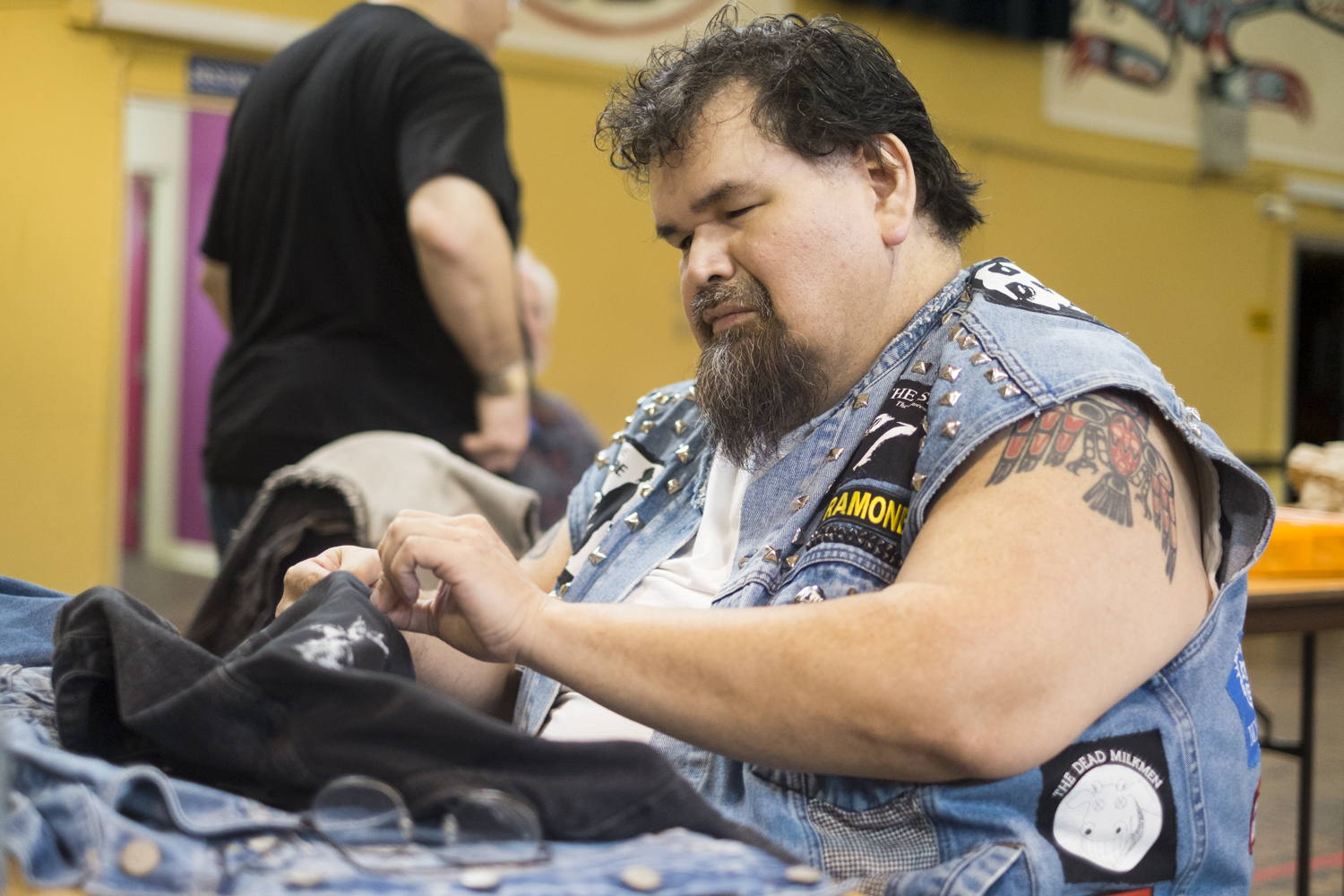
Alfie Price of Juneau sews patches and to a denim vest at Artists of All Nations on Sunday, Sep. 24, 2017. (Photo by Annie Bartholomew/KTOO)

Juneau artist Alfie Price sewed patches to his “Rock and Roll Battle Vests.” Made from old jean jackets, his designs are adorned with patches from favorite bands, political statements or personal messages that represent the wearer.

Price usually sources his denim on eBay or hunts for them at local thrift stores.

He said the older the better, “If they’re kind of worn in they look a lot cooler, and they’re more comfortable.

The next Artists of All Nations gathering takes place Sunday, Oct. 22 at the JACC.

Can Juneau handle 1.5 million cruise ship visitors? Docks and Harbors says it’s time to plan

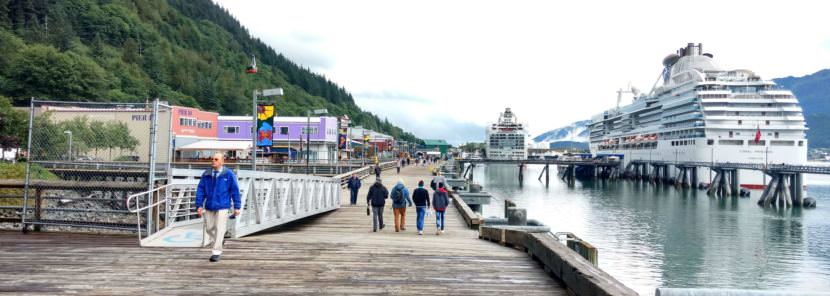
A pair of Panamax cruise ships docked in downtown Juneau on Aug. 30, 2017. The floating berths have eliminated the need for yellow security fencing and opened up a wide promenade for pedestrians. (Photo by Jacob Resneck/KTOO)

Juneau could see 1.5 million cruise ship passengers per season in the next decade, according to a recent study commissioned by the city’s Docks and Harbors.

In order to plan for the influx, Docks and Harbors is crafting a plan for the downtown waterfront.

Juneau has invested millions in new floating berths to accommodate bigger cruise ships that tie up downtown.

The floating docks can accommodate four large ships at a time plus one anchored offshore. In real numbers, that’s 10,000 to 15,000 passengers and crew daily.

City Port Engineer Gary Gillette said it was necessary to move with the times.

“The city built these two new cruise berths at the direction of the industry,” Gillette said. “They basically said, ‘We’ve got bigger ships coming and the docks that you have can’t accommodate them.'”

There’s also more space created by the floating berths. Gone is the yellow security fencing.

The long, broad wooden seawalk is a pedestrian promenade once again.

Last year Juneau broke the million passenger mark for the first time since 2009, when the Great Recession hit the cruise industry hard. And the numbers are expected to keep rising.

Gillette said forward thinking is needed for the promenade and the vendors that serve it.

“Rather than just say the first guy comes along, ‘OK, you go over here.’ And the next guy comes along, ‘Well, we’ll put you over here.’ And then in five or 10 years we go, ‘Oh god, why did we do that with no plan?” he said. “Now we’ve got a mess. How do we figure that out?'”

Docks and Harbors commissioned Rain Coast Data to make some projections on visitor numbers.

“The number that the cruise ship industry often have touted to use as a projected growth number is 2 percent, and so if you take that 2 percent growth figure and you march it forward, we’re going to see a 1.5 million cruise ship passengers in Juneau in 15 years,” said Meilani Schijvens, the research firm’s director.

Schijvens data shows visitor numbers are climbing at twice that rate.

“Mirroring what has happened over the past 15 years and moving that forward, we’re going to have 1.5 million cruise ship passengers in Juneau in 10 years,” she said.

Either way, a half-million more cruise ship visitors would have an impact downtown.

“We’ve got all those people disembarking in the downtown Juneau area. They’re moving through the stores, they’re moving through the community,” Schijvens said. “We want that to be a really positive experience for them, we want it to be a positive experience for the locals.”

Docks and Harbors is working on an urban design plan.

Consultants working on the plan said the newly opened up waterfront isn’t just for people off the ships – it’s for everyone.

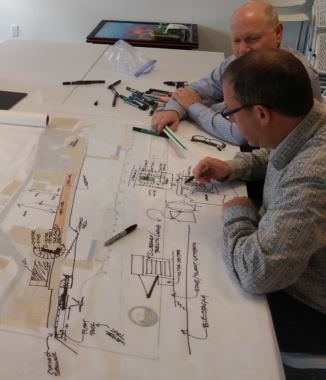
Consultants Chris Mertl, foreground, and Dick Somerville sketch concepts during an open studio held by Docks and Harbors on Sept. 7. (Photo by Jacob Resneck/KTOO)

“We’re seeing a lot of locals are coming down and spending time down here just because there’s plenty of open space,” said lead consultant Chris Mertl, a landscape architect. “There’s artwork, there’s vendors and it’s really becoming an area of activity, it’s no longer congested. We’re looking at opportunities of how can we carry this success down the length of the seawalk, down towards Marine Park.”

Strong visitor numbers are good for the economy. But there are also broader questions about the downtown’s capacity.

“How many cruise ship passengers can our community handle and not constantly impact our quality of life,” asked Juneau resident Sue Schrader at a recent workshop hosted by Docks and Harbors. “We’re up to over a million. What are we going do? When are we going to start talking about this? I think the time is now.”

There hasn’t been a study on the downtown’s upper limit for cruise ship visitors, nor is Docks and Harbors asking that question specifically.

But Rob Steedle head of the city’s Community Development Department, said it’s something worth pondering.

“How many more vans can we put on our streets before the experience of the visitors is greatly diminished, before the experience of residents is greatly diminished? How many more destinations would need to be developed for all those visitors?” Steedle said. “That’s the question I think we should be asking ourselves is: ‘How many people can this community absorb?'”

Cruise ships bring more than 90 percent of tourists to Juneau.

Overall, visitors paid nearly a fifth of the local sales tax last year. And the marine passenger fee also funds much of the city’s dockside infrastructure and services.

But there are always unintended consequences.

“Tourism has been hugely beneficial for Juneau in terms of sales tax revenue, certainly, and in terms of employment,” Steedle said. “But is the quality of life going to diminish? And I think so far, I think the answer of the community is coming up with is: ‘No, it’s not.’ But at a million and a half? Will we have too many? We’ll see in another 10 to 15 years.”

Docks and Harbors’ urban design plan is limited to the immediate waterfront between Marine Park and Taku Smokeries.

But the planning exercise is a chance to delve into larger issues facing downtown in the long run.

Initial design concepts for waterfront planning will be presented to the Docks and Harbors board at 5 p.m. Thursday, Sept. 28, in the Assembly chambers.

Tlingit poet and scholar Nora Marks Dauenhauer, 90, was culture bearer

Nora Dauenhauer won an Ecotrust Indigenous Leadership Award in 2011.
Nora Dauenhauer won an Ecotrust Indigenous Leadership Award in 2011. (Creative Commons photo by Sam Beebe)

Tlingit poet, scholar and culture bearer Nora Marks Dauenhauer has passed away at age 90.

A fluent Tlingit speaker, Dauenhauer made countless contributions to the study and preservation of the language and oral tradition.

In 2012, she was the Alaska State Writer Laureate, and is the winner of an American Book Award among other honors.

Here is a selection of Dauenhauer reading from her poem “Salmon Egg Puller” in 2012, courtesy of Dixie Hutchinson at Sealaska Corp.

And here is Dauenhauer in “Lineage: Tlingit Art Across Generations,” a recent documentary by KTOO Public Media and 360 North.

Services information was not immediately available.

How much could electric vehicles put the brakes on Alaska’s oil economy?

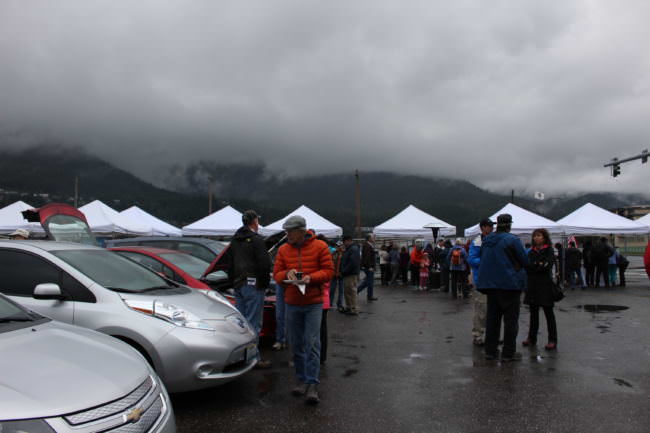
The Juneau electric vehicle fair was part of the National Drive Electric Week. (Photo by Elizabeth Jenkins/Alaska’s Energy Desk)

Alaska’s economy is powered by oil. So are the vast majority of cars and trucks worldwide. But globally, the market for electric vehicles is growing. So as more people move away from gasoline powered cars, the big players in the oil industry have started to pay attention — and that includes Alaska.

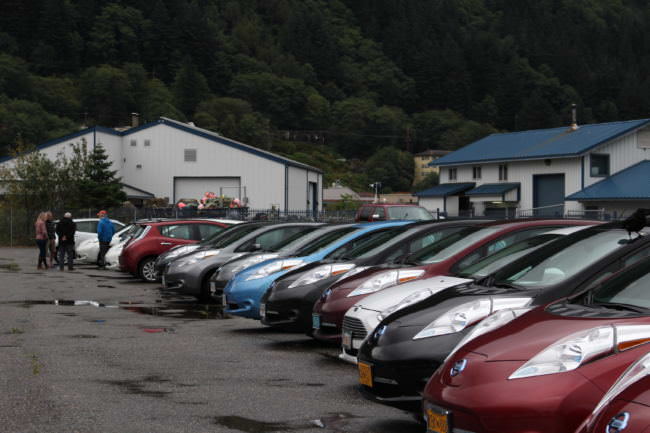
On a recent weekend, nearly 70 electric vehicles are lined up in a bare parking lot near downtown Juneau. It’s the city’s annual electric vehicle fair. The 1980’s song “Electric Avenue” is playing in the background. 

John Cooper is here showing off his two EVs. And he’s proud to say he was one of Juneau’s early adopters.

He invites me inside his fully-electric sedan and pops the keys in the ignition.

Cooper says there are plenty of charging stations in Juneau. Range anxiety isn’t an issue. He says the convenience of owning an electric car was a big selling point.

“When you’re on the way to work, your car is [at] full [charge],” Cooper said. “And it’s an incredible feeling to get in the car — like, the whole time we’ve been talking — this car has been on and idling.”

It’s quiet because there’s no rumble of a gasoline-powered internal combustion engine.

Not too long ago, electric vehicles weren’t commercially available. But over the span of about five years, the number of EVs has reached into the millions worldwide.

That’s still only a tiny fraction of cars on the road. Even so, oil companies and Alaska state economist Neal Fried are paying attention.

“Does it keep me up at night? Not too often,” Fried said. “But it’s not just a thought experiment by any means.”

For the past 40 years, Alaska has paid its bills largely using oil revenue.

Recently, that’s presented the economy with some extreme challenges, and Fried says electric cars are potentially yet another threat. How big of a threat? That depends a lot on how quickly the shift happens.

“Look at iphones and how fast they were adopted. Could the same thing happen to us?” Fried said. “I don’t know.”

There’s a range of opinions on that. Some energy analysts forecast that electric vehicles could outsell gasoline cars by 2040.

Then, there are companies like BP, which project much smaller numbers.

Sam Ori, the executive director at the Energy Policy Institute at the University of Chicago, agrees with Fried that electric vehicles are nothing to scoff at. 

The global demand for oil is still increasing, but Ori says as consumers snap up more electric cars, the demand could start to flatten out.

“It’s not as if people are going to stop showing up to buy oil from Alaska,” Ori said. “But the price that they buy that oil is going to be less than it otherwise would have been, because of this change in the oil market. And electric vehicles are a piece of that — a small piece, but they’re going to become a bigger piece of it.”

Already, he says, electric vehicles and more fuel-efficient cars are affecting the global oil market.

That trend is likely to continue as countries consider measures to reduce carbon emissions. The Chinese government is thinking about banning gasoline-powered cars altogether.

Juneau’s ten public charging stations around town give EVs owners a variety of places to plug-in. (Photo by Elizabeth Jenkins/Alaska’s Energy Desk)

But Ori says the transition isn’t going to happen overnight.

“I think if people are thinking of it as like, ‘Well, are electric vehicles going to become so widespread in the next few years that they eliminate the demand for oil?'” Ori said. “That’s not happening soon.”

Still, Ori says globally it’s becoming cheaper to produce oil. Far-flung places where it’s expensive to drill, like Alaska, could start to look less and less appealing.

Back at Juneau’s electric vehicle fair, Monique Reeder is taking a break from the rain under a tailgate tent.

She’s here promoting her dealership, which carries electric vehicles. But Reeder herself?

“You know, I actually don’t own a car,” Reeder said with a laugh. “But I do take home demos.”

In any case, she doesn’t think the capital city’s enthusiasm to move away from gasoline cars has to be a reflection on the state’s economy.

She says Alaska will have to adapt.

“Because we don’t want what’s happening with the barrel prices, we don’t want that to affect our economy so much, where it’s really hurting our budget because we’re dependent,” Reeder said. “If we can diversify, it’s going to be a positive all around.”

As for her business, Reeder’s been selling electric cars for about a year, and she says they’ve been flying off the lot.

Site notifications
Update notification options
Subscribe to notifications