Kathy Streveler is the president of a local nonprofit behind the effort. She said it began in 2008 when a parcel near the town’s most prominent intersection hit the market.
“There was 8 acres of property in the middle of town that went up for sale,” she recalled. “And so seven of us good friends would be driving by that field thinking, ‘What’s going to happen?’ It’s right in the middle of town, a beautiful spot, and we did not want to see it turn into who-knows-what.”
“We started a big fundraising effort back then and we bought that property — $254,000 we raised locally, entirely locally,” Streveler said.
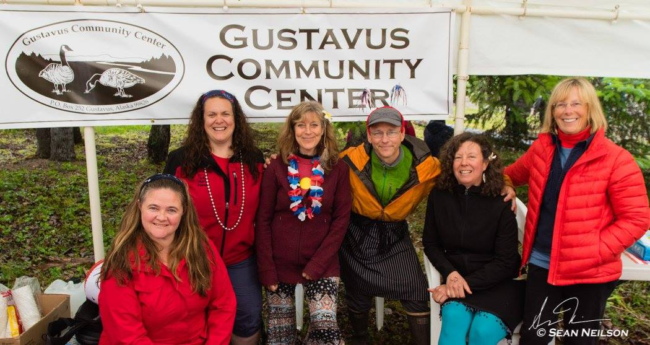
Members of the Gustavus Community Center board members pose at the July 4 “Pie For Breakfast” fundraiser booth in Gustavus. (Photo courtesy of Gustavus Community Center)
Flash forward nearly a decade and ambitions for a $1.4 million, 3,200-square-foot community center that seats 200 – about half of Gustavus’ year-round population – is closer to reality.
Streveler says there’s no public funding. The nonprofit still needs to raise about $300,000 in cash or equivalent in sweat equity by the end of the year for the Rasmuson Foundation to release the $400,000 grant.
“One of the ways we’re looking at closing that funding gap is that all the local contractors and carpenters, of which there are a lot, are willing to help do this project at reduced cost,” she said.
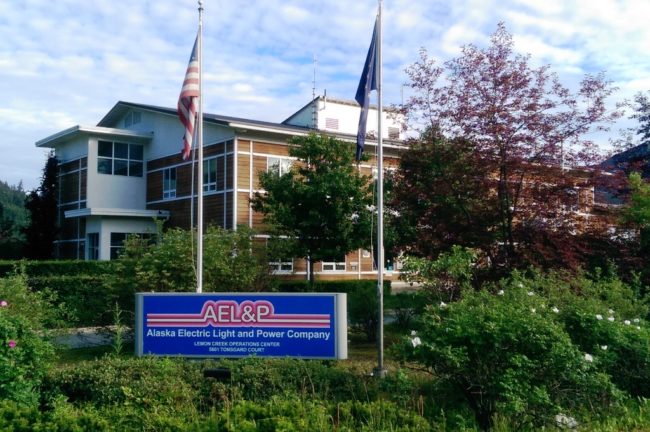
Alaska Electric Light and Power Company headquarters on Tonsgard Court in Juneau. (Photo by Rosemarie Alexander/KTOO)
The parent company of Juneau’s electric utility will be based in Canada. Avista has owned Alaska Electric Light & Power for the past four years. The company has headquarters in Spokane, Washington. But on Thursday, Hydro One — an Ontario company — announced it plans to buy Avista for $5.3 billion dollars.
According to the press release, Hydro One will keep the Spokane offices and staff on board. Energy costs are not expected to go up.
Avista sells electricity in Alaska, Washington, Oregon, Idaho, and Montana.
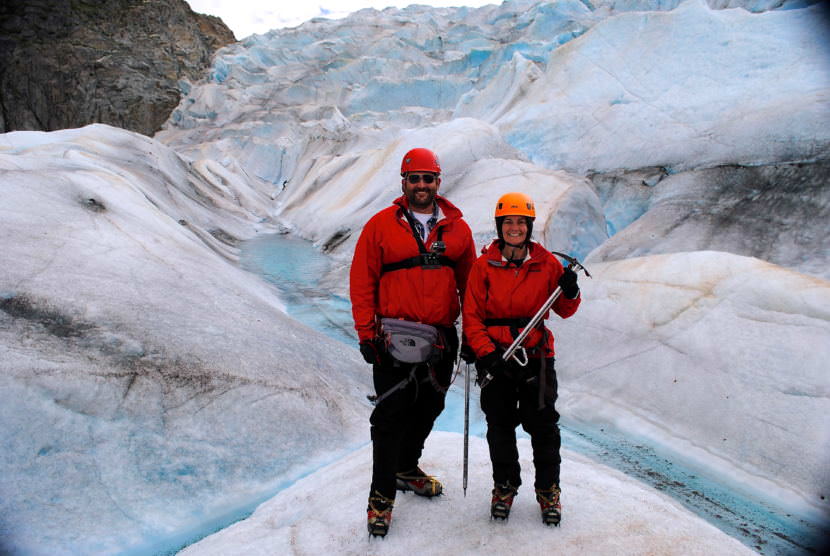
Shawn Hipsh and Darla Orbistondo standing on the glacier during Hipsh’s trip to Juneau this month.
In October 1990, Shawn Hipsh, a fifth-grade kid from Lewisville, Texas, bought a classified ad in the Juneau Empire asking for someone to send him info about Alaska for a class project.
Darla Orbistondo responded to the ad, sparking a 27-year friendship.
Shawn Hipsh and Darla Orbistondo the first time they met in Tulsa, Oklahoma. Orbistondo said Hipsh’s height surprised her.
The penpals reunited this month in Juneau and reminisced.
Darla’s first letter to Shawn began like this:
“Shawn, saw your letter in our paper and thought since I was home being a housewife and mother I would answer your request. I hope these things are some help. Thought you would enjoy seeing our local paper, maybe you can compare things in Juneau to Lewisville.”
“I just started gathering all this stuff from Juneau,” Darla said. “I mailed it off to him and of course I had my address in the letter if he wanted to respond back. He was only in fifth grade so that’s how it all started … Eighth grade, and prom, and graduation. … Pretty much seen his whole life for almost 27 years.”
Shawn lives in Memphis, Tennessee, now.
“We used snail mail for the first number of years and switched over to email and Facebook,” Shawn said.
They met up years later in Tulsa when Darla was passing through.
“Been trying to get up to Alaska the entire time, and finally was able to make it happen 27 years later,” Shawn said.
Snail mail, Shawn said, is “the original form of social networking.”
“With text and stuff you lose a lot of the emotion and the thought. When you’re writing a letter you’re sitting there and you put your thoughts on paper and actually have time to think about it. … But having someone out there, that cares about you, that doesn’t really know you is kind of cool.”
Darla still gets choked up remembering some of the old correspondence.
“I think the hardest thing for me was when he went off to Kuwait, and seeing him over there with his uniform on and the guns,” she said. “He turned into my own boy, so that was the hard part.”
Before Shawn made the trip up, Darla did send another snail mail letter.
“I just had to do this, wow 27 years ago this happened, a friendship. What an amazing journey we have been on. I can’t wait to see you guys in Alaska. I get goosebumps just thinking about it.
“P.S. – this is how it all started, a boy’s fifth-grade school project.”
Darla said the friendship is priceless. For his visit, she’s been playing tour guide for Shawn around the region.
Thanks to Marian Call for the use of an instrumental version of “Highway Five” in the radio version of this story.
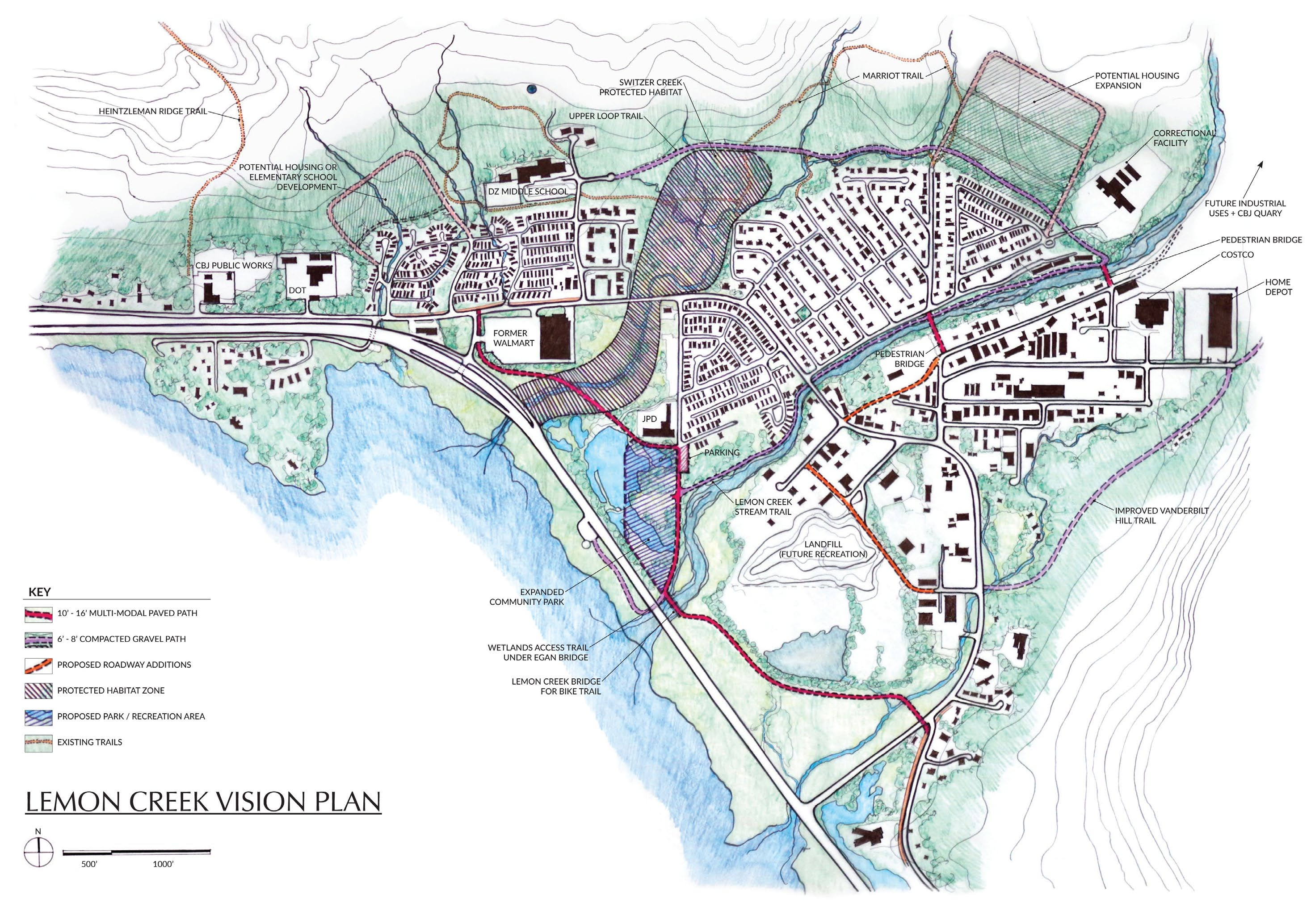
A sketch of future development guidelines for the Lemon Creek area was released July 14 by the City and Borough of Juneau. (Courtesy of City and Borough of Juneau)
The public can give input on how the Lemon Creek area will be shaped over the next 20 years.
Those changes could affect future development going forward.
“Lemon Creek has definitely grown up very organically,” City Planner Jill Maclean said.
Today, south of Lemon Creek is mostly commercial and industrial whereas the north side has a relatively high concentration of residential buildings.
“I think the challenge is making them complement one another rather than compete,” Maclean said.
One idea is more mixed-use areas where people live and work. Better pedestrian and bicycle access also is in the plan as well as developing city parks.
A 12-member steering committee of residents, property and business owners and a planning commission liaison has been meeting over the past year and will review comments received.
The committee will review those comments next month before forwarding ideas to the Juneau Assembly and Planning Commission.
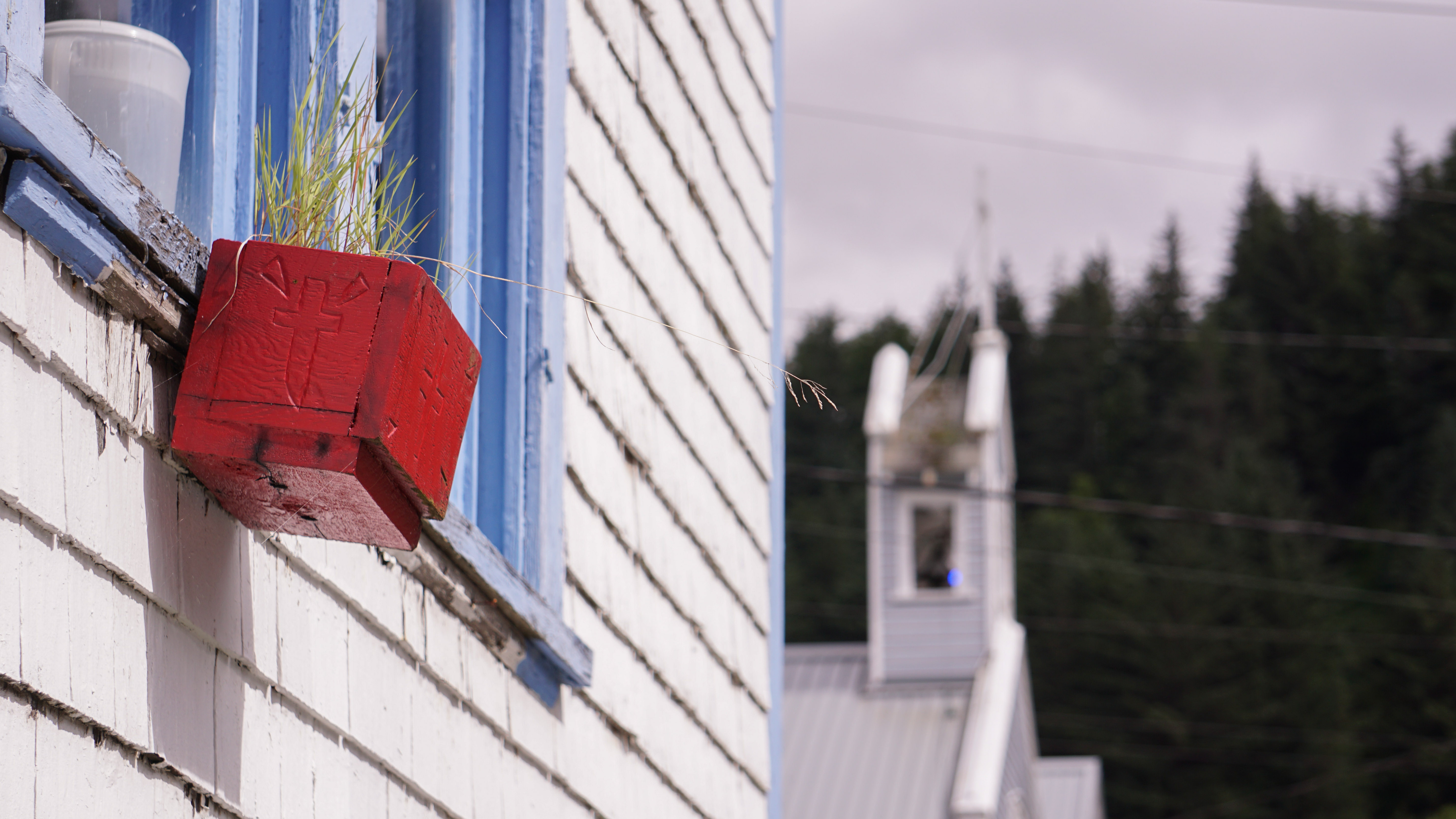
Grass grows in a planter off a window of St. Nicholas Russian Orthodox Church in downtown Juneau on July 15, 2017. The Catholic Cathedral of the Nativity of the Blessed Virgin Mary is in the background. (Photo by Jeremy Hsieh/KTOO)
Today, Alaskans are on average less religious than the rest of the country, and a subset who don’t identify with any particular religion is growing, according to data from the Pew Research Center.
“I grew up fairly religious, went to organized church, and then kept that going probably through the first year of college, and kind of lessened that. Now I don’t practice anything specific,” Chelsea Maller, a Juneau local, said.
Despite this, Maller says she still prays.
“I would say that’s the most consistent thing I keep up with if anything,” Maller said. “Just giving myself a peace even if I don’t necessarily feel like if I need to go worship in a church or anything like that.”
Maller falls into a growing group of the religiously unaffiliated, which can include anyone from atheists to the “spiritual but not religious” types.
The Pew Research Center refers to this group collectively as “nones,” which originates from the “none of the above” option on a religion survey.
In Alaska, about 3 out of 10 people are nones. Nationwide, it’s 2 out of 10. Both have grown since 2007.
A common misconception about nones is they don’t have any beliefs — but like Maller many of them fall into a spiritual gray area.
Elizabeth Drescher, the author of the book, “Choosing our Religion: the Spiritual Lives of America’s Nones” conducted her own research on the subject.
“It turns out that about 70 percent of the religiously unaffiliated, or nones, believe in God or a life force or some kind of higher power,” Drescher said. “They don’t identify with a particular religious tradition, even though they might participate in things that are kind of obviously religious to most of us.”
It’s not uncommon for nones to pray, attend religious services or consider religion important in their lives.
“That package that’s called religion, some of it works for me, but mostly not so much all the time,” Drescher said, voicing what many nones feel. “I’m happy to take some of those resources, but I don’t belong to that.”
Drescher hasn’t studied nones in Alaska specifically, but she guessed a seasonal workforce and fewer connections within the community could contribute to more nones.
Across the country, religious unaffiliation has increased and in every race, age, gender, education and socioeconomic background.
This concerns some religious leaders, and there are theories why people are leaving traditional religion, such as a more scientific world views, seeking out a more individualized religion and LGBTQ and women’s rights.
Juneau local Rachel Smith grew up Mormon but doesn’t align with that anymore.
“Mormonism is so – it’s very black and white. I just never felt that way, it’s a little, depending on who teaches it, it’s a little bit demeaning towards women,” Smith said.
Pat Casey, a pastor for the Catholic Church here in Juneau, says there are a lot of nones in town, but he also sees a lot of people who mix religious traditions.
“People tell me you know I’m a Christian, I believe in God but I like to do it in my own way,” Casey said. “You know, the yoga movement and other types of meditation.”
He says to say the Catholic Church is shrinking is a misconception. Nationally, immigrants are a major source of growth in the Catholic Church. Catholicism is still really popular in Latin America and the Philippines. But what draws people to Catholicism now?
“I’ve had a number of people come to me who want to talk about the Catholic Church where it is now, versus where it was when they left,” Casey said. “Many of them find that challenging and welcoming.”
In 1966, Time magazine published one of their most iconic covers ever. In bold red against a black background, a single three-word question sparked outrage and backlash.
“Is God Dead?”
Half a century later, the issues the magazine explored may sound familiar: Explaining the divine in an increasingly secular world, how theologians responded, and the move toward individualized religion.
The Rotary Club of Homer is collaborating with a German foundation aimed at cultivating peace through painting. The Together in Peace Foundation has been running its United Paintings program throughout Europe for 21 years.
The initiative aims to educate elementary-aged children about the idea of peace through curriculums in the classroom. At the end of the program, kids express what peace means to them by painting on canvas banners.
The program will now take root right here in Alaska. The founder of the program, Olaf Ring, contacted Homer Rotary Club President Jane Little about implementing the program in the U.S. earlier this month.
Little said she has been looking for a project for some time, and she jumped at the opportunity to work with Ring.
“Right now, he has about three miles of length of banner, and what our goal is to get another three miles in Alaska, the Yukon and the U.S. in the next two, two and a half years,” Little explained, “So we can present this string of banners at the Rotary International Convention in Germany in 2019.”
Little has served as district governor for Rotary clubs in Alaska and Canada, and she said the project will fit the humanitarian organization’s mission. She will be working with the Rotary Club of Fairbanks to design a curriculum for the program.
“What we see this as is not a one-day project, but perhaps several weeks or months of having the curriculum to teach the children about peace,” Little said. “Then at the end of it, have them paint a picture that is peace and also depicts their hometown, their community, their school.”
Painting pictures can seem like such a simple idea, but Little likes the program’s ground-up approach because it cultivates understanding of others and helps broaden understanding of what peace can look like.
“I think that for most of us that are involved in the peace movement of some sorts is that we will see a kinder, gentler world. We’ll see people that are able to get along better and that we’ll have dialogue,” she said. “It’s one person at a time.”
Little explains the topic of peace can be a large one, and she doesn’t know exactly what the U.S.-based program will look like. She plans to work with schools throughout Alaska, the Yukon and the Lower 48. Little hopes to have a timeline for its implementation later this summer.
Close
Update notification options
Subscribe to notifications
Subscribe
Get notifications about news related to the topics you care about. You can unsubscribe anytime.