Community

Healthy housing market shows Ketchikan’s resilience

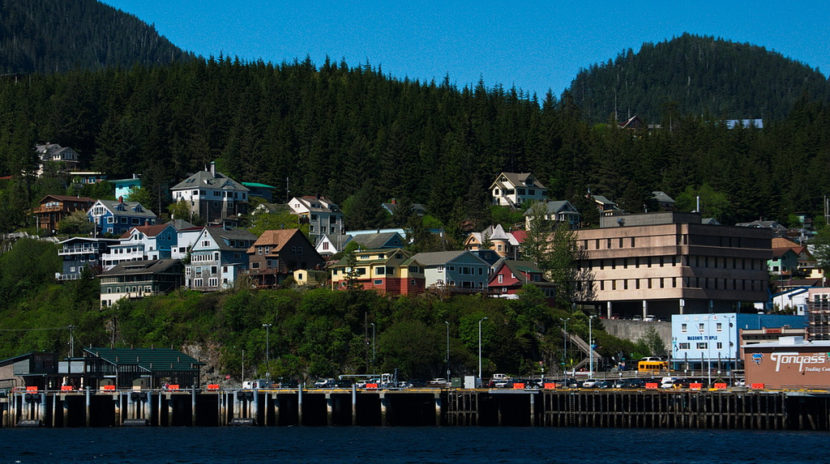
The Ketchikan skyline. Creative Commons Photo by Dave Bezaire)
The Ketchikan skyline. (Creative Commons photo by Dave Bezaire)

Like many industries in the city, the story of Ketchikan’s housing market is closely tied to the shutdown of Ketchikan Pulp Company in 1997.

Gateway City Realty broker Bill Bolling said the local market is quite healthy now. He said the robust local economy is in part due to the closing of the mill.

“If there was any silver lining in the loss of our mill, it was the diversification of our economy,” he said.

Ketchikan’s economy suffered in the years following the shuttering of the mill. The Great Recession affected Ketchikan just like it did the rest of the country. But the city bounced back, and so did the housing market.

“And then somewhere around 2012, 2013, things seemed to change for us, so far as activity and the number of sales, and prices started rising again,” Bolling said.

Bolling said real estate companies have seen Ketchikan become more of a seller’s market in recent years.

“There’s not a lot of product out there for people to look at or buy,” he said. “And so, it’s a macroeconomic love affair. There’s a lot of demand and not as much supply.”

Mary Wanzer, a broker for Coastal Real Estate Group, agreed.

“We’re seeing homes going on the market and selling within two or three days and getting multiple offers,” she said.

The average price of a single-family home in Ketchikan in 2016 was about $320,000. This is more than the national average price, which in June 2016 sat just above $290,000. Here’s Wanzer again.

“It stayed the same for quite a while, but I’d say definitely in the last three years, the average home price has increased,” she said. “Probably five to 10 percent in the last year would be my guess, without actually looking at all the data.”

She said companies are seeing more people coming to Ketchikan and building new houses.

“What we are seeing are [sic] more new construction,” Wanzer said. “So we’re seeing build-outs in areas like Emerald Forest, Ravenwood, White Rock. So we’re getting new construction, so more of a housing development that we haven’t seen in the past.”

Bolling attributes the market’s strength to the people of Ketchikan.

“Ketchikan has really been, kinda, this little engine that could,” he said. “And people here are tough. I mean, I think I’ve seen more businesses opened up since the mill shut down in Ketchikan than I remember ever opening up before. So, I think people have a good spirit here, and they have a can-do attitude, and they’re willing to put their money where their mouth is.”

Wanzer added that people of all kinds come to live in Ketchikan – people with the Coast Guard, the Forest Service and the hospital, especially. And they all need a place to live.

Juneau’s Housing First opening delayed until September

The Housing First Project under construction on November 17, 2016. (Photo by David Purdy/KTOO)
The Housing First Project under construction on Nov. 17, 2016. (Photo by David Purdy/KTOO)

The opening date for the Juneau’s Housing First project has been pushed back again.

Originally slated to open in early summer, the complex of 32 efficiency apartments and a downstairs clinic is now scheduled to open in mid-September. Its goal is to provide 32 homeless people with permanent housing with access to on-site medical care.

Housing First’s project manager Mariya Lovishchuk explained the delay was over finishing the Lemon Creek facility’s parking lot.

“It’s a paving issue,” she said Friday. “We just have to have enough time to finish paving the parking lot. That’s the last remaining item – is the parking lot paving.”

The $8.2 million project has received funding from a number of sources including about $2.7 million from the City and Borough of Juneau. Lovishchuk said national studies show that providing subsidized housing is worth it to communities in the long run.

“Projects like this do end up saving money in emergency service utilization,” Lovishchuk said, “and they also really improve the quality of life in the community for both the tenants of the facilities as well as for the general public.”

The housing project also has a new name: Alder Manor. A total of 32 homeless residents are being selected for accommodation based on a vulnerability survey – those chronically homeless and most likely to literally die in the streets.

The first eight residents are expected to move in on Sept. 15.

Gustavus city council reinstates fired librarian after mayor quits

There’s been another shakeup of local government in the City of Gustavus.

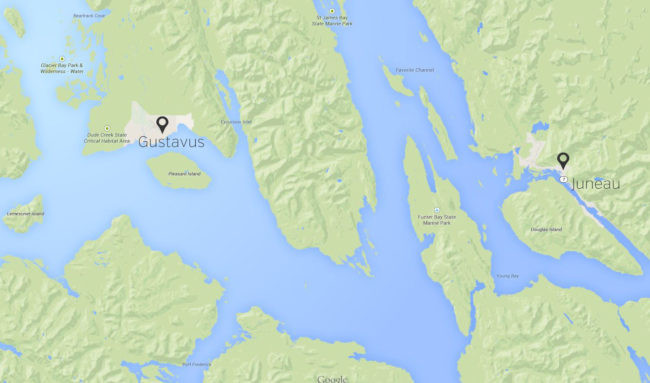
The city hall has been struggling following the resignation of key staffers.

For the past month, Gustavus city hall has been staffed by city council members following the abrupt departure of its entire administrative staff.

The resignations of the two employees followed the firing of a longtime librarian by Mayor Connie Edwards, who was sworn in last month. The city isn’t saying why its clerk and administrative assistant quit and it’s unclear whether their departure and the librarian’s firing were connected.

But at Monday’s City Council meeting, Mayor Connie Edwards resigned her seat from city council, which leaves Gustavus without a sitting mayor.

The remaining City Council then voted to reinstate librarian Kate Boesser the mayor had fired last month.

“Kate has worked here as the librarian for a number of years, she’s very popular and everyone felt she had done her librarian job very well,” said City Councilman Mike Taylor who was helping staff city hall on Tuesday morning. “We’re happy to have her back in the librarian position and I think the community will be happy to have her there.”

The city is seeking to fill the positions of clerk and administrative assistant.

“In the meantime, those functions are being covered to the extent we can by council members,” Taylor said, “With some assistance from other members of the community with some expertise that’s been offered.”

The City of Gustavus has a year-round population of less than 500 and is the gateway to Glacier Bay National Park.

Peratrovich dollar coin will either have her likeness or a symbolic Tlingit raven

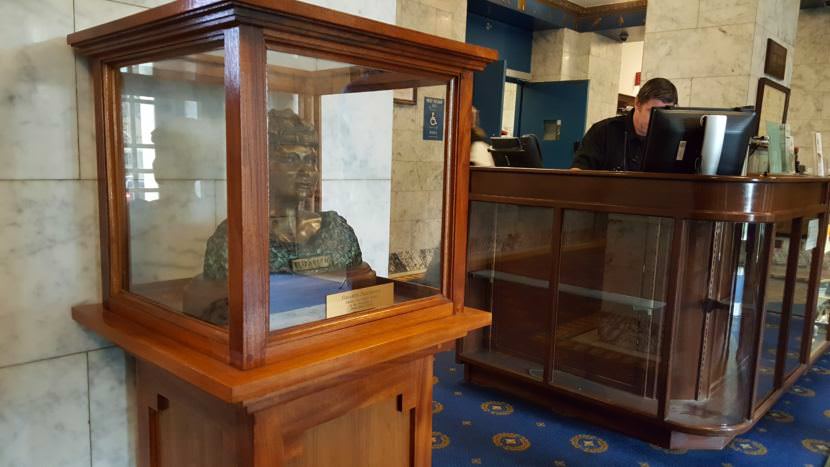
Ryan Strickland, a security and information specialist for the State of Alaska, works the front desk of the Alaska Capitol on Tuesday, July 11, 2017, in downtown Juneau. In the front lobby a bust of Alaska Native civil rights leader Elizabeth Peratrovich greets capitol visitors. (Photo by Tripp J Crouse/KTOO)
Ryan Strickland, a security and information specialist for the state of Alaska, works the front desk of the Alaska Capitol on Tuesday in downtown Juneau. In the front lobby a bust of Alaska Native civil rights leader Elizabeth Peratrovich greets capitol visitors. (Photo by Tripp J Crouse/KTOO)

The 2020 dollar coin honoring Elizabeth Peratrovich will either have a literal image of the Alaska Native civil rights leader on it, or a Raven holding a key — a symbol of her Tlingit Raven moiety and her role in agitating for an anti-discrimination law.

The 2020 Sacagawea dollar coin design will feature one of two designs on the "tails" or reverse side: A raven unlocking a door (pictured above) or a picture of Elizabeth Peratrovich featuring her Tlingit Raven clan moiety. (Image courtesy U.S. Mint)
The 2020 Sacagawea dollar coin design will feature one of two designs on the “tails” or reverse side: A raven unlocking a door (pictured above) or a picture of Elizabeth Peratrovich featuring her Tlingit Raven clan moiety. (Image courtesy U.S. Mint)
This coin sketch shows the proposed design for the reverse of the 2020 Sacagawea gold dollar coin, which features Alaska Native civil rights leader Elizabeth Peratrovich. It is one of two designs being considered by the U.S. Secretary of Treasury. (Image courtesy U.S. Mint)

While a final decision by the head of the Treasury Department is months away, a lot has gone into getting the Peratrovich onto the flipside of the Sacagawea dollar coin up to this point.

Since 2009, the reverse of Sacagawea dollar coins has been redesigned annually to honor Native American heritage. The coins aren’t made for general circulation anymore, though coin collectors do buy them directly from the U.S. Mint above face value.

“For each year we go to our staff of artists and they generate designs,” said Mike White, who has been with U.S. Mint for 28 years. “We consult with various Native American groups,” White said. “In the instance of the 2020 (coin) we’re consulting with the Tlingit tribe.”

A team of five artists in Philadelphia worked with various stakeholders on coin designs, including the Central Council of Tlingit and Haida Indian Tribes of Alaska, the Sealaska Heritage Institute and U.S. Sen. Lisa Murkowski.

The artists want to ensure the designs fit historically and culturally.

“We’ve got a very talented group of artists that work on them,” White said. “When we go before the committees, we try to give them a real variety of designs and a good representation of whatever the theme is chosen that year.”

The organizations he’s referring to are the Citizens Coinage Advisory Committee and the Commission of Fine Arts. The coin advisory committee endorsed the Raven perched on a door handle grasping a key. The fine arts commission chose a design showing a three-quarters profile of Peratrovich with a symbol of her Tlingit Raven moiety.

Thomas Luebke is secretary of the Commission of Fine Arts. His background is in architecture. He said coins aren’t that different from designing sculptures and buildings.

“It’s sort of graphic and it’s sort of 3-D at the same time,” he said. “It’s interesting to try to convey the meaning in a symbolic way on a very small medium. I think that everyone likes to see the mint stuff.”

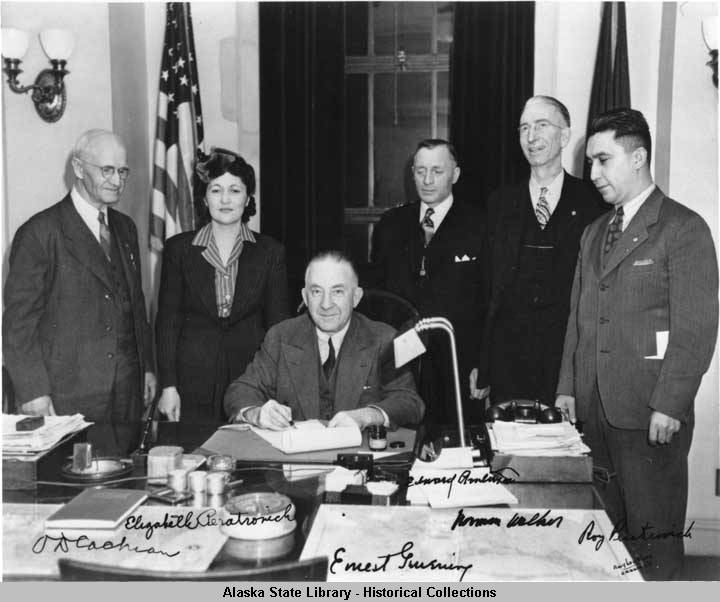
Then-Alaska Gov. Gruening signs the Anti-Discrimination Act of 1945, as O.D. Cochran, left, Elizabeth Peratrovich, Edward Anderson, Norman Walker and Roy Peratrovich stand behind him. (Photo courtesy Alaska State Library Photo Collection, P01-3294)

The abridged version of Peratrovich’s story begins when she and her husband moved from Klawock to Juneau in the 1930s or 1940s. As Alaska Native Sisterhood Grand President Cecelia Tavoliero tells it, the couple faced housing discrimination because they were Alaska Native.

“They found there were barriers, and they were not subtle like they are now. They were very blatant,” Tavoliero said. “They were disrespected and told that they couldn’t live in certain areas. They took objection to that and decided to do something about it.”

With the support of Alaska Native Sisterhood and Alaska Native Brotherhood, Tavoliero said Peratrovich took the fight to Alaska’s territorial legislature.

A plaque explains the importance of Elizabeth Peratrovich and the Anti-Discrimination Act of 1945 above a bust of the Alaska Native civil rights leader in the Alaska Capitol in downtown Juneau. (Photo by Tripp J Crouse/KTOO)

“Seeming like David and Goliath because there were very many of the senators speaking very blatant negative about the Native people, basically calling the Native people inferior,” Tavoliero said.

Portrait of Elizabeth Peratrovich. (Photo courtesy Alaska State Library Office of the Governor Collection, P274-1-2)

Peratrovich is credited with successfully advocating for the passage of the Alaska territory’s Anti-Discrimination Act of 1945.

Alaska became the first U.S. state or territory with such a law, which guaranteed equal voting rights and equal access to commercial accommodations and services – years before the civil rights movement protesting racial segregation in the Lower 48.

“With her testimony, even though there were other folks involved in trying to get the bill passed, the anti-discrimination bill, she’s the one that pushed the final stone over the mountain,” Tavoliero said.

Raeanne Holmes, the communications coordinator for the Tlingit and Haida Central Council, said the coin is an exciting recognition.

“It’s the perfect way to mark the 75th anniversary of the state of Alaska’s Anti-Discrimination Act of 1945. We can’t think of a better way to honor the memory of her as our civil rights leader and that landmark passage.”

Vacant bishop position to be filled for Diocese of Juneau

A Catholic pastor who previously served the Archdiocese of Anchorage has been named to Juneau’s vacant bishop position.

Rev. Andrew E. Bellisario received his Master of Divinity degree from De Andreis Institute of Theology in Lemont, Illinois.

The Rev. Andrew E. Bellisario, 60, will be ordained and installed as the sixth bishop of the Diocese of Juneau on Oct. 10.

Bellisario said when he got the call to be selected for the position, he was surprised and even had trouble catching his breath.

“The call to love and to serve the poor, the venerable, children, immigrants refugees, prisoners, seniors, the sick, the discarded, the addicted the lonely the depressed, the homeless the forgotten is the call of the church,” Bellisario said this morning at a news conference.

The bishop seat has been vacant since Edward J. Burns, who held the position since 2009, was appointed bishop of Dallas in February.

“We have many people of all faiths here in this diocese, and I send my fraternal greetings to you,” Bellisario said. “I look forward to collaborating with you, and dialoguing with you.”

The Diocese of Juneau is the smallest in the United States by population, but covers all of Southeast Alaska.

About 16 percent of Alaskans are Catholic, according to the Pew Research Center, which is lower than the national average of about 20 percent.

The Diocese of Juneau reports a Catholic population of 10,600 parishioners.

Juneau Assembly considers sales tax revenue for child care

Colleen Brody, assistant director of Gold Creek Child Development Center in Juneau, said July 5 that their child care center has 60 spaces and about 130 children on its waiting list. (Photo by Jacob Resneck/KTOO)

Child care remains out of reach for many Juneau parents who can’t find a place or just can’t afford it.

Juneau has about 2,400 children under 6 and just 560 child care slots.

Now, a volunteer group is appealing to the Juneau Assembly to channel millions in sales tax revenue to address the problem.

Meghan Stangeland had her first child last year – a boy. Within two months, the 25-year-old mother had to be back at her job as a purchasing agent at a fish processing plant.

Her son came to work with her too.

“It was intense,” she said. “I mean, I was definitely grateful that my employer allowed me to. However, you are not quite as productive with a three-month-old strapped to your chest.”

It’s not like she didn’t try to find child care. She was willing to shell out the going rate of about $700 to $1,000 a month.

“Either they weren’t taking children that young, they never returned my phone call and I couldn’t contact anybody at the day care provider,” Stangeland said, “or the most frustrating situation was one day care provider who said they’d have one space available as of August, but she already had 40 applicants on file for that one position.”

She’s since found a temporary arrangement – for the summer.

“My fiancé’s sister watches my son full-time, but I’m not sure how sustainable that’s going to be as we enter the fall season as she has two children of her own and works with the school district,” she said.

Child care professionals say this isn’t at all uncommon.

“We call a lot of people who have family members that they’ve flown out to watch their children, people who haven’t been able to find care who decide to stay home,” said Colleen Brody, assistant director of Gold Creek Child Development Center that’s on the ground flood of the federal building in downtown Juneau.

State Department of Labor data reports there are about 2,400 children 6 and younger in Juneau, yet there are just 560 spaces at licensed child care centers, according to the Association for the Education of Young Children.

It’s gotten so bad, Brody said, that she gets calls from parents offered jobs in Juneau who then change their mind about relocating when they take a look at child care options.

“Multiple families that we’ve called that that’s an issue,” Brody said. “By the time we’ve offered them a spot, they’ve already left.”

A group of child care advocates recently approached the Juneau Assembly to allocate sales tax revenue to help.

The Assembly will likely ask voters in October to extend a 1 percent sales tax for another five years that would create a pool of about $47 million available for projects in the community.

The working group is calling it Best Starts and is asking the city to earmark $14 million over five years to subsidize child care and pre-school programs.

“Right now, our infrastructure for our kids is broken,” said former Juneau City Manager Kevin Ritchie, who recently made a pitch to the Assembly to fund the Best Starts initiative. “Economically, we can’t say we have a great economic development effort unless we have affordable and available child care.”

The proposal would expand pre-school programs and subsidies for low-income families. It would also boost wages for child care providers who have trouble keeping staff.

All this would build on programs already in place but thinly stretched.

“What we’re talking about doing is simply allowing child care centers that develop either from the private sector or the nonprofit sector to be successful financially,” Ritchie said. “The problem is now economically is there’s a huge pent-up demand for good quality child care but the people who demand it and want it can’t afford to pay for it, even fairly high-income families.”

The subsidy would be structured as $3.3 million annually.

It’s competing with a wish list totaling $125 million that includes renovating the downtown swimming pool, a new performance arts center and improved harbor facilities – to name a just few projects under consideration.

The Assembly will finalize what proposals would qualify for funding at its July 12 meeting next week.

“There’s been a lot of interest, we’re getting a lot of email about it,” Finance Committee Chairman Jesse Kiehl said. “We’re going to see where the group comes out here in our mid-July finance meeting.”

In the meantime, Meghan Stangeland and other working parents say they’re caught in a conundrum.

“It’s one thing if you can find a day care that will take your child, it’s another if you can afford to keep them in that day care,” Stangeland said. “And then you have the question of whether does it make more sense for one parent to stay home, because if their entire income is going towards day care, that doesn’t really pan out in the end.”

An online petition urging the Juneau Assembly to support Best Starts already has  gathered more than 600 signatures.

Site notifications
Update notification options
Subscribe to notifications