A Lower Kuskokwim School District social worker received a national award this week in Washington D.C. for his work in the Yukon-Kuskokwim Delta on suicide prevention.
James Biela is an itinerant Social Worker for LKSD, frequently traveling out to Newtok, Tununak, Toksook Bay, Nightmute, Mekoryuk, and Nunapitchuk to hold trainings and lectures on suicide prevention.
He received the Sandy Martin Grassroots Award, given out to three members of the National American Foundation for Suicide Prevention, for work in grassroots programs. Beila is a volunteer and the founder of the AFSP Alaska Chapter.
Winning the award was an honor, says Biela, an honor he was not prepared for.
“Actually, I was totally shocked that I’d be receiving this award. I didn’t have anybody giving me a heads up,” said Biela. “I feel it’s an honor, but it was also a sad time because one of my friends out in a village before I got on the plane, died by suicide.”
For Biela, the news underscored his life’s work.
“It gives you more power to do more,” said Biela. “Actually, this year I was very fortunate to have a young man from Newtok, an Alaska Native, come with me to Washington D.C. to talk to the congressional leaders about suicide. But on this one it just makes our work more important. To be the voice about how suicide can be prevented and get the Congressional leaders in D.C. to listen.”
And they did just that. They sat down for twenty-five minutes with Senator Dan Sullivan and Senator Lisa Murkowski, discussing village suicides in the YK Delta.
“I know everybody needs to pitch in with the leadership that they can afford to understand our needs,” said Biela.
That’s especially important now, said Biela, with the ongoing healthcare debate and the possibility that mental health care will be cut out of the budget.
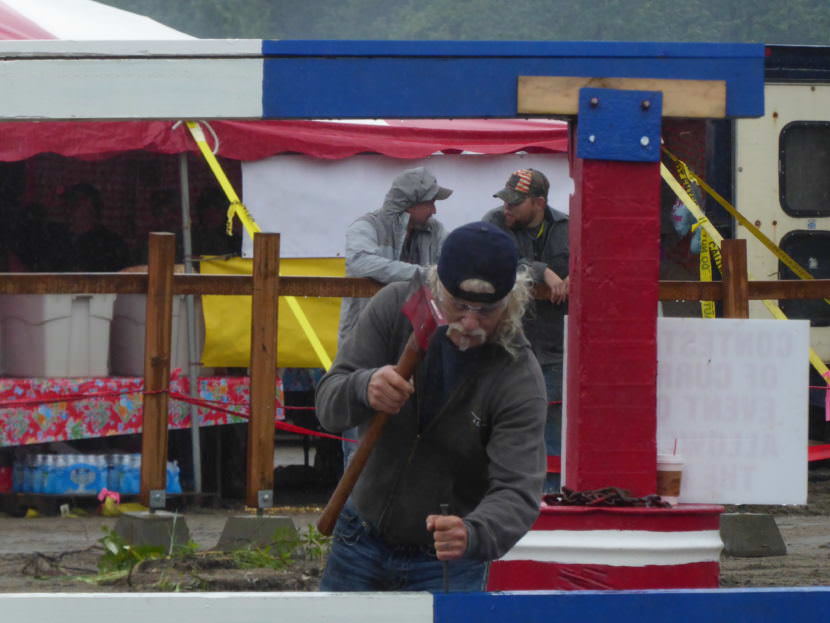
A contestant drives spikes at Juneau Gold Rush Days on Saturday. (Photo by Quinton Chandler/KTOO)
It’s wet and muddy, but that isn’t stopping raincoat-clad Juneau residents from enjoying the 27th annual Gold Rush Days.
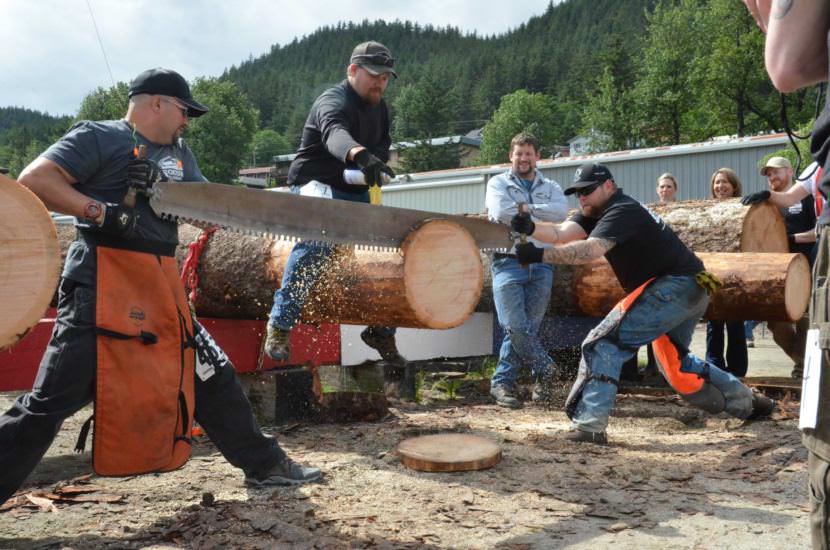
The two-day celebration promotes Juneau’s oldest industries: mining and logging. It has labor-intensive competitions like jackleg drilling, spike driving, axe throwing and log bucking. The games and fair atmosphere are part of a larger plan to strengthen relationships between residents and the workers who help build the local economy.
Right now contestants are finishing up the men’s spike driving competition.
It’s pretty much what it sounds like. Each contestant takes his turn hammering in metal spikes with the butt of an axe.
Nicolette Dunlap is sitting under the food pavilion with a friend. She says her favorite thing to watch are the men and women’s speed climbing competitions.
“When they climb the pole or whatever,” Dunlap says. “I don’t know it’s just really cool that someone could do that, because I could never do it.”
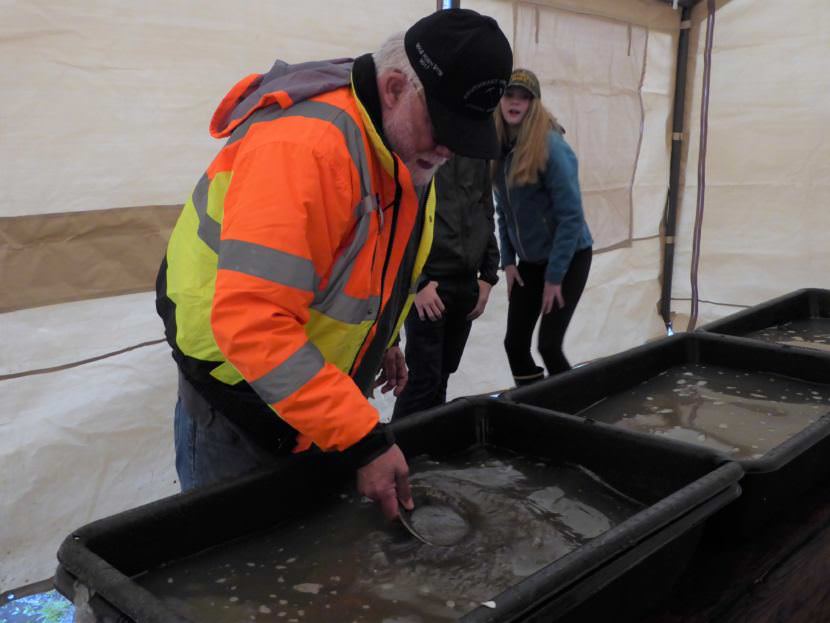
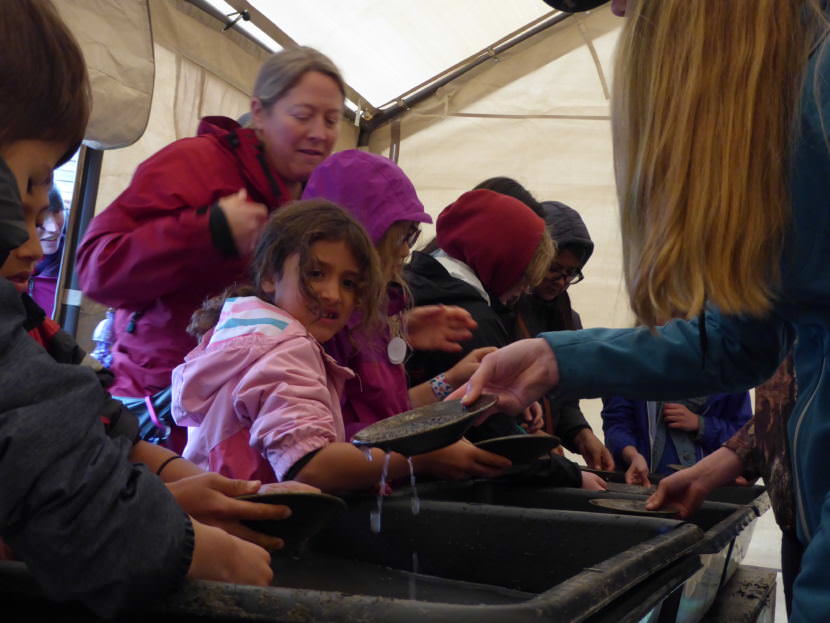
Across the way, Jerry Harmon is inside of a tent planting tiny pieces of gold in three plastic containers full of murky water. He is staging a hands-on gold panning exhibit for a herd of little kids waiting outside.
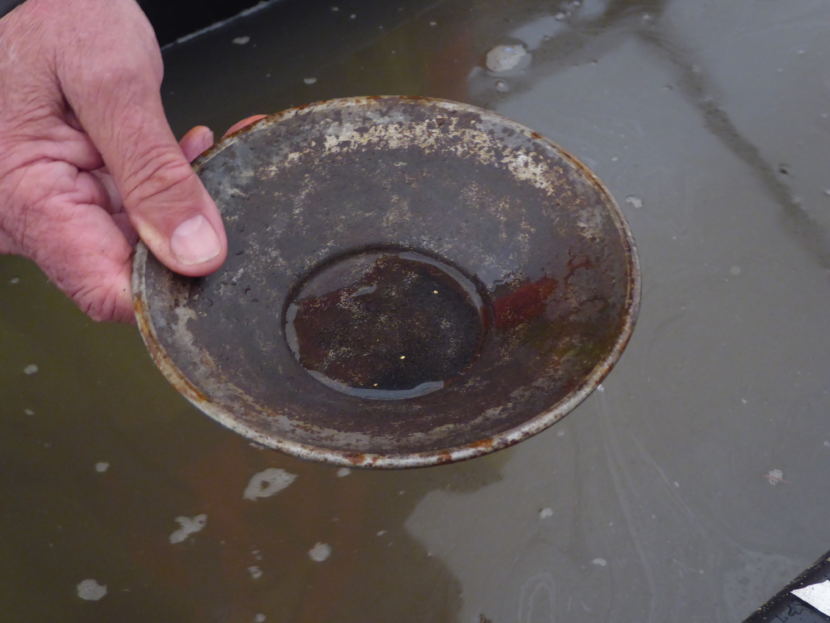
Harmon lifts a bowl out of the dirty water and holds it up for inspection.
“How does that look?” he asks.
Several tiny flecks of gold shine against the rough, worn bowl.
“Everybody finds gold, (I) guarantee it. There’s a lot of gold in there,” Harmon says.
Jerry Harmon has been helping coordinate Juneau Gold Rush Days since the event first started 27 years ago. (Photo by Quinton Chandler/KTOO)
Jerry Harmon holds a bowl he used to pan for a few small gold pieces visible in the center. (Photo by Quinton Chandler/KTOO)
A group of children try their hand at gold panning at Juneau Gold Rush Days on Saturday. (Photo by Quinton Chandler/KTOO)
He has been helping with Gold Rush Days since the very beginning. He says it was originally set up to give Juneau residents a place to come meet their miners and loggers.
“So that they could have friends that were miners and we have a lot friends now that are miners,” Harmon explains. “We have a lot of people who are not miners and not loggers that come out and compete as well.”
Juneau was founded shortly after gold was discovered in the area in 1880. The first strikes drew hundreds of new residents and sparked a need for logging to build the mines and people’s homes.
Harmon points out that today mining is still a big piece of Juneau’s identity.
“The Kensington mine is operating here. The Greens Creek mine is operating here and it’s part of the way of life,” he says. “(It’s) just a way of life!”
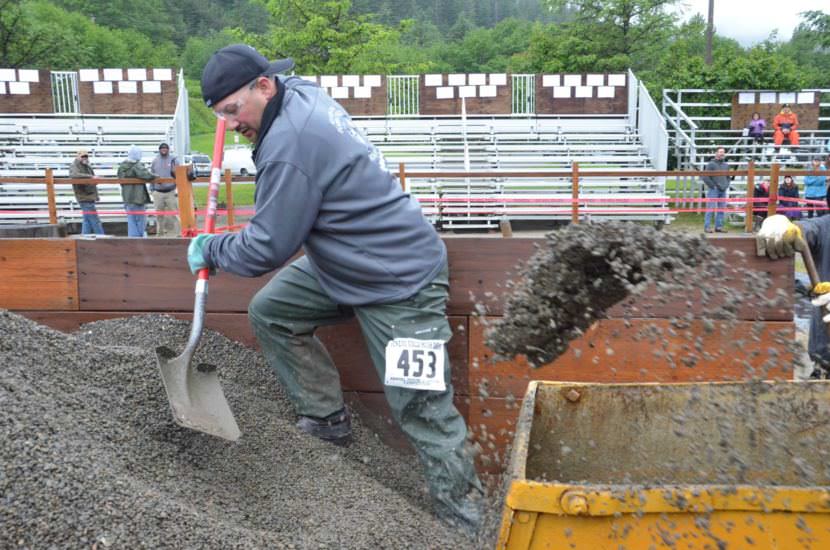
Competitor in the men’s hand mucking competition on Saturday. (Photo courtesy Juneau Gold Rush Days)
Two men compete in the hand bucking competition on Sunday. (Photo Courtesy Juneau Gold Rush Days)
Harmon says usually up to 10,000 people come to this two-day event. It’s hard to gauge the crowd size today, but it’s easy to see that people are having a good time.
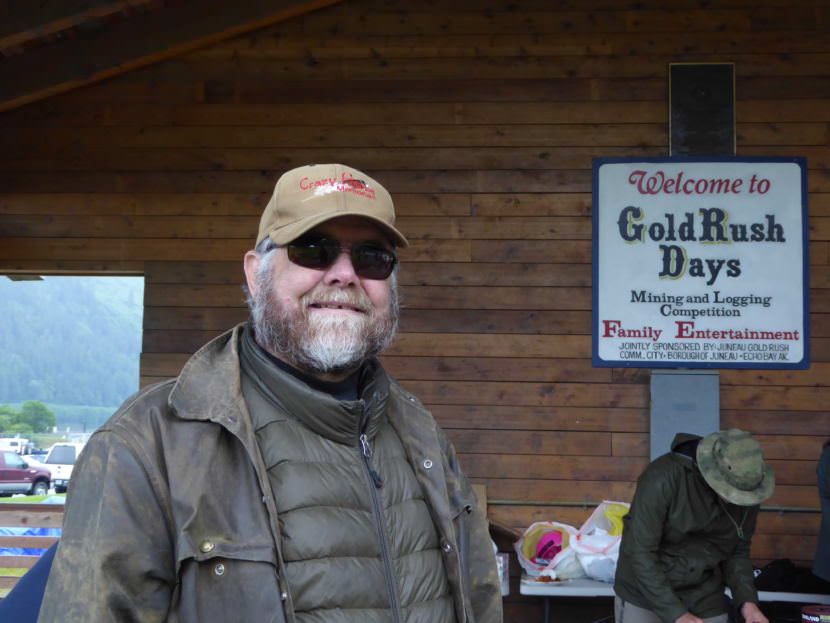
Kirk Ziegenfuss is a driller and blaster on mostly surface construction jobs. He used to be a miner and he also has been coming since the very first Gold Rush Days. Now, he jokes that he’s gotten too old to compete in most of the games.
“… I used to do all the events in my younger years,” Ziegenfuss says. “The hand mucking where you use a shovel or the spike driving where you’re driving these big spikes with an axe. I’m getting to slow on everything else to even think about those anymore.”
It’s a fun time for Ziegenfuss. It’s a free, family event.
“I kind of like it because I get to hob knob it with some of the miners that I know like, old timers like, this guy and some of the new guys coming up,” he says. “I just show up to give (them) something to shoot for. And they’re passing me up now.”
Kirk Ziegenfuss at Juneau Gold Rush Days, Saturday. (Photo by Quinton Chandler/KTOO)
But, he also likes that the party helps connect people in the community who work and live in very different environments.
He smiles and says, “Some people actually have to get in there and get dirty and wear their bodies out. It kind of brings everybody together and gives them something to … especially in Southeast Alaska, everybody likes a good fair.”
Gold Rush Days is sponsored by over 40 Juneau businesses including the Hecla Greens Creek Mining Company and the Kensington Mine. Jerry Harmon says local residents generally donate about $30,000 each year.
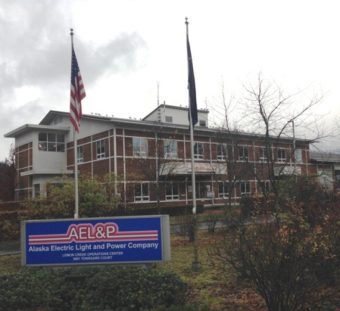
AEL&P headquarters in Lemon Creek. (Photo by Casey Kelly/KTOO)
Juneau’s electric utility thinks a bird or squirrel caused a power outage late Sunday morning.
Debbie Driscoll with Alaska Electric Light and Power Company said the outage lasted for almost an hour.
“What we call our line 2 transmission line opened, which has caused an outage to several areas including Douglas, West Juneau, North Douglas and parts of downtown,” Driscoll said.
Driscoll said the transmission line “trips open” when a problem is detected. It’s a safety measure that cuts the flow of electricity to prevent more damage. She compared it to a circuit breaker flipping in a home.
She said AEL&P crews checked the lines for a cause but they didn’t find anything.
“So after patrolling the line and not finding any evidence of anything in contact with the line, we then restored power and that line held, and it didn’t trip back off, so whatever had caused the fault had been cleared,” Driscoll said.
She said past power outages have been caused by mechanical malfunctions, and by animals or objects contacting a transmission line.
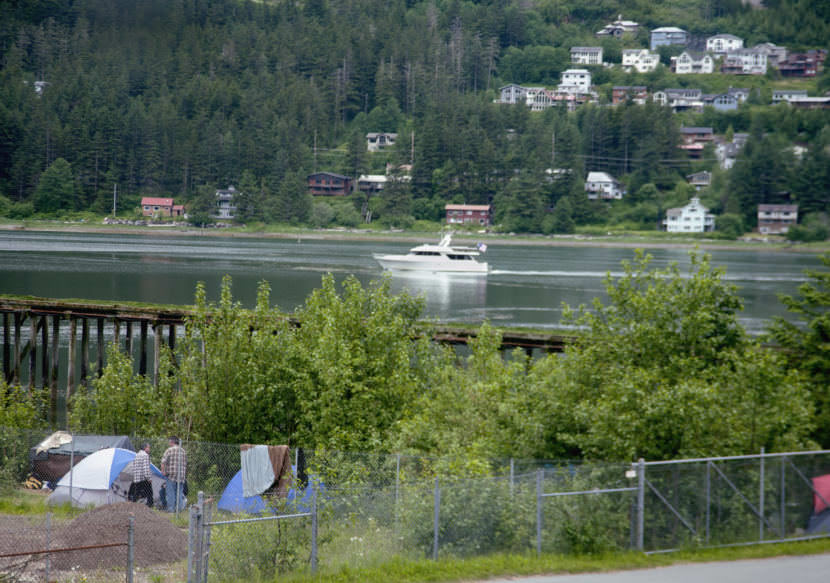
Campers gather near a small group of tents about noon Thursday near the 300 block of Egan Drive in Juneau. (Photo by Tripp J Crouse/KTOO)
A tent village has sprang up near the abandoned subport in recent weeks. Juneau continues to struggle with a housing and homelessness crisis that’s culminated in a new community on the edge of downtown.
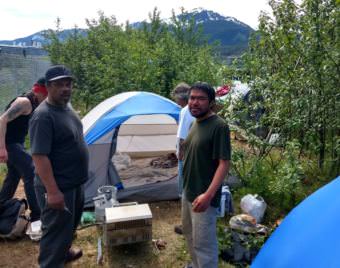
In the encampment, there’s steak grilling on a propane stove. Tents began appearing in this wooded area about three weeks ago.
“I set up mine and then I woke up and there were three or four next to me. They followed, it just kind of came in waves,” said Kevin Howard, 44.
He looks around and sees community among the cluster of tents.
“Everybody here looks after each other and nobody does nothing to nobody. … (We) make sure everybody’s OK in the morning. Need something to eat? Need some water? We look after each other here.”
Juneau has been wrestling with a rising homeless population. Responding to complaints from downtown merchants, the Juneau Assembly passed an ordinance this winter banning camping on private property in the downtown core.
Kevin Howard and his friend David Waits recall officers telling homeless people in the park, “You guys get your s— out of here or otherwise it’s going in the trash,” Howard recalled.
“Somebody got a ticket, too,” Waits said. “We were like, ‘Aw, dude you can come down here and hang with us. We got our, you know, set up.’”
Howard added: “They threw everybody out of the doorways and threw everybody out of the park and now we’re all down here.”
Lorenzo Jefferson, left, and Kevin Howard grill steak on a propane stove in an encampment near the former subport off Egan Drive on June 6, 2017. (Photo by Jacob Resneck/KTOO)
Critics of the anti-camping ordinance had warned that a crackdown would just move the problem around.
“What happened is what we’ve seen happen in other communities that have similar ordinances is they’re displacing homeless individuals,” said Brian Wilson, executive director of the Alaska Coalition on Housing and Homelessness. “If we displace these individuals again, I’m not really sure where they’re going to go.”
The city of Juneau is coming around to this reality. City Manager Rorie Watt said a new Assembly-appointed task force is looking for a new strategy.
“People genuinely don’t have somewhere to go,” Watt said. “So if people got trespassed repeatedly they would be moving around. And if a situation is quiet and not causing issues that likely could be better than a lot of alternatives if those people got moved along.”
Juneau police won’t move on the camp without a trespassing complaint from the landowner. In this case that’s the Alaska Mental Health Trust Authority.
Wyn Menefee, deputy director of the trust’s land office, said the waterfront acreage is in the process of being sold to private developers. But for now there’s no plan to try and move the camp.
“If it were to get into a situation where it started in hindering the ability to make revenue off of the trust, we may have to do something further about it,” Menefee said. “But right now it hasn’t stopped us from doing what we intend to do with the parcel.”
About half of Juneau’s homeless population report suffering from mental illness. That’s according to a spring survey conducted by social workers who canvassed the community.
Brian Wilson said of the 96 unsheltered people that social workers interviewed, 45 people self-reported mental health issues or concerns.
“That’s typically an under-reported number as well,” Wilson said.
The irony of the mentally ill trespassing on Mental Health Trust Authority land is not lost on the organization.
“We’re actively engaged in the community on a number of different levels and probably target this population in one way or the other,” said Steve Williams, the authority’s chief of operations.
“The folks that we’re seeing down at the camp are candidates for Housing First interventions,” Brian Wilson said, “but at the current state of our capacity, we don’t have that here locally. We need a lot more units.”
The city and the trust authority have received at least one complaint from the public concerned about health and sanitation. That will inevitably be an issue if the camp remains here long term.
David Waits said there’s a sense of pride about making the best out of what little you have.
“It doesn’t matter how much money you make or how much you have or anything else,” Waits said. “We’re all common people. I’m a Lakota Sioux Indian and we believe everybody’s related. Nobody’s higher or lower than the next person.”
So with few options available for Juneau’s homeless population, it appears a cluster of tents on the edge of town has become the status quo.
Editor’s note: KTOO’s building sits on land leased from the Alaska Mental Health Trust Authority. KTOO has also applied for and received occasional grants for special reporting projects from the authority.
The Juneau Assembly adopted a budget Monday without closing any facilities or laying off any staff. The $335 million budget taps into more than $800,000 in savings, imposes cost-cutting across city departments and repays debt at a slower pace.
The city will still have more than $10.5 million in its reserves.
But two vacant city staff positions will remain unfilled to cut costs, a city planner and a community service officer for the Mendenhall Valley area.
Alaska Fish & Game wildlife biologist Stephanie Sell appealed to the Assembly not to cut the community service officer because of its role in keeping household garbage from attracting bears.
“I realize that the city faces a lot of budgeting decisions that are very difficult but I’m concerned that the remaining four CSOs will struggle to maintain the level of service they currently provide,” she said. “Particularly their role in education and enforcement of the CBJ bear nuisance attractants law which I’ve been informed will be cut to compensate for the loss of this staff.”
The budget was adopted unanimously without funding the CSO position.
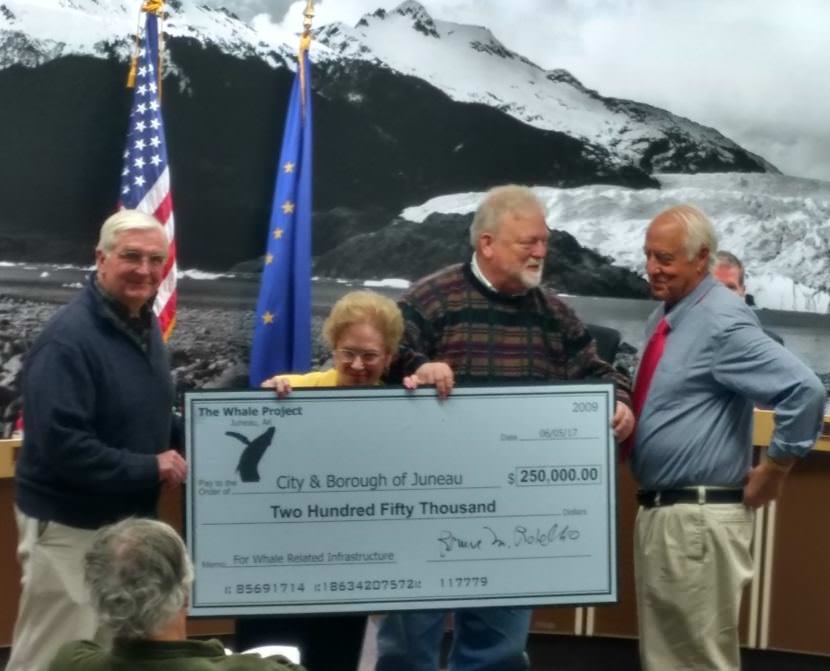
Whale Committee members Jim Clark, left, Jean Overstreet and Bruce Botelho present an oversize check for $250,000 to Mayor Ken Koelsch to help fund the infrastructure for the whale statue at the June 5, 2017 meeting of the Juneau Assembly. (Photo by Jacob Resneck/KTOO)
Former Mayor Bruce Botelho presented the Assembly with an oversized check alongside fellow committee members Jean Overstreet and Jim Clark.
“We believe that this whale sculpture and the park will be an enduring monument to Alaska’s 50th anniversary for statehood and will become a great symbol,” Botelho said.
“I know they have the tailgate parties and all that but tailgate parties are outside where it’s cold and miserable,” Becker said. “And inside the lodge where it’s nice and warm and lovely, drinking will be more appealing and I think that it will cause more drinking.”
Under the terms of the ordinance no hard liquor will be sold. Beer, wine and cider will be allowed at special events and by approved vendors. Eaglecrest board members pitched the alcohol sales as a way to raise revenue for the city-owned ski area.
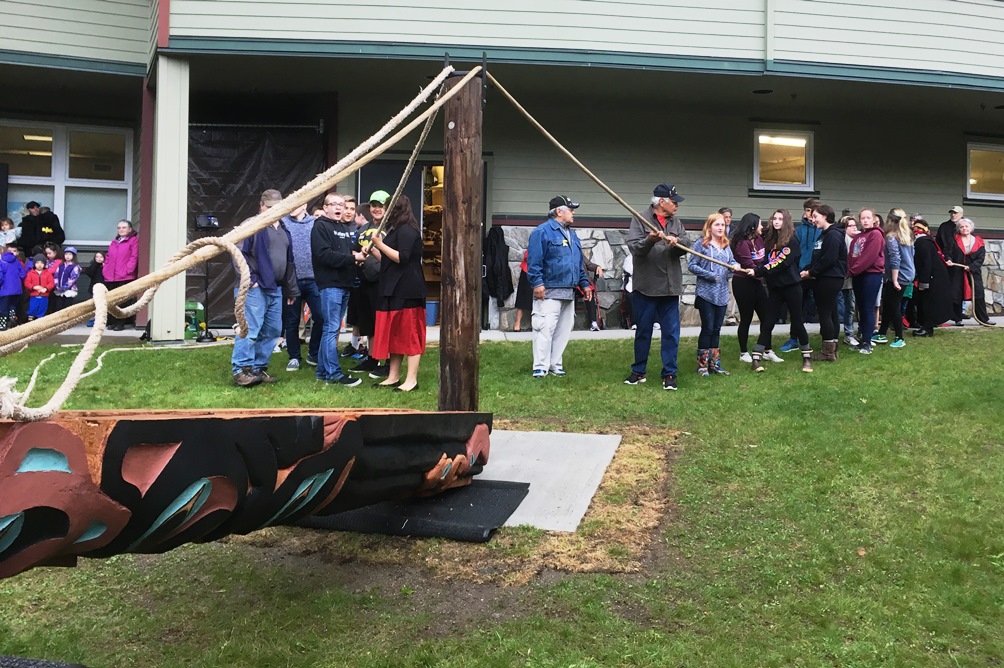
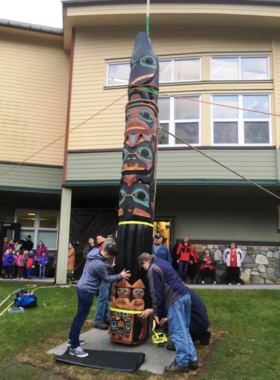
Schoenbar Middle School students and visitors prepare to raise the Pathfinder totem pole. (Photo by Leila Kheiry/KRBD)
Schoenbar Middle School celebrated the end of the school year with a special totem-raising ceremony.
The Pathfinder totem pole was carved by Schoenbar students over the past year under the direction of carver Kelly White.
It now stands in front of the school, where an earlier pole used to stand decades ago.
A blessing song welcoming the ancestors kicked off the totem-raising celebration at Schoenbar Middle School.
Students and visitors filled the gymnasium bleachers, and the old totem pole, which had been in storage for many years, lay in a place of honor in front of the lectern.
The old pole will be returned to the earth, Principal Sheri Boehlert said following tradition, after the new pole is raised, also in the traditional way.
“The Pathfinder totem pole project is a striking example of our students, teacher and local community members collaborating and honoring our great strengths, diversity and finding our way,” she said.
The Pathfinder totem pole at Schoenbar Middle School. (Photo by Leila Kheiry/KRBD)
Diversity was a recurring theme among the speakers.
Ketchikan Gateway Borough Vice Mayor Stephen Bradford talked about his former home in Kansas, which is the historic land of several Native tribes.
But, he said, the schools there do nothing to honor that history.
“I’m just very proud to live in Ketchikan and Southeast Alaska, where we acknowledge the rich and wonderful history of people that have been here for centuries,” he said. “We’re doing that with this totem raising and I’m very proud to be part of it.”
Elder Richard Shields talked about the symbolism of the Pathfinder pole, saying everyone relies on their teachers, family, community members and ancestors to help them find their path in life.
Shields gave an example of weavers, first learning to make a basket. Their early attempts are full of bumps and holes, but as they get better their baskets are so tight they can carry water.
“Remember that the skills that are given to you are a gift,” he said. “Not only does it belong to you, it belongs to someone else that you’re going to be able to encourage. Everything that we’re given in our lifetime is a gift. Use that gift to support somebody else.”
Schoenbar art teacher Angel Williams received a standing ovation when it was her turn to speak.
She was the organizing force behind the pole, but she used most of her time at the lectern thanking others for their help.
Williams said the pole is about community. The school invited anyone who was interested to come and help carve or paint the Pathfinder pole.
“We had kids of all ages and all abilities working on this from little ones to big ones to adults to former students,” she said. “It is a community pole. It brings us together.”
Everyone filed outside for the pole raising, and the rain miraculously held off for the event.
Carver Kelly White organized students, teachers and others on the various ropes needed to get the pole into the air.
After it was up and bolted into place, White told the story of the pole. The top figure is a killer whale. White said that when traveling through treacherous waters by canoe, Native people often would follow the path of the killer whale, to find the safest, shortest route.
Carver Kelly White watches the Pathfinder totem pole as it’s raised. (Photo by Leila Kheiry/KRBD)
“We put the killer whale up there to represent people who would be considered role models,” he said. “People you would follow: Your parents, your teachers, your elders. All these people are trying to guide you through the safest passage while you’re traveling from village to village.”
Below the killer whale is the sun, which marks the seasons and when certain tasks must be performed.
Next is a wolf. White said wolves must communicate with each other for the pack’s overall success.
“Same things goes with anyone else in this world. You have to communicate,” he said. “You have to work with one another. You have to talk in order to ensure your survival. It’s not about just one. It’s about all of us.”
The octopus is a figure used by shamans, White said, and eight is a lucky number. So, that figure represents support, luck and spiritual healing.
Three human figures below the octopus represent the Tlingit, Haida and Tsimshian people. Beside them are salmon, which represent perseverance.
“They have to start at the very bottom of the creek and they have to work really hard up the streams,” he said. “That’s kind of like you children today. You are working against the tides and the waters in order to get to your destination.”
At the bottom of the pole is a bentwood box figure with lovebird design, representing people of non-Native descent.
After telling the pole’s story, White performed the traditional carver’s dance, but not by himself.
“I don’t know what particularly I’m supposed to do, but I’m gonna dance,” he said, laughing. “While I’m dancing, I want the people who were involved, whether they held a paintbrush, whether they just held a tool for a moment while standing next to the pole. Whoever has helped with this pole, please join me.”
White and others danced around the Pathfinder totem pole, then filed back inside the Schoenbar Middle School gym for more singing, dancing and celebration on the last day of school.
Close
Update notification options
Subscribe to notifications
Subscribe
Get notifications about news related to the topics you care about. You can unsubscribe anytime.