Community

Hundreds of thousands “misappropriated” by former Naknek Electric manager

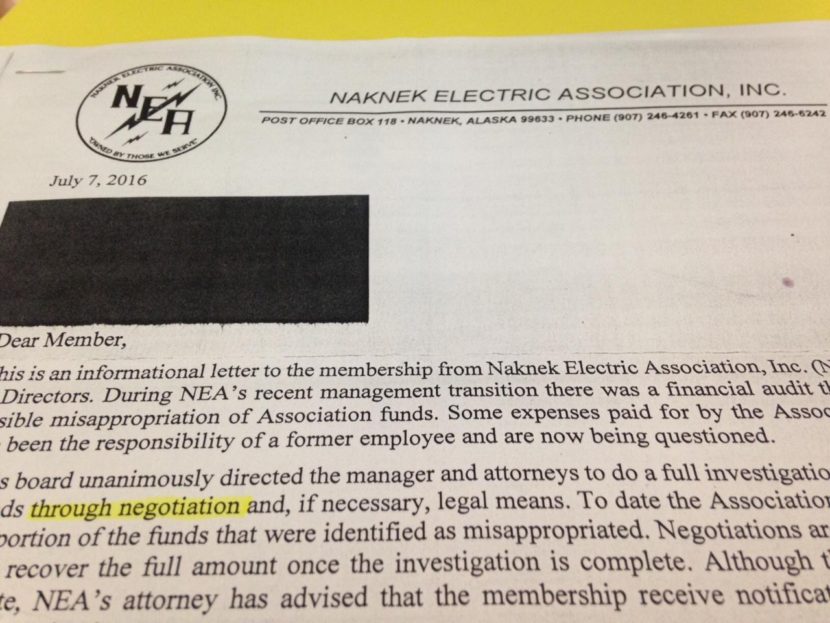
A letter sent to co-op members in July laid out some of the details of suspected embezzlement. This copy was forwarded to KDLG by a member upset by the "negotiations" rather than prosecution.
A letter sent to co-op members in July laid out some of the details of suspected embezzlement. This copy was forwarded to KDLG by a member upset by the “negotiations” rather than prosecution. (Photo by KDLG Staff)

The Naknek Electric Association is working to collect hundreds of thousands of dollars embezzled over several years and repair its reputation with a furious membership. The theft was discovered as new manager Dianne King took the helm from longtime manager Donna Vukich, who retired in March. King and an independent audit turned up the missing money, and NEA’s governing board ordered a forensic audit of the books to at least 2010.

“Some expenses paid for by the Association should have been the responsibility of a former employee and are now being questioned,” board president Nanci Morris Lyon wrote to members in a July letter. “NEA’s board unanimously directed the manager and attorneys to do a full investigation and recover the funds through negotiation, and if necessary, legal means. To date, the Association has been repaid a large portion of the funds that were identified as misappropriated.”

Vukich was the former employee who has since paid back $405,000 to NEA. She has been in her husband’s home country of Croatia for several months.

Twenty or more co-op members turned out for the August 29 meeting of NEA’s governing board, some with stiff comments and questions to deliver.

“This was almost $500,000. How did it get by you guys?” one person asked. Others in the audience called out their disappointment in Vukich, the auditors, and the board members. Some asked the board to go after bonuses and benefits paid to Vukich, and several insisted the board turn the matter over to the state for criminal prosecution.

“Bank robbers would love to have this deal,” another person called out, upset to think the board might put the matter to rest if all the money is paid back.

The board convened with its attorneys in executive session to determine what details of the investigation could be shared at the August meeting.

“It is the advice of our attorney, in the interest in looking out for the board and NEA itself, we don’t want to make claims that we have not been able to prove yet, to stay clear of defamation of character suits in the future,” Morris Lyon said, promising to offer more updates and information after the audit is completed and the attorney advises it prudent to do so.

King said two lump sum payments had been made thus far, the first for $237,000, and the second for $168,000. An audit back to 2014 was complete as of the August board meeting, and work was underway to check the books through 2010.

“And if something is found, will we continue to keep going back?” asked a person in the audience.

“Absolutely,” said Morris Lyon.

The specifics of how the money was taken have not been fully disclosed, but the board and its attorney Andrew Fierro alluded to credit card payments online and over the phone that had pulled purchases away from oversight. Speaking in general terms about “these types of cases,” Fierro said embezzlers evade detection through “mischaracterized expenses, overstated expenses, and multiple reimbursements.”

“It just doesn’t happen by somebody writing themselves a check every month and then it piles up and we have a large amount of money,” he said. “It’s usually never that way at all. It takes various ways and forms, and when it’s not done in-house when something is purchased over the internet, then that takes it even further afield from the office procedures.”

The question of criminal prosecution remains to be determined. Morris Lyon said a federal investigator had already looked at the case and declined to take it on. The board could still turn findings from its internal investigation over to the state, but she said they are moving cautiously for now.

“We’ve been advised against it at this point until we know exactly where we’re at, because if we do move forward with any legal procedures, we again risk NEA, the membership, the board, in defamation lawsuits,” she said. “Once we do decide that we’ve concluded the investigation, have our numbers confirmed, and know what they are, at that point, we will be able to choose to move forward or not.”
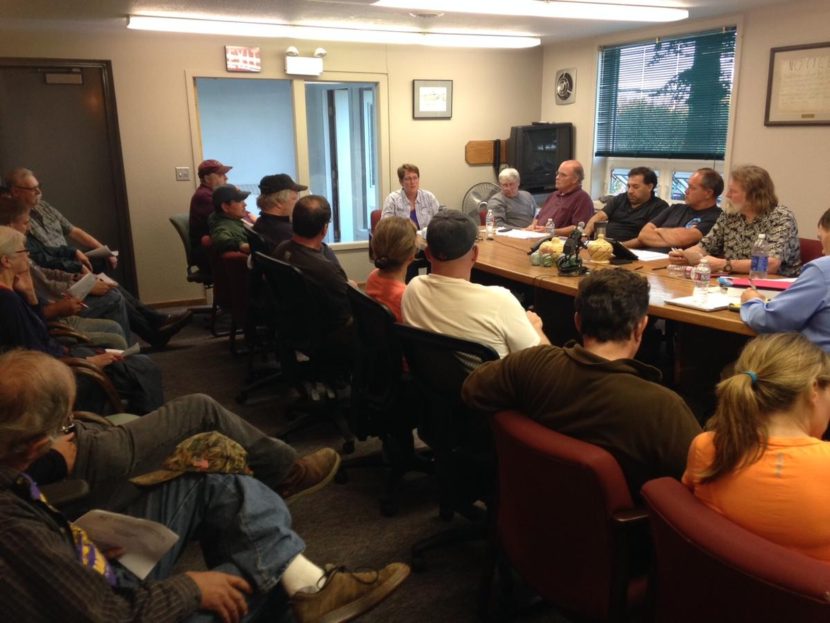
About 20 co-op members showed up for the August 29 NEA board meeting to hear the latest about hundreds of thousands of "misappropriated" dollars.
About 20 co-op members showed up for the August 29 NEA board meeting to hear the latest about hundreds of thousands of “misappropriated” dollars. (Photo by KDLG Staff)

That answer rankled the members present at the August meeting. One person said it would not be good for the youth to see the case go unprosecuted, another called for the alleged thief to be “banned from [NEA] membership,” and another wanted her “ostracized from the community.”

Fred Pike, a former manager and mayor of the Bristol Bay Borough, picked careful words to express his disappointment. “Living in the community for as long as we have, and putting the trust in the board and the people that they hire, and having someone that was hired from our community misappropriate that amount of money was a real disservice,” he said after the meeting.

Pike said he and his wife were shocked when they learned that Vukich, who he did not refer to by name, was suspected of stealing money from NEA. She was someone they had known for decades, had had over to the house for dinner, and had seen as a prominent figure in Naknek. Now he wants her prosecuted.

“It’s important that the board do what they can to put this before the state, and hopefully the state will follow through and prosecute this individual so that it sets an example that we don’t tolerate that sort of thing in our small communities,” he said. “If you get caught stealing from a bank, and you give the money back, you still go to jail.”

During her long tenure, Vukich spearheaded the NEA attempt to produce geothermal energy, a costly endeavor she said in a 2012 KDLG interview dated to discussions in the late nineties. The ambitious project failed and NEA settled tens of millions in debts through bankruptcy.

Morris Lyon downplayed the impact of the stolen funds on the electric cooperative’s bottom line.

“The board now feels confident reporting that the amount of misappropriated funds is not enough to affect payroll, benefits, cash flow, credit worthiness, or ongoing operations in any material way,” she wrote in the July letter. “NEA’s annual revenues are nearly $7 million and the Association has a net worth of nearly $10 million. The Association will remain current on all debts incurred as a result of Chapter 11 bankruptcy.”

NEA hopes to answer more questions for its members ahead of the October meeting. So far the Association has not disclosed the exact amount of misappropriated funds, what the money was used for, nor what source of NEA funding was tapped into. NEA says new policies and controls are in place to better prevent this theft from occurring again.

Attempts to reach Donna Vukich for comment have not been successful.
With assembly approval, Central Council expands plans for 3-acre Immersion Park

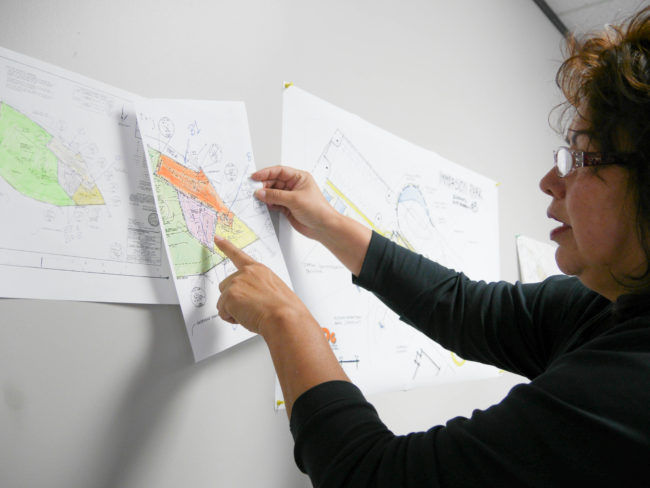
Central Council of Tlingit and Haida Indian Tribes of Alaska Business and Economic Development Manager Mryna Gardner explains the plans for the immersion park. (Photo by Lakeidra Chavis/ KTOO)
Central Council of Tlingit and Haida Indian Tribes of Alaska Business and Economic Development Manager Myrna Gardner explains the plans for the immersion park. (Photo by Lakeidra Chavis/ KTOO)

The Central Council of Tlingit and Haida Indian Tribes of Alaska has a new target date for opening its cultural immersion park at the old Thane Ore House.

Last year, Central Council officials had hoped it would open this summer. Now, they’re shooting for 2018, after the Juneau Assembly approved a 1.2-acre land lease making it possible Monday evening.

Myrna Gardner is spearheading the Tlingit and Haida Immersion Park project.

She said the Central Council wants to put Juneau’s Native culture at the forefront when cruise passengers visit — literally. The cruise ships must pass the nearly 3-acre waterfront site before they arrive in port.

“When they come to Juneau, you have gifts shops and you have art galleries,” she said. “We want to tie the living culture effect of who we are, with it.”

Gardner said that the park will include classes on totem pole and canoe carving, as well as basic language skills. She said it’s important to remember that Southeast Alaska Native cultures are living cultures.

There will also be a restaurant, gift shop and showcases for Alaska Native artists and dance performances.

“When you think about places you’ve gone or traveled, and you read about the history of people and they talk about them in the past tense, our people have been here for 10,000 years,” Gardner said. “However, today we want people to know that we’re still here and you see it and you get to talk to people in other communities.”

Plans for the park are constantly changing.

Over time, Gardner said they plan to line the road up to the property with totem poles from each of the Southeast tribes. The park will use the two large buildings on the property for cultural activities.

“Our plan is to have a huge Haida style longhouse cover it that shows the Haida heritage side,” she said. This side, we’re going to put a façade of Tlingit longhouses in front of it, so you almost get the image you’re walking through a village.”

Gardner says the estimated $3 million park – plans have expanded since it was pitched as a $1.3 million park last year — will be paid for using a collection of federal grants and Central Council funds. She said while the focus is on culture, the park is intended to create jobs and be a revenue source for the Central Council.

“This is about workforce development and job creation,” she said. “We understand that as a business, as a tribe and as a government, we see from the federal state, especially the state, the budget cuts, and the need for creating jobs and employment within our community.”

The lease terms say the city will be also eventually be paid a $1 per park customer.

If the buildings need to be rebuilt, Gardner says then the park could open in 2018.

Juneau Assembly ups licensing price per pooch

Dogs playing. (Creative Commons photo by Sean Dustman)

Dog licensing fees at the Gastineau Humane Society and Southeast Alaska Animal Medical Center have been increased for the first time in 15 years.

The Humane Society and Juneau Police Department requested the fee increase to cover animal control services. The Juneau Assembly approved a resolution raising the fees Monday evening.

The licensing fee for dogs that are not spayed or neutered will increase from $35 to $45. The fee for spayed and neutered dogs will go up from $15 to $20.

City Manager Rorie Watt reported that the Humane Society and Animal Medical Center collects about $73,000 in licensing and impound fees each year. Most of the impound fees come from dogs.

For dog licenses, the fees are used to track dogs within city limits if they go missing and return the dogs to their owners when found.

The new rates went into immediate effect.

Humane Society director Matt Musslewhite says the shelter licenses about 4,000 dogs annually.

House window shot in Auke Bay

Juneau Police Department badge logo
An arm badge for the Juneau Police Department on Lt. Kris Sell’s uniform, April 1, 2016. (Photo by Jeremy Hsieh/KTOO)

The window of a house was shot out in the Auke Bay area Saturday morning.

The Juneau Police Department said in a press release one shot was fired in the 13000 block of Glacier Highway. Police and an Alaska State Trooper responded.

Two people were inside the house during the shooting. They told police they didn’t hear the shot being fired.

No one was injured, but police said it does not appear to be a random shooting. The investigation is ongoing.

Why Alaska utilities can build now, ask for rate increases later

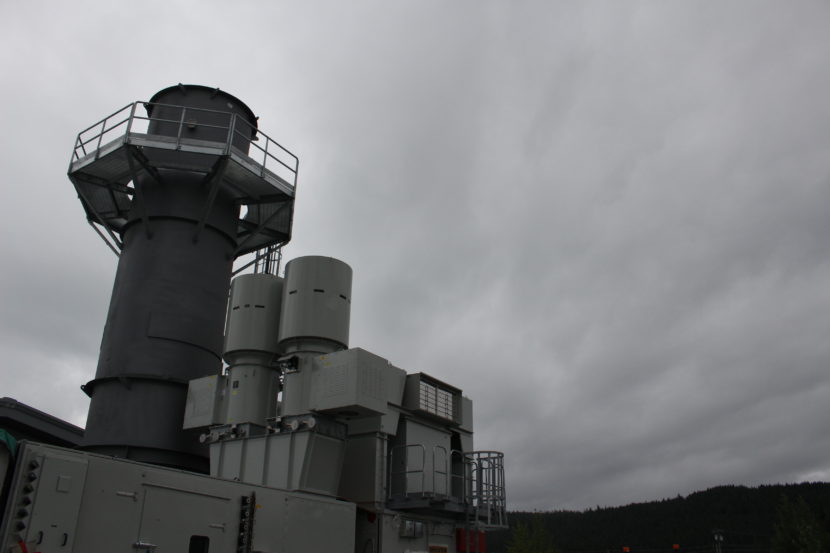
The exhaust stack for diesel turbine. (Photo by Elizabeth Jenkins/KTOO)
The exhaust stack for the diesel turbine. (Photo by Elizabeth Jenkins/KTOO)

Alaska’s privately owned electric utilities can’t increase their rates overnight. They first have to go through a process with the state’s regulatory commission to demonstrate a need. That’s what Juneau’s utility — AEL&P — is at the beginning stages of doing.

But customers get little say about projects already on the books.

Last week, Alaska Electric Light & Power announced Juneau residents could expect to pay 8 percent more on their electric bills by the end of 2017 — pending approval from the Regulatory Commission of Alaska, or RCA.

The community’s last rate permanent increase was six years ago after a new hydro project was built.

“A lot happens in that amount of time,” said Debbie Driscoll, AEL&P’s vice president.

Like investments of over $50 million, according Driscoll. Since 2010, she says the company spent money on improvements to its transmission lines, substation upgrades and — most visibly — a new $22 million backup diesel plant.

“Which is less than half of the $50 million that we’ve invested over the last six years. In addition to those capital investments, we also just have increased costs,” she said.

Driscoll says that comes from normal inflation. And it was necessary to build the diesel plant to avoid rolling blackouts, in case of an emergency, like an avalanche.

The utility is proposing increasing Juneau rates in phases. First, this November by nearly 4 percent and again next year, by about another 4 percent. Essentially, the way it works for the state’s privately-held utilities is build now, ask for rate increases later.

“You have to pay for everything upfront. All the infrastructure. And the regulatory commission allows you to recover that over time,” she said.

Driscoll doesn’t think the utility typically earns everything back.

Still, compared to most other states, the order this happens in is unusual. And in Alaska, it can look like putting the cart before the horse. Or, in this case, the diesel plant and capital improvements before a final say on a rate increase.

“That’s a specific construct the legislature has created,” said Bob Pickett — a commissioner at Alaska’s regulatory authority.

He says in lots of other places, electric utilities have to submit a plan before spending money on projects. That plan can include things like current and projected load growth, how much power will be used over time, community input and ways to reduce the overall costs.

But here, the conversation happens afterward. At least, publicly. And it always has.

“Pretty much. Yeah,” he said.

There is a process of checks and balances. Privately owned utilities, like AEL&P, have to go through hearings with the state’s regulatory commission to establish a need for steeper electric rates.

“It’s like a trial. Yes, that’s probably a way to think about it,” Pickett said.

He says it takes over a year to reach a final decision on a permanent rate increase.

As it currently stands, Debbie Driscoll, from AEL&P, says Juneau’s electric rates are below the national average. And if the regulatory authority approves the full 8 percent, she says the capital city would only be slightly above that. It’s an increase of nearly $7 a month for an average customer in the summer.

“And an increase of $8 a month of during the winter,” Driscoll said.

Comments are open on the rate increase until Oct. 20.

Last private primary care practice in Haines to close its doors

Dr. Keirstead’s office has been open in Haines for nine years. (Photo by Abbey Collins/KHNS)

The last primary care physician with a private practice in Haines is closing her doors.

Dr. Linda Keirstead has been in business at the Chilkat Valley Medical Center in Haines for nine years. But in a letter sent to her patients earlier this month, she says the office will soon close.

Starting next month, patients heading to the doctor’s will only have one option.

In the letter, Keirstead said this is not a decision taken lightly, writing the office has looked for a way to continue practicing “without being consumed by the enormous and escalating administrative burden that our healthcare system has placed on us.”

Dr. Keirstead’s office declined to comment for this story.

She is not alone in this complaint.

Dr. Leonard Feldman closed his medical practice in Haines around two years ago, after 30 years of business. During that time, he says he experienced frustrations with the administrative process, and working with Medicare and Medicaid.

“As a doctor, if you accept Medicare, then not only do they set the prices for you, and determine whether or not your treatment was even necessary, but they also require that you submit the billing yourself to Medicare,” Feldman said.

Over the years, he says it became a greater and greater burden.

“Those sorts of things subtract from the time you can spend with your patients,” Feldman said. “And sort of eat away at your positive attitude, because you get these letters from Medicare saying that you’re not going to get paid.”

Though he calls the process “a bit of a nightmare,” Feldman said that’s not why he closed his practice.

His experience as a private practitioner in town was extremely positive and Feldman does think a town loses something by not having any private practice options for medical care.

“You get to know your patients very well,” Feldman said. “If there are more options then one private practice in a town, then the people who come to see me were people who wanted to see me.”

Once Keirstead’s office closes, the only general care option in Haines will be at the local South East Alaska Regional Health Consortium clinic.

Eric Gettis is the Director of Practice Management for primary care at SEARHC.

He said Keirstead’s closing could mean hiring additional doctors or nurse practitioners to hire an influx in patients.

“We are looking at various different options to make sure that we have enough staff to support the entire Haines borough and I’m confident that we will work that out over the coming months,” Gettis said.

This will not be the first case of SEARHC being the only primary care option for a community, he said.

“I think we do our very best to coordinate what the community needs and make sure we’re responsive for the community as we have been in Haines for a number of years,” Gettis said.

Gettis  only became aware of the closure last week, and hopes to maintain a relationship with Keirstead, he said.

“We’ve worked closely with Dr. Keirstead over the years,” Gettis said. “I’ve met with her. And hopefully we’ll be able to continue that to help in this transition and we’ll continue to work closely with Dr. Keirstead while she transitions away from her own private practice.”

Her office will be closed effective November 1.

Site notifications
Update notification options
Subscribe to notifications