Community

Alcohol tax revenue higher than expected in Bethel

BNC Liquor Store
BNC Liquor Store (Photo by Dean Swope/KYUK)

The city of Bethel has had some trouble collecting taxes in recent months, but one tax they’re not having trouble collecting is the 12% sales tax from alcohol.  Since the city sold its first legal alcohol in April, Bethel has collected over a quarter of a million dollars from Bethel’s two alcohol vendors. A third vendor recently opened but those numbers were not included. .

At 5 p.m. you can see people stopping at the city’s new liquor store on their way home to pick up a six pack or bottle wine. Each purchase includes a bit to pay alcohol taxes to the city.

AC Quick Stop, which opened in May, paid $271,652 to the city in alcohol taxes. That means the store sold about $2.5 million from sales before taxes. The city is well on its way to meeting and possibly exceeding former Bethel City Manager Anne Capela’s estimated alcohol tax revenue of about half a million per year. She made that prediction based on the amount that the city brings in from cigarette sales tax.

Though most of the alcohol sales took place at the AC Quickstop liquor store, Fili’s Pizza paid the city $5,606 which means they made about $47,000 before taxes.

The city’s tax revenue reveals that the two vendors combined made almost $2.4 million since the first beer was sold on April 8, 2016.

But is it worth it? In other words — does the money the city makes from alcohol taxes help… more than it hurts by increasing the rate of alcohol-fueled crime? District Attorney for Bethel, Michael Gray, thinks it does help because he hasn’t seen any increase in crime, at least in Bethel.

“We were really expecting to see a real significant uptick. And so far, in terms of the cases referred to us, we just haven’t seen it,” Gray said.

The Association of Village Council Presidents recently passed a resolution condemning the effect of alcohol sales on the villages. Gray says the villages are another matter that’s difficult to measure, though he suspects legal sales may have caused an increase there.

“In August and September, we were noticing a significant uptick in the referrals for sexual assaults in the river villages. I can’t say that that’s related but I certainly suspect that it may be,” Gray said.

Gray says the additional revenue should be used to help Bethel’s police department.

“For years they’ve been understaffed, they have a hard time. Bethel’s a hard town to recruit people to come and live in.” Gray said.

Though Gray doesn’t explicitly support a liquor store, he thinks the income will make a positive difference if it’s used for law enforcement.

City begins taking public comment on fireworks ordinance tonight

Tonight Juneau residents will be able to voice their opinions regarding a proposed ordinance to restrict the use of fireworks.

The City and Borough of Juneau is hosting two public meetings within the next week.

The ordinance would restrict the use and purchase of fireworks to certain times of the year, like New Year’s and the Fourth of July.

The current draft would limit the use of fireworks to Dec. 31 to Jan. 2, and July 3 to July 5, between 10 a.m. and 1 a.m.

Penalties could be as a high as a $300 fine.

City Clerk Lauri Sica said the city has received emails for almost a year about the issue.

Juneau residents will be able to voice their opinions on the most recent draft tonight at the Assembly Chambers starting at 6 p.m.

There will be another public meeting regarding the issue 6 p.m. next Monday, Oct. 24, at the Mendenhall Valley Library.

Haines waterfront trail project takes community input

Leslie Ross ranks potential uses for the waterfront trail.
Leslie Ross ranks potential uses for the waterfront trail. (Photo by Emily Files/KHNS)

On Wednesday, the waterfront aesthetics committee met for the first time in months. The meeting was a conglomeration of different things. It included an update on the waterfront trail project and a workshop to gauge opinion on harbor uplands development.

Public process is a point of contention for the Haines small boat harbor expansion. Residents have repeatedly said they feel the project moved forward without taking into account what many people in the community want. Borough staff are drawing from that experience as they begin a new and related project: a Portage Cove waterfront trail. They hope robust public input will be a key part of the trail’s development.

Public Facilities Director Brad Ryan gave the audience an overview of the trail project.

“It’s always been that this should be a community-driven project,” Ryan said. “Trying to get more community input and hopefully get a lot of buy-in and trust that we’re putting projects forward the community wants.”

Here’s the borough’s vision for the trail, as described in its request for design proposals: the Portage Cove Interpretive Trail and Harbor Park would route pedestrians through the small boat harbor area, and tie the harbor project to a waterfront trail. Interpretive signs would enhance the experience.

The trail would connect the cruise ship dock and boat harbor, and possibly extend toward Picture Point in one direction and Battery Point in the other. The project would also include relocation of Lookout Park to the southeast end of the expanded harbor parking lot.

A selection committee recently reviewed three conceptual design proposals and settled on a top choice. That decision should be announced early next week.

“I want to say this is not just the harbor expansion,” Ryan said. “This is the trail around Portage Cove. Hopefully, a little bit of parking issues can be engaged in that. And we want to engage the community to help direct borough efforts around Portage Cove.”

Some of the residents who attended the meeting doubted the trail’s viability. Much of the waterfront property the path might cover is privately owned.  Ryan says that’s something the design firm will take into account.

“I keep hearing ‘well you can’t put the trail on the beach all the way around.’ I’m not telling anybody we should do that,” Ryan said. “I have nothing against the trail being on the road or going in and out of property. I think the design firms will be savvy enough to know that.”

Ryan says he had a casual conversation with a Federal Highways Administration representative about the possibility of a safety corridor out to Battery Point. He says that’s just one idea that might be incorporated into the trail as it progresses.

As for funding, Ryan says cruise ship head taxes are paying for the design contract. The Alaska Department of Fish and Game may provide funding for the relocation of Lookout Park. That funding is tied to construction of a sport fishing ramp in the harbor project. There is also a federal recreational trails grant program.

Planning technician Holly Smith facilitated the next part of the meeting.

“I do want to know what the community wants,” Smith said. “And if you participate, it’s gonna help me help the borough, which in turn is supposed to help the public.”

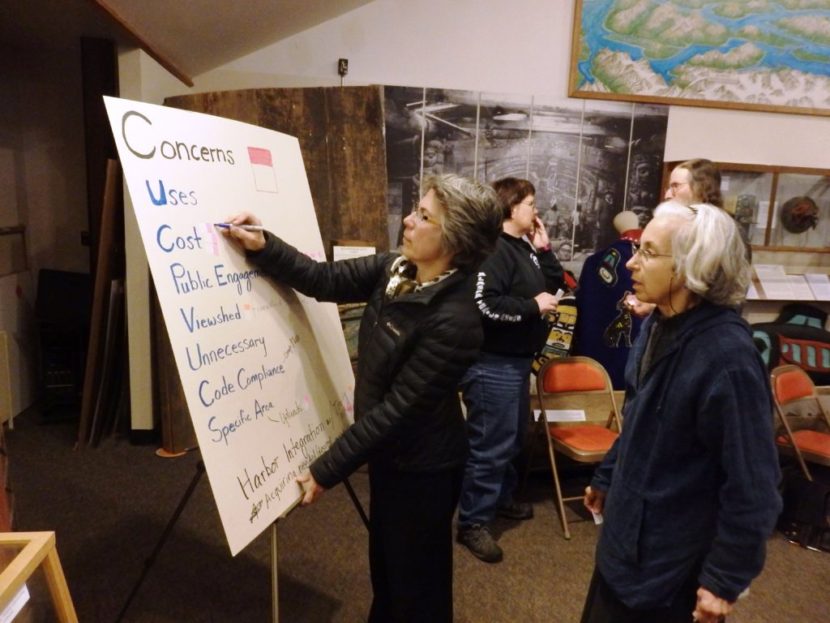
Debra Schnabel ranks concerns for the waterfront trail project.
Debra Schnabel ranks concerns for the waterfront trail project. (Photo by Emily Files/KHNS)

Debra Schnabel ranks concerns for the waterfront trail project. (Emily Files)

Smith gathered public feedback on the trail and harbor uplands using stickers. Each attendee was given stickers to rank what they would like to use the area for, which part of the project should be the top priority, their concerns, and the best ways to engage the community.

The results showed the Wednesday group’s biggest concerns are integration of the harbor project with the waterfront trail and public engagement.

The public will have more opportunities to weigh in on the trail. The contract for design work includes five community meetings.

Potential fireworks ban sparks debate among Juneau Assembly

The Juneau Assembly is working on restricting fireworks use in Juneau.

The assembly discussed a draft ordinance at its work session Monday evening. It’s a template for Juneau residents to review and comment on.

Assembly members Mary Becker, Maria Gladziszewski and Debbie White were unhappy with the definitions of fireworks.

White and Mayor Ken Koelsch had concerns about possession and how enforcing it might affect the Juneau Police Department.

Police Chief Bryce Johnson told the assembly that having clear restrictions would lessen the burden on the police.

“The way it is now, it takes up a lot of staff time,” he said. “Similar to the conversation you’re having, about half the public thinks it shouldn’t be happening, about half the public is doing it.”

He says the issue with fireworks is about quality of life. It’s not a safety issue but it becomes one when it takes up all of the department’s resources.

“I was working the Fourth of July and the calls started coming in 1, 2 p.m. in the afternoon,” Johnson said. “By about 5, 6 in the afternoon, every single police officer that was on duty was on a fireworks call. And that is a really poor use of resources, especially on the Fourth of July when a lot of stuff is going on.”

Johnson said anything, even the draft ordinance right now, would be an improvement.

Currently, the city doesn’t have any restrictions on fireworks.

As it stands, the draft makes the possession of fireworks in Juneau legal between December 1 through January 3 and June 1 through July 6.

It would be legal to use the fireworks from December 31 through January 2, and July 3 through July 5, from 10 a.m. to 1 a.m.

Consequences include a fine as high as $300.

The assembly is soliciting public comment on fireworks restrictions at meetings on Oct. 19 in the Assembly Chambers and Oct. 24 at the Mendenhall Valley Public Library.

New addition will help food bank store even more food than before

Jim Wilcox holds up a $100 donation on Saturday.
Jim Wilcox holds up a $100 donation on Saturday. (Photo by Quinton Chandler/KTOO)

The Southeast Alaska Food Bank celebrated an increased capacity during an open house Saturday.

The new addition allows the food bank to give away even more food than before.

Last year, Jim Wilcox was the board president, but he gave that up to head the food bank’s warehouse expansion.

“I couldn’t do both, so I turned the presidency over to one of my buddies,” said Wilcox, who sits on the Southeast Alaska Food Bank’s board of directors.

In the last four years, the number of people asking for food increased by 30 percent to 40 percent, he said, wearing a red cap with the food bank’s logo over his white hair.

That’s why adding space onto the warehouse was paramount.

“We can probably store probably six months of food in here right now,” Wilcox said.

“Before that, it was down in that little end down there and we’d be lucky if we could get a month that we could store. That was piled clear to the ceiling.”

Wilcox planned for the entire project — a 2,200-square-foot expansion — to take a full three months. Some said it would take double that.

He said they did it in just 52 days.

“And four of them days were half days,” Wilcox said.

“They said it could take up to a year just to get a permit from the Corps of Army Engineers,” he said. “The guy come out here, walked over, dug a couple of holes. He was here about an hour and a half and come and sign the paper off and said, ‘You got it.’ These contractors couldn’t believe it.”

He gave part of the credit for the quick turnaround to a former Juneau contractor who he hired out of Hoonah.

“I asked him if he’d come back to Juneau and be my ramrodder, because he knew all of the contractors and everything too.”

“When the guys were still here cutting the floor, the next contractor to put all the walls up was here laying out the walls before we even had the floor done,” Wilcox said. “And that’s the way we went with the whole job.”

Wilcox gave another round of praise to the businesses who helped build the space and the others that contributed. He estimated a third of them gave their services for free.

“Engineers, surveyors – they were all free. The people who drew the building and drew all the blueprints – they were free. The electricians, 99 percent of the work they did for free,” Wilcox said.

The rest the food bank covered – mostly through donations. Wilcox said it cost them less than $70 per square foot when it should have cost about $250.

Darren Adams is the food bank manager. (Photo by Quinton Chandler/KTOO)

The food bank’s manager Darren Adams said that right before the new and improved warehouse’s open house and ribbon cutting, about 45 people came to collect close to 1,600 pounds of food.

The new space is going to go a long way toward the food bank’s day to day operations, he said. There’s an obvious divide between the old space and the add-on.

Adams pointed out a sharp contrast between the two.

“In years past whenever I’d get a huge food drive, or get a huge food donation, I’d have to make it all fit in here,” he said.

Adams recalled pallets scattered everywhere and food stacked to the ceiling.

“I had to call in a lot of favors and ask people who don’t normally store food for us to store food for us,” he said.

But, not anymore.

“This will help us bring in more food, keep enough back to where we’ve got food for today and for tomorrow, and it will also help us buy food in bulk,” Adams said.

One thing the extra space can’t do is give Adams more manpower. He’s the only full-time employee and said the food bank is always looking for volunteers.

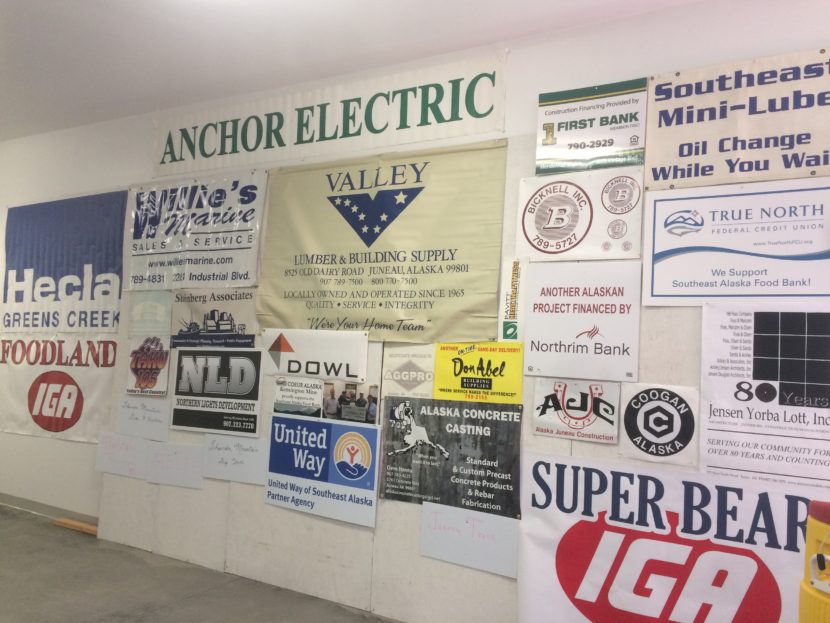
Wilcox left the warehouse in a good mood, but not before insisting on getting a photo of a wall covered in the names of all the organizations that helped make the expansion possible.

One of the warehouse's walls was dedicated to the organizations that helped make the expansion possible.
One of the warehouse’s walls was dedicated to the organizations that helped make the expansion possible. (Photo by Quinton Chandler/KTOO)

Southeast candidates suggest a range of state budget fixes

Bob Sivertsen, Sheila Finkenbinder, Bert Stedman, Sam Kito III and Dan Ortiz
Bob Sivertsen, Sheila Finkenbinder, Bert Stedman, Sam Kito III and Dan Ortiz (Photo courtesy of KFSK

Candidates for state office representing Southeast Alaska presented a wide range of approaches to fixing the state’s multi-billion dollar budget crisis in September. Ideas ranged from use of Permanent Fund earnings to an income tax to more budget cuts, to harvesting natural resources.

Five candidates for state office appeared on a legislative panel hosted by Southeast Conference during that organization’s annual meeting in Petersburg. They aren’t all the candidates running for office in the region. The candidates were asked what they saw as the right balance of new revenues for the state.

Ketchikan state representative Dan Ortiz, an independent who caucused with the house minority, called it a travesty that the legislature didn’t come up with a fiscal plan. Ortiz thought the legislature would have to start voting on revenue measures this session. “We’re going to have to look at Permanent Fund earnings as a source of revenue at least in the short term for our operating budget, which means we need to restructure the Permanent Fund,” Ortiz said. “But in doing so I honestly believe that that’s the best hope that we have in preserving a Permanent Fund dividend into the future.” Ortiz also thought the best of some bad alternatives is an income tax and said he’d prefer that over a sales tax. He thought the state would have to look for other revenue and continue to cut spending.

One of Ortiz’ opponents in for the House district 36 seat, Ketchikan Republican Bob Sivertsen did not put too much stock in an income tax. “Prosperity isn’t gauged at how well the bureaucracy’s doing but its private business,” Sivertsen said. “We need to get out of the way. We’re going to have to use our natural resources as a big part of this long term. We talk about an income tax and you look at 43 percent of the state will pay that. It’ll raise approximately 330 million dollars; we don’t know what it costs to administrate it yet. When you’re talking about over a three billion dollar hole, 330 million doesn’t get it done.” Sivertsen thought it would be a multi-year process to fix the budget. Constitution party candidate Kenneth Shaw is also running for the house district 36 seat, representing Ketchikan and Wrangell.

Another candidate for state house, Sitka Republican Sheila Finkenbinder is seeking the district 35 seat, representing Sitka, Petersburg, most of Prince of Wales Island and a number of smaller villages. “Being a brand new candidate here it’s a little early for me to be speaking very intelligently about sources of revenue but like Mr. Ortiz I’ve been listening to my constituents, or not yet constituents, voters,” Finkenbinder said. “When we’re talking about taxes they are preferring an income tax, if it comes to that, over a sales tax. People talk about the education tax that they used to pay and the income tax that they used to pay. I’ve also heard ideas such as the fish box tax for charter guided and unguided fishermen that take a lot of fish out of this state.”

Finkenbinder also thought the state would have to restructure the Permanent Fund and promote new businesses to bring more money to Alaska. Finkenbinder is challenging incumbent democrat Jonathan Kreiss-Tomkins for the house district 35 seat. Kreiss-Tomkins had a prior engagement and did not appear at the legislative panel.

Juneau Democrat Sam Kito III told the gathering that the legislature would not be able to make significant reductions in spending for some of the largest pieces of the state budget without significant negative impacts to the state’s economy. He suggested capping the Permanent Fund dividend and using the fund’s earnings would cover a big part of the state’s budget deficit.

“What the governor has put forward puts a lot of components and tools on the table that we can use in the legislature to figure out how we’re going to identify or divide up that revenue stream so that we can have a real discussion about what our state’s going to look like in five years,” Kito said. “And if we don’t do something this year I think most people have said and I agree that we end up in a situation where we could very send our state’s economy into a recession.”

Kito is running to keep his seat representing Juneau, Haines and Skagway. Haines libertarian candidate Bill McCord plans to run a write-in campaign for that seat as well. Sitka Republican senator Bert Stedman is running to keep his seat. Stedman thought the legislature would have to scale back state spending.

“And if we don’t do that and just plug the hole with this tax, that tax or the next guy’s tax all we’re going to do is be right back in the same boat in two to three years,” Stedman said. “So you’re going to see more cuts coming in the next two to three years or so and they’re going to be relatively painful because the easy cuts have already been done.” Stedman represents southern and central Southeast Alaska communities.

Lieutenant governor Byron Mallott ended his keynote speech to Southeast conference with the belief that state government will make necessary changes. “I believe the 2017 Alaska legislature will do what it must because the alternatives are too draconian to consider,” Mallott said.

Governor Walker last year proposed a wide array of budget cuts and new revenue sources to make up for a deficit of over four billion dollars. The legislature did not enact any of Walker’s budget proposals but did cut state spending.

Editor’s note: this story has been corrected to show Haines write-in candidate Bill McCord’s challenge for the House district 33 seat.

Site notifications
Update notification options
Subscribe to notifications