An artist rendering of the art installation. (Image courtesy Juneau Docks and Harbors)
The first cruise ship of the season arrives in Juneau on Saturday. And next week, large ships will be able to use a new, floating dock.
They’re called Panamax ships because they’re the biggest thing that can fit through the Panama Canal.
The nearly $54 million project is paid for by marine passenger fees. In the past, some Panamax ships have had to anchor offshore and tender passengers over in small boats. Carl Uchytil , the port director for Juneau Docks and Harbors, said this deters tourists from leaving the ship.
“And so we really want that ability for the vessels to tie up at our float, walk ashore, go on excursions, go to shops and frequent the restaurants,” Uchytil said.
Now more passengers will be able to walk down a ramp to the wharf. Uchytil said he’s seen an uptick in Panamax ships with the popularity of Alaska’s cruise industry.
Phase 2 of the project is slated to be completed next May.
“Then in Southeast Alaska you’ll have the three major cruise ship ports: Skagway, Juneau and Ketchikan, all capable of accommodating four Panamax-sized cruise ships,” Uchytil said.
The status quo has been three in Juneau.
A $500,000 light-up art installation is also in the plans. It features several abstract columns along the waterfront. It was designed by a Los Angeles artist, inspired by whale flukes and the span of eagle wings.
Uchytil expects the art to go in sometime in the late summer of 2017.
In a new public service spot out of Unalaska, fourth graders from Eagle’s View Elementary School sing and dance to the tune of rapper M.I.A’s “Paper Planes.” Unlike M.I.A., whose lyrics are about immigrant stereotypes, drugs and violence, the fourth graders are recruiting for a community cleanup.
“We walk through the town and we comb the beach/
We see plastic bags and Comet with bleach/
Trash around town can be such a drag/
So we walk through with this yellow bag.”
The iconic gun shots and ka-chings in the original song’s chorus are replaced with well-punctuated sounds of industrial strength garbage bags being whipped open. The onomatopoeia is rounded out with trash being crushed and dunked into bags.
Chrissy Roes of KUCB’s Channel 8 worked closely with fourth grade teacher Mary Heimes to create the music video PSA.
The Unalaska Community Center organizes two weeks of intensive spring cleanup each year to deal with a winter’s worth of stormy weather that dumps trash on the beaches and along the roads.
This year’s cleanup runs from May 1 through May 15. As part of the cleanup, the center has even stashed 12 prize tickets around town that can be redeemed for a prize.
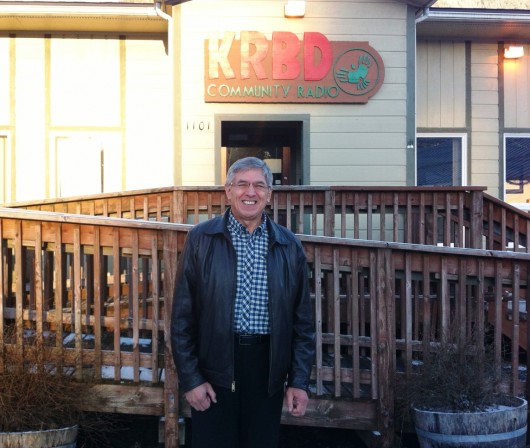
Lt. Gov. Byron Mallott poses at KRBD-FM in Ketchikan. (KRBD file photo)
Lt. Gov. Byron Mallott visited Prince of Wales Island and Ketchikan this week. He stopped in at KRBD to talk about his visit to the big island, issues facing the state and what he called his “weird” job.
“You’re responsible for state elections, which is certainly an important responsibility, and you’re on a few boards and commissions,” Mallott said. “But, constitutionally, the principal responsibility of the lieutenant governor is to be available in the event that the governor is incapacitated or otherwise unable to serve. And that’s not a fun thing to do.”
But, Mallott said, working with Gov. Bill Walker, he’s able to do a lot more than previous lieutenant governors.
“And I really enjoy this job,” he said. “Since we’ve been in office, going on a year and a half now, I’ve traveled in this state pretty close to 180,000 miles.”
He meets with Alaskans, gives presentations and hears concerns. His active role in the administration is part of the agreement he and Gov. Walker came up with when they decided in 2014 to merge their gubernatorial campaigns.
Among Mallott’s responsibilities is the issue of transboundary mines – mines in Canada built near rivers that flow into Alaska. There’s been concern over environmental impacts of mine tailings.
That’s partly why the lieutenant governor went to Prince of Wales Island. He spoke during a symposium focused on that topic.
“They are concerned with the Unuk, the Stikine and the Taku. They are anxious that any mineral development in British Columbia not impact our waters or the environmental integrity of those river corridors that flow into Alaska,” he said.
The State of Alaska and British Columbia officials are working on a statement of cooperation regarding those mines. Mallott said he expects a draft of that statement from the B.C. government in the next month.
Mallott also visited various communities on Prince of Wales Island and said he was particularly impressed with some of the sustainable food projects that schools are running in Thorne Bay and Coffman Cove. Students in both of those Southeast Island School District schools help run greenhouse gardens heated by wood-fired boilers.
The Thorne Bay greenhouse provides vegetables to the cafeteria and a school-run restaurant.
“And then in Coffman Cove, they have another greenhouse that has 11,000 plants in it that allows the school district to provide fresh vegetables, mostly green vegetables, throughout the island,” he said.
Among the concerns he heard from POW residents was the issue of timber availability, and the recent announcement that Viking Lumber might close in the next year.
Mallott said the state can only do so much to make its own land available for logging. The problem, he said, is litigation that delays or stops federal timber sales and other projects, such as the Shelter Cove Road.
That’s a state project, but it requires a federal easement that recently was challenged in court by five environmental groups. Mallott said the constant litigation from national groups is “unconscionable” because it keeps small communities from having a viable economy.
He said it’s a pattern “of a strategy to essentially remove people from the equation of making public policy in the Tongass National Forest by, for example, calling the Tongass National Forest a salmon forest.”
Mallott said salmon are certainly important to the ecology of the entire forest. But, he said, calling the Tongass a salmon forest downplays the impacts policies have on people.
“I love salmon. Salmon is revered by us all,” he said. “I’m a Tlingit Indian. It’s an elemental part of my spirit and who I am as a human being. But when I look to the future of who I am as a Tlingit person, and as a resident of the region and as a citizen of the State of Alaska and even as a citizen of the United States of America, I want to put the face of a human child as a symbol of the Tongass Forest.”
He doesn’t necessarily support a push to transfer parts of the national forest to state control, though. Mallott said unless there’s a huge shift in the way people think in Washington, D.C., and throughout the Lower 48, that effort is the equivalent of baying at the moon.
“We do enough baying at the moon,” he said. “We need to be much smarter than we have been, I think, in many ways. And we haven’t been very smart. We also continue to litigate. We also continue to be confrontational.”
Mallott said the state should work on educating national groups, and working with them to establish policies that work better for everyone.
A big issue on pretty much every Alaskan’s mind these days is the state budget. Mallott said his biggest concern is that the legislature this year solves the problem of the state’s multi-billion dollar deficit, brought on by low oil tax revenue.
“To be able to look ourselves and the rest of the world in the eye and to say: We had the opportunity and the resources; it was a critical time in our history. We made the right decisions. We have a fiscal structure in place that allows us to go forward with a balanced budget and we can look to the future,” he said. “Anything else is crippling.”
But, Mallott said, the budget shouldn’t be balanced on the backs of municipal governments.
He doesn’t support phasing out revenue sharing, for example, and said the legislature needs to find a fair solution to costs associated with the state-mandated Public Employees’ Retirement System and Teachers’ Retirement System, commonly called PERS and TRS.
“We as a state rant and rail at unfunded mandates from the federal government. We as a state government, having done that, should be hugely sensitive to not doing that to our own forms of governance, which are local governments across our state,” he said.
Mallott said he and Gov. Walker have been told that they should find a big project that will be their legacy. But, he said, this administration’s goal – and maybe its legacy — is to help Alaskans get through the state’s current financial challenge.
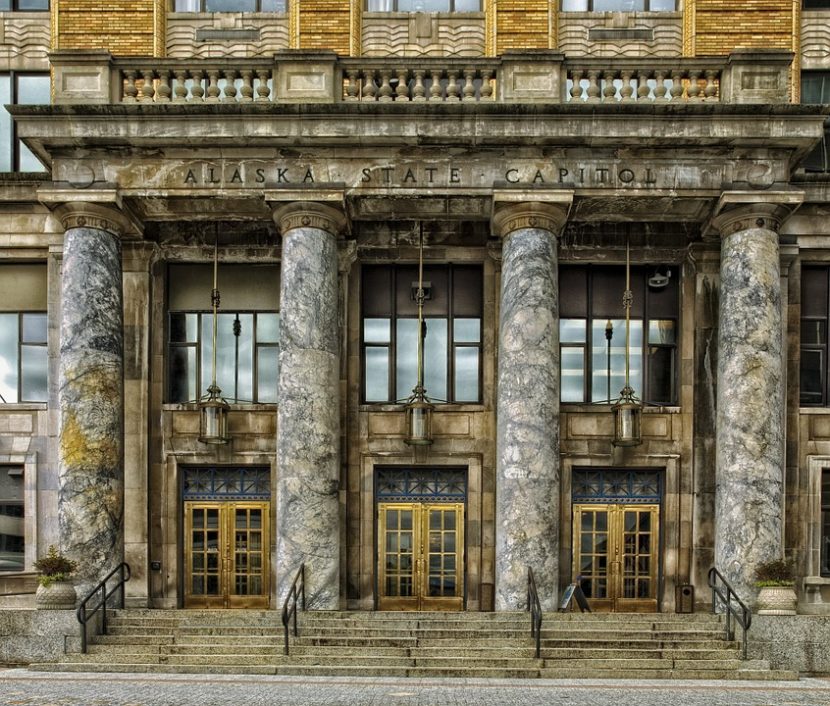
The Alaska state capitol building in Juneau. (Public Domain photo)
Alaska’s larger cities could see a drop in state funding as Community Revenue Sharing is scaled down. Anchorage takes the biggest hit. Juneau could lose over a million dollars in the next few years. Meanwhile, some rural communities could receive more. But as legislators squabble about how to fill the state’s budget void, the uncertainty has some municipalities wondering if they’ll be fine, or have to close entirely.
Back in 1999, Alaska’s policy makers believed the state had enough oil wealth to share with local governments. And for about 17 years there was.
Under its Community Revenue Sharing program, the state paid some municipalities millions of dollars. It was prorated based on population. Some cities used it to pay for the necessities, like emergency services and plowing roads in the winter. In smaller places, it sometimes helped fund an entire city’s’ operations.
Now, legislators have given it a new name: Community Assistance. And with it, some changes.
“The difference is the formula is different and it’s half of what it was before,” said Kathie Wasserman, the executive director of the Alaska Municipal League.
The legislature passed SB 210 this month, and it’s waiting on the governor’s approval. It establishes a formula to manage the dwindling funds. Small communities will receive the same amount — if not more. Big cities receive less. The total pot of money to be doled out yearly would be no more $30 million.
“Senate Bill 196 which says, ‘OK, here’s where we get the $30 million and put it into the revenue sharing, that has not passed,” Wasserman said. “So we have a funding amount and a formula, but we don’t have the money.”
Left as is, the Community Assistance fund would stop paying out by the year 2020. That’s according to the Community Revenue Sharing office.
Wasserman says that would be a huge blow to cities in rural Alaska — where it can be up to 85 percent of the operating budget.
“You know, what do you do? Should you put the key to the city hall in an envelope now? And have it ready to mail to somebody? It’s just difficult to run anything well when you can’t plan,” Wasserman said.
In the immediate future, larger cities must deal with less. In fiscal year 2018, Anchorage could see an $11 million reduction in Community Assistance. In Juneau, it would be about a $1 million reduction.
Bob Bartholomew, Juneau’s finance director, said the capital city relies on numerous funding sources from the state.
“And so, we know it’s coming and we’re just trying to, number one, get advanced notice and, two, try to understand, over the next couple of years — it’d be nice to know what is the size of the overall reduction?” Bartholomew said.
Historically, Juneau has used the funds to help pay for police patrols and emergency services. It uses it to pay out local grants. Permanent supportive housing for the city’s at-risk homeless is being built with a portion of the money. Bartholomew thinks Juneau’s diverse economy will help the city pull through.
But if the funding doesn’t come back, Kathie Wasserman says that could be the end of some small city offices.
“It will certainly change the look of Alaska, and I don’t know if the legislature has really thought that out,” Wasserman said.
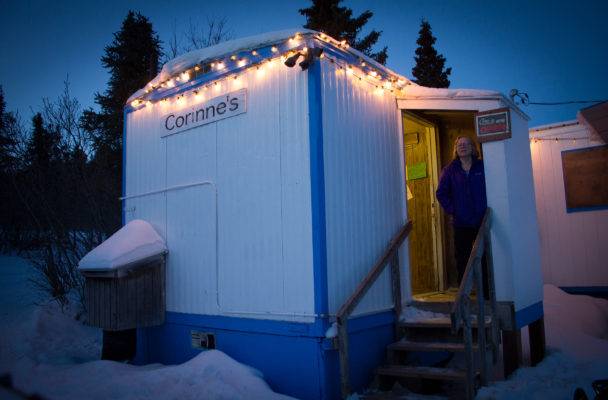
Corinne Trish outside her shop in Koyuk. (Photo by Emily Russell/KNOM)
In Western Alaska, the options for socializing are limited. Most communities have a basketball court, some have a bingo hall, but there isn’t usually a place to just hang out unless you’re in Koyuk. There’s one shop in the small village where people can rent movies, indulge in junk food, and simply pass the time, but ownership of the Koyuk haven is about to change hands.
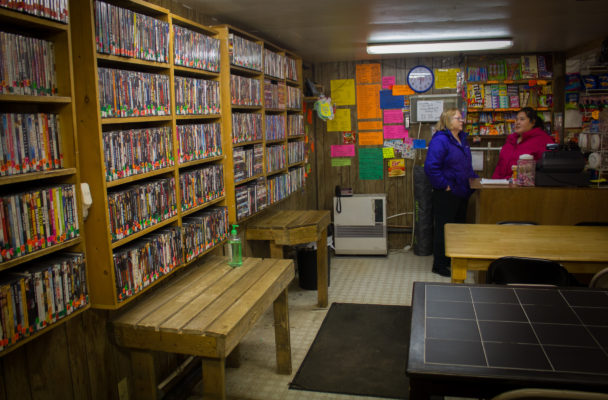
A tiny blue and white trailer glows under a single strand of twinkle lights. The trailer houses the shop known as Corinne’s. Inside, the latest top-40 tracks fill the air.
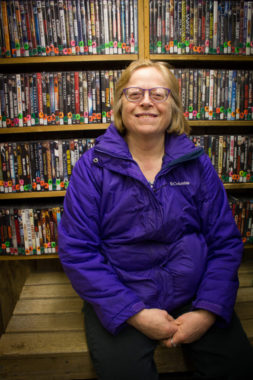
At first glance, it looks a bit like a library, but the floor-to-ceiling shelves are actually stocked with DVDs.
“On Thursdays, when we get new movies, you’ll see three or four guys come running to come get the movies,” explained the shop’s owner, Corinne Trish. “It’s kind of fun.”
Corinne Trish inside her shop in Koyuk. (Photo by Emily Russell/KNOM)
Trish rents DVDs to the community of Koyuk. And the movies that are less popular? She sells those.
“And in my store, if [you] spend twenty dollars worth on movies, [you] get a free movie,” Trish explained.
Trish moved to Koyuk twenty-five years ago to work as a teacher. She had no idea what a tiny village in western Alaska would have in the way of entertainment, so she filled her suitcases to the brim with movies.
In all, she shipped up about seventy-five VHS tapes. It wasn’t long before word got out about the collection.
“There was a gentleman in our village,” Trish explained, “he knew I had a lot of videos, and he said, ‘Why don’t you start renting them?’ So, I thought, ‘Okay, I can start renting them,’” Trish said.
But there was just one problem: you’re not allowed to run a business out of school district housing. She ended up renting space in the local pool hall. She said the room was tiny.
“Then someone was selling this trailer, so I started my business in that, just with videos and pop and candy and pretzels and nachos,” Trish explained.
There was a lot of demand in Koyuk for a place like Corinne’s.
“We’ve had teen centers, but it hasn’t been consistent. They’re based on grants,” Trish said, “so when they’d lose the grant, they’d lose the teen center.”
The school’s basketball gym offers teens a place to go after class. When its doors shut, many trudge up the hill to Corinne’s for a late night snack. Despite the foot traffic, Trish said she never got into business to make money.
“In fact, I still don’t make money,” Trish admitted. “There were years that I had to use my paycheck as a teacher to pay for payroll.”
Trish has employed dozens of local kids over the years. In a community like Koyuk, where jobs are scarce, opportunities to learn skills like how to count change and fill out a timesheet don’t come around that often.
Corinne Trish catches up with Crystal Dewey before the shop opens for the evening. (Photo by Emily Russell/KNOM)
Today, Crystal Dewey is on Trish’s payroll. She says working at Corinne’s for the past decade has helped her find a routine.
“I like interacting with people and seeing everybody every day,” Dewey said. “It gives me something to do.”
Dewey was just a toddler when Trish moved to Koyuk. The two have grown close over the years. So close, in fact, that when Trish retires from Koyuk Malimiut School next year, she plans to hand the keys over to Dewey.
“I’m hoping that Crystal can keep this going when I leave,” Trish said. “Then she’ll have a business, she has a definite income, and she can still employ people as well.”
But Dewey is hesitant.
“I am worried about completely owning it, as far as taxes and everything else,” Dewey admitted, “but I think I could handle keeping it running and sustaining it, at least.”
Dewey has Optic Nerve Hypoplasia. The congenital eye disease means it hard for her to make out details like eye color and dollar bill amount. Trish said Dewey was really nervous about missing one detail in particular.
“Scratches on DVDs, because she can’t see them,” Trish explained. “That was always her fear, but she’s always done really well with money, with food, and all that stuff.”
“Now she does just about everything,” Trish said.
And with that, Trish walks out the front door. It’s just minutes before Corinne’s is set to open for the evening, and she knows Dewey will be there behind the counter. The deed isn’t set to transfer to Dewey until next year, but it’s clear that shop is already in good hands.
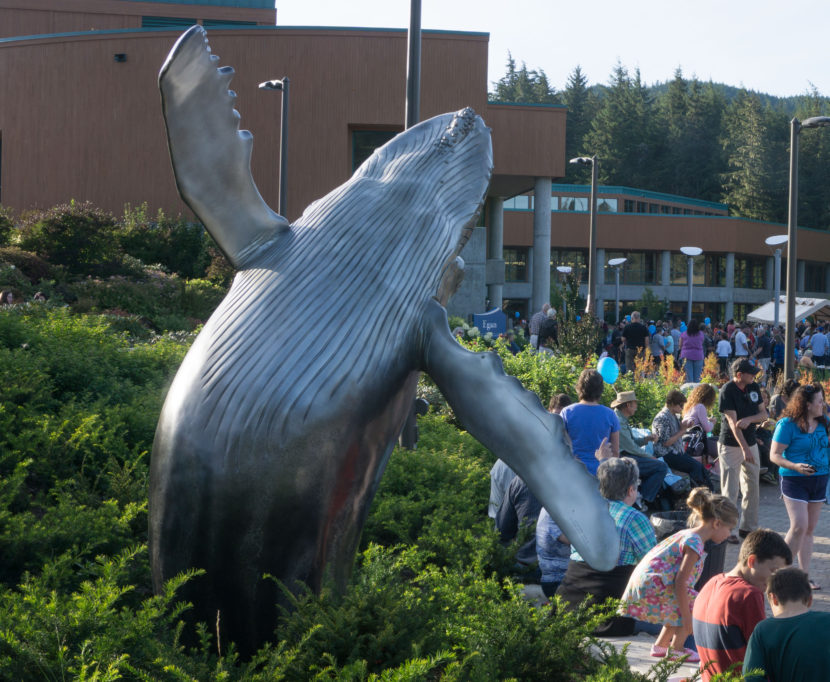
A scale model of the humpback whale sculpture at the University of Alaska Southeast campus, Aug. 14, 2015. A life-size version is destined for a waterfront park in downtown Juneau. (Photo by Jeremy Hsieh/KTOO)
On Tuesday, Cruise Lines International Association hit Juneau with a lawsuit filed in federal court. It alleges the city misused a combination of marine passenger fees, port development fees and state excise taxes.
The association represents major cruise lines, like Celebrity, Disney and Holland America.
When it comes to how the city allegedly misused the funds, the lawsuit names a life-size bronze whale statue. The whale itself was paid for by private donors. But a $10 million park under construction — featuring an artificial island — will be paid for by tourists.
The president of the association, John Binkley, said he doesn’t think the whale benefits cruise ships and passengers. It’s located near the Douglas Bridge — about a mile from the port.
“And so while we’re not opposed to paying taxes, we feel that proposed island and the foundation for the whale sculpture is beyond what those funds should be used for. We’re just trying to get guidance from the court,” Binkley said.
Actually, the filing also asks the court to permanently stop “the assessment, collection and improper use” of the fees.
Binkley estimates, every year, up to $8 million is collected from passengers that arrive in Juneau. He said the association sent letters to the city about the whale park, but their concerns weren’t addressed.
In a press release, the municipality stated it was expending the fees in a “responsible” way. Kim Kiefer, the city manager, said she thought the city was doing its best.
“We’re trying to use those fees to facilitate the safe and effective movement of those passengers throughout community, and I think we do that quite well,” Kiefer said.
The association said it would not be targeting other cruise ship ports with similar fees — like Ketchikan.
Close
Update notification options
Subscribe to notifications
Subscribe
Get notifications about news related to the topics you care about. You can unsubscribe anytime.