Community

One couple, two tales of immigration

Dayra and Mario Valades at their home in Anchorage. (Photo by Anne Hillman/KSKA)

Stereotypes about Mexican immigrants in the United States abound, but everyone has a unique situation. This is the tale of one couple with two very different stories.

Dayra and Mario Valades sit on the couch of their pleasantly cluttered apartment. Plants for their garden and piles of mail fill the table. It’s one of the rare times they’re both home together in the early evening. Mario is a bit of a workaholic.

“When I don’t work – it’s hard for me to go to sleep. I get sick if I don’t work for three or four days,” he says.

“That’s true,” Dayra chimes in. “If he don’t work, he gets sick.”

He says he’s always been this way. He started working full-time when he was 17 and crossed the border from Mexico to California, nearly 30 years ago. He talks about the trip like it was a casual two-hour walk, even though he came into the United States without legal documents.

“Yeah, it was scary. But I didn’t care,” he laughs. “They told us if you get caught, they’re not going to hurt you. They’ll just send you back. And I thought, ‘OK.’”

Mario’s tone is light, but he didn’t really have a choice. Like many others, he needed to support his family and there wasn’t work near his home.

“My dad passed away… and my sisters were young. I felt like I had to take over.”

He arrived in California then soon moved to Washington to pick fruit and hops. After a few years, he knew there wasn’t a future in it. “I (have) seen people who were working there (for) 30 years, and we got paid by the hour and they were still working the same like 30 years ago.”

So Mario bought himself an English course with audiocassettes and books. He’d return from the fields after a long day and study in the late afternoon. After a few months, he joined Job Corps in Oregon. There, he took proper English classes and learned a trade – building maintenance and floor installation. On the advice of a friend, he moved to Alaska in the early 1990s because the pay was better. Soon after he met his first wife, had a son, and decided to apply for his green card. He says back then, it was easy.

“I didn’t have any problem with the law or anything. I didn’t have any tickets or anything,” he says. Immigration officials “didn’t ask me for anything. They just called me to immigration, took a picture of my fingerprints, and make sure it was me, and yeah.” Done. Easy. He stayed in Alaska and started his own business.

By the time Dayra arrived nearly 15 years later, things had changed a bit. She first came to Alaska as a tourist, then as a researcher. That’s how she met Mario – she interviewed him for her master’s thesis on Mexican immigration to Alaska.

“Yeah, we started hanging out and we kind of fell in love,” Mario recalls, looking at his wife and giggling. “I told her not to leave. I wanted her to stay here.”

“But I left!” she exclaims.

Dayra wanted to return to Mexico to finish her master’s degree and deciding to come back to Alaska to stay was hard. She had friends and family in Mexico and she didn’t need to move north to support anyone financially. According to the Pew Research Center, by 2008, more Mexicans were leaving the U.S. to return home than were arriving to find work.

“And then I came here I went from being a really busy person to not working or going to school or other things. So I was at home most of the time. And he was working. Well, he works a lot. And that was hard.”

Eventually, Dayra started to meet people and learned about job searching in Alaska. She found a position, but she says she doesn’t really put her master’s degree to its full use. When the couple decided to get married in 2008, the process for Dayra to get a green card seemed much harder than what Mario went through a decade earlier.

“They were pretty confusing, the forms were. Well, they were to me.”

A person helped them fill out the forms and a month later, they were called into the immigration offices for an interview. Mario had gotten his citizenship shortly after they started dating. Dayra says officials seemed suspicious of her motive.

“They asked me in that tone like, ‘So, then, he was really attractive to you?’” she says with disgust. “No. He was before.” They were dating before she knew he had even applied.

“They just wanted to see if we really were gonna get married and were gonna stay together,” Mario interjects. “Because like I said before, a lot of people do it just to get their citizenship.”

It may be a common assumption that people just get married to stay in the US, but U.S. Citizenship and Immigration Services doesn’t actually track marriage fraud. Most petitions for permanent residency for spouses are approved. Within about a year, Dayra received her green card, which they both say is a relief, in part because they feel like attitudes towards immigration have changed. Authorities are more likely to check their documents.

“Now they check for everything,” Mario says. “Even if you want to buy property or something they check it out.”

But they both also say that they don’t experience any discrimination in Anchorage. They’ve built their lives here and plan to stay.
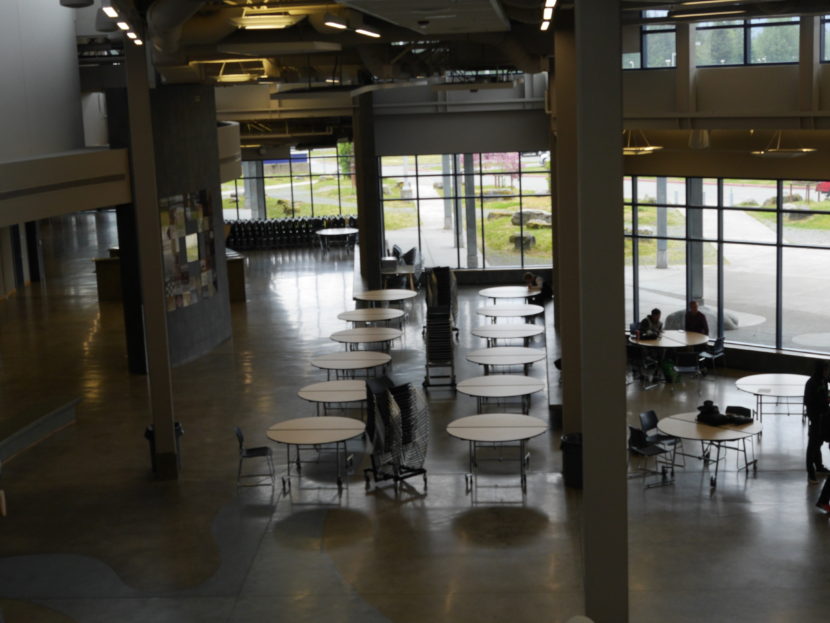

Juneau schools could benefit from knowing graduates’ futures

Thunder Mountain High School Commons
Thunder Mountain High School Commons (Photo by Quinton Chandler/KTOO)

The Rusted Root single, “Send Me on My Way” is the class song for seniors at Thunder Mountain High School. And it’s appropriate when you consider Juneau’s three high schools are all asking the question: send you where?

The Juneau School District will see more than 300 seniors walk across the stage Sunday. Some students seem to know their next steps and are looking forward to the end of high school. But the district might never know if most of them follow through on their plans.

Kelley Olson is a senior at Thunder Mountain High School and she’s on track to graduate. She has decided to study biology this fall at Pacific Lutheran University in Tacoma, Washington.

“I love science so much. It’s definitely one of my favorite things and also biology … I love how different things work and everything,” Olson said.

Kelley Olson (right) with her friend and fellow senior Deanna Hobbs.
Kelley Olson (right) with her friend and fellow senior Deanna Hobbs. (Photo by Quinton Chandler KTOO)

She wants to be a doctor. She doesn’t mind blood, so specializing in surgery is what she’s leaning toward.

“I’m possibly thinking of going into the military and helping them out there or going into (a) hospital,” Olson said.

Olson didn’t randomly stumble onto her dream and her plan to make it real. School counselors helped her rule out options and successfully apply to colleges and scholarship programs.

Without that support Olson thinks it would’ve been much harder and taken her longer to decide on a career path.

Terri Calvin is the career adviser for Thunder Mountain and Juneau-Douglas high schools, and she’s worked closely with Olson. She says junior year is the latest they start talking with kids about the future and right now about 80 percent of her seniors have a general idea of what’s next for them.

“Now and then you get the one who comes in and the week after school we’re spending the week in the career center making some plans but for the most part they’ve had exposure to their choices throughout high school,” Calvin said.

But that doesn’t mean plans are set in stone. The truth is that the Juneau School District doesn’t know where most of their past graduating seniors ended up and they probably won’t ever find out how many of this year’s class sticks to their initial plans.

“Tomorrow, at our practices, each school will do an exit survey and the kids will give me an idea what their plans are for next year. Whether they follow through with that or not is a different story,” Calvin said.

The district gives that survey each year but they don’t follow up on it after kids presumably get jobs, graduate college or do whatever they said they would do. Calvin says the survey helps her office and the district as a whole find out whether they’re giving their seniors what they need, and it helps them improve. But she thinks digging a little deeper to discover where graduates go in the future could help on a broader level.

“They fund this, the governor’s performance scholarship, to keep our students in the state of Alaska to go to school so that they stay here and live. And it would be nice to know if that’s what happening,” Calvin said.

According to the Juneau School District the biggest obstacle to a follow up survey is the cost and resources required. The district would prefer performing the survey in-house if possible, but there are also informal discussions of contracting the work out to a third party.

A district spokesperson said a follow up to the exit survey would be extremely valuable, but there are no official plans to start one.

Olson knows what she’ll put down on the survey, but she’s not naïve about the possibility she’ll change her mind.

“One of my friend’s speeches was, ‘the future is always uncertain.’ And you never know what the future holds for you, so I could go in with (the) expectation that ‘Oh, I’m going to try and major in biology,’ but there’s always the possibility that I’m going to find a different thing that I love and I could go into that,” she said.

No matter what happens, Olson says she’s “excited for what the future holds.”

If they want to know too, the school district may have no choice but to cross their fingers and hope Olson, and other graduates send a thank you note with their story of life after high school.

Sitka upgrades to silver level for bicycle friendly streets

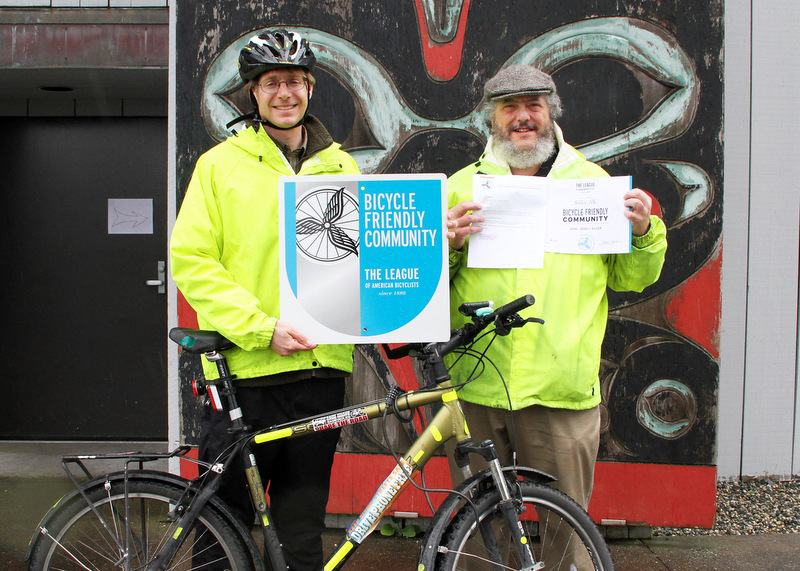
Doug Osborne and Charles Bingham Sitka with Bike Award 05 17 2016
Doug Osborne, left, and Charles Bingham of the Sitka Bicycle Friendly Community Coalition hold Sitka’s new Bicycle Friendly Community sign and certificate letter. The League of American Bicyclists announced on May 18, 2016, that Sitka is now a Silver level Bicycle Friendly Community after winning the Bronze level award in 2008 and 2012. (Photo by Ken Sprague/Courtesy City of Sitka)

Last week, the League of American Bicyclists designated Sitka a silver level bicycle friendly community. Only 73 other communities in the United States have earned this honor, including Anchorage.

Sitka was the first city in Alaska to earn a bronze level designation in 2008 and again in 2012. In the past eight years, a lot has changed. The percentage of bike commuters in Sitka has doubled to 5.42 percent, which is well over national and state averages.

Bingham, a spokesman for the Sitka Bicycle Friendly Community Coalition, said this makes Sitka’s ridership pretty unique.

“Our culture is somewhat different in that we’re not really dominated by the racing community. Our people riding bikes are people riding bikes to work, riding bikes to school, riding bikes to do errands – everyday life kind of biking. You don’t see a lot of spandex-clad people here in town,” Bingham said.

To improve safety for those in town, the coalition has implemented a host of programs, from youth camps to safety campaigns. The wintertime “Be Bright at Night” program distributed reflective tape and yellow vests to riders.

Bingham said there are material improvements too. The city has repaved main roads with wider bike lanes to accommodate the wave of cyclists, including Halibut Point Road, Granite Creek and No Name Creek Bridges. And just last week, the city added directional arrows on Halibut Point Road to remind cyclists to ride on the right side of traffic.

Bingham attributed the popularity of bicycling to low traffic speeds and improved driver awareness, but reminds cyclists to be just as savvy as drivers when sharing the road.

“We still have some ways to go,” Bingham said. “Some of it the cyclists need to do. We need to ride on the right. We need to make sure that if we’re riding at night we have headlights and taillights and we also need to be visible, but I appreciate the fact that the cyclists are getting a lot more help from drivers in terms of trying to make this a safe community.”

Looking to the future, Bingham wants there to be even more accountability for personal safety.

“I’d love to see the police stopping wrong way riders and telling them, ‘Hey, you’re supposed to riding with traffic. You’re not supposed to be riding on a sidewalk in the downtown area.’ Unless you’re a little kid, get off your bike and walk it. If you’re under 18, you’re supposed to have a bike helmet. Sometimes our enforcement has been pretty lax.”

Anchorage is also at the silver level as a bicycle friendly community and Juneau at the bronze level.

Biomass boost: Haines and Hydaburg win renewable heating grants

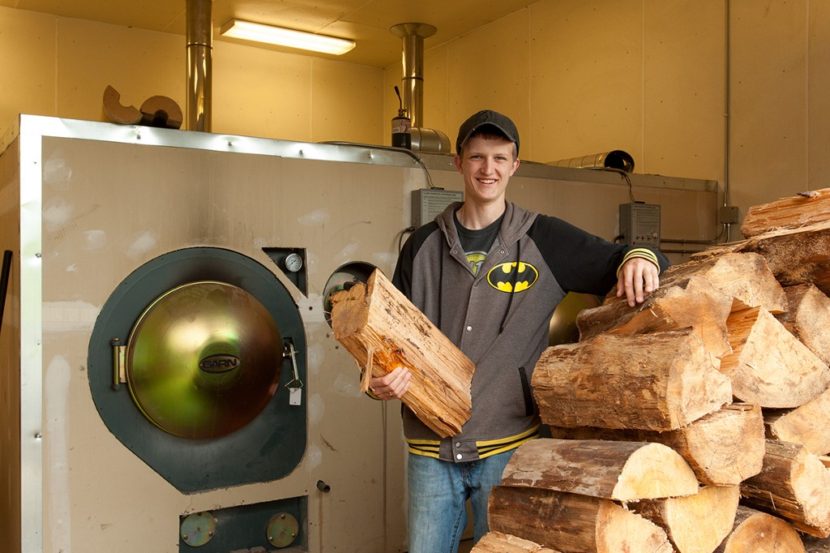
Thorne Bay has been using its biomass system since XX.
The Thorne Bay School installed its biomass system 2012. It heats the school, gym and a greenhouse. (Photo courtesy U.S. Forest Service)

Two Alaska communities are receiving a federal grant to jump-start renewable energy projects. Haines and the village of Hydaburg were selected from 77 applicants nationwide.

Over the past 10 years, about 36 biomass systems have been installed in Alaska. The term sounds pretty technical, but it’s used to describe a prehistoric way to stay warm: a wood burning fire.

“You know, we’re not talking about some smoky, old wood stove here. We’re talking about high-tech equipment,” said Daniel Parrent, a program manager at the U.S. Forest Service.

He said the Wood Innovation Grants were awarded to projects that maximize energy efficiency. Typically, the wood comes from second growth or byproducts. It also mitigates the threat of wildfire.

In the village of Hydaburg, the grant is funding the heat system for the school, which also includes a greenhouse. Cordwood will keep the buildings warm, displacing over 24,000 gallons of heating fuel a year. The total cost is about $900,000, with the bulk of the funding coming from the Alaska Energy Authority.

In the past decade, Parrent said he’s seen more cities consider biomass as a viable option.

“You know, several years ago, oil prices were through the roof, and that’s when a lot of these projects got started and got funded,” Parrent said.

Although the price of oil has dropped, that interest has remained.

A $1.5 million biomass system is in the works that could heat the Haines Borough’s schools, some public facilities and a swimming pool with wood chips. Darsie Culbeck, a biomass consultant to the borough, said the project will lessen dependency on fuel shipped in from Seattle, helping the community become more sustainable.

In turn, he said the wood chips could come from the Haines State Forest and stimulate the local economy.

“(If a) budget crisis happens and we lose our art teacher, … can we keep that art teacher because we saved enough money on fuel? That would be awesome,” Culbeck said.

In 2010, the village of Tok fired up its biomass boiler and three years later they were saving enough money to add a music teacher and school counselor.

Hydaburg and Haines’ biomass systems are expected to be completed next year.

New tribal court programs aim to reduce recidivism

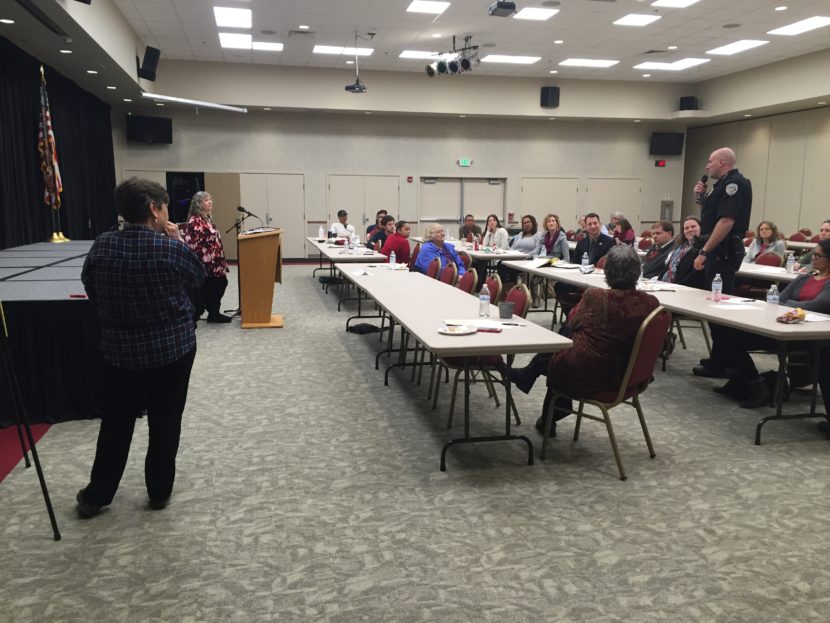
Youth Wellness Court held a meeting on XX to hear feedback from the community. Next, it will appoint members to an advisory board. (Photo by Elizabeth Jenkins/KTOO)
Youth Wellness Court held a meeting in April to hear feedback from the community. Next it will consult with elders and appoint an advisory board. (Photo by Elizabeth Jenkins/KTOO)

Two new tribal court programs are getting off the ground at Central Council Tlingit and Haida Indian Tribes of Alaska. They’re focused on reducing recidivism.

At the Elizabeth Peratrovich Hall,  a framework is being created.

It’s part of a larger conversation to identify what’s holding some people back from reaching their potential. Namely, things such as childhood trauma, unstable home lives and a disconnect from culture.

Colleen Belardi is one of the coordinators at Central Council’s Youth Wellness Court. She said the program is still being developed.

“What we do know is that we would like to intervene with youth in the court system … and also kids who may be at risk of becoming involved in the court system,” Belardi said.

The juvenile court could take the shape of therapeutic court or family conferencing. It’s funded by a 3-year $550,000 grant from the U.S Department of Justice. But they want to make the program sustainable.

Belardi said mentorship will play a key role.

“We want to teach them traditional ways — putting up food, carving, what is it to have an elder in your life and what does that mean to have an elder in your life.”

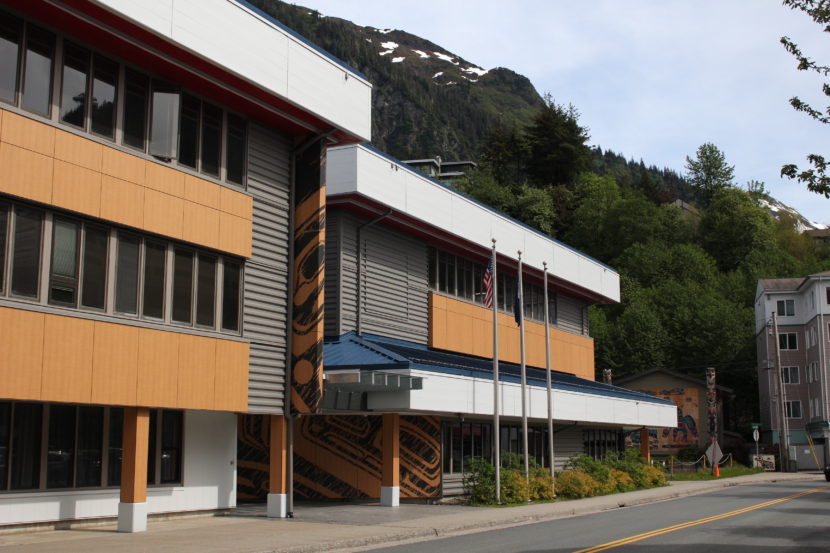
Elizabeth Peratrovich Hall is the new location of Central Council's tribal court. (Photo by Elizabeth Jenkins/KTOO)
The Andrew Hope Building is the new location of Central Council’s tribal court, which is located on the third floor. Elizabeth Peratrovich Hall is on the first floor. (Photo by Elizabeth Jenkins/KTOO)

A different program aimed at helping adult offenders is also underway.

Tribal Judge Debra O’Gara said the program primarily handles family law, but soon it will also be able to sentence some criminal cases.

State court judges reached out to the tribe, O’Gara said. Central Council signed an agreement with the state in April.

Defendants who plead guilty or are found guilty will be able to have their cases transferred to Central Council. From there, they’ll go through circle sentencing.

“We will have more time to delve into what is causing (them) to do this criminal behavior,” O’Gara said. “We’ll also have more time to inform the defendant as to what the effect their behavior has had on their family or what effect (it’s) had on their family or anybody who is harmed by that behavior.”

O’Gara said four other tribes up north have had success with the program. Eventually, Central Council wants to offer circle sentencing in other Southeast tribal courts.

Typically in the state court system, she said, the prosecutor or the judge have no connection to the defendant.

“Whereas in tribal court, we’re going to have family members and members … of their own tribe there, and often their grandma or grandpa or aunts or uncles or parents or siblings are going to be there in the court and have to explain why they’re doing what they’re doing.”

O’Gara says criminal behavior can sometimes be linked to poverty, childhood trauma or substance abuse. Depending on the case, the sentencing outcome could be job training or treatment — recommendations which will be sent back to the state.

The adult program could start up by the end of summer. O’Gara says she hopes it brings healing.

Editor’s note: A photo caption incorrectly stated the new location of the tribal court is at Elizabeth Peratrovich Hall. It’s actually located on the third floor of the Andrew Hope building, which also houses Elizabeth Peratrovich Hall. 

Why Eagle River 8th graders want more police

Tonya Shakhov
Tonya Shakhov recaps a three-month project focused on crime in Anchorage and Alaska with her seventh period social studies class at Gruening Middle School. (Photo by Zachariah Hughes/ Alaska Public Media)

In order to fight rising property crime, Anchorage needs more police. That’s the conclusion of a group of miniature experts, a class of eighth graders in Eagle River. And they think they’ve got a solution for city leaders.

“I need everyone’s attention right up here,” said Tonya Shakhov to the 21 students in her seventh period social studies class. “Which group would like to share?”

It’s a warm, sunny day at Gruening Middle School just a few days before summer vacation, and the class is talking about crime.

“Some of you said, ‘Well we can never stop crime all together.’ Was that our goal?” Shakhov asked.

“No,” replied a small smattering of students.

“So what was our goal then?”

“To reduce it,” came the enthused response.

The class was wrapping up something called Project Citizen, a three-month-long educational program designed to engage students in the civic process for addressing community problems. On this particular day, the class is recapping what worked.

Initially, they considered focusing on education funding or school lunches. But when students started doing interviews with parents and teachers about problems facing the municipality, they heard a lot of concerns over rising crime rates. So they began researching the topic for themselves.

“We also had to write down every website and look at it to see if there was any good information,” said Tyler Ormsbee. He and his class partner Matthew Rainey explained how they went about finding data to bring into class discussions.

Neighborhood Watch,” Rainey said, rattling off sites.

“I used the FBI crime rates,” Ormsbee jumped in.

Gruening Middle School is in Eagle River, a corner of the municipality of Anchorage that has long enjoyed a reputation as a neighborly, semi-rural suburb free of big city problems like high crime rates.

But that’s changing. The area’s assembly representatives held a public forum earlier in May focused on a perception that drug use and property crime are on the rise.

“I was talking to my mom, like, ‘I don’t think crime is that big of an issue,’ and she was like, ‘Oh yeah it is!’” recalled Gabby Schilling. “And I realized crime is a really, really big issue.”

Schilling explained that around the time the class started its research, there was an incident at the daycare where she volunteers that put the topic front and center for her. A teacher’s car was broken into in the parking lot, and some college textbooks were taken.

For Schilling, seeing how disruptive and unnerving the theft was for someone she actually knew added a human face to all the data she was encountering in the classroom.

“Sometimes when you’re looking at statistics you normally just see, ‘Oh, that’s 84, cool, it’s just a number,’” she said. But pouring over news accounts of people’s personal experiences changed things for Schilling. “The stories behind those statistics were amazing. It’s just really personal when you realize that they’re individual people, instead of numbers.”

According to recent data from the Anchorage Police Department, crime in Eagle River is not rising — in fact, by a lot of measures it’s nudging downward after decades of steadily declining.

But that’s not what these students perceive. And Schilling adds that even though the crime rate has gone down, it’s still stubbornly and unacceptably high.

The solution arrived at by the class is hiring more police officers, a view shared not only by the police department itself, but the Berkowitz administration, too. The students started a media campaign, writing letters to policymakers and news organizations, one of which arrived at the offices of Alaska Public Media, politely asking for help raising awareness about police staffing levels, and signed in cursive by Gabby Schilling.

This is the fifth year Shakhov has run Project Citizen, and she’s used to classes picking topics like crime, substance abuse, and suicide that are grim, but keep students invested. Her priority, though, is getting young people engaged in the civic process itself.

“Year after year, when kids come back and visit me they ask ‘Are you still doing Project Citizen?’” Shakhov said, adding that past students often tell her the experience made them realize they don’t have to wait for adulthood to begin working for change.

Site notifications
Update notification options
Subscribe to notifications